1inch Exchange Review: Best DEX Aggregator for Smart Crypto Trades in 2026
 Jan, 17 2026
Most people think crypto exchanges are either centralized platforms like Binance or simple decentralized swaps on Uniswap. But if you're trading more than a few hundred dollars worth of tokens, you're probably leaving money on the table. That’s where 1inch exchange comes in - it doesn’t just trade crypto, it hunts for the best price across 200+ decentralized exchanges before you even click confirm.
What Makes 1inch Different?
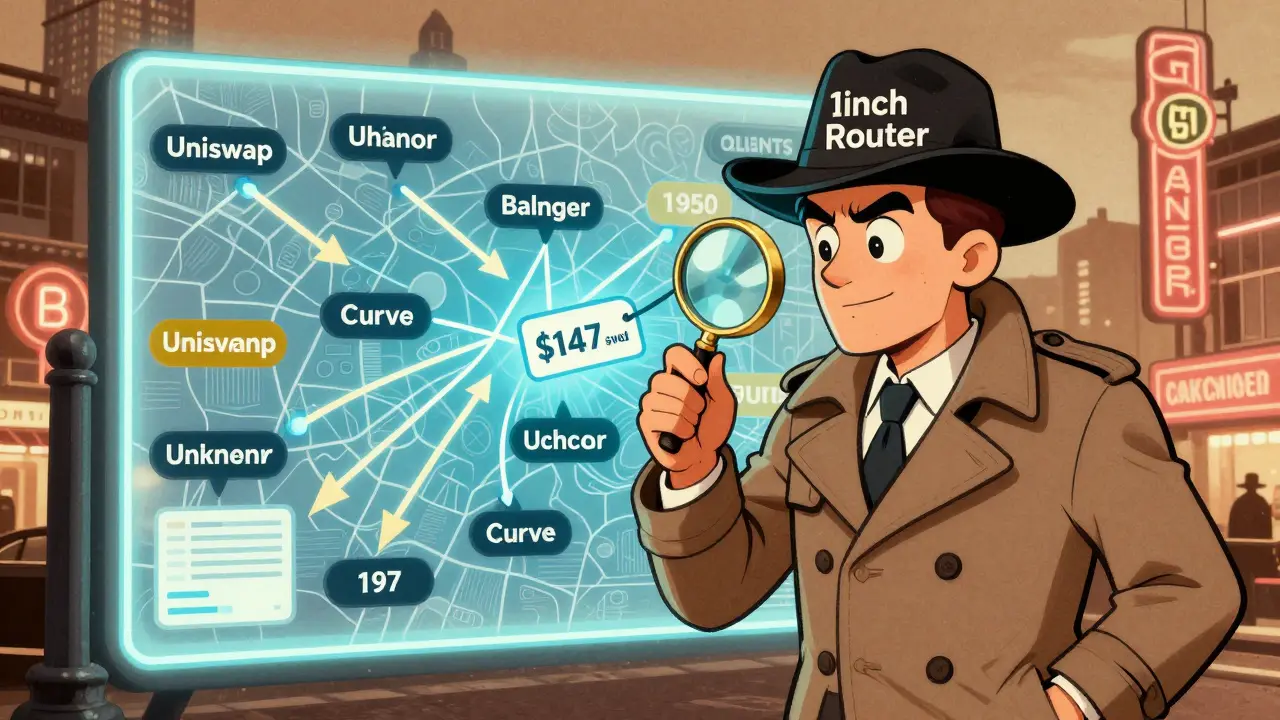
1inch isn’t a standalone exchange. It’s a router. Think of it like a flight search engine, but for crypto. Instead of trading on just one DEX like Uniswap or SushiSwap, it checks them all at once. If Uniswap has a bad rate for your ETH-to-USDC swap, 1inch looks at Balancer, Curve, and 197 others to find the cheapest path. Its Pathfinder algorithm splits your trade across multiple sources to cut slippage and save gas.
That matters. In late 2025, a user swapped 25 ETH using 1inch and saved $147 in gas fees compared to going straight to Uniswap. That’s not luck - it’s the algorithm working. The platform uses CHI gas tokens to reduce fees by up to 43% during Ethereum network spikes. You don’t need to be a developer to use it, but you do need to understand that gas isn’t just a fee - it’s the cost of getting your trade executed fast.
How It Works - Step by Step
Using 1inch is simple if you stick to the basics:
- Go to app.1inch.io (always verify the URL - scam sites copy it).
- Connect your wallet: MetaMask, WalletConnect, or Ledger.
- Select the token you want to trade and the one you want to receive.
- Click "Swap" and review the estimated rate, slippage, and gas cost.
- Confirm in your wallet.
That’s it. No deposits. No KYC. Your funds never leave your wallet. 1inch never holds your crypto. That’s the whole point of decentralized exchanges - you’re in control.
But here’s where it gets tricky. The advanced features? They’re powerful, but dangerous if you don’t know what you’re doing.
The Infinity Unlock Trap
One of the most common mistakes new users make is clicking "Infinity Unlock." It sounds like a good idea - "permanent approval" means you won’t have to approve every single trade. But it also means any dApp you connect to can drain your tokens forever. A Reddit user lost $320 after accidentally approving a scam token with Infinity Unlock. That’s not a bug - it’s a user error. And it happens more often than you think.
Instead of Infinity Unlock, use the "Single Swap" approval. It only gives 1inch permission for that one trade. Yes, you’ll have to approve again next time. But your funds stay safe. The platform’s documentation doesn’t scream this warning loud enough. That’s a design flaw.
What You Can and Can’t Trade
1inch only works with ERC-20 tokens on Ethereum and EVM-compatible chains like Polygon and Arbitrum. You can’t trade Bitcoin directly. But you can trade wBTC - wrapped Bitcoin - which is backed 1:1 by real BTC. Same goes for BNB. You’ll need wBNB.
It supports over 400 tokens, including major DeFi coins like AAVE, MKR, and COMP. But if you’re trying to swap obscure altcoins, check if they’re listed first. Some tokens are too illiquid, and 1inch won’t find a route. The platform doesn’t warn you until you’ve already selected the token - then it says "No liquidity found." Frustrating, but honest.

How It Compares to Other DEX Aggregators
Here’s how 1inch stacks up against its main rivals as of 2025:
| Feature | 1inch | Matcha | CowSwap | ParaSwap |
|---|---|---|---|---|
| Liquidity Sources | 200+ | 150+ | 80+ | 120+ |
| Best for Large Trades | ✓ | ✓ | ✓ | ✓ |
| MEV Protection | Partial (Fusion Protocol) | ✗ | ✓ (Batch Auctions) | ✗ |
| Beginner-Friendly UI | ✗ | ✓ | ✓ | ✓ |
| Gas Optimization | ✓ (CHI Tokens) | ✓ | ✓ | ✓ |
| Market Share (DEX Agg) | 22.7% | 28.3% | 15.4% | 18.1% |
Matcha has the easiest interface. CowSwap protects you from sandwich attacks. But 1inch has the most liquidity and the most complex routing. If you’re trading over $500, 1inch almost always gives you the best rate. For small swaps under $50? The gas fees eat the savings. Stick to a simple DEX like Uniswap then.
Security and Audits
1inch has never been hacked. That’s rare in DeFi. Its smart contracts have been audited by Trail of Bits and OpenZeppelin - two of the most respected names in blockchain security. The 1INCH token is an ERC-20 with a total supply of 1.5 billion, and 1.399 billion are in circulation. Only 38.7% of the supply is allocated to the community. That’s a red flag for some. The staking reward is 4.2% APY - not bad, but not exciting either.
The bigger risk isn’t the code - it’s you. If your wallet gets compromised, and you’ve used Infinity Unlock, you’re out of luck. Always use a hardware wallet like Ledger. Never approve tokens from unknown dApps. And never click "Approve" without reading the token address.
Who Is This For?
1inch isn’t for beginners. It’s for people who trade regularly, care about gas fees, and want the best possible price. If you’re holding Bitcoin and only swapping ETH once a month, use Uniswap. If you’re trading DeFi tokens daily, managing multiple positions, or doing OTC-sized swaps - 1inch saves you money.
As of 2025, 68% of its 1.7 million monthly users are intermediate to advanced DeFi traders. Only 10% are complete beginners. The platform’s learning curve is real. First-time users take 22 to 35 minutes to complete their first swap. That’s not because it’s broken - it’s because DeFi is complex. And 1inch doesn’t hold your hand.

Support and Community
Customer support is decent. Live chat answers in under 25 minutes. Email takes about 15 hours. The Discord server has over 84,000 members. But here’s the catch: 92% of support resources are in English. If you’re not fluent, you’re on your own.
GitHub has excellent developer docs. But the beginner guides? They assume you already know what a gas limit is. That’s a gap. The platform is built for people who’ve read the whitepaper. Not for those who just downloaded MetaMask last week.
What’s Next?
1inch is expanding. By late 2025, it added support for Arbitrum, Optimism, and BNB Chain. Cross-chain swaps are coming in Q4 2025 - meaning you’ll be able to trade from Ethereum to Polygon without bridging manually. That’s a game-changer.
It also launched the 1inch Card with Mastercard. You can now spend crypto directly at any store that takes credit cards. The card charges 1.5% per transaction. It’s not the cheapest option, but it’s the first of its kind from a DEX aggregator.
Token price predictions vary. Some say $0.27 by end of 2025. Others say $0.20. The market cap is around $237 million - not huge, but stable. The real value isn’t in the token. It’s in the infrastructure. 1inch is the plumbing behind DeFi trades. And plumbing doesn’t make headlines - it just works.
Final Verdict
1inch exchange is the most powerful DEX aggregator on the market. It saves you money, works with almost every major token, and has a flawless security record. But it’s not for everyone. If you’re new to crypto, start with Uniswap. Learn how gas works. Understand approvals. Then come back to 1inch.
If you’re trading more than $500 a week, this is your tool. The gas savings alone pay for the learning curve. And if you avoid Infinity Unlock and use a hardware wallet? You’re safer here than on 90% of centralized exchanges.
It’s not perfect. The UI is clunky. The support is English-only. The tokenomics are weak. But for raw trading power? Nothing else comes close.
Is 1inch safe to use?
Yes, 1inch is one of the safest DeFi platforms. It’s non-custodial - your funds stay in your wallet. The smart contracts have been audited by Trail of Bits and OpenZeppelin, and there have been no major hacks since its 2020 launch. The biggest risk is user error - especially using Infinity Unlock or approving tokens from unknown dApps. Always use a hardware wallet and avoid permanent approvals unless you fully understand the risk.
Can I trade Bitcoin on 1inch?
Not directly. 1inch only supports ERC-20 tokens on Ethereum and EVM chains. But you can trade wrapped Bitcoin (wBTC), which is a tokenized version of BTC backed 1:1 by real Bitcoin. The same applies to BNB - use wBNB. You can’t swap BTC for ETH directly without wrapping it first.
What’s the difference between 1inch and Uniswap?
Uniswap is a single decentralized exchange. 1inch is a router that searches Uniswap and 199+ other DEXs to find the best price. If you trade $1,000 on Uniswap, you might get a 1% slippage. On 1inch, the same trade might have 0.2% slippage because it splits the order across multiple sources. 1inch is better for larger trades. Uniswap is simpler for small swaps under $50.
Why is gas so high on 1inch?
Gas isn’t high because of 1inch - it’s high because of Ethereum. 1inch actually helps reduce gas costs by finding the most efficient trade paths and using CHI tokens to lower fees. But during network congestion, Ethereum fees spike across all platforms. 1inch doesn’t control Ethereum’s base fees - it just optimizes around them. For small trades, the gas cost might not be worth it. For large trades, the savings outweigh the fee.
Do I need the 1INCH token to use 1inch?
No. You can use 1inch without holding any 1INCH tokens. The token is only needed for governance voting or staking to earn rewards. All trading functions - swaps, limit orders, liquidity provision - work without it. The 1INCH token doesn’t unlock special features. It’s purely for participation in the platform’s future decisions.
Is 1inch legal?
Yes. 1inch operates as a non-custodial, decentralized platform with no central authority. It doesn’t hold user funds or process KYC, which helps it avoid classification as a regulated exchange under current rules. In February 2025, the SEC issued guidance targeting some DEX aggregators, but 1inch’s structure has so far kept it outside regulatory action. Always check local laws in your country - regulations vary.
Bill Sloan
January 19, 2026 AT 07:14kristina tina
January 20, 2026 AT 15:58Anna Gringhuis
January 22, 2026 AT 02:40Ashlea Zirk
January 23, 2026 AT 10:03myrna stovel
January 24, 2026 AT 20:02Josh V
January 25, 2026 AT 07:30Christina Shrader
January 26, 2026 AT 23:48Bharat Kunduri
January 27, 2026 AT 14:23Alexis Dummar
January 27, 2026 AT 22:52Alexandra Heller
January 28, 2026 AT 22:08Tony Loneman
January 29, 2026 AT 05:26Kelly Post
January 29, 2026 AT 06:05Shaun Beckford
January 29, 2026 AT 21:26Hannah Campbell
January 31, 2026 AT 10:57Rod Petrik
February 2, 2026 AT 00:49Andre Suico
February 2, 2026 AT 07:04Telleen Anderson-Lozano
February 2, 2026 AT 19:35Liza Tait-Bailey
February 3, 2026 AT 21:09Bryan Muñoz
February 4, 2026 AT 22:36Pat G
February 6, 2026 AT 18:10Chidimma Okafor
February 7, 2026 AT 06:55Chris O'Carroll
February 8, 2026 AT 04:27