Bimix Crypto Exchange Review: BitMEX vs. Bibox Explained
 Jul, 14 2026
There is a problem right out of the gate: Bimix does not exist as a cryptocurrency exchange. If you typed that name into your browser looking for a place to trade Bitcoin or Ethereum, you likely hit a dead end or, worse, a scam site trying to mimic a real brand. This confusion usually stems from two very different, legitimate platforms that sound similar: BitMEX, the heavyweight champion of crypto derivatives, and Bibox, an AI-focused spot trading platform. Getting this distinction wrong could cost you money, so let’s clear up the fog immediately.
The Identity Crisis: Why You Can’t Find Bimix
When traders search for "Bimix," they are often mixing up phonetics. In the world of finance, BIMIX actually refers to the Baird Intermediate Bond Fund, a traditional fixed-income product for institutional investors. It has nothing to do with blockchain, wallets, or digital assets. In the crypto sphere, the typo almost always points to one of two giants. Understanding which one you actually need depends entirely on what you want to achieve. Are you looking to bet on price movements with leverage, or do you want to buy and hold coins using automated tools?
BitMEX: The Derivatives Powerhouse
If you heard about high-leverage trading, perpetual swaps, or professional-grade infrastructure, you were thinking of BitMEX. Founded in April 2014 by Arthur Hayes, Benjamin Delo, and Samuel Reed, this platform revolutionized the industry by introducing the perpetual swap contract. It remains the go-to destination for serious traders who need deep liquidity and low latency.
BitMEX operates under the parent company 100x Group Ltd., based in Seychelles, with significant operational hubs in Dubai. Despite facing regulatory headwinds-including a $100 million fine from the U.S. Department of Justice in 2020 for anti-money laundering violations-the exchange has maintained an impeccable security record. Since its inception, BitMEX has never lost customer funds to hacking. That claim might sound bold in an industry plagued by breaches, but it holds true. Their multi-signature cold storage solutions have been setting industry standards since 2016.
| Feature | Detail |
|---|---|
| Primary Focus | Crypto Derivatives (Perpetual Swaps, Futures, Options) |
| Max Leverage | Up to 100x on select BTC contracts |
| Trading Fees | Maker: -0.025% to -0.05% (Rebate); Taker: 0.075% to 0.1% |
| Security Record | Zero fund losses due to intrusion since 2014 |
| User Base | ~1.2 million active monthly users (Primarily Asia/Europe) |
| Regulatory Status | Restricted in US/EU; Operates via Seychelles/Dubai entities |
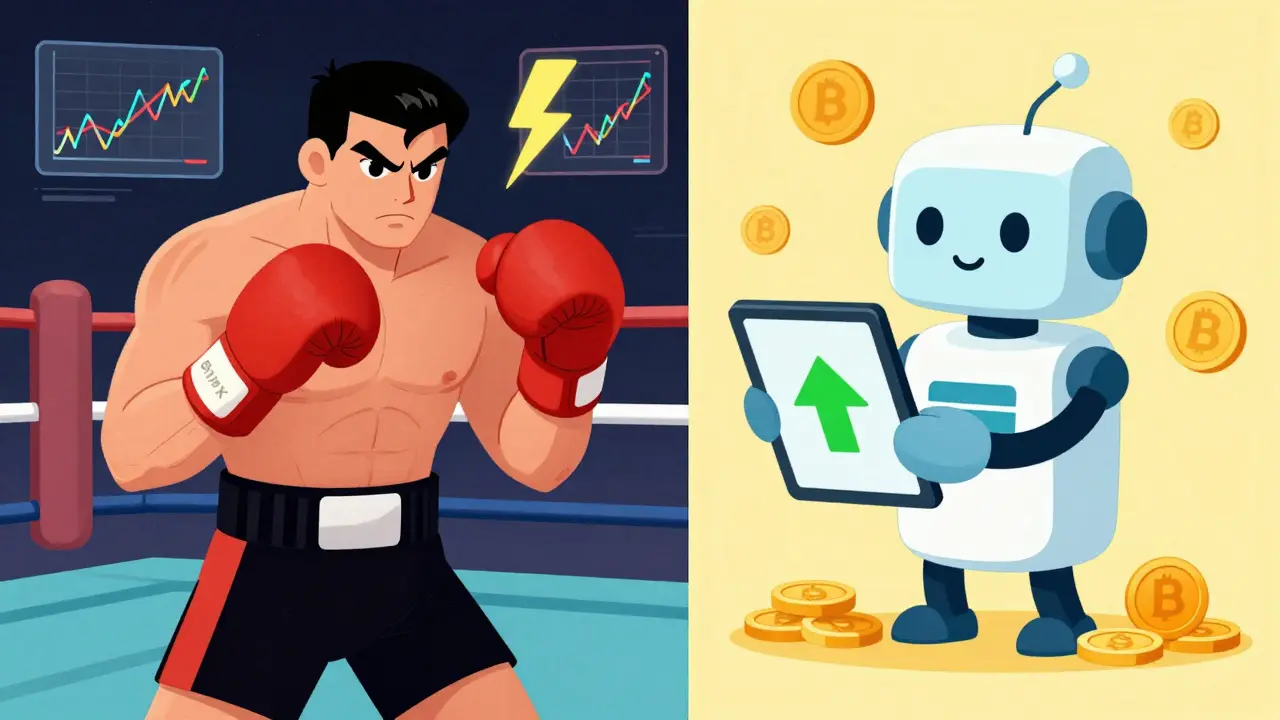
The technical backbone of BitMEX is robust. Its matching engine processes over 100,000 orders per second with latency under 100 milliseconds. For a trader executing large block trades, this speed prevents slippage. The order books maintain tight spreads, often between 0.5% and 1.0%, even during periods of extreme market volatility. As of late 2023 and continuing into 2026, BitMEX holds approximately 8.2% of the global crypto derivatives market share, trailing only Binance and Bybit. While competitors have eaten into its slice of the pie, BitMEX retains a loyal following among institutional players and experienced retail traders who prioritize reliability over flashy features.
Bibox: The AI-Powered Alternative
On the other side of the spectrum is Bibox. Established in 2017, Bibox positions itself as the first AI-powered digital asset exchange. Unlike BitMEX, which focuses heavily on complex derivatives, Bibox caters more to spot trading enthusiasts and those interested in algorithmic strategies. It holds a Swiss VQF license, adding a layer of regulatory credibility that BitMEX lacks in major Western jurisdictions.
Bibox offers over 400 cryptocurrencies and 270+ trading pairs. Its standout feature is the integration of AI trading bots and CopyTrading functionality. If you aren't interested in managing your own portfolio minute-by-minute, Bibox allows you to follow successful traders automatically. This makes it significantly more accessible for beginners compared to the steep learning curve of BitMEX. However, Bibox does not offer the same depth of liquidity for Bitcoin derivatives, meaning large orders might experience higher slippage here than on BitMEX.
Head-to-Head: Which One Fits Your Strategy?
Choosing between these two isn't about which is "better" in a vacuum; it's about which tool fits your hand. Let’s break down the decision criteria based on common user goals.
For Professional Traders: If you understand margin calls, funding rates, and delta hedging, BitMEX is superior. The liquidity depth ensures your large orders don't move the market against you. The recent mobile app overhaul introduced gesture-driven controls like "Swipe to Close," making it easier to manage positions on the go. However, be prepared for a complex UI. There are no "easy mode" buttons here. You are expected to know what you are doing.
For Beginners and Passive Investors: BitMEX will likely overwhelm you. The terminology alone-perpetuals, inverse contracts, auto-deleveraging-can be daunting. Bibox, with its simplified interface and AI bots, offers a gentler entry point. You can start with small spot trades and gradually explore copy-trading. But remember, lower complexity often means higher fees relative to volume and less sophisticated risk management tools.
For Security-Conscious Users: Both platforms have strong reputations, but for different reasons. BitMEX boasts a decade-long hack-free record for customer funds. Bibox relies on its Swiss licensing and cold storage protocols. If you are holding long-term investments, consider whether keeping funds on any centralized exchange is wise. Hardware wallets remain the gold standard for storage, regardless of where you trade.

Practical Steps to Get Started
Once you’ve decided which platform aligns with your needs, the onboarding process differs significantly.
- KYC Verification: BitMEX requires a three-tier KYC process. Basic verification takes 1-24 hours, while higher tiers can take up to 72 hours. Expect to provide government ID and proof of address. Bibox also requires KYC but generally reports faster approval times for standard accounts.
- Funding Your Account: BitMEX primarily supports cryptocurrency deposits. There are no deposit fees, but network fees apply. Minimum deposits are around $10 for spot and $100 for derivatives. Bibox offers more fiat on-ramps, including credit card purchases, though these come with higher processing fees.
- Practice First: Before risking real capital, especially on BitMEX, use their testnet. Experienced users report needing 40-60 hours of practice to master advanced features. Skipping this step is how new traders lose their initial deposits within days.
Risks and Regulatory Realities
No review is complete without addressing the elephant in the room: regulation. BitMEX operates in a gray area for many users. Due to its 2020 settlement with the CFTC and DOJ, it restricts access from the United States and several European countries. If you are located in these regions, attempting to bypass geo-restrictions violates terms of service and exposes you to legal risk. Bibox, with its Swiss license, may offer better accessibility for EU residents, but always check local regulations. Crypto laws change rapidly, and what was permissible in 2024 might be restricted by mid-2026.
Additionally, leverage is a double-edged sword. BitMEX’s 100x leverage option sounds attractive until you realize that a mere 1% move against your position liquidates your entire account. Most profitable traders use significantly lower leverage, often 5x to 10x, to survive market noise. Never trade with money you cannot afford to lose.
Is Bimix a safe crypto exchange?
No, because Bimix does not exist as a legitimate cryptocurrency exchange. Searching for it may lead you to phishing sites or scams. You are likely confusing it with BitMEX or Bibox, both of which are established platforms with distinct security profiles.
Can I use BitMEX if I live in the USA?
Generally, no. BitMEX blocks IP addresses from the United States and several other restricted jurisdictions due to past regulatory settlements. Attempting to bypass these restrictions can result in account closure and forfeiture of funds.
What is the difference between BitMEX and Bibox?
BitMEX specializes in high-leverage derivatives trading like perpetual swaps and futures, catering to professional traders. Bibox focuses on spot trading and AI-powered tools like copy-trading, making it more suitable for beginners and passive investors.
Has BitMEX ever been hacked?
Since its launch in 2014, BitMEX has not suffered any hacks resulting in the loss of customer funds. It maintains a strict cold-storage policy and has a zero-loss security record regarding intrusions.
Which exchange is better for beginners?
Bibox is generally better for beginners due to its simpler interface, spot trading focus, and AI-assisted tools. BitMEX has a steep learning curve and complex products that can lead to rapid losses for inexperienced users.