Bitcoin Block Reward Explained: Subsidy, Fees, and the 2024 Halving
 Jul, 31 2026
You might have heard that miners get paid to secure the Bitcoin network, but do you know exactly what they receive? The Bitcoin block reward is the compensation mechanism that incentivizes miners to validate transactions and secure the blockchain through proof-of-work. It’s not just a single payment; it’s a dual-component system consisting of newly minted coins and transaction fees. Understanding this mechanism is crucial because it dictates Bitcoin’s monetary policy, influences its price dynamics, and determines the long-term security of the entire network.
As we move further into 2026, the landscape has shifted significantly since the last major event in April 2024. The block reward is no longer just about finding blocks; it’s about surviving on a shrinking subsidy while relying more heavily on user fees. Let’s break down how this system works, why it halves every four years, and what it means for the future of Bitcoin.
The Anatomy of a Block Reward
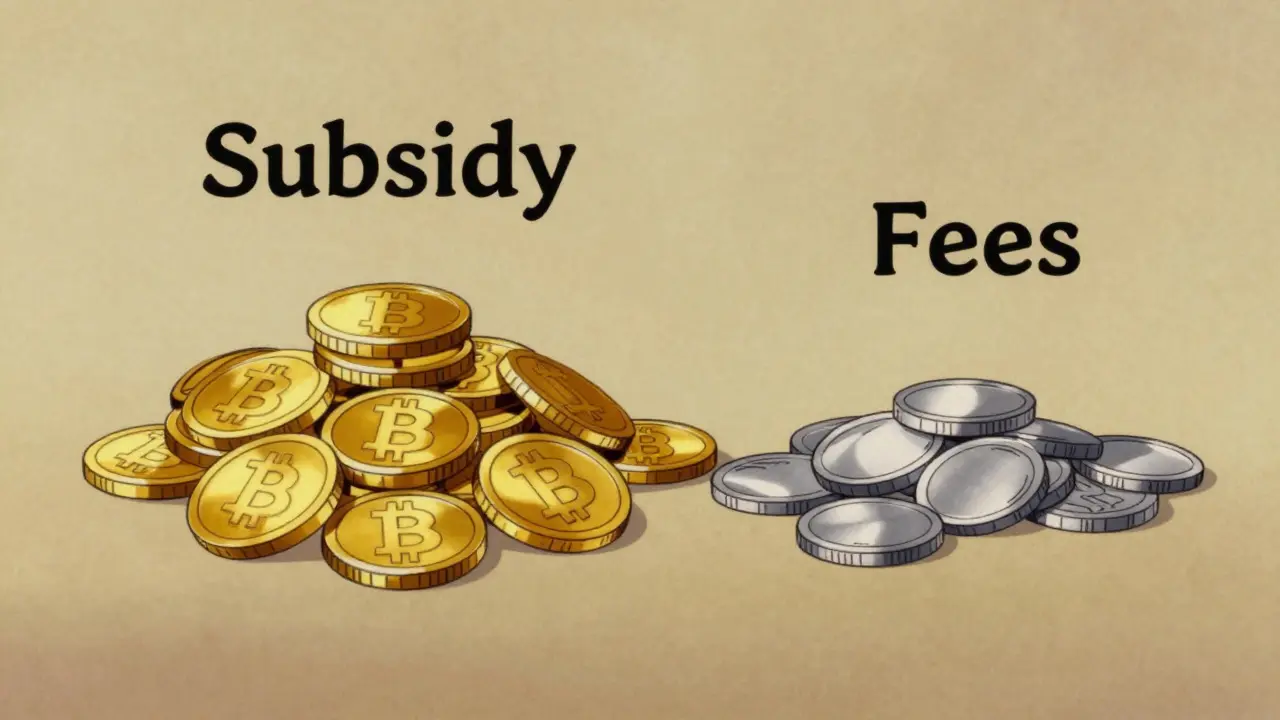
When a miner successfully solves the complex mathematical puzzle required to add a new block to the blockchain, they are granted the right to create a special transaction called the coinbase transaction. This is the first transaction in every block and serves as the vehicle for claiming the reward. The total reward consists of two distinct parts:
- Block Subsidy: These are newly created bitcoins. They come out of thin air, adhering to a strict schedule defined by Satoshi Nakamoto in the original protocol. As of mid-2024, following the most recent halving, this subsidy stands at 3.125 BTC per block.
- Transaction Fees: These are the leftover amounts from transactions included in the block. Users pay these fees to prioritize their transactions. Miners collect all fees from the transactions they bundle together.
Technically, the block subsidy is determined by the block height. Every 210,000 blocks, the code automatically cuts the subsidy in half. This isn’t a decision made by a central bank or a company board; it’s hard-coded logic. The coinbase transaction allows miners to claim this specific amount based on the current epoch. If the subsidy is 3.125 BTC, that is exactly what the protocol permits them to create. Any attempt to claim more results in the block being rejected by the network.
The Halving Mechanism: Deflationary by Design
The most unique aspect of the Bitcoin block reward is the halving, an event that occurs roughly every four years. This mechanism reduces the block subsidy by 50%, effectively slowing the rate at which new bitcoins enter circulation. Here is the historical progression:
| Date | Block Height | Reward Before | Reward After |
|---|---|---|---|
| November 2012 | 210,000 | 50 BTC | 25 BTC |
| July 2016 | 420,000 | 25 BTC | 12.5 BTC |
| May 2020 | 630,000 | 12.5 BTC | 6.25 BTC |
| April 2024 | 840,000 | 6.25 BTC | 3.125 BTC |
The next halving is projected for around 2028, which will reduce the subsidy to approximately 1.5625 BTC. This predictable scarcity is often compared to gold mining, where it becomes harder and more expensive to extract each additional ounce over time. However, unlike gold, Bitcoin’s supply cap is absolute: 21 million coins. As of early 2025, nearly 20 million BTC had already been mined, leaving only about 1 million remaining to be issued. This creates a disinflationary asset class that defies traditional fiat currency models, which typically expand their money supply annually.
Miner Economics: Profitability and Survival
For miners, the block reward is their revenue stream, but it’s not pure profit. They face significant operational costs, primarily electricity and hardware depreciation. The profitability equation looks like this:
(Block Subsidy + Transaction Fees) - (Electricity Cost + Hardware Amortization) = Net Profit
With the subsidy dropping to 3.125 BTC in 2024, the pressure on miners intensified. Professional mining operations now require electricity costs below $0.045 per kWh to remain profitable with current hardware efficiency levels. Compare this to the era when the subsidy was 6.25 BTC, where operators could tolerate costs up to $0.06 per kWh. This shift forced less efficient mining rigs offline. In fact, immediately after the 2024 halving, reports indicated that about 12% of older, less efficient mining operations shut down due to negative margins.
Hardware choices matter immensely. Modern ASIC miners, such as the Antminer S21 Hydro, can cost upwards of $15,000. These machines generate immense heat-over 3,500 watts per unit-requiring sophisticated cooling solutions. The barrier to entry has risen sharply. Newcomers often spend 2-3 months studying hash rates, difficulty adjustments, and pool dynamics before deploying capital. The network’s difficulty adjusts every 2,016 blocks (approximately every two weeks) to maintain a 10-minute block time, meaning if many miners quit, the difficulty drops, making it easier for those who remain. Conversely, if more miners join, difficulty rises, squeezing margins again.
The Role of Transaction Fees
As the block subsidy diminishes, transaction fees become increasingly critical. Currently, fees account for a smaller portion of total miner revenue, but this ratio is shifting. During peak congestion periods post-2024 halving, transaction fees accounted for roughly 28% of total miner revenue, up from 15% previously. This trend highlights a vital transition: Bitcoin must eventually rely almost entirely on fees for security once the subsidy approaches zero around the year 2140.
This creates a potential challenge. If fees are too low, miners may lack incentive to secure the network, potentially leading to centralization among large pools or reduced security. Analysts predict that by 2100, average transaction fees would need to rise to $15-$25 per transaction to maintain current security levels, compared to the current average of $2.50. To mitigate this, the community is developing layer-2 solutions like the Lightning Network. With over 18,500 nodes as of late 2024, Lightning moves small, frequent transactions off-chain, reducing congestion on the main blockchain and allowing base-layer fees to remain focused on high-value settlements.
Comparison with Other Consensus Models
Bitcoin’s proof-of-work (PoW) model differs starkly from proof-of-stake (PoS) systems like Ethereum. In PoS, validators stake existing coins to secure the network and earn rewards primarily from transaction fees and inflationary issuance, but without a hard-coded halving mechanism. Bitcoin’s fixed supply cap contrasts with inflationary models like Dogecoin, which has no maximum supply, or Litecoin, which has an 84 million cap but follows a similar halving schedule. Bitcoin’s advantage lies in its predictable, deflationary monetary policy, which supports its narrative as digital gold. However, this comes at the cost of higher energy consumption. Critics point out that Bitcoin’s annual electricity usage reached approximately 121.72 TWh in 2023, comparable to countries like Argentina. Proponents argue that much of this energy comes from renewable sources, with the Bitcoin Mining Council reporting 62% sustainable energy usage, though independent studies suggest the figure may be closer to 39%.
Future Outlook and Challenges
The long-term viability of the Bitcoin block reward system hinges on the successful transition to fee-based security. Economist Nouriel Roubini has criticized this model, arguing that miners will eventually lack sufficient incentive once subsidies disappear. Conversely, experts like Nic Carter highlight the halving as a historic innovation in monetary policy. The International Monetary Fund warns that without adequate fee market development, Bitcoin’s security could face risks after 2050 when subsidies fall below 0.5 BTC. Meanwhile, institutional adoption continues to grow, with major public companies holding Bitcoin on their balance sheets, partly due to confidence in its scarce supply model. The ongoing debate reflects the tension between economic theory and practical implementation in a decentralized network.
What is the current Bitcoin block reward?
As of April 2024, the block subsidy is 3.125 BTC. The total block reward includes this subsidy plus any transaction fees from the transactions included in the block.
When will the next Bitcoin halving occur?
The next halving is expected around 2028, at block height 1,050,000. It will reduce the block subsidy from 3.125 BTC to approximately 1.5625 BTC.
How do miners make money if the reward decreases?
Miners rely on a combination of the block subsidy and transaction fees. As the subsidy drops, they must operate more efficiently, using cheaper electricity and newer hardware, while hoping transaction fees increase to compensate.
What happens when all 21 million bitcoins are mined?
Around the year 2140, the block subsidy will reach zero. Miners will then rely entirely on transaction fees for revenue. The network’s security will depend on users paying sufficient fees to incentivize miners.
Is Bitcoin mining profitable in 2026?
Profitability depends on electricity costs and hardware efficiency. With the 3.125 BTC subsidy, miners generally need electricity costs below $0.045/kWh to remain profitable with modern ASICs. Home mining is largely unprofitable without extremely cheap power.
How does the block reward affect Bitcoin's price?
The halving reduces the supply of new bitcoins entering the market. Historically, this supply shock has preceded bull markets, as demand remains constant or increases while new supply drops by 50%.
What is the difference between block subsidy and transaction fees?
The block subsidy is newly created bitcoin issued by the protocol. Transaction fees are payments made by users to prioritize their transactions. Both are collected by the miner who finds the block.
Why does Bitcoin have a supply cap of 21 million?
The 21 million cap was designed by Satoshi Nakamoto to create digital scarcity, mimicking precious metals like gold. This fixed supply aims to prevent inflation and preserve value over time.
How does the Lightning Network impact block rewards?
The Lightning Network handles small transactions off-chain, reducing congestion on the main blockchain. This helps keep base-layer fees manageable for large settlements while allowing the network to scale without compromising security incentives.
Can the block reward be changed?
Changing the block reward requires a consensus change across the entire network, including miners, nodes, and developers. It is intentionally difficult to alter, ensuring the monetary policy remains predictable and trustless.