BitLicense Requirements for Crypto in New York: A Complete Guide
 May, 25 2026
Trying to run a crypto business in New York without a BitLicense is like trying to open a bank account with a fake ID. It’s not just difficult; it’s illegal. The New York State Department of Financial Services (NYDFS) enforces some of the strictest cryptocurrency regulations in the world. If you are a startup founder, an exchange operator, or even a custodian looking to serve New York residents, understanding these rules isn't optional-it's your ticket to survival.
New York holds about 40% of the U.S. financial market share. Ignoring that state means ignoring a massive chunk of potential customers. But getting into that market requires jumping through hoops that have scared off giants like Kraken and Binance. This guide breaks down exactly what you need to know to navigate the BitLicense landscape in 2026.
What Exactly Is a BitLicense?
The term "BitLicense" is shorthand for a specific type of business license issued by the NYDFS under Part 200 of Title 23 of the NYCRR. It was introduced in 2015 by former Superintendent Benjamin Lawsky to bring traditional financial oversight to the wild west of early cryptocurrency.
You don't need a BitLicense just because you own Bitcoin. You need one if you engage in Virtual Currency Business Activity involving New York residents. The NYDFS defines this broadly. Do any of these sound like your business model?
- Transmitting: Receiving virtual currency on behalf of another person or transmitting it to them.
- Custody: Storing, holding, or maintaining control of virtual currency for others (like a wallet provider).
- Exchange: Buying and selling virtual currency as a customer business.
- Issuance: Controlling, administering, or issuing a virtual currency (this includes stablecoin issuers).
- Trading: Acting as a dealer in virtual currency transactions.
If you answered yes to any of those, you are likely a "Covered Institution" under NY law. As of 2025, only about 1.2% of U.S. crypto businesses hold this license, yet they process roughly 35% of all crypto transactions involving U.S. residents. That scarcity is intentional. The NYDFS wants quality over quantity.
The High Cost of Entry: Capital and Bonds
Let’s talk money. One of the biggest hurdles for new applicants is the financial requirement. The NYDFS doesn't give a one-size-fits-all number here. Instead, they look at your risk profile and business scale.
However, there are concrete baselines you must meet. Under 23 NYCRR 200.8, you need sufficient capitalization. For most mid-sized operations, this means having between $1 million and $5 million in net worth. Small startups often find this impossible to raise just for compliance.
Then there is the customer protection fund. Under 23 NYCRR 200.9(a), you must post a surety bond or maintain a funded account. The minimum is $500,000. But watch out-this amount scales up based on your transaction volume and risk assessment. If you plan to handle millions in daily trades, expect that bond requirement to skyrocket.
| Cost Category | Estimated Range (USD) | Notes |
|---|---|---|
| Application Fee | $100,000+ | Non-refundable upfront cost. |
| Legal & Compliance Setup | $200,000 - $1M+ | Consultants charge $200-$500/hour. |
| Surety Bond / Customer Fund | $500,000+ (minimum) | Increases with transaction volume. |
| Annual Maintenance | $15,000 - $80,000 | Audits, reporting, and regulatory fees. |
According to Brico.ai’s 2025 analysis, the total upfront cost to get licensed can easily exceed $150,000, excluding the capital reserves. This creates a "regulatory moat." It protects consumers from fly-by-night operators, but it also locks out small innovators who can’t afford the entry fee.
Compliance: AML, KYC, and Cybersecurity
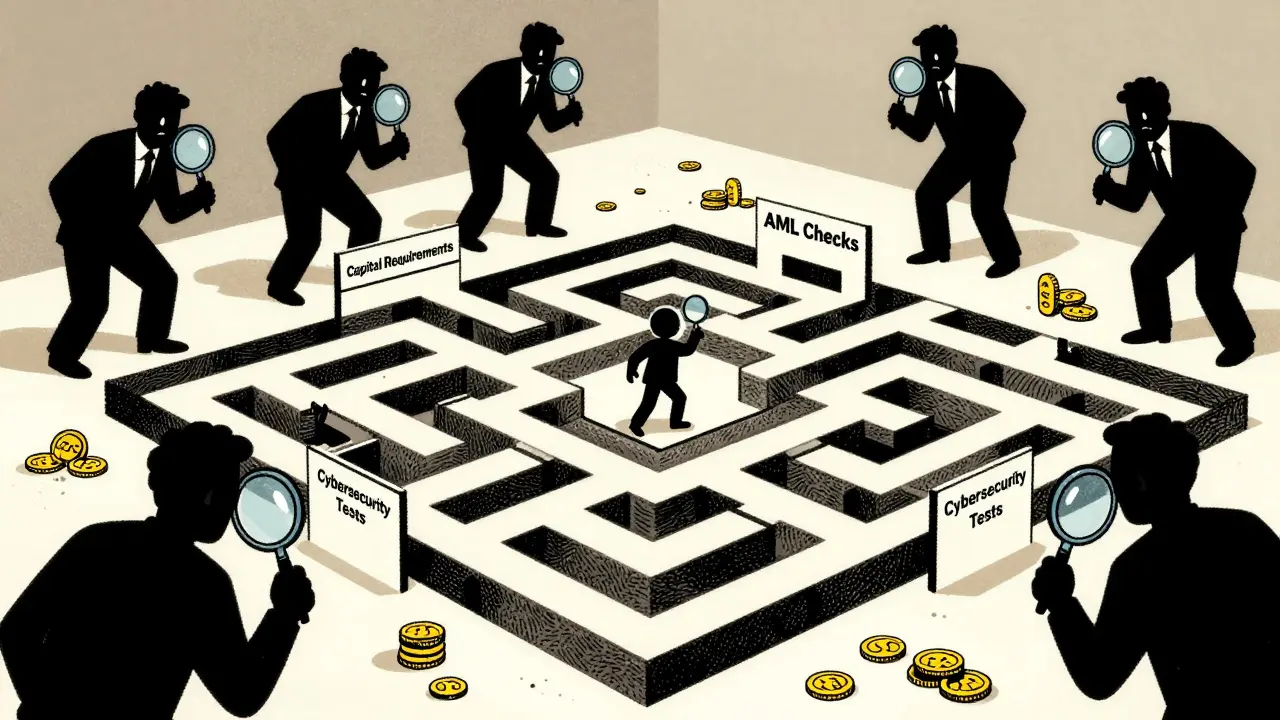
Paying the fees is only step one. The real work happens in your daily operations. The NYDFS demands military-grade security and rigorous anti-money laundering (AML) protocols.
Anti-Money Laundering (AML) and Know Your Customer (KYC)
Your AML program must meet the standards of the Bank Secrecy Act. This means you cannot be anonymous. Every user must be verified. You need robust systems to detect suspicious activity and file Suspicious Activity Reports (SARs) when necessary. In 2025, the NYDFS expanded its expectations for blockchain analytics. All Covered Institutions must now use advanced blockchain tracking tools to monitor flows of funds, a rule previously reserved for trust companies.
Cybersecurity Protocols
New York is home to the NYDFS Cybersecurity Regulation 500. This is arguably the toughest cybersecurity standard in the industry. You aren't just asked to "be secure." You must prove it. Requirements include:
- Regular penetration testing by independent third parties.
- Multi-factor authentication for all access points.
- Encryption of sensitive data both at rest and in transit.
- A designated Chief Information Security Officer (CISO).
- Incident response plans that are tested regularly.
If you suffer a breach, the consequences are severe. The NYDFS will scrutinize your entire operation. Given the high-profile hacks in the crypto space, this scrutiny is intense.
The Application Process: What to Expect
Applying for a BitLicense is not filling out a form online. It is a marathon. According to NYDFS statistics cited in Chambers Global Practice Guides, the process typically takes 12 to 18 months. Here is how it usually goes:
- Pre-Application Consultation: You meet with NYDFS examiners to discuss your business model. They will tell you if your idea even fits within the current framework.
- Detailed Submission: You submit a comprehensive package including your business plan, AML policies, cybersecurity frameworks, and proof of capitalization.
- Examination: NYDFS examiners dig deep. They interview your staff, review your code, and test your security systems. They may ask for changes multiple times.
- Approval or Denial: If you pass, you get the license. If you fail, you might get a chance to fix issues, or you might be denied entirely.
Most companies hire specialized compliance consultants during this phase. These experts charge premium rates because their knowledge of NYDFS nuances is critical. Without them, you risk missing subtle requirements that could delay your approval by months.
Recent Changes: Coin Listing and Blockchain Analytics
The regulatory landscape isn't static. Two major updates in recent years have changed how licensed entities operate.
First, the November 15, 2023 Guidance on Coin-Listing and Delisting. Before this, exchanges had more freedom to list tokens. Now, the NYDFS expects licensed entities to evaluate every new token for legitimacy, market manipulation risks, and securities law compliance. You can't just list whatever the community wants. You need a formal process to vet assets.
Second, the 2025 Industry Letter expanded blockchain analytics requirements. Previously, only trust companies and bitlicensees had strict monitoring duties. Now, the expectation applies broadly to all Covered Institutions. This means if you are a custodian or a payment processor, you must track where coins come from and where they go. This move aims to close loopholes that bad actors used to launder money through less-regulated service providers.
Alternatives to the BitLicense
If the BitLicense seems too expensive or restrictive, are there other ways to operate in New York? Yes, but they come with their own challenges.
- Limited Purpose Trust Company Charter
- This allows institutions to offer trust services, including custody of digital assets. Companies like Uphold have used this path. It offers similar regulatory oversight but can be easier for certain types of businesses focused on custody rather than trading.
- New York State Bank Charter
- Fewer companies pursue this due to the extreme capital and operational requirements. It provides broad banking powers but is generally only viable for well-established financial institutions.
- Operating Outside New York
- Some companies, like Kraken, chose to exit the New York market entirely. Kraken famously called the BitLicense "a creature so foul, not even Kraken would face it." While this saves costs, it means losing access to New York's wealthy consumer base and institutional investors.
For most serious players, the BitLicense remains the gold standard. Having it signals trust and stability to customers. Coinbase and Gemini leverage their licenses as marketing tools, telling users, "We are safe because we are regulated by New York."
Who Has the License?
As of 2025, the club of major exchanges with BitLicenses is small but powerful. Here is who is playing in New York:
- Coinbase: One of the earliest adopters, using the license to build dominant market share.
- Gemini: Founded by the Winklevoss twins, fully compliant with both BitLicense and Trust Charter.
- Circle: Issuer of USDC, received the first BitLicense in 2015.
- Robinhood: Operates under a BitLicense with limited wallet functionality.
- eToro: Entered the New York market in 2025 after securing compliance.
- Uphold: Operates through a Limited Purpose Trust Charter.
- Bitstamp: Holds a BitLicense for its European and U.S. operations.
- MoonPay USA LLC: Received full BitLicense approval in June 2025, showing the door is still open for fintech payment processors.
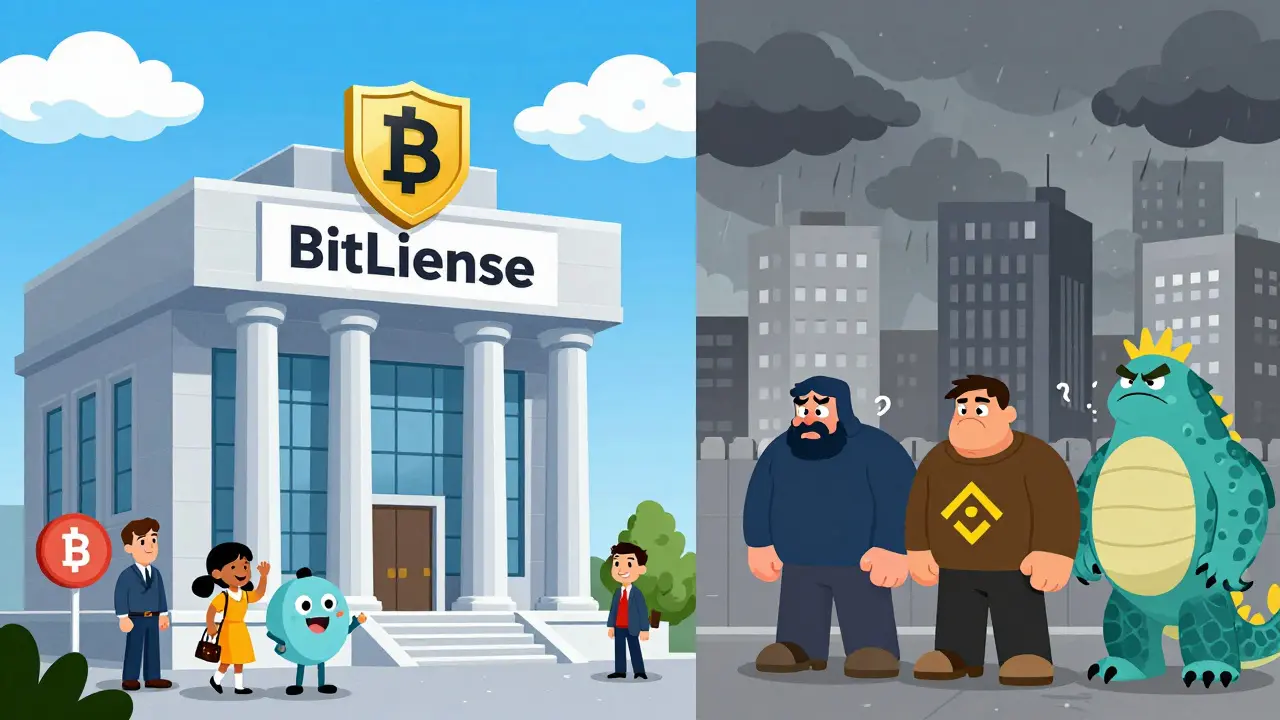
Notice who is missing? Binance, Kraken, and several other major global exchanges do not serve New York residents directly. If you live in New York, your choices are limited, but the options available are generally considered safer and more transparent.
Conclusion: Is It Worth It?
The BitLicense is a double-edged sword. On one side, it provides immense credibility and access to a lucrative market. On the other, it demands significant financial resources and operational discipline. For small startups, the barrier to entry is often prohibitive. For established firms, it is a necessary cost of doing business in America's financial capital.
If you are planning to launch a crypto business in New York, start preparing early. Build your compliance team, secure your capital, and understand that the NYDFS is watching. The goal isn't just to get the license; it's to keep it. And in New York, keeping it means staying ahead of the curve on security, transparency, and consumer protection.
How long does it take to get a BitLicense?
The application process typically takes 12 to 18 months. This timeline includes pre-application consultations, detailed submissions, and thorough examinations by NYDFS officials. Delays can occur if additional information is requested or if the business model requires significant modifications to meet regulatory standards.
What is the minimum capital requirement for a BitLicense?
While there is no single fixed number, the NYDFS generally expects net worth capitalization ranging from $1 million to $5 million depending on the scale and risk profile of the business. Additionally, a customer protection fund or surety bond of at least $500,000 is required, which can increase based on transaction volumes.
Can I operate a crypto exchange in New York without a BitLicense?
No. If you engage in Virtual Currency Business Activity involving New York residents, such as exchanging, storing, or transmitting virtual currency, you must have a BitLicense or an equivalent charter like a Limited Purpose Trust Company. Operating without one is illegal and can result in severe penalties.
Why did Kraken and Binance leave New York?
These companies found the compliance costs and operational restrictions of the BitLicense too burdensome relative to the revenue potential. Kraken publicly criticized the license as stifling innovation. By exiting, they avoid the high costs of maintaining a dedicated compliance team and meeting stringent cybersecurity and capital requirements.
What are the cybersecurity requirements for BitLicense holders?
BitLicense holders must comply with NYDFS Cybersecurity Regulation 500. This includes implementing multi-factor authentication, encrypting data, conducting regular penetration tests, appointing a CISO, and maintaining an incident response plan. These measures are designed to protect customer assets from hacking and theft.