Block Headers vs Block Body in Blockchain: What They Do and Why It Matters
 Mar, 20 2026
When you hear about blockchain, you might picture a chain of blocks - simple, linear, and easy to understand. But underneath that simple image is a clever, two-part design that keeps the whole system secure, fast, and tamper-proof. At the heart of every block in Bitcoin, Ethereum, and nearly every major blockchain are two distinct pieces: the block header and the block body. One holds the secrets. The other holds the value. And together, they make blockchain work.
What’s Inside the Block Header?
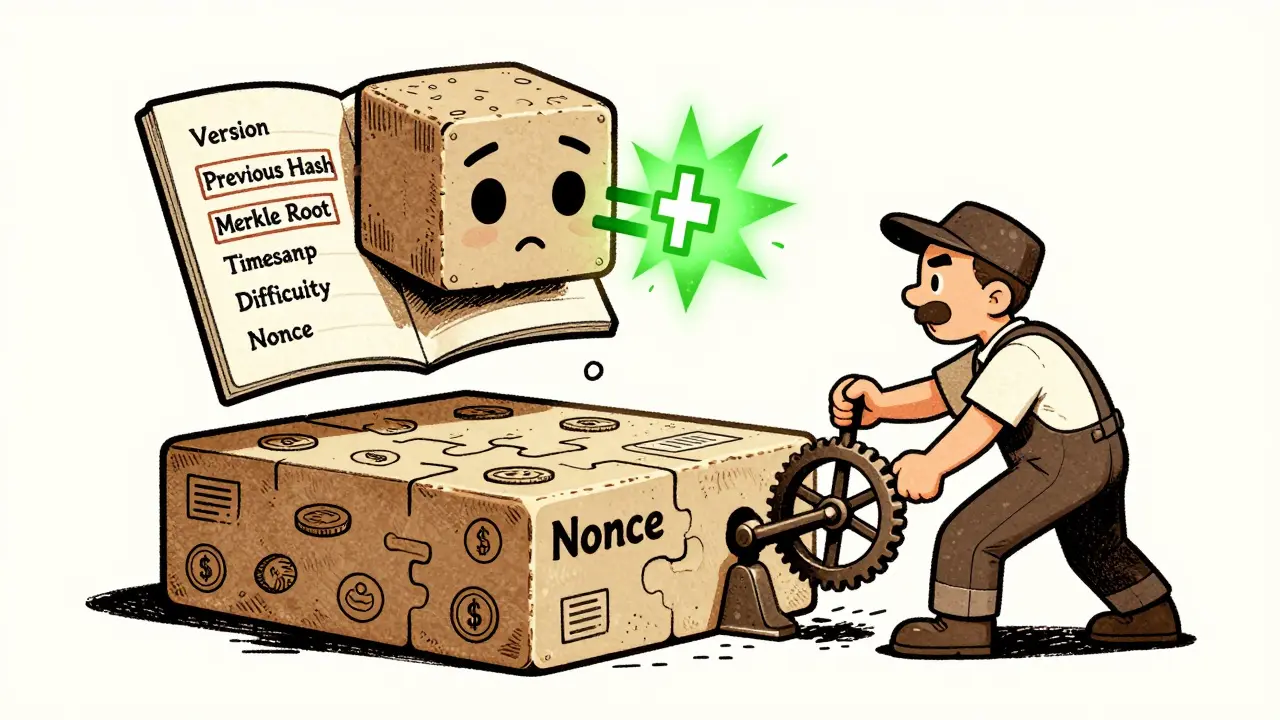
The block header is small - just 80 bytes in Bitcoin. That’s less than a single tweet. But inside that tiny space lives everything needed to prove the block is real and connected to the one before it. Think of it like a passport for the block: it doesn’t contain your personal details, but it has the stamps, seals, and barcode that let anyone verify you’re who you say you are.
In Bitcoin, the header has six key fields:
- Version number - tells the network which rules the block follows.
- Previous block hash - the cryptographic fingerprint of the block before this one. This is what chains blocks together. Change one block? The next block’s header breaks.
- Merkle root - a single hash that represents every transaction in the block body. If even one transaction changes, this number changes too.
- Timestamp - when the block was created (roughly).
- Difficulty target - how hard it should be to mine this block. Adjusts every 2016 blocks to keep Bitcoin’s block time around 10 minutes.
- Nonce - a random number miners tweak over and over until the block hash meets the target.
Miners don’t mine the whole block. They mine the header. Every second, Bitcoin miners are hashing this 80-byte header trillions of times per second - over 300 exahashes per second - trying to find a hash that starts with enough zeros. That’s the Proof-of-Work puzzle. The body? It’s just sitting there, waiting. The header is the puzzle. The body is the prize.
What’s Inside the Block Body?
The block body is where the real action happens. This is where all the transactions live - the money moves, the smart contracts execute, the NFTs get minted. In Bitcoin, the body starts with a count of how many transactions are in it (usually just one byte), then lists each transaction one after another.
Bitcoin’s block body can hold up to 4MB of data after SegWit. That’s a lot of transactions. A typical block has between 1,500 and 3,000 transactions. Each one has inputs, outputs, signatures, and fees. All of it gets hashed together into a Merkle tree, and only the final root gets stored in the header. That’s the magic trick: the header doesn’t store transactions. It stores a fingerprint of them.
But not all blockchains are the same. Ethereum’s block body is more complex. It doesn’t just hold transactions - it also holds ‘ommers’ (called uncles in older versions), which are valid blocks that weren’t chosen as the main chain. These help make Ethereum’s network more secure because they reward miners who almost found the next block. Ethereum’s body also carries data for smart contract execution, like gas usage and state changes.
Why the Split? Security vs. Efficiency
Why not just put everything in one big chunk? Because that would break everything.
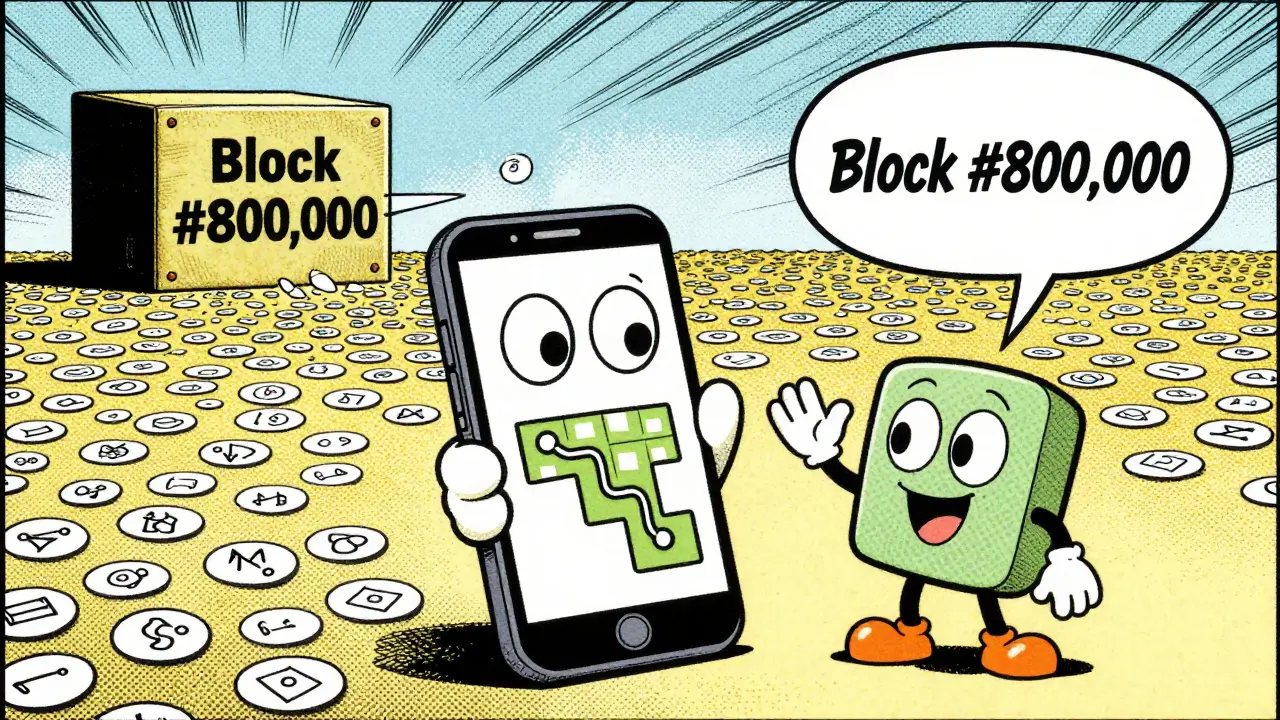
Imagine if every node on the network had to download and verify a full 4MB block every 10 minutes just to check if a single transaction was real. Mobile wallets? Forget it. Light clients? Impossible. That’s where the header-body split saves the day.
Because the header contains the Merkle root, a smartphone can verify a transaction without downloading the whole block. It just asks a full node: ‘Is this transaction in block #800,000?’ The full node gives it the transaction and a short proof - a path through the Merkle tree - that links it back to the header’s root. The phone checks the math. Done. No download needed. This is called SPV (Simplified Payment Verification), and it’s what lets wallets like Electrum and BlueWallet work on your phone.
Meanwhile, miners and validators only need to hash the header to prove they’ve done the work. They don’t care about the details of each transaction - just that they’re all accounted for. The body is handled separately, stored, and validated later. This separation makes the system scalable. It also makes it tamper-proof.
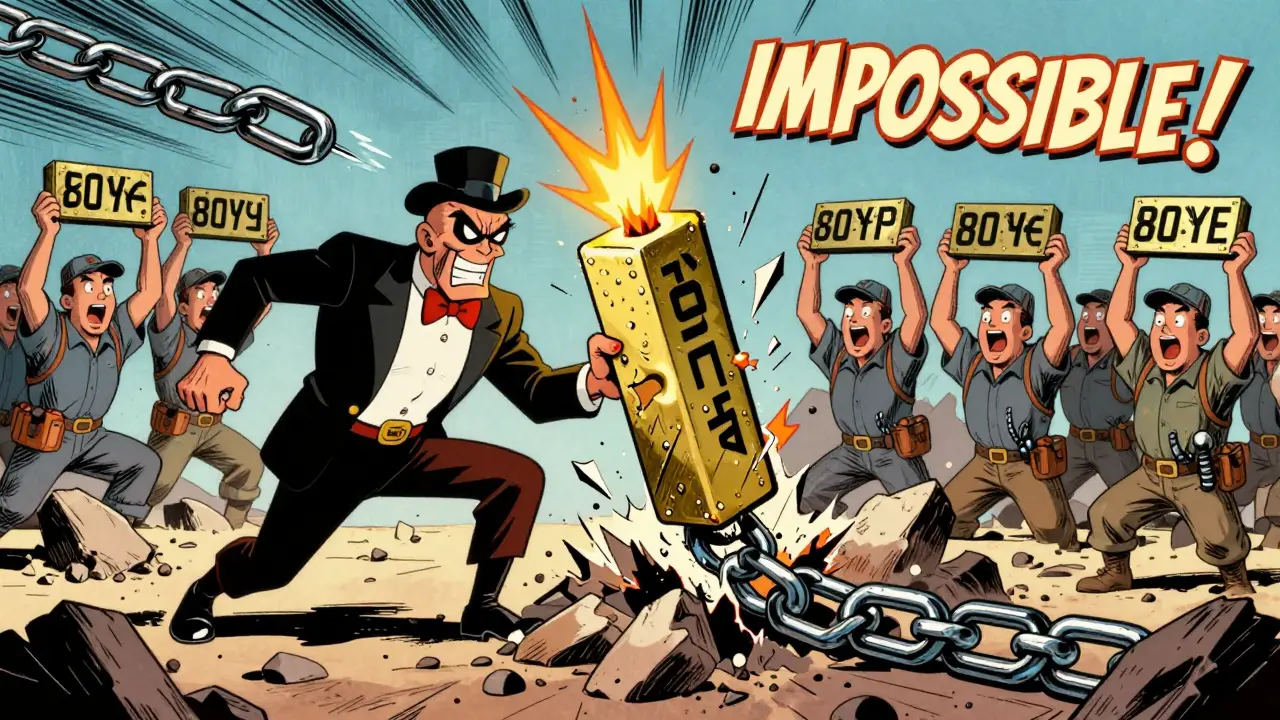
If someone tried to change a transaction in the body - say, turning a $10 payment into $1,000 - the Merkle root would change. The header would change. The block’s hash would change. And since the next block’s header contains the hash of this one, that next block would be invalid. The whole chain would break. That’s why tampering is computationally impossible without redoing every block after it - which takes more energy than exists on Earth.
How Different Blockchains Handle It
Bitcoin stuck with the original 80-byte header. But others evolved.
Ethereum’s header is much bigger - around 500 bytes - because it includes extra fields: state root (the snapshot of all account balances), transaction root (Merkle root of all transactions), and receipts root (log of smart contract events). These let Ethereum’s network verify not just payments, but the entire state of the system after each block. That’s powerful, but it means light clients need more bandwidth.
Cardano uses a 128-byte header that includes stake distribution data for its Proof-of-Stake system. Solana’s header is a massive 1,280 bytes because it includes a ‘proof-of-history’ timestamp sequence - a way to prove the order of events without needing network-wide consensus. Each blockchain tweaks the header to fit its goals.
And then there’s Bitcoin Cash. When Bitcoin’s block size debate heated up in 2017, Bitcoin Cash forked off and increased the block size to 8MB - but kept the same header structure. That’s telling. The header didn’t change. Only the body did. The security model stayed the same. The scalability changed.
What’s Coming Next?
The header-body structure has lasted 15 years. But it’s not frozen in time.
Ethereum is replacing its Merkle Patricia tree with ‘Verkle trees’ in 2024. This will shrink the proof sizes needed for verification by 97%. Light clients will become even lighter. Stateless clients - nodes that don’t store any state data - will become possible. The header will still exist. But the data inside it will change.
Bitcoin is exploring MAST (Merkelized Abstract Syntax Trees), which would let complex smart contracts live in the body while keeping the header small. This could make Bitcoin more flexible without bloating the header.
And then there’s the elephant in the room: quantum computing. SHA-256, the hash function used in Bitcoin’s header, could be broken by a powerful enough quantum computer. If that happens, blockchains will need to switch to quantum-resistant hashes - and that means redesigning the header from the ground up.
For now, though, the header-body split remains the backbone of every major blockchain. It’s simple. It’s elegant. And it’s survived every test - from mining wars to scaling crises to regulatory scrutiny.
Why This Matters to You
You don’t need to be a developer to understand this. But knowing the difference helps you understand what’s really going on when you send crypto.
When you send Bitcoin, your transaction goes into the body. It waits in the mempool. Miners grab it. They bundle it with others. They hash the header. They solve the puzzle. And when they win, your transaction becomes part of the permanent record - not because the whole block was copied, but because the header proved it belonged there.
When you use a mobile wallet and see ‘confirmed,’ you’re not seeing the full block. You’re seeing a tiny proof linked to the header. That’s the power of this design.
Understanding headers and bodies also helps you avoid scams. If someone tells you they can ‘change’ a transaction after it’s confirmed, they don’t understand blockchain. Once a header is buried under six more blocks, changing it is impossible. The body might have changed - but the header’s fingerprint didn’t. And that’s what matters.
What’s the difference between a block header and a block body?
The block header is a small, fixed-size section that contains metadata like the previous block’s hash, the Merkle root of all transactions, the timestamp, difficulty target, and nonce. It’s used for security, linking blocks together, and mining. The block body contains the actual transactions - the money transfers, smart contract calls, or data records. While the header ensures integrity, the body delivers value.
Why is the block header so small in Bitcoin?
The Bitcoin block header is kept small (80 bytes) to make verification fast and efficient. Light clients, like mobile wallets, only need the header to confirm transactions using SPV (Simplified Payment Verification). A smaller header means less data to download, faster syncing, and lower bandwidth use - critical for adoption on mobile devices and low-power hardware.
Do all blockchains use the same header structure?
No. While all blockchains separate header and body, their structures vary. Bitcoin uses a simple 80-byte header. Ethereum’s header is around 500 bytes and includes state and receipts roots for smart contract verification. Cardano adds stake data, and Solana includes a proof-of-history sequence. Each design reflects the blockchain’s consensus mechanism and goals.
Can you change a transaction after it’s in a block?
No. If you change even one byte in a transaction in the block body, the Merkle root in the header changes. That changes the block’s hash. Since the next block’s header contains the previous block’s hash, the entire chain breaks. To fix it, you’d need to redo all Proof-of-Work from that block forward - which requires more computing power than exists on Earth.
How do miners find a valid block?
Miners take the block header - which includes the list of transactions, timestamp, and previous block hash - and repeatedly change the nonce (a random number) until the hash of the header starts with enough zeros to meet the network’s difficulty target. They don’t touch the body during this process. The body is fixed. Only the header is tweaked to solve the puzzle.
Graham Smith
March 21, 2026 AT 21:36Jerry Panson
March 23, 2026 AT 04:45Katrina Smith
March 23, 2026 AT 05:53Anastasia Danavath
March 23, 2026 AT 09:34anshika garg
March 24, 2026 AT 20:05Bruce Doucette
March 26, 2026 AT 17:10Marie Vernon
March 28, 2026 AT 05:28rajan gupta
March 29, 2026 AT 21:37Billy Karna
March 30, 2026 AT 00:00Cheri Farnsworth
March 31, 2026 AT 23:38Gene Inoue
April 1, 2026 AT 19:36Ricky Fairlamb
April 3, 2026 AT 15:17Tony Weaver
April 4, 2026 AT 06:29Patty Atima
April 5, 2026 AT 18:59Lauren J. Walter
April 7, 2026 AT 02:12Konakuze Christopher
April 8, 2026 AT 14:00Angelica Stovall
April 9, 2026 AT 08:43Taylor Holloman.
April 10, 2026 AT 04:08Bryan Roth
April 10, 2026 AT 19:07shreya gupta
April 10, 2026 AT 21:42Derek Lynch
April 11, 2026 AT 21:39