Blockchain Payment Speed and Cost Benefits: The 2026 Reality Check
 Sep, 6 2026
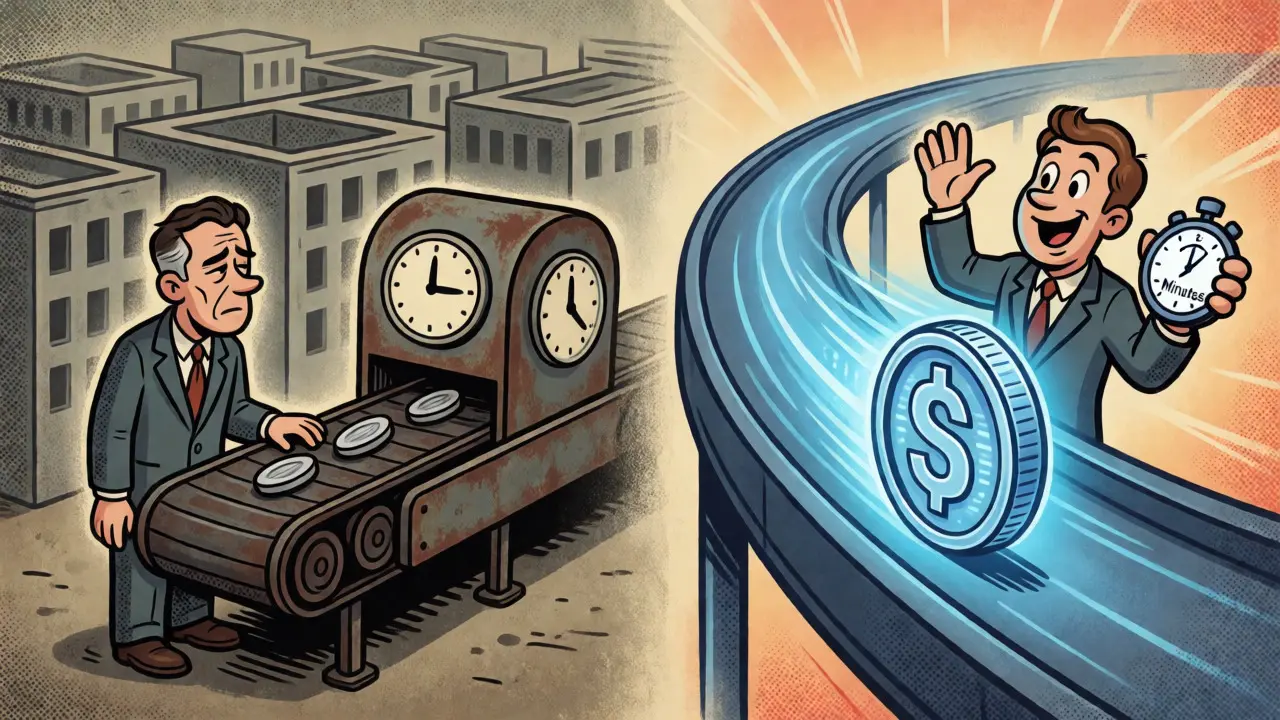
Imagine waiting three to five business days for a wire transfer to clear, only to watch nearly half of your profit margin evaporate into intermediary fees. That was the standard reality for international businesses just a few years ago. Today, that wait time has collapsed to under three minutes, and the fees have dropped by up to 80%. This isn't a futuristic promise; it is the operational baseline for modern finance in 2026. If you are still routing cross-border transactions through legacy banking rails, you aren't just slow-you are leaving money on the table every single day.
| Metric | Traditional Wire/SWIFT | Blockchain/Stablecoin Rails |
|---|---|---|
| Settlement Time | 3-5 Business Days | < 3 Minutes (often < 10 seconds) |
| Transaction Cost | 2% - 7% | 0.1% - 1% |
| Intermediaries | High (Correspondent Banks) | Low/None (Decentralized Network) |
| Transparency | Limited until settlement | Real-time tracking |
The Death of the Waiting Game
Speed used to be a luxury feature in fintech marketing. Now, it is the primary driver of adoption. Traditional cross-border payments rely on a chain of correspondent banks, each adding processing time and holding funds in nostro accounts. It’s an inefficient relay race where the baton gets dropped or delayed at every handoff. Blockchain payment systems eliminate this relay entirely. By using decentralized networks, they settle transactions peer-to-peer, bypassing the need for multiple intermediaries to verify and move the value.
According to recent industry analyses from BVNK, blockchain settlements now finalize in under three minutes. For specific high-throughput networks like Solana or Avalanche, finality can occur in seconds. Compare this to the 3-5 day window of SWIFT transfers, and the cash flow advantage becomes obvious. You get your capital back faster, meaning you can reinvest it sooner. For a logistics company paying suppliers in Asia, moving from a four-day wait to an eight-second confirmation frees up working capital that would otherwise sit idle in transit.
Why Your Margins Are Bleeding Out
Let’s talk about the numbers, because they don’t lie. Traditional payment processors like PayPal or Stripe charge between 2.9% and 3.5% per transaction, plus fixed fees. Add in foreign exchange spreads-which often hide another 1-5% in costs-and international transaction fees, and you’re looking at a total cost of ownership that can hit 7%. On a $1 million annual volume, that’s $70,000 gone before you’ve even paid your staff.
Blockchain rails slash these costs dramatically. Stablecoins like USDC and USDT operate on networks where transaction fees are often negligible fractions of a cent. Even when accounting for gas fees on congested networks, the total cost usually lands between 0.1% and 1%. A case study from Safeheron highlighted an e-commerce retailer processing $500,000 annually. They paid $35,000 in traditional gateway fees but reduced that to just $5,000 using crypto payment gateways. That is a $30,000 annual saving from switching rails alone. For larger enterprises, these savings compound into millions.

Not All Blockchains Are Created Equal
Here is where many beginners trip up: they assume all blockchains are fast and cheap. They aren’t. Bitcoin, while secure, processes transactions in blocks that take roughly ten minutes to confirm, with fees that can spike during congestion. Ethereum offers better speed but suffers from volatile gas fees that can range from $0.50 to over $50 depending on network demand. If you are running a retail point-of-sale system, you cannot afford unpredictable settlement times or costs.
This is why specialized networks dominate commercial payments. Networks like RippleNet, Stellar, and Polygon are engineered specifically for financial throughput. Stellar, for instance, processes transactions for approximately $0.000002 each. RippleNet handles billions in monthly volume with enterprise-grade stability. When choosing a rail, look beyond the hype. Focus on practical metrics:
- Finality Time: How long until the money is irreversibly settled? Seconds are ideal for retail; minutes are acceptable for B2B.
- Throughput (TPS): Can the network handle peak holiday traffic without clogging?
- Fee Stability: Does the cost remain predictable during market volatility?
The Role of Stablecoins in Reducing Volatility
You might be thinking, "Crypto prices swing wildly. How can I use that for payroll or supplier payments?" The answer lies in stablecoins. These are cryptocurrencies pegged 1:1 to fiat currencies like the US Dollar or Euro. They provide the technical benefits of blockchain-speed, low cost, transparency-without the price risk of Bitcoin or Ethereum.
In 2026, stablecoins have moved from niche experiments to mainstream infrastructure. Circle’s USDC and Tether’s USDT processed over $1.2 trillion in commercial volume in Q1 2025 alone. McKinsey predicts that tokenized cash will drive a material shift in the payments industry this year. For businesses, this means you can hold value in a digital dollar, send it instantly across borders, and convert it to local currency upon receipt, all while avoiding the FX spreads charged by traditional banks.

Implementation Hurdles: What No One Tells You
While the benefits are stark, integration isn't always plug-and-play. A common pitfall is underestimating the complexity of reconciling blockchain transactions with traditional accounting software. Deloitte’s survey found that 63% of companies struggle with this reconciliation process. Your accountant expects a bank statement; you’re handing them a hash string and a wallet address. Bridging that gap requires middleware or specialized ERP integrations.
Another challenge is regulatory fragmentation. While New Zealand and Singapore have clear frameworks, other jurisdictions remain murky. IMF officials have warned that without coordinated international rules, we risk creating new financial silos rather than true global connectivity. Ensure your chosen provider complies with KYC/AML regulations in both the sending and receiving countries. Don't let compliance surprises halt your payment flows.
Who Should Switch First?
If you are a consumer buying a coffee, stick to your card for now. Chargeback protections and universal acceptance still favor Visa and Mastercard for small retail purchases. However, if you fall into one of these categories, blockchain is no longer optional-it’s competitive necessity:
- Cross-Border B2B Companies: If you pay suppliers in different currencies, the fee savings alone justify the switch.
- Remittance Services: Sending money to emerging markets is where blockchain shines brightest. Users in Africa and Southeast Asia report 40-60% cheaper transfers compared to Western Union or MoneyGram.
- High-Volume Digital Platforms: Gaming, streaming, and SaaS platforms benefit from micropayments that are impossible on traditional rails due to fixed fees.
The trend is undeniable. Gartner predicts that by 2027, half of Fortune 500 companies will use blockchain for major cross-border functions. The question isn't whether to adopt it, but how quickly you can integrate it to stay ahead of competitors who are already cutting their overheads by 30%.
Are blockchain payments really safer than traditional wires?
Blockchain transactions are cryptographically secure and irreversible, which prevents fraud after settlement. However, unlike traditional wires, there are no built-in chargebacks. If you send money to the wrong address, it is gone forever unless the recipient returns it. Security depends heavily on your internal controls and wallet management practices.
What are the hidden costs of using blockchain for payments?
Beyond transaction fees, consider integration costs, staff training, and potential conversion fees when moving between stablecoins and local fiat currencies. Some providers also charge withdrawal fees to off-ramp to your bank account. Always calculate the total cost of ownership, not just the network fee.
How does blockchain help with cash flow?
By reducing settlement times from days to minutes, blockchain releases trapped working capital. You receive payments faster, allowing you to reinvest in inventory or operations sooner. This velocity of money improves liquidity ratios and reduces the need for short-term borrowing to cover gaps.
Is regulation a barrier to entry for small businesses?
It varies by region. In places like New Zealand and the EU, regulations are becoming clearer. Using established providers like RippleNet or BVNK helps mitigate compliance risks, as they handle much of the regulatory burden. Small businesses should consult local tax advisors to ensure proper reporting of crypto assets.
Can I accept blockchain payments for retail goods?
Yes, but it's best suited for high-value items or digital goods. For low-value retail, the friction of customer education and wallet setup can outweigh the benefits. However, with the rise of user-friendly wallets and stablecoin integration, acceptance is growing, especially among tech-savvy demographics.