Chinese Crypto Holders: Legal Protection and Risks in 2026
 Apr, 26 2026
Imagine waking up to find that your digital wallet is legally protected on a Tuesday, only to hear by Friday that holding those same assets could land you in a courtroom. For the estimated 58 million people holding digital assets in China, this isn't a hypothetical nightmare-it's the reality of navigating one of the world's most contradictory regulatory environments. In 2026, the line between being a "tech enthusiast" and a "criminal" remains dangerously thin.
The core problem for any Chinese cryptocurrency laws is a fundamental clash between state control and decentralized finance. While the government wants the efficiency of a digital economy, it refuses to relinquish its grip on the flow of money. This creates a precarious situation where millions of citizens hold assets that the state simultaneously ignores and prohibits.
The Great Legal Contradiction: Property vs. Prohibition
If you ask a judge in Beijing about the legality of holding Bitcoin, you might get two completely different answers depending on which 2025 memo they are reading. For years, the stance was clear: everything from trading to ownership was illegal. Then came the chaos of 2025. In June, reports surfaced of a total, comprehensive ban on even individual ownership. But barely a month later, in July, contradictory signals suggested that cryptocurrencies might finally be recognized as legally protected property.
This flip-flop isn't just a bureaucratic glitch; it's a systemic instability. Currently, virtual assets are treated as virtual commodities rather than legal tender. This means that while you can physically possess a private key, the legal system doesn't truly recognize your "ownership" in the way it does a house or a bank account. If your funds are stolen in a hack, don't expect the local police to file a report or a court to enforce a contract. In the eyes of the law, a contract involving crypto is often considered void from the start.
The Danger Zone: What Actually Triggers a Crackdown?
Possessing a few coins in a cold wallet is one thing; running a business is another. The Chinese state draws a hard line at "financial activities." If you move from simple holding to active trading, you enter a high-risk zone. Activities classified as illegal fundraising-such as launching an ICO (Initial Coin Offering) or operating an unlicensed exchange-can lead to severe criminal charges.
Financial institutions are strictly forbidden from touching this space. Your bank cannot open an account for a crypto business, and payment providers cannot settle crypto trades. Because of this, most holders rely on OTC Trading (Over-the-Counter), where assets are swapped privately. However, these transactions are often flagged as suspicious by automated bank monitoring systems, leading to frozen accounts and "interrogations" regarding the source of funds.
| Activity | Legal Status | Risk Level | Typical Consequence |
|---|---|---|---|
| Passive Holding | Gray Area | Low to Medium | No legal recourse if stolen |
| OTC Trading | Prohibited | Medium to High | Frozen bank accounts |
| Mining | Banned | High | Equipment seizure/Fines |
| Running an Exchange | Criminal | Extreme | Imprisonment / Asset forfeiture |

Blockchain vs. Crypto: The State's Strategic Divide
It would be a mistake to think China hates the technology. In fact, they love it-as long as they own the switch. The government has made a surgical separation between Blockchain and cryptocurrency. While they've crushed the mining industry to stop energy waste and financial speculation, they are pouring billions into state-sanctioned blockchain applications for logistics, healthcare, and government tracking.
The ultimate goal is the total dominance of the e-CNY, the digital yuan. Unlike Bitcoin, which is decentralized and anonymous, the e-CNY is a Central Bank Digital Currency (CBDC). It gives the state a real-time window into every single transaction made by its citizens. By banning private tokens, China isn't just fighting financial crime; it's clearing the field for its own digital currency to become the only game in town.
Practical Risks for the Modern Holder
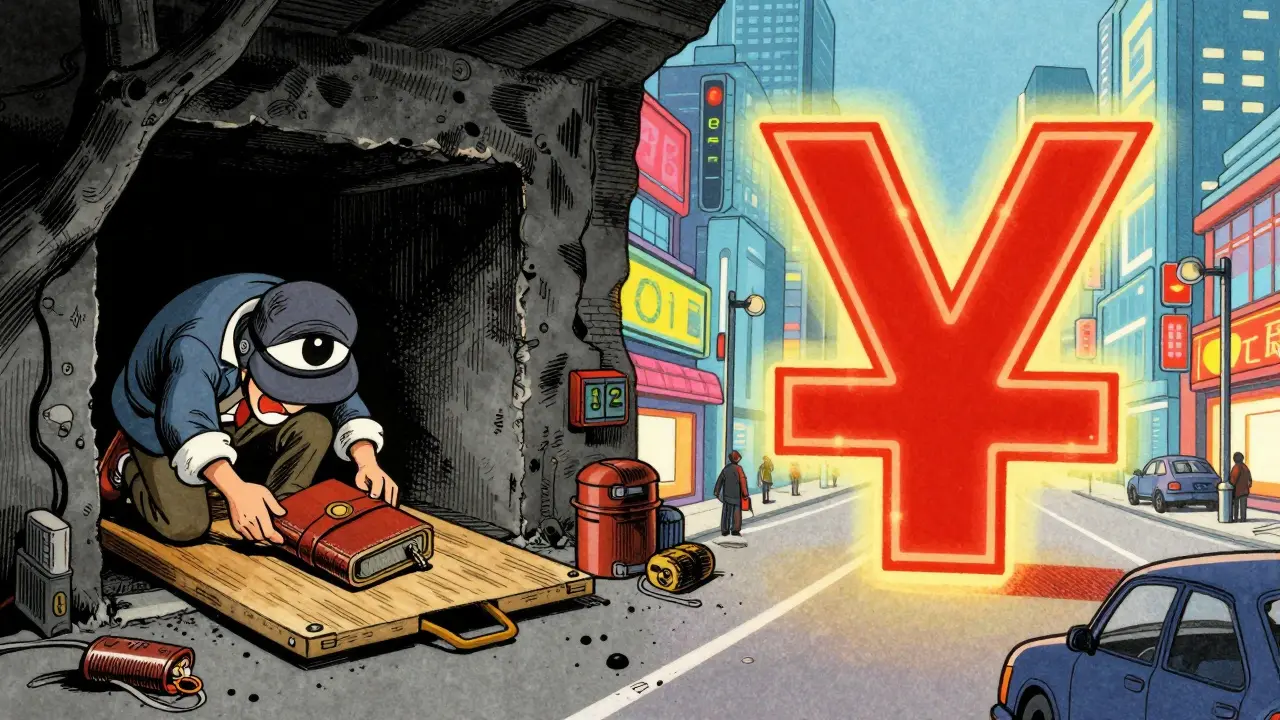
If you are holding crypto in China today, you are essentially operating in a shadow economy. The most immediate risk isn't necessarily a knock on the door from the authorities, but the total lack of a safety net. Because the legal framework doesn't recognize these assets, you have zero protection against scams. If a "guaranteed return" platform vanishes with your money, the courts will likely tell you that since the activity was illegal, you have no right to recover the loss.
Then there is the technical risk. Many users rely on VPNs to access international exchanges. While common, using these tools to bypass the Great Firewall for financial transactions adds another layer of legal vulnerability. You aren't just breaking a financial rule; you're circumventing national security infrastructure.
How to Navigate the Gray Area
For those who continue to hold assets, risk mitigation is about staying invisible and staying liquid. Avoiding any activity that looks like "fundraising" or "business operation" is the only way to stay out of the crosshairs. Using hardware wallets (cold storage) minimizes the risk of exchange hacks, though it doesn't solve the legal problem if the assets need to be converted to cash.
Keep a close eye on the Shanghai State-owned Assets Supervision and Administration Commission. Their hints about "softening" the stance on digital assets in late 2025 suggest that the government is still experimenting. They might not unban crypto, but they may create a highly regulated "sandbox" for certain types of digital assets that don't threaten the e-CNY.
Is it illegal to simply own Bitcoin in China?
It exists in a legal gray area. While the government has banned the trading and mining of crypto, they haven't consistently prosecuted individuals for the simple act of holding private keys. However, you have no legal protection if those assets are stolen or lost.
Can I use a foreign exchange via VPN?
Many people do, but it's risky. Not only is the exchange activity prohibited, but circumventing government internet restrictions can lead to administrative penalties. Furthermore, these platforms offer no legal recourse within China.
What happens if my bank account is frozen due to crypto trading?
This is a common occurrence with OTC trades. If the bank flags a transaction as related to virtual currencies, they may freeze your account for "illegal financial activities." Recovering the funds usually requires proving the source of the money, which is difficult if the source is crypto.
What is the difference between e-CNY and Cryptocurrency?
The e-CNY is a centralized digital version of the national currency, controlled entirely by the People's Bank of China. Cryptocurrency, like Bitcoin, is decentralized and operates on a public ledger without a central authority. The state supports the former and prohibits the latter.
Are foreigners in China allowed to use crypto?
No. The ban on cryptocurrency activities applies to everyone within Chinese borders, regardless of nationality. Any crypto-related transactions are considered illegal financial activities.
Rain Richardsson
April 26, 2026 AT 12:12Sounds like a total nightmare for the average person.
Iestyn Lloyd
April 28, 2026 AT 10:15The distinction between the underlying blockchain technology and the speculative assets is quite common in several jurisdictions, though rarely as starkly enforced as it is here. It's a pragmatic approach for a state prioritizing systemic stability over individual financial autonomy.
April D Thompson
April 30, 2026 AT 03:25Oh my god, can you even imagine the sheer terror of waking up and realizing your entire life savings are now a legal liability?? It's like some dystopian sci-fi novel come to life! We're talking about the fundamental erasure of ownership, just poof, gone because some bureaucrat changed their mind on a Friday afternoon. It's absolutely wild how they can just pivot the definition of property like that!
The psychological toll of living in that kind of constant uncertainty must be utterly draining. It's not just about the money, it's about the total lack of agency over your own digital existence. We really need to think about what happens to the concept of freedom when the state can just flip a switch on your assets. It's truly heartbreaking and terrifying all at once!
Kara Spadone
April 30, 2026 AT 08:51Typical. People think they found a shortcut to wealth and then act surprised when the universe balances the scales 🙄 it's all just an illusion of control anyway ✨
Arun Prabhu
May 1, 2026 AT 08:12The sheer audacity of these plebeians attempting to navigate a sophisticated financial apparatus while operating in a legal vacuum is almost comical. It is a pedestrian struggle, really, characterized by a lamentable lack of foresight and a quaint belief in decentralization as a panacea for state omnipotence. Truly a banal tragedy of the highest order.
Jehan ZA
May 3, 2026 AT 01:16The implementation of a Central Bank Digital Currency provides an interesting case study in governance and surveillance. One must acknowledge the efficiency of the e-CNY, provided one accepts the inherent loss of privacy.
Amanda Macy
May 4, 2026 AT 02:48The move toward CBDCs suggests that the state isn't fighting digital currency, but rather the loss of monopoly over the issuance of money.
Chloe Fletcher
May 4, 2026 AT 15:24Exactly! 👏 It's all about that control! Using a VPN just to check your balance is honestly so stressful 😱 stay safe everyone! 🛡️✨
Mitali Rajvanshi
May 4, 2026 AT 18:56It's a very difficult situation for those involved. The lack of a safety net makes the risk even higher.
Ralph Espinosa
May 5, 2026 AT 17:56Cold storage is definitely the way to go here!!! Just don't try to cash out through a local bank!!! That's where the real trouble starts!!!
Lex Harley
May 6, 2026 AT 00:37man those OTC trades are a total minefield... the KYC/AML flags on the fiat side r just brutal when the bank sees weird transfers. basic liquidity provison is basically a gamble at this point lol.
Tony Phan
May 6, 2026 AT 05:53I bet the slippage on those OTC deals is insane too! Totally kills the alpha if you're just trying to exit a position quickly. I've seen guys lose half their stack just trying to get it into a usable currency!
Veronica Bago
May 7, 2026 AT 01:30Wow, just a crazy situation all around. Glad I'm not dealing with that stress!