COREDAX Crypto Exchange Review: What You Need to Know in 2026
 Mar, 1 2026
When you're looking for a crypto exchange, especially if you're based in South Korea, COREDAX pops up in search results. But is it right for you? It’s not Binance. It’s not Coinbase. It doesn’t have hundreds of coins or support for credit cards. What it does have is a strong focus on compliance, a clean track record, and a design built for Korean users. If you’re outside Korea, it might not be the easiest fit. Let’s break it down - no fluff, just facts.
What COREDAX Actually Is
COREDAX is a cryptocurrency exchange founded in 2020 in South Korea. It wasn’t built to compete with global giants. Instead, it carved out a niche: serving Korean retail traders who want a platform that follows local laws, speaks their language, and handles their money the way they expect. Unlike many offshore exchanges that operate in legal gray zones, COREDAX is fully licensed under South Korea’s Virtual Asset User Protection Act, which kicked in July 2023. That means they’ve got to prove they hold your coins, keep your funds separate from their own, and run strict checks on who can use the platform.
They don’t advertise big numbers - no public user count, no daily trading volume. But industry reports from the Korea Blockchain Association show COREDAX handles about 6.2% of South Korea’s $3.2 billion daily crypto trading volume. That puts them as the fourth-largest exchange in the country, behind Upbit, Bithumb, and Korbit. They’re not the biggest, but they’re stable. And in a market where 51 exchanges shut down between 2021 and 2025 due to regulatory pressure, just being alive is a win.
What Coins Can You Trade?
COREDAX lists 47 cryptocurrencies as of September 2025. That’s not a lot compared to Binance’s 600+ or Coinbase’s 240+. But it’s not random. They focus on what matters in Korea: Bitcoin, Ethereum, Solana, and a handful of local blockchain projects like Klaytn and Aptos. If you’re into obscure memecoins or DeFi tokens from obscure chains, you won’t find them here. This isn’t a place for speculation on everything under the sun. It’s for people who want to trade the major coins, safely.
The selection is tight because of regulation. Korean law requires exchanges to vet every coin they list. They need legal clarity, audited teams, and clear use cases. That’s why COREDAX doesn’t carry hundreds of tokens - they’ve got to prove each one is safe. For most Korean users, that’s a feature, not a bug.
Fees and Deposit Options
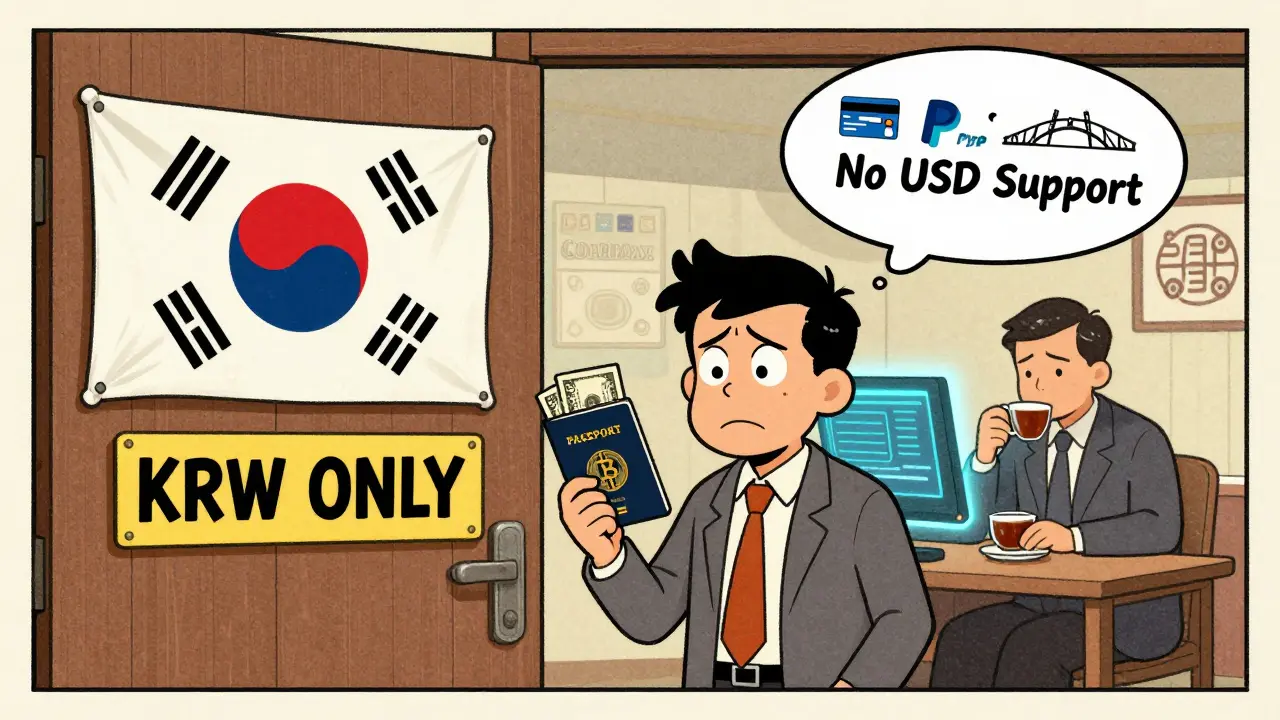
COREDAX doesn’t charge trading fees. That’s right - zero fees on buys and sells. It’s a common tactic in Korea, where exchanges make money from spreads and withdrawal fees instead. But here’s the catch: you can’t deposit with a credit card, PayPal, or even a digital wallet. The only way to put money in is via Korean Won (KRW) bank transfer. Minimum deposit? ₩50,000, or about $38 USD.
Withdrawals? Bitcoin withdrawals cost 0.001 BTC per transaction. That’s higher than Binance (0.0005 BTC) and Upbit (0.0004 BTC). For smaller traders, that adds up. If you’re moving $500 worth of BTC every few weeks, you’re paying roughly $30 a year in fees just to get your coins out. Not terrible, but not great either.
And here’s the big downside for international users: no other currencies. You can’t deposit USD, EUR, or JPY. If you’re outside Korea, you need to find a way to send KRW from your bank - which usually means using a third-party service or having a Korean bank account. Most people can’t do that. That’s why Nomura Financial Insights reported COREDAX has a 34% lower new user conversion rate than exchanges like Coinone that support multiple payment methods.
Platform and Mobile App Experience
COREDAX offers both a desktop platform and a mobile app. The desktop version works on Windows 10+ and macOS 11+. You need at least a 1366x768 screen. It’s clean, no flashy graphics, no clutter. The interface is designed for serious traders - charts, order books, depth maps. It’s not beginner-friendly, but it’s not overwhelming either. On the Crypto Usability Scale, it scores 6.2/10. That’s between Coinbase (4.1) and BitMEX (8.7). You’ll need to learn how to use it, but if you’ve traded before, you’ll get it fast.
The mobile app is on both iOS and Android. It’s rated 4.1/5 on Google Play with over 1,200 reviews. Users like the real-time alerts, biometric login, and push notifications for price changes. But there’s a recurring complaint: lag during market spikes. When Bitcoin surges 10% in 10 minutes, the app slows down. It doesn’t crash, but it stutters. That’s a problem if you’re trying to sell fast.
Documentation? Only in Korean. Core functions have basic English translations, but guides, tutorials, and help articles? Korean only. If you don’t read Korean, you’re on your own. Customer support is 24/7, but English support takes an average of 18.7 minutes to respond. Korean support? Under 3 minutes.
Security and Compliance
COREDAX has never had a public security breach. No hacks. No leaks. No reports of stolen funds. That’s rare. Most exchanges get hacked at least once. But here’s the thing: they don’t publish security audits. You can’t see their cold storage percentages or multi-sig setup. But you can infer.
Under Korean law, they must:
- Hold at least ₩3 billion ($2.3M USD) in capital
- Insure 90% of customer assets
- Perform regular proof-of-reserves audits
- Use segregated wallets for user funds
That’s more than most global exchanges do. Binance, for example, doesn’t legally require proof-of-reserves in most countries. COREDAX does. That’s why Trustpilot has zero English reviews - they don’t target international users. Their entire system is built around Korean regulation, and that’s their strength.
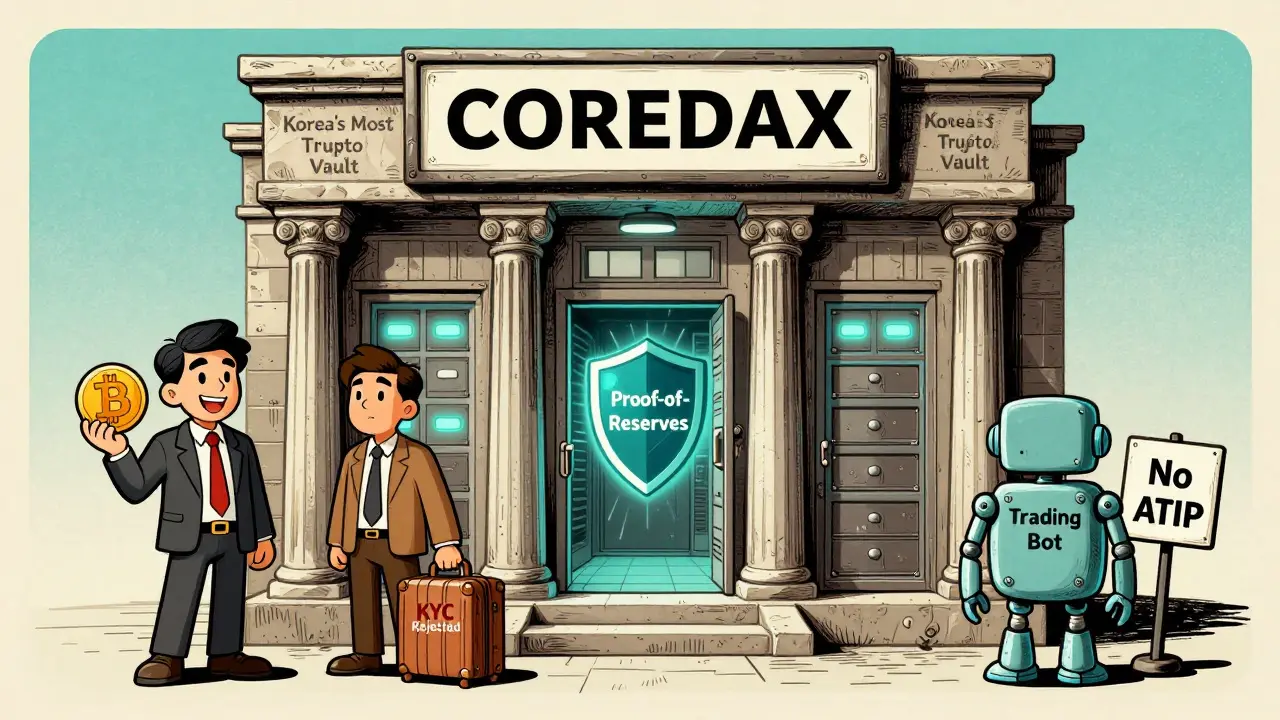
They also likely follow Cloud Security Alliance guidelines: cold storage for over 95% of assets, withdrawal whitelists, and IP restrictions. These aren’t advertised, but they’re required by law. If you’re worried about hacks, this is one of the safer places to keep your crypto - if you’re okay with the limits.
Who Is COREDAX For?
COREDAX isn’t for everyone. It’s for:
- Korean citizens with a resident registration number
- Foreigners living in Korea with a local bank account
- Traders who prioritize regulation over coin selection
- People who don’t need instant deposits or credit card funding
It’s not for:
- International users without Korean bank access
- Those who want 100+ altcoins
- People who need fast, one-click fiat deposits
- Developers looking for API access or trading bots
If you’re outside Korea and trying to sign up, you’ll hit walls. The KYC process requires notarized translations of passports. It takes 35-45 minutes just to get started. Many international applications get rejected because documents don’t match Korean format rules. Reddit users on r/CryptoKorea report a 12.7% rejection rate for non-Korean applicants.
The Bottom Line
COREDAX is a safe, regulated, no-frills exchange built for the Korean market. It’s not flashy. It doesn’t have the most coins. It won’t let you deposit with PayPal. But if you’re in Korea, it’s one of the most trustworthy platforms you can use. The lack of hacks, strict compliance, and local support make it a solid choice for retail traders who want to avoid offshore exchanges with sketchy records.
For everyone else? It’s a hard sell. The payment restrictions, language barrier, and limited coin list make it impractical. If you’re not in Korea, look elsewhere. If you are? COREDAX gives you peace of mind - and that’s worth something.
Is COREDAX safe to use?
Yes, COREDAX is considered one of the safer crypto exchanges in South Korea. It operates under strict government regulations, including mandatory proof-of-reserves, asset segregation, and insurance coverage for 90% of customer funds. There have been no public security breaches since its launch in 2020. While it doesn’t publish third-party audits, its compliance with Korea’s Virtual Asset User Protection Act means it follows industry-leading security standards like cold storage and multi-signature wallets.
Can I deposit USD or EUR on COREDAX?
No. COREDAX only accepts fiat deposits in Korean Won (KRW) via bank wire transfer. You cannot use USD, EUR, or any other currency. This makes it nearly impossible for users outside South Korea to fund their accounts unless they have a Korean bank account or use a third-party service to convert and send KRW.
Does COREDAX support credit card payments?
No. COREDAX does not accept credit cards, debit cards, PayPal, or any e-wallets. The only way to deposit fiat is through a Korean bank wire transfer. This is a major limitation compared to global exchanges like Coinbase or Kraken, which offer multiple funding options.
How many cryptocurrencies does COREDAX list?
As of September 2025, COREDAX lists 47 cryptocurrencies. The selection focuses on major assets like Bitcoin, Ethereum, and Solana, along with a few Korean blockchain projects like Klaytn and Aptos. It does not offer hundreds of altcoins like Binance or Coinbase, prioritizing regulatory compliance over variety.
Is COREDAX good for beginners?
It depends. If you’re a Korean speaker and familiar with trading interfaces, COREDAX is manageable. Its desktop platform is clean but not overly simple, scoring 6.2/10 on the Crypto Usability Scale. However, the lack of English documentation, complex KYC for foreigners, and absence of educational resources make it challenging for true beginners - especially those outside Korea.
What are the withdrawal fees on COREDAX?
COREDAX charges a fixed fee of 0.001 BTC for Bitcoin withdrawals. This is higher than competitors like Binance (0.0005 BTC) and Upbit (0.0004 BTC). For other cryptocurrencies, fees vary by asset but are generally in line with industry averages. There are no trading fees, but withdrawal fees can add up for frequent traders.
Does COREDAX have an API for trading bots?
There is no publicly available API documentation for COREDAX. Unlike exchanges like Kraken or Binance, COREDAX does not appear to support third-party trading bots or automated strategies. This limits its appeal to advanced traders who rely on algorithmic trading tools.
Can I use COREDAX if I’m not from Korea?
Technically, yes - but it’s very difficult. You need to provide a notarized translation of your passport and meet strict KYC requirements. Many international applications are rejected due to document format mismatches. Plus, without a Korean bank account, you can’t deposit fiat. For most non-Koreans, other exchanges will be far easier to use.
Lucy Simmonds
March 1, 2026 AT 21:27Samantha Stultz
March 2, 2026 AT 14:48Robert Conmy
March 3, 2026 AT 22:49Lilly Markou
March 4, 2026 AT 17:19McKenna Becker
March 5, 2026 AT 10:01Phillip Marson
March 6, 2026 AT 17:55Ryan Burk
March 7, 2026 AT 11:51Amanda Markwick
March 8, 2026 AT 15:58Tabitha Davis
March 9, 2026 AT 05:50Vishakha Singh
March 10, 2026 AT 08:28Don B.
March 11, 2026 AT 16:58Leslie Cox
March 13, 2026 AT 14:20Derek Sasser
March 14, 2026 AT 09:28Fiona Monroe
March 15, 2026 AT 09:44Molley Spencer
March 15, 2026 AT 22:42John Fuller
March 16, 2026 AT 23:42Maggie House
March 17, 2026 AT 17:48Dana Sikand
March 18, 2026 AT 19:40Cameron Pearce Macfarlane
March 20, 2026 AT 18:01Elizabeth Smith
March 22, 2026 AT 06:37Robert Kromberg
March 23, 2026 AT 01:30Daisy Boliaan
March 23, 2026 AT 20:59Nicki Casey
March 24, 2026 AT 06:53Samantha Stultz
March 24, 2026 AT 18:39McKenna Becker
March 26, 2026 AT 08:11