Crypto Tax Comparison: Rates by Country in 2025
 Feb, 13 2026
When you trade, sell, or even earn cryptocurrency, the government might be watching - and taxing. But here’s the thing: crypto tax rates aren’t the same everywhere. In one country, you could pay zero. In another, you could lose over half your profit. If you’re holding crypto across borders, or thinking about moving, this isn’t just a footnote - it’s a make-or-break detail.
Where crypto is completely tax-free
Twelve countries don’t tax cryptocurrency at all in 2025. That means whether you bought Bitcoin in 2020 and sold it last month, or earned Dogecoin from a staking reward, you keep every penny. These places aren’t just random outliers - they’ve built their economies around attracting crypto businesses and investors.- Brunei: No capital gains tax, no income tax. Crypto is treated like any other asset.
- Cyprus: Exempts crypto gains for individuals. Business activity is taxed separately.
- El Salvador: The only country that made Bitcoin legal tender. No tax on personal crypto transactions.
- Georgia: Zero tax on crypto sales if you’re not a business. Simple, clear, and investor-friendly.
- Hong Kong: Only taxes crypto if you’re trading like a business. Personal holdings? Tax-free.
- Malaysia: No capital gains tax. Mining and staking aren’t taxed unless you’re running a commercial operation.
- Oman: No income tax at all. Crypto gains fall under that same blanket.
- Panama: No capital gains tax. Non-residents pay nothing, even if they trade daily.
- Saudi Arabia: No personal income tax. Crypto profits are invisible to the taxman.
- Switzerland: Zero tax on private crypto holdings. Only business trading gets taxed.
- United Arab Emirates: No federal income tax. Dubai and Abu Dhabi are crypto hubs for this exact reason.
- Germany: Wait - this one’s tricky. Crypto held over one year? Tax-free. Sell within a year? Taxed like income. So it’s not fully tax-free - but it’s close for long-term holders.
These places aren’t just avoiding taxes - they’re betting on crypto as the future. If you’re looking to reduce your tax burden, residency matters more than your wallet.
Europe’s messy patchwork
Europe tries to act like a single market, but when it comes to crypto taxes, it’s a patchwork quilt. Some countries are strict. Others are relaxed. And a few? They’re actively trying to lure crypto investors.France has one of the toughest systems. They hit you with a flat 30% on crypto-to-fiat sales - that’s capital gains plus social charges. But here’s the twist: crypto-to-crypto trades (like swapping ETH for SOL) are tax-free. Mining, staking, and airdrops? Treated as income, taxed up to 45%. And if you forget to report? Fines can hit €750 per unreported wallet. They’re not messing around.
Germany is the opposite. If you hold crypto for more than a year, you walk away with 100% of your profit. Sell within a year? You pay income tax - up to 45%. That’s not a loophole. It’s a strategy. The government wants you to hold, not flip. And they enforce it: every transaction over €10,000 gets flagged to the Federal Central Tax Office.
United Kingdom uses a capital gains system. Basic-rate taxpayers pay 10%. Higher-rate? 20%. But here’s the catch: you get a £3,000 tax-free allowance in 2025. That means if you made £2,800 in crypto gains this year? You owe nothing. But if you made £5,000? You pay tax on £2,000. And you must report everything through Self-Assessment. Miss it? Penalties can reach 200% of what you didn’t pay.
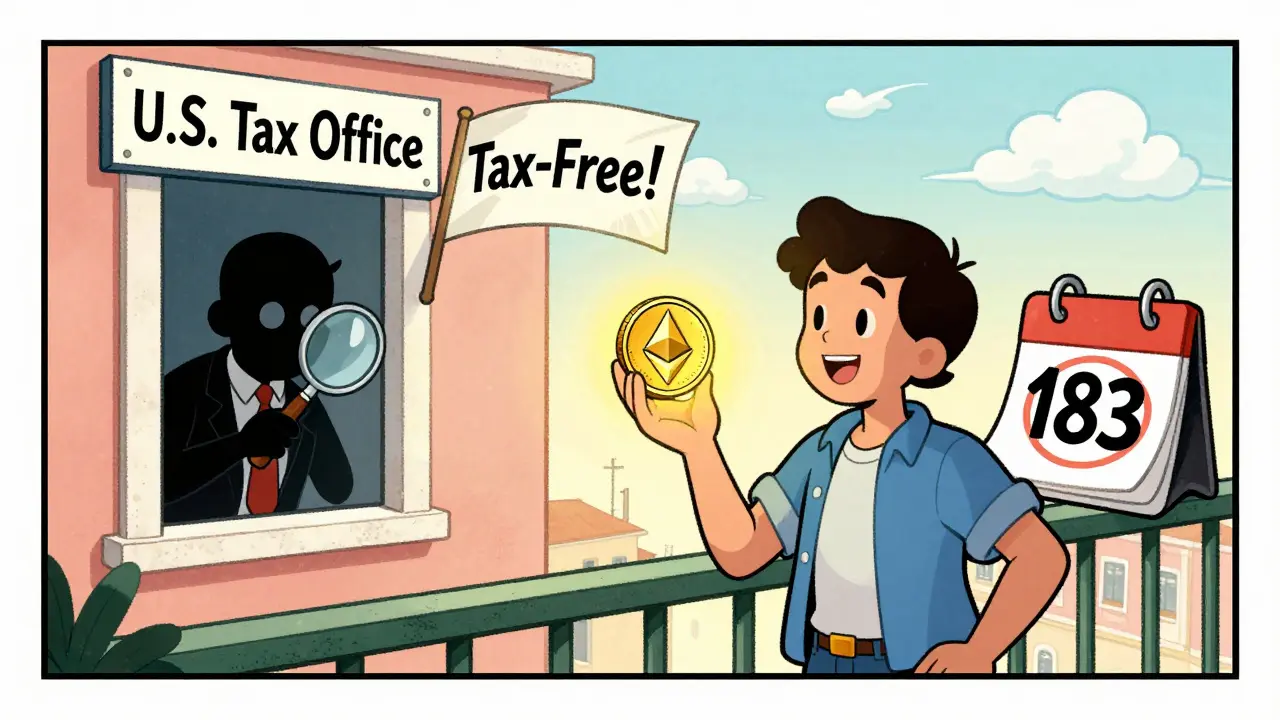
Portugal is a middle ground. If you hold crypto for over a year, no tax. Under a year? 28% tax on gains. But here’s the kicker: you have to be a tax resident - meaning you live there 183+ days a year. Non-residents? Zero tax. That’s why so many crypto investors set up temporary residency in Lisbon.
How the U.S. taxes crypto - and why it’s complicated
The U.S. doesn’t just tax crypto - it taxes it like cash. And it’s messy.Short-term gains (crypto held less than a year)? Taxed as ordinary income. That means if you’re in the 32% income tax bracket, your crypto profit gets hit at 32%. No breaks. No exceptions.
Long-term gains (held over a year)? That’s where it gets better. Rates drop to 0%, 15%, or 20%, depending on your total income. If you’re single and make under $47,025? Your crypto gains are tax-free. That’s a real incentive to hold.
But here’s what most people miss: earning crypto is taxed differently. If you get paid in Bitcoin for freelance work? That’s income. If you mine Ethereum? That’s income. If you get an airdrop? That’s income. All taxed at your full income rate - even if you never sold a single coin.
The IRS tracks this. Exchanges report to them. And if you didn’t report $10,000 in mining income? You’re looking at audits, penalties, and interest. The U.S. system doesn’t care if you’re a beginner. It cares if you made money.
What about staking, mining, and airdrops?
These aren’t just technical terms - they’re tax events. And every country treats them differently.- Staking rewards: In the U.S., France, and the UK, they’re taxed as income when you receive them. In Germany? Only if you’re trading actively. In Switzerland? Tax-free if you’re not a business.
- Mining: Treated as business income in most places. That means expenses (like electricity and hardware) can be deducted - if you report them. In Malaysia and Hong Kong? No tax unless you’re running a mining operation as a company.
- Airdrops: In the U.S., you pay tax on the fair market value the day you receive them. In Portugal? Only if you sell within a year. In UAE? Nothing. Ever.
Here’s the brutal truth: if you don’t track when you received crypto - even if you didn’t sell it - you’re at risk. The tax isn’t on what you sell. It’s on what you earn.
Residency rules matter more than you think
You can’t just “live in crypto” and ignore taxes. Countries define who owes tax based on residency - not citizenship.Most countries consider you a tax resident if you live there 183 days or more in a year. That’s why people move to Portugal, Dubai, or Georgia. You don’t need to be a citizen. You just need to be present.
Non-residents? Usually exempt. If you’re a U.S. citizen living in Dubai, the U.S. still taxes you - but Dubai doesn’t. If you’re a German citizen living in Malaysia? Malaysia doesn’t tax you. Germany might, but only if you’re still considered a resident there.
And here’s the sneaky part: some countries (like Switzerland and the UAE) don’t even ask for your global income. They only tax what you earn within their borders. So if you’re trading crypto from abroad? They don’t care.
What you should do right now
Don’t wait for an audit. Don’t hope you’ll “get lucky.” Here’s what to do:- Track every transaction. Buy, sell, swap, stake, earn - record the date, value in USD, and wallet address.
- Know your residency. Where do you live 183+ days? That’s where your tax obligation likely lies.
- Check holding periods. In Germany, Portugal, and Switzerland, holding over a year can erase your tax bill.
- Separate personal from business. If you’re mining or trading daily, you might be running a business - and that changes everything.
- Use crypto tax software. Tools like Koinly or CoinTracker auto-import exchange data and calculate gains. They’re not perfect - but they’re better than spreadsheets.
There’s no global crypto tax law. There’s no single rule. But there is a pattern: countries that want your money tax it hard. Countries that want your business let you keep it.
Which countries have the lowest crypto tax rates in 2025?
The lowest rates are in zero-tax countries like the UAE, Portugal (for long-term holds), Switzerland, and Georgia. Portugal charges 28% on short-term gains but nothing after one year. Switzerland and the UAE charge 0% on private crypto investments. Germany also offers 0% if you hold for over a year. For most people, Portugal and Switzerland offer the best balance of low tax and legal clarity.
Do I have to pay tax if I never sell my crypto?
Yes - in some cases. If you earn crypto through staking, mining, or airdrops, most countries tax that as income the moment you receive it. The U.S., UK, and France all treat earned crypto as taxable income, even if you never sell. Only countries like the UAE and El Salvador don’t tax it at all - even then, you still need to prove you’re not a business. Selling isn’t the only trigger.
Can I avoid crypto tax by moving to a tax-free country?
Yes - but only if you become a tax resident. Simply owning property or visiting doesn’t count. Most countries require you to live there 183+ days per year. And even then, your home country might still tax you (like the U.S. or Australia). You need to cut ties: close bank accounts, move your primary residence, and prove you’re no longer a resident. It’s not just about location - it’s about legal status.
Why does Germany tax crypto after one year but not before?
Germany doesn’t. It’s the opposite: crypto held over one year is tax-free. If you sell within a year, it’s taxed as income. The government wants to discourage day trading and encourage long-term holding. It’s a policy designed to reduce speculative activity. That’s why Germans often hold crypto for 13+ months before selling - it’s not a loophole, it’s a rule.
Are crypto-to-crypto trades taxable?
In most countries, yes - they’re treated as a sale. Swapping BTC for ETH is seen as selling BTC and buying ETH. That triggers a taxable event. France, the U.S., and the UK all tax these trades. But Germany and Portugal don’t - if you hold the original asset for over a year. And in Hong Kong and Malaysia? Only if you’re trading like a business. Always check your country’s rules - this is one of the most misunderstood areas.
Sanchita Nahar
February 14, 2026 AT 16:39bala murali
February 14, 2026 AT 22:44Desiree Foo
February 16, 2026 AT 22:38Elijah Young
February 18, 2026 AT 10:48Donna Patters
February 20, 2026 AT 04:25Holly Perkins
February 21, 2026 AT 15:59Will Lum
February 21, 2026 AT 22:34Ben Pintilie
February 21, 2026 AT 23:54Sakshi Arora
February 22, 2026 AT 14:22Ekaterina Sergeevna
February 23, 2026 AT 07:37SAKTHIVEL A
February 24, 2026 AT 02:54Santosh kumar
February 25, 2026 AT 12:32Claire Sannen
February 27, 2026 AT 11:47Christopher Wardle
March 1, 2026 AT 01:08blake blackner
March 1, 2026 AT 11:29Jeremy Lim
March 2, 2026 AT 04:03kelvin joseph-kanyin
March 2, 2026 AT 18:38Benjamin Andrew
March 3, 2026 AT 15:26Michelle Cochran
March 5, 2026 AT 07:00monique mannino
March 5, 2026 AT 10:03