EU Privacy Coin Ban 2027: What Monero and Zcash Holders Need to Know
 May, 6 2026
The clock is ticking for anyone who relies on financial anonymity in Europe. By July 1, 2027, the European Union will effectively shut the door on privacy coins like Monero (XMR) and Zcash (ZEC) within its borders. This isn't a rumor or a vague threat from a distant committee; it is a finalized law embedded in Regulation 2024/1624. For millions of users, this means the era of easy, untraceable transactions on regulated platforms is coming to an abrupt end.
If you hold these assets or plan to use them, you need to understand exactly what changes, when they hit, and how you can still access your funds without breaking the law. The landscape is shifting from open permissionless finance to a tightly controlled compliance model, and ignoring it could leave your digital assets stranded.
The New Legal Reality: Article 79 Explained
At the heart of this crackdown is Article 79 of the EU's Anti-Money Laundering Regulation (AMLR). This specific clause acts as a kill switch for anonymity-enhancing technologies in the hands of licensed service providers. It explicitly prohibits credit institutions, financial firms, and Crypto-Asset Service Providers (CASPs) from maintaining anonymous accounts or handling privacy-preserving digital assets.
In plain English, if you want to buy, sell, or trade Monero or Zcash using a platform that operates legally in the EU-like Binance EU, Coinbase, or any local exchange-you won't be able to after mid-2027. These companies are now required to verify identities for all crypto transfers above €1,000. They must maintain a clear audit trail. Privacy coins, by design, hide the sender, receiver, and amount. You cannot have both total transparency and total privacy. Regulators have chosen transparency.
This rule doesn't just affect exchanges. It covers wallets, custodians, and any intermediary that facilitates transactions. The goal is to eliminate what regulators call "tools that facilitate illicit financial activities." While the intent is to stop money laundering and terrorist financing, the collateral damage is the removal of financial privacy tools from the mainstream market.
Why Monero and Zcash Are Targeted
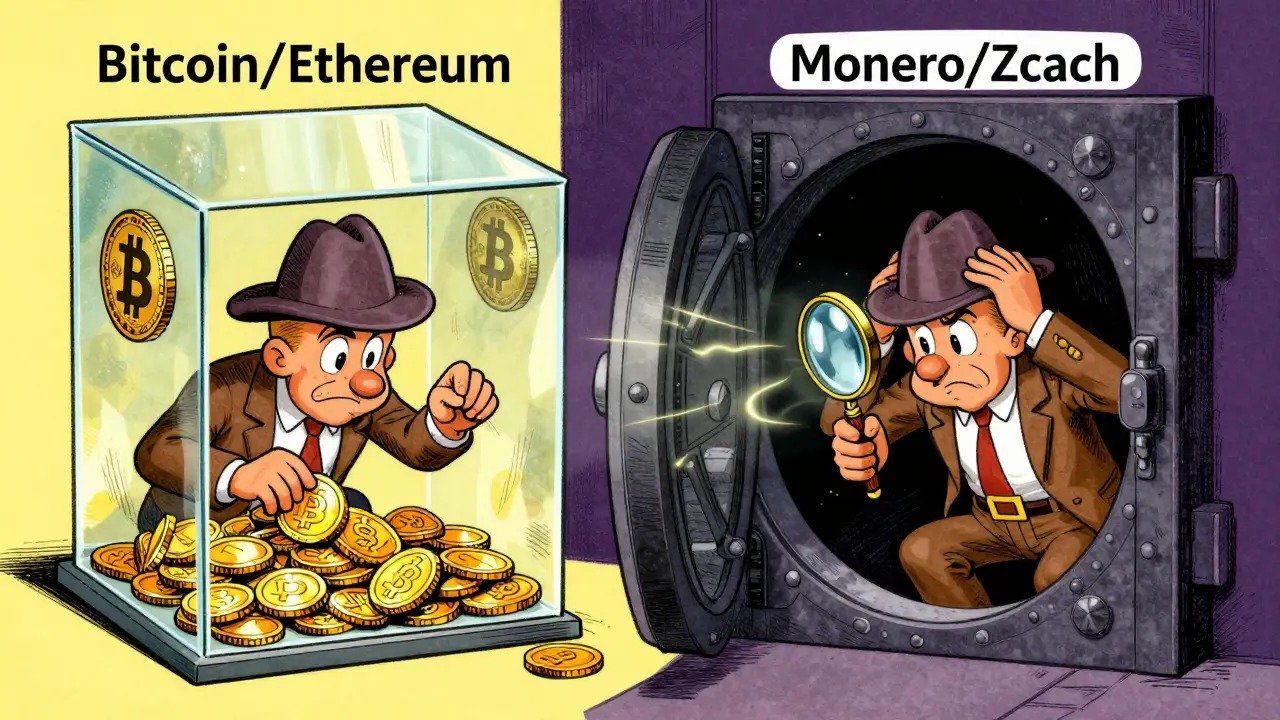
To understand why this ban is so absolute, you have to look at how these coins work compared to standard cryptocurrencies like Bitcoin or Ethereum.
Monero uses ring signatures and stealth addresses. When you send XMR, the network mixes your transaction with others, making it impossible to trace where the funds came from or where they went. Zcash uses zero-knowledge proofs (specifically zk-SNARKs) to allow "shielded" transactions. In a shielded transfer, the blockchain records that a transaction happened, but hides the details entirely.
For traditional banks and anti-money laundering agencies, this is a nightmare. They rely on chain analysis software to track suspicious flows. With transparent coins, they can see every step. With privacy coins, the chain goes dark. The European Crypto Initiative (EUCI) has noted that these features make it "difficult to identify related transactions that might give rise to suspicion." In the eyes of the EU, this difficulty is not a feature; it is a critical security flaw.
| Coin Type | Privacy Mechanism | Traceability | Status on EU Regulated Platforms (Post-July 2027) |
|---|---|---|---|
| Bitcoin (BTC) | Pseudonymous (Public Ledger) | Fully Traceable | Allowed |
| Ethereum (ETH) | Pseudonymous (Smart Contracts) | Fully Traceable | Allowed |
| Monero (XMR) | Ring Signatures / Stealth Addresses | Untraceable | Banned |
| Zcash (ZEC) | Zero-Knowledge Proofs (Shielded) | Selectively Private | Banned |
Who Enforces the Ban? Enter AMLA
A law is only as good as its enforcement. To ensure no loopholes remain, the EU has established the Anti-Money Laundering Authority (AMLA). This new supervisory body will oversee the largest crypto firms in the bloc. If a company serves tens of thousands of customers or processes over €50 million in transactions, AMLA will be watching closely.
Initially, AMLA will target about 40 major firms. These are the giants-the ones most people actually use. The European Banking Authority (EBA) is currently translating the broad framework into specific enforceable standards. As of May 2025, the core prohibition is locked in. While technical details are still being refined through public consultations, the ban on privacy coins itself is not up for debate. The EUCI has published an AML Handbook to help firms comply, signaling that resistance is futile. Companies must adapt their internal policies to exclude privacy coins before the deadline.
Does This Mean You Can't Own Privacy Coins?
This is the most common misconception, and it’s crucial to get right. **The ban does not criminalize individual possession.**
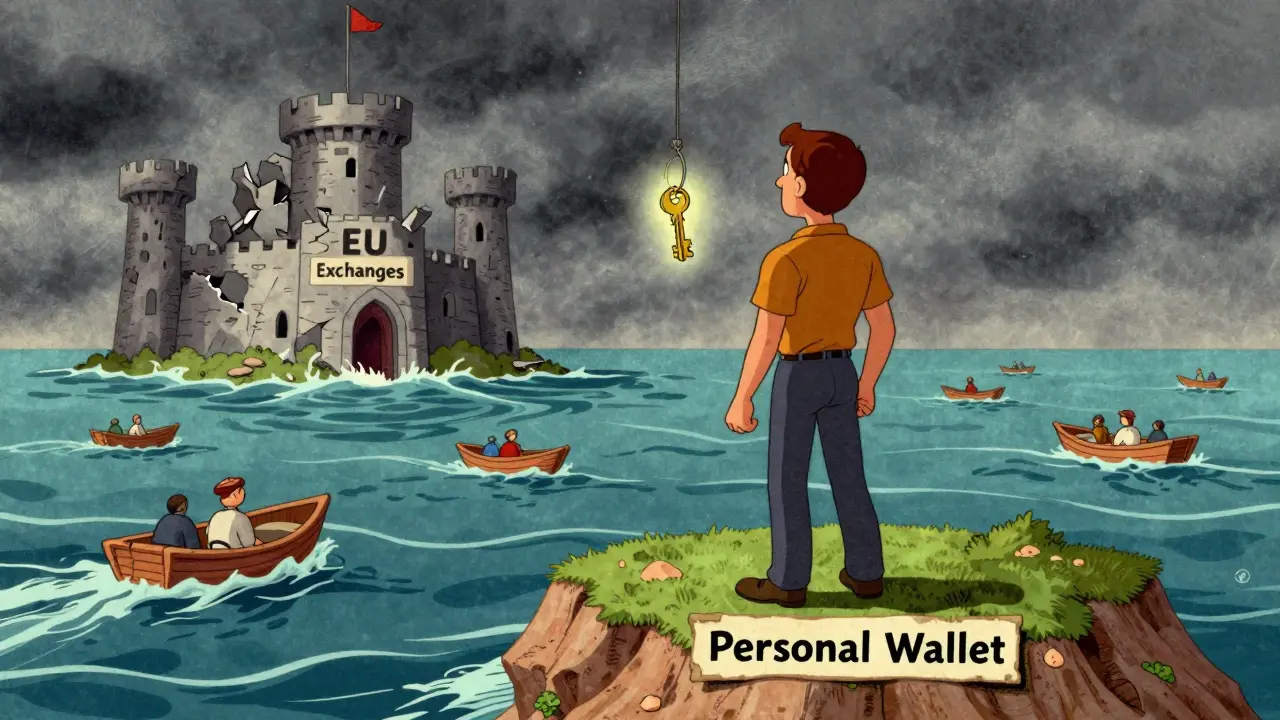
You are not going to jail for holding Monero or Zcash in your own wallet. The law targets service providers, not individuals. If you bought XMR two years ago and kept it in a non-custodial wallet (like a hardware wallet or a private software wallet), you can still hold it. You can even send it to another person directly, peer-to-peer, without using an exchange.
However, getting fiat currency (Euros, Dollars) onto or off of those coins becomes incredibly difficult. You cannot deposit Euros into a regulated exchange to buy XMR. You cannot sell your XMR for Euros on a regulated platform. You are cut off from the traditional banking system for these specific assets. This creates a "liquidity trap" where your assets may lose value simply because fewer people can easily buy or sell them within the legal framework.
Workarounds and Regulatory Arbitrage
So, how do privacy advocates plan to survive this? The answer lies in regulatory arbitrage. Since the ban applies to EU-based entities, activity will likely shift to jurisdictions outside EU control.
- Non-EU Exchanges: Users may turn to platforms based in countries with looser regulations, such as certain offshore jurisdictions or nations that have not adopted similar AML rules. However, these platforms often carry higher risks of fraud or sudden shutdowns.
- Decentralized Exchanges (DEXs): Protocols that operate without a central intermediary are harder to ban. Swapping assets directly on-chain via a DEX remains technically possible. But here’s the catch: you still need to bridge fiat to crypto. Getting Euros into the system usually requires a compliant entry point, which brings us back to square one.
- Peer-to-Peer (P2P) Networks: Direct trades between individuals, facilitated by escrow services that don’t store user data, may see a resurgence. This mirrors the early days of Bitcoin trading before centralized exchanges dominated.
Keep in mind that while these methods exist, they come with significant friction. You lose the convenience, customer support, and insurance protections that regulated exchanges offer. You also face higher scrutiny if you ever try to convert large amounts back to fiat through informal channels.
Market Impact and Future Outlook
The psychological impact on the market has already begun. Traders anticipate volatility as the July 2027 deadline approaches. Institutional investors, who require strict compliance, are likely to exit privacy coin positions entirely. This could lead to a long-term decline in liquidity and price stability for XMR and ZEC within European markets.
However, demand for privacy does not disappear just because regulators ban it. There is a growing segment of users who view financial privacy as a fundamental human right, not a tool for crime. For them, the ban reinforces the value proposition of these coins. They become scarce, niche assets rather than mainstream commodities.
Looking globally, the EU’s move sets a powerful precedent. Other major economies, including potentially the US or UK, may follow suit. If the world’s largest financial blocs align against privacy coins, the global ecosystem will fragment. We may see a split between "compliant crypto" (transparent, regulated) and "sovereign crypto" (private, decentralized). Understanding where you stand in this divide is essential for your long-term strategy.
What Should You Do Now?
If you are an EU resident holding privacy coins, take stock of your situation immediately. Here is a practical checklist:
- Audit Your Holdings: Determine how much XMR or ZEC you hold and where it is stored. Is it on an exchange or in a private wallet?
- Move Off Exchanges: If your coins are on a centralized exchange, withdraw them to a self-custody solution. Once the ban hits, exchanges may freeze withdrawals or delist pairs, leaving you unable to access your funds.
- Secure Your Keys: Ensure you have backed up your seed phrases securely. Without access to your private keys, your assets are lost forever.
- Consider Liquidity Needs: Ask yourself if you need to convert these assets to fiat soon. If yes, do it before the regulatory pressure tightens further. Selling later may involve complex, high-cost P2P arrangements.
- Stay Informed: Watch for updates from the European Banking Authority regarding final implementation guidelines. Small details in enforcement can change the risk profile significantly.
The window for easy adjustment is closing. The next two years are not just a waiting period; they are a preparation phase. Adapt now, or find yourself scrambling later.
Will I go to jail for owning Monero or Zcash in the EU?
No. The ban targets service providers (exchanges, banks, wallets), not individual holders. Possessing privacy coins is not illegal. However, you cannot use regulated EU platforms to buy, sell, or trade them after July 1, 2027.
Can I still buy Monero with Euros after 2027?
Not through regulated EU exchanges. You would need to use non-EU platforms, decentralized exchanges (DEXs), or peer-to-peer networks. These options often lack buyer protection and may pose higher security risks.
What happens to my Monero if it's on a European exchange?
Exchanges will likely delist privacy coins before the deadline. You should withdraw your assets to a personal wallet immediately. If you fail to do so, you may lose access to your funds or face difficulties converting them back to fiat.
Why did the EU decide to ban privacy coins?
Regulators argue that privacy coins facilitate money laundering and terrorist financing by hiding transaction details. They believe that financial transparency is necessary to protect the integrity of the EU's financial system, and that privacy features conflict with anti-money laundering (AML) requirements.
Is this ban permanent?
As of 2026, the ban is part of finalized legislation (Regulation 2024/1624). Reversing it would require significant political effort and legislative change. While laws can evolve, the current trajectory strongly favors continued restriction of anonymity-enhancing coins in the EU.
How does this affect the price of Monero and Zcash?
The ban removes institutional buyers and easy retail access within the EU, which could reduce liquidity and downward pressure on prices. However, scarcity and increased demand from privacy-focused users outside the EU could support or increase values. Volatility is expected as the deadline approaches.
What is AMLA and why does it matter?
AMLA (Anti-Money Laundering Authority) is the new EU body responsible for enforcing these rules. It will monitor large crypto firms to ensure they comply with the ban on privacy coins. Its existence ensures that the ban is not just theoretical but actively enforced across the bloc.