FATF Travel Rule Implementation for Crypto Worldwide: What You Need to Know in 2026
 Mar, 2 2026
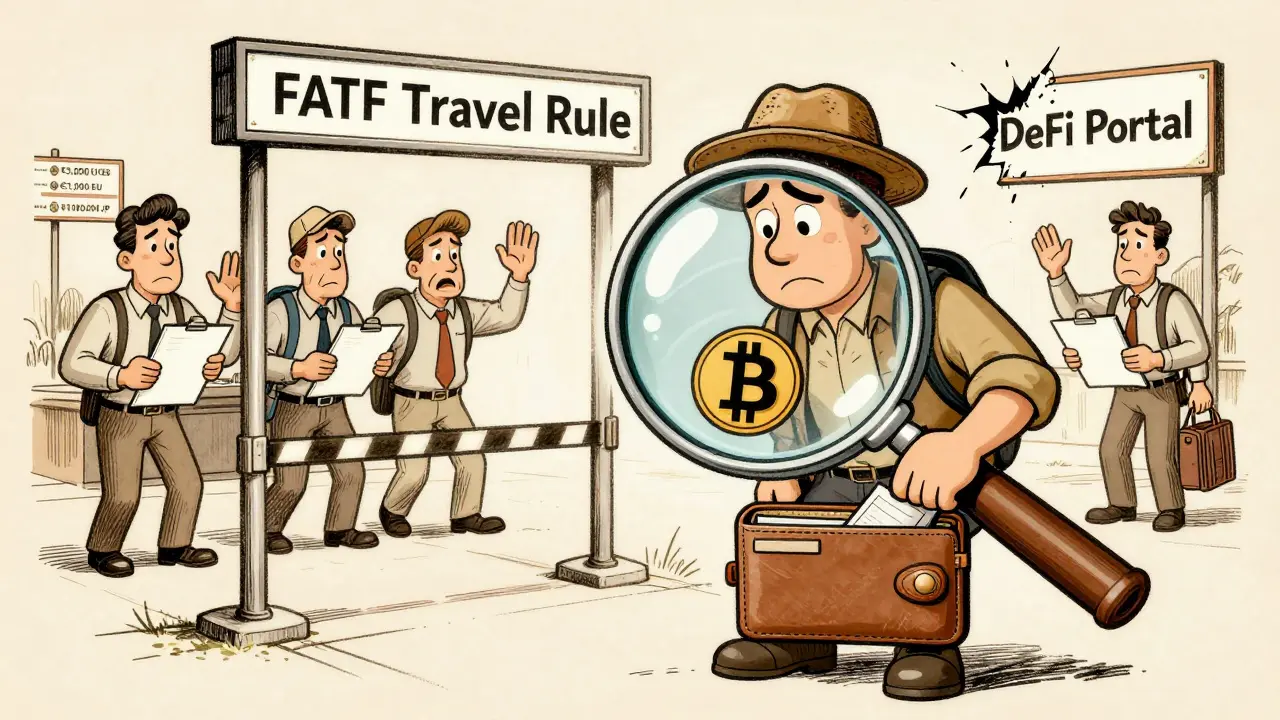
The FATF Travel Rule isn’t just another regulation. It’s reshaping how crypto moves across borders - and who gets left behind. If you’ve ever sent Bitcoin to a friend overseas or used a crypto exchange to pay for a flight, you’ve already felt its impact. As of 2026, nearly every major economy enforces this rule. But how it works, who it affects, and what it actually does behind the scenes? That’s where things get messy.
What the FATF Travel Rule Actually Does
The Financial Action Task Force (FATF) didn’t invent this idea. Back in the 1990s, banks had to share sender and receiver details for wire transfers over $3,000. That was to stop money laundering. In 2019, they said: same rules apply to crypto. Now, if you send more than a certain amount - say, $3,000 in the U.S. or €1,000 in the EU - the exchange you’re using must collect and send your personal info to the receiving exchange.
This isn’t optional. It’s law. The data includes:
- Your full name
- Your account number or wallet ID
- Your physical address or date of birth
- The recipient’s name and account number
No one’s asking for your Social Security number or passport. But they do need enough to tie a transaction to a real person. The goal? Stop criminals from using crypto to hide money. The side effect? Legit users now face extra steps.
Global Patchwork: No Two Countries Do It the Same
Here’s the truth: there’s no global standard. Just a bunch of rules that mostly match - but not always.
In the European Union, the rule kicked in fully in June 2024 under MiCA. Every member state uses the same threshold: €1,000. That’s about $1,080 USD. It’s clean. It’s consistent. Exchanges like Kraken and Bitpanda built their systems around it.
In the United States, it’s chaos. FinCEN says $3,000. But some states like New York have their own rules. And with Executive Order 14712 in January 2025, federal agencies now coordinate digital asset oversight - but enforcement still varies. A U.S. exchange might let you send $2,900 without a hitch. Send $3,001? Suddenly, you’re filling out forms.
Japan? ¥100,000 threshold - roughly $700. South Korea? Real-time monitoring. Australia? AUD 1,000. Singapore? Risk-based, so it depends on your history. And in countries like Nigeria or Vietnam? The rule exists on paper, but enforcement is patchy at best.
This mismatch creates real problems. Imagine sending ETH from Coinbase (U.S.) to Binance (Singapore). Coinbase says: “We need your address.” Binance says: “We only need your wallet ID.” The transaction stalls. You call support. It takes three days. This isn’t rare. It’s routine.
Who’s Getting Hit the Hardest?
Big exchanges? They’ve paid the price. Chainalysis, Notabene, and Sumsub now handle over 70% of the compliance tech market. A medium-sized exchange spends an average of $487,000 to get compliant - and $183,000 every year after just to keep up. That’s why smaller platforms are vanishing. CryptoBridge, a once-popular exchange, now has a 2.1/5 rating on Trustpilot. Why? 78% of negative reviews mention “Travel Rule delays.”
DeFi users? They’re stuck. The FATF’s June 2025 update said decentralized protocols can be classified as VASPs if they handle transfers. That’s a bombshell. Platforms like Uniswap or Curve aren’t companies. They’re code. But now, if you use them to send $1,500 in USDC, regulators say: “Who’s the sender? Who’s the receiver?” No one has a clear answer yet.
And then there’s privacy. Dr. Richard Turrin, a privacy researcher, put it bluntly in March 2025: “68% of small transactions below thresholds are still being tracked anyway.” Why? Because some exchanges collect data on all transfers - just in case. That’s not compliance. That’s overreach.

What’s Working? Real User Experiences
Not everyone hates it.
On Reddit, u/CryptoTraveler89 wrote: “Used Travala to book a trip to Bali with Bitcoin in August 2025 - no extra steps. Felt safer.” Travala, a travel platform that accepts crypto, now has a 37% higher trust score among users who’ve used compliant services, according to Blockchain Market Insights. Why? Because when your payment clears instantly and you know it’s traceable, you’re less afraid of scams.
Kraken, with 4.3 stars from over 1,200 reviews, gets constant praise for “smooth international transfers.” Users say: “I don’t mind the extra step if it means my money doesn’t vanish.” That’s the trade-off: convenience for security.
Meanwhile, enterprise adoption is surging. 83 of the Fortune 100 companies now hold crypto as part of their treasury - all compliant. Why? Because banks won’t touch non-compliant assets. If you’re a CFO and your crypto wallet triggers a red flag, your bank freezes your account. Compliance isn’t optional anymore. It’s survival.
The Tech Behind the Scenes
Behind every smooth transaction is a system you never see. The Travel Rule Protocol (TRP) is now used by 63% of compliant exchanges. It’s an open standard that lets platforms talk to each other without custom code. Before TRP, every exchange had its own way of sending data. Now, it’s plug-and-play.
But here’s the kicker: modern systems add just 0.8 seconds to a transaction. In 2022? It was 4.2 seconds. That’s barely noticeable. You don’t feel it. But your money is being checked.
And it’s getting smarter. Zero-knowledge proofs - a type of cryptography that proves you’re compliant without revealing your data - are being tested. By 2027, Gartner predicts 95% of major crypto transactions will use privacy-preserving compliance. That means: you’re still traceable to regulators - but no one else sees your info.
What’s Coming Next?
FATF has three major reports coming:
- Stablecoins - October 15, 2025
- Offshore VASPs - February 12, 2026
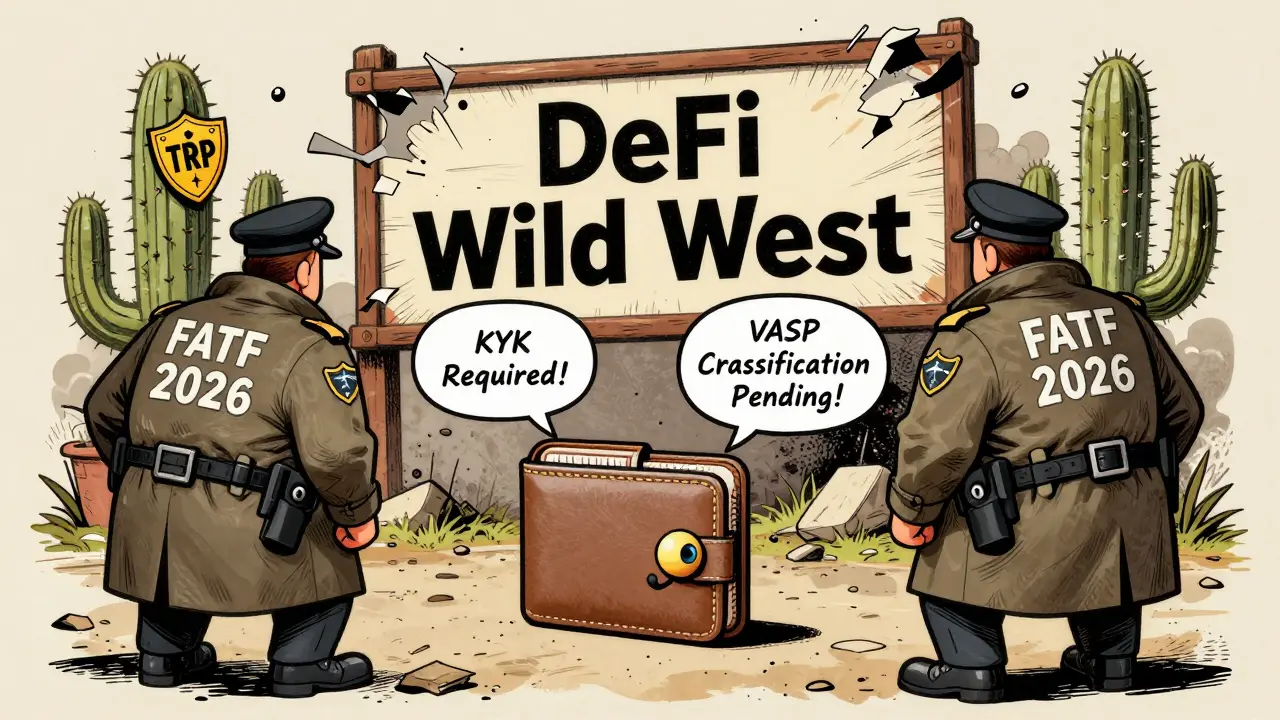
- DeFi - June 20, 2026
Stablecoins are the next frontier. USDT and USDC make up over 60% of crypto volume. If they’re fully covered, every dollar sent will be tracked. That’s huge.
Offshore VASPs? Think exchanges based in the Cayman Islands or Panama that serve global users. FATF says: “If you’re serving EU or U.S. customers, you’re under our rule.” That’s going to shut down a lot of loopholes.
And DeFi? It’s still the wild west. But by 2027, regulators expect every wallet to be identifiable - even if it’s a smart contract. That could mean mandatory KYC for interacting with DeFi apps. No more anonymous swaps.
What Should You Do?
If you’re a regular user:
- Use a major exchange. They’ve spent millions to make this seamless.
- Keep your ID and address info updated. One missing digit can freeze a transfer.
- Don’t try to bypass it. Sending crypto through a non-compliant service risks losing funds - or worse, getting flagged.
If you’re a business:
- Don’t wait. Compliance isn’t a cost. It’s a license to operate.
- Use TRP-compliant tools. They’re cheaper and faster than building your own.
- Train your team. The Chainalysis AML certification has a 92% pass rate - and it’s worth it.
The Travel Rule isn’t going away. It’s getting tighter. And it’s not just about stopping crime. It’s about making crypto look and act like real finance. Because if it doesn’t, banks will keep saying no.
Is the FATF Travel Rule mandatory for all crypto transactions?
No. It only applies to transactions above jurisdiction-specific thresholds - $3,000 in the U.S., €1,000 in the EU, ¥100,000 in Japan, etc. Below those amounts, most exchanges don’t require full data sharing. But some still collect more than required, which has sparked privacy concerns.
What happens if I send crypto from a non-compliant exchange?
Your transaction may be blocked. Many compliant exchanges refuse incoming transfers from non-compliant platforms. You might also face delays while customer support investigates. In extreme cases, funds could be frozen if regulators flag the sender or receiver as high-risk.
Does the Travel Rule apply to DeFi wallets like MetaMask?
Not directly - yet. But if you interact with a DeFi protocol that’s classified as a VASP (like a lending platform that handles transfers), you may be required to complete KYC. FATF’s June 2025 update says decentralized apps can be treated as VASPs under certain conditions. This is still evolving.
Can I avoid the Travel Rule by using privacy coins like Monero?
Technically, yes - but practically, no. Most major exchanges have banned privacy coins entirely. Even if you find a platform that accepts them, sending them to a compliant exchange will trigger a freeze or investigation. Regulators view privacy coins as high-risk, and compliance systems are built to flag them.
How much does it cost for a crypto company to comply with the Travel Rule?
For a medium-sized exchange processing $50-500 million monthly, implementation costs around $487,000 upfront, with $183,000 per year in ongoing maintenance. Smaller platforms often can’t afford this - which is why many have shut down or merged since 2023.
Are there any countries not enforcing the Travel Rule?
Yes - but they’re shrinking. As of 2026, only about 2% of global crypto volume comes from jurisdictions with no enforcement. Most of these are small islands or nations with weak regulatory systems. FATF is targeting 100% implementation among major markets by 2027, and pressure is mounting on holdouts.
Ryan Burk
March 2, 2026 AT 07:46Michael Teague
March 3, 2026 AT 03:49Cameron Pearce Macfarlane
March 3, 2026 AT 10:19Sriharsha Majety
March 3, 2026 AT 15:14Dana Sikand
March 3, 2026 AT 23:46Michelle Xu
March 4, 2026 AT 23:31Tabitha Davis
March 5, 2026 AT 05:49Lucy Simmonds
March 5, 2026 AT 05:55Cathy Sunshine
March 6, 2026 AT 10:00Shannon Holliday
March 7, 2026 AT 02:37kati simpson
March 7, 2026 AT 06:33Maggie House
March 7, 2026 AT 20:59John Fuller
March 9, 2026 AT 12:07Richard Cooper
March 9, 2026 AT 17:40Kenneth Genodiala
March 11, 2026 AT 03:13Danny Kim
March 12, 2026 AT 16:55Mary Scott
March 13, 2026 AT 02:08Elizabeth Smith
March 13, 2026 AT 04:56Shannon Black
March 14, 2026 AT 09:38Dee Resin
March 14, 2026 AT 15:42Michael Rozputniy
March 16, 2026 AT 12:06Ifeanyi Uche
March 16, 2026 AT 21:43Robert Kromberg
March 18, 2026 AT 02:44Cory Derby
March 18, 2026 AT 07:20Jeremy buttoncollector
March 18, 2026 AT 16:32