Future Sybil Attack Prevention Methods in Blockchain Networks
 Mar, 28 2026
In the early days of blockchain, security felt like a shield built of unbreakable math. Fast forward to March 2026, and the landscape has shifted dramatically. Last year alone, DeFi protocols hemorrhaged millions to bots farming airdrops, while legitimate users struggled to verify their presence on-chain. We aren't just talking about theoretical risks anymore. According to Chainalysis' 2024 Crypto Crime Report, Sybil attacks accounted for 37% of all blockchain security incidents. That number hits hard when you consider how much trust we place in distributed ledgers.
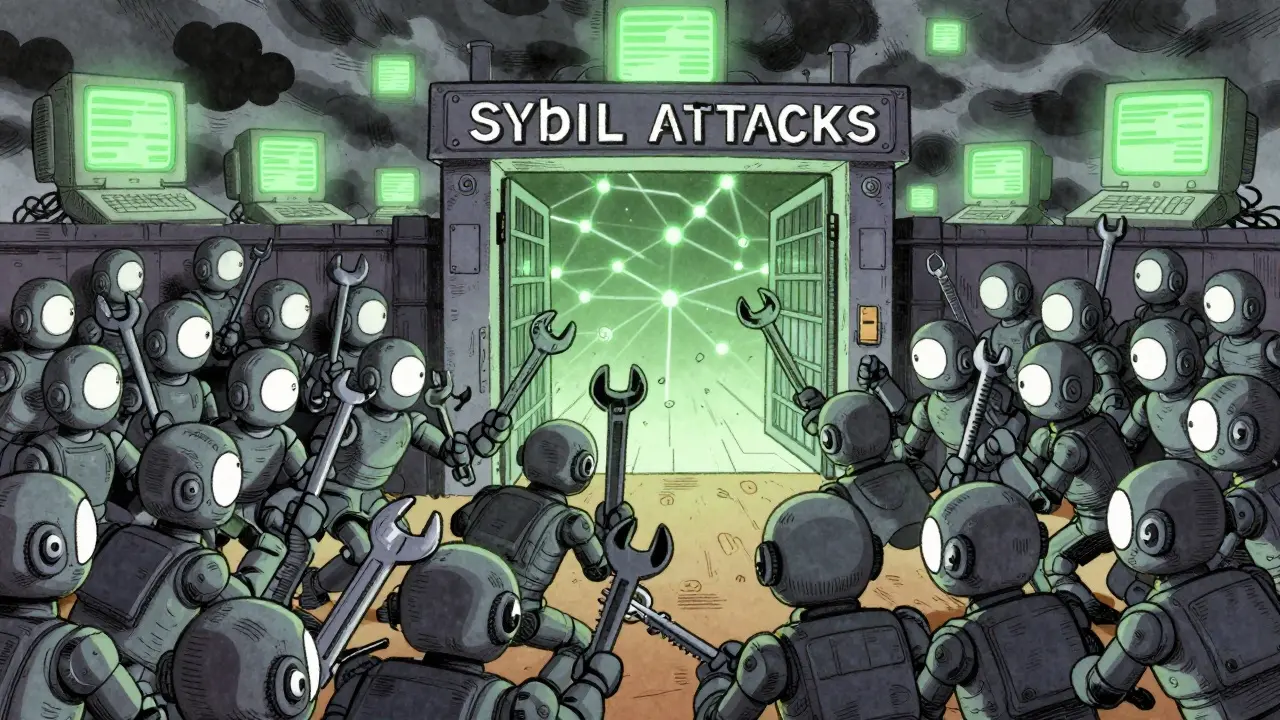
The core issue remains simple: a bad actor creates thousands of fake identities to swamp a network. But solving it isn't just about blocking IPs or requiring phone numbers. As networks grow, traditional defenses crumble under the weight of synthetic identities. Today, we're looking at the next generation of defense systems emerging across 2025 and 2026. These aren't just patches; they represent a fundamental rethink of how digital identity works in Web3.
Why Traditional Consensus Mechanisms Struggle
For years, we leaned heavily on Proof-of-Work and Proof-of-Stake to stop Sybil attacks. The logic was sound-if creating an identity costs real resources (electricity or capital), bad actors can't do it cheaply. However, scaling proved difficult. Proof-of-Work burns too much energy, and Proof-of-Stake often leads to wealth concentration.
We saw this limitation play out during the 2023 airdrop season. Platforms like Optimism and Arbitrum faced massive coordination attacks where automated scripts claimed rewards meant for humans. While Ethereum continues to dominate, its native consensus doesn't inherently verify unique humans. This gap created a fertile ground for exploiters. Recent studies show that relying solely on economic stakes fails to distinguish between a legitimate whale and a cluster of bot wallets owned by one person.
The Role of AI in Behavioral Detection
Artificial intelligence has moved beyond buzzwords into practical security tools. By mid-2025, AI-driven behavioral analysis became standard for high-value governance proposals. Systems now scan transaction timing patterns and device fingerprint signatures. If 50 wallets send transactions from the same IP range at identical millisecond intervals, the system flags them immediately.
According to Rejolut's 2024 Blockchain Security Trends Report, these AI-powered systems achieved 92.7% accuracy in identifying Sybil clusters across large node networks. This level of precision requires analyzing over 15 different behavioral metrics. Think of it as a digital immune system that learns your habits rather than just checking a checkbox. For example, if a wallet usually interacts with DeFi protocols every Tuesday morning but suddenly starts transacting 24 hours a day across unrelated chains, it triggers an alert.
- Transaction Timing Patterns: Identifies irregular bursts typical of scripts.
- Device Fingerprinting: Links addresses to hardware profiles.
- Network Interaction Graphs: Maps relationships between wallets to find hidden clusters.
Zero-Knowledge Proofs and Identity
Privacy advocates have long argued that verifying uniqueness shouldn't require revealing personal data. Enter Zero-Knowledge Proofs. These cryptographic techniques allow you to prove you are a unique human without exposing your biometric data to the network. Startup Defense's research demonstrated that combining ZK-proofs with reputation scoring reduced Sybil vulnerability by 83% in test networks.
Implementation details matter here. A major hurdle for developers has been the verification speed. As of late 2024, generating a zero-knowledge identity proof took roughly 3.2 seconds per user. While fast for some apps, this latency breaks high-throughput applications needing instant access. However, Ethereum Foundation benchmarking in July 2024 pointed toward optimizations that could slash this time significantly by Q1 2026. The goal is frictionless verification where your identity moves with you seamlessly.
| Method | Accuracy | User Friction | Privacy Risk |
|---|---|---|---|
| AI Behavioral Analysis | 92.7% | Low | Medium |
| Biometric Verification | 99.98% | High | High |
| Zero-Knowledge Proofs | 96.3% | Low | Low |
| Economic Disincentives | Variable | Medium | None |

Biometric Verification Controversies
Biometrics offer perhaps the strongest guarantee of uniqueness, but they carry heavy privacy baggage. Worldcoin's Orb device processed facial scans with near-perfect accuracy. Yet, the debate rages. In August 2024, the Electronic Frontier Foundation warned that centralized biometric databases create permanent risks. One leaked database affects everyone forever.
Surveys from early 2025 showed 63% of users expressed discomfort sharing facial recognition data, even for enhanced security. This creates a paradox: the most effective solution is the least accepted by the community. Some projects adopted a hybrid model, allowing optional biometric verification for higher reputation scores. This way, you can choose to verify your humanity more deeply for greater access rights, while others stick to purely economic methods.
Economic Disincentives and Social Trust
Not everyone agrees on high-tech solutions. Dr. Emin Gün Sirer from Ava Labs argued in a Consensus keynote that we shouldn't over-engineer identity. His approach relies on economic disincentives where attempting a Sybil attack incurs a minimum cost of $500 in computational fees. It sounds expensive, but it protects the permissionless nature of the protocol.
Social trust graphs also play a role. Projects like BrightID examine social connections across users. The idea is simple: humans have messy, overlapping social circles. Bots don't. However, MIT evaluations noted an 18% false positive rate, meaning honest users sometimes get flagged because they lack deep community ties. This highlights why layered defense is crucial-no single method works perfectly.

Implementation Realities for Developers
If you're building a dApp planning to integrate these protections, expect a learning curve. Developer surveys indicate advanced systems demand 8-12 weeks for full integration. You need expertise in Smart Contract upgrades and behavioral analytics. Documentation quality varies wildly across the ecosystem.
Gitcoin's Passport system offers a smoother entry point, processing verifications via multiple credentials like social logins and domain ownership. Their transparency report noted 89% user satisfaction. However, balancing privacy with verification remains cited by 78% of developers as a top challenge. Custom threshold adjustments based on your specific network size often require trial and error to avoid locking out legitimate users.
What to Watch in 2026 and Beyond
Looking ahead, the trajectory points toward modular verification. The Decentralized Identity Foundation aims to launch cross-chain protocols enabling reputation transfer between Ethereum, Solana, and Cosmos by mid-2026. Imagine proving your "human status" once and reusing that credential across dozens of platforms without re-uploading your data.
Enterprise adoption is accelerating too. With 67 Fortune 100 companies piloting identity solutions, regulatory pressure is mounting. The EU's MiCA framework mandates robust identity checks for stablecoins by June 2025. Compliance is driving investment, pushing innovation toward standards that both satisfy regulators and protect user privacy. The market is projected to hit $19.2 billion by 2028.
Ultimately, the future won't rely on one silver bullet. It will involve a stack of defenses: ZK-proofs for privacy, AI for anomaly detection, and economic barriers for immediate protection. The industry consensus is shifting toward frameworks where networks select protection levels based on their risk profile. Whether you are securing a small DAO or a global ledger, understanding these layers is now essential for maintaining network integrity.
Justin Smith
March 28, 2026 AT 11:00The latency figures cited are inaccurate regarding current zero-knowledge proof implementation speeds.
Justin Garcia
March 29, 2026 AT 18:57Why do you insist on believing outdated technical specs?
Zackary Hogeboom
March 31, 2026 AT 07:05Actually the benchmark report updated those numbers recently in July though.
Leah Lara
April 2, 2026 AT 01:52Boring read.
Ashley Stump
April 2, 2026 AT 13:22They definitely want your face data to sell you ads next.
Katrina Tate
April 4, 2026 AT 07:34The surveillance infrastructure described presents unacceptable systemic risks for civilian adoption.
Alex Kuzmenko
April 5, 2026 AT 18:40its coool that we dont have to show ID cards anymore tho.
Tiffany Selchow
April 7, 2026 AT 16:29Oh sure, trust the big tech solutions they give us.
Cara Boyer
April 8, 2026 AT 08:26This iis just too much hype lol :(
Addy Stearns
April 9, 2026 AT 14:52The concept of digital uniqueness relies heavily on physical proof. Physical proof creates a tangible chain of custody. This custody inevitably centralizes authority. Authority centralization contradicts decentralized ideals. Ideals often bend to practical necessity. Necessity dictates security protocols evolve. Evolution favors strong nodes. Strong nodes require capital. Capital requires access. Access requires identity. Identity requires biology. Biology is immutable. Immutable data leaks cause irreversible harm. Irreversible harm demands caution. Caution slows adoption rates.
Markus Church
April 10, 2026 AT 13:16The distinction between economic stake and behavioral analysis warrants further scrutiny from an academic perspective.
joshua kutcher
April 12, 2026 AT 07:17Just take it slow and test these things before you commit funds.
Chris R
April 13, 2026 AT 21:14We should focus on collaboration rather than fear mongering here.
Disha Patil
April 14, 2026 AT 17:20I am so tired of bots ruining everything for real humans online!!!
Raymond K
April 15, 2026 AT 13:42This future looks super brigt if we work together :)
Jamie Riddell
April 17, 2026 AT 01:00i hope everyone gets safe online soon