Hotbit Crypto Exchange Review: What Happened and Why You Should Avoid It
 Jan, 21 2026
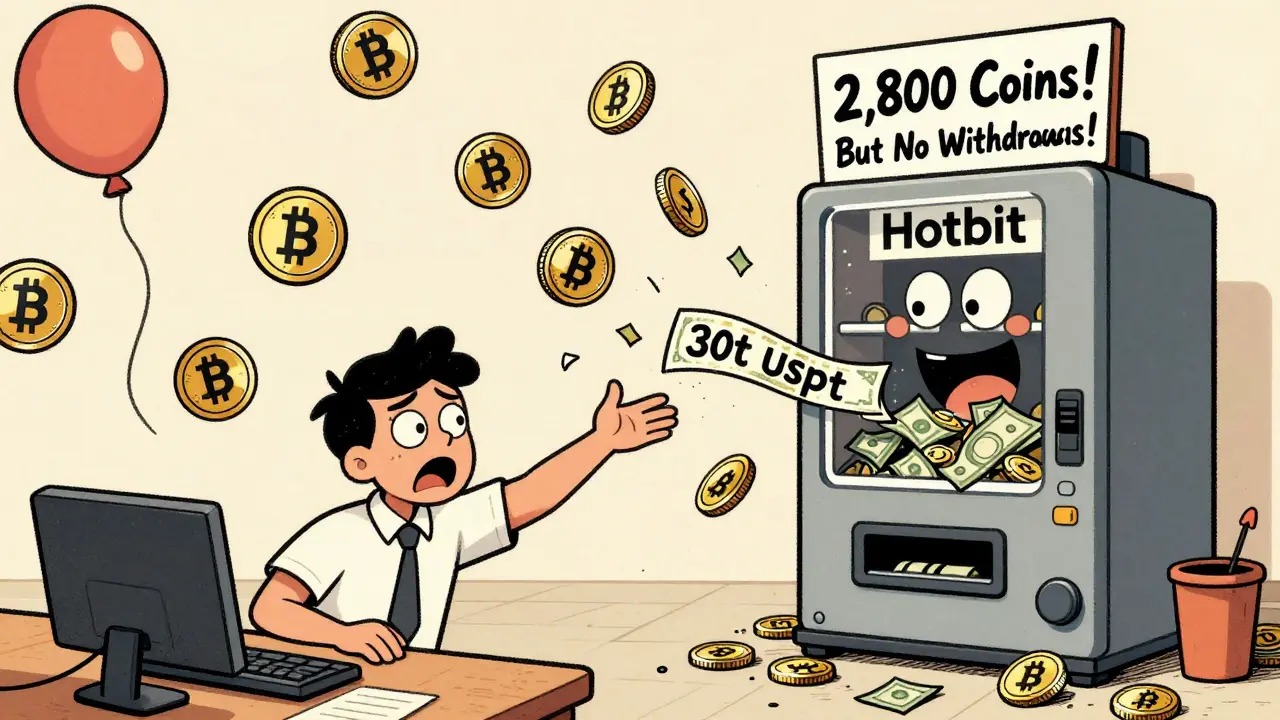
Hotbit was once promoted as a crypto exchange with over 2,800 coins - more than almost any other platform. But if you're looking to trade today, you won't find it. Hotbit shut down permanently in 2023, leaving thousands of users stuck with frozen funds and no clear path to recovery. This isn't just another exchange that failed quietly. It collapsed under the weight of unregulated operations, outrageous fees, and a criminal investigation that froze its assets. What happened to Hotbit? And why should you care if you're trading crypto in 2026?
Hotbit’s Rise: Too Many Coins, Not Enough Trust
Hotbit launched in 2018, right in the middle of the last crypto boom. It didn’t have the brand recognition of Binance or Coinbase, but it made up for it with sheer volume. At its peak, it offered trading pairs for more than 2,800 cryptocurrencies. For someone chasing the next meme coin or obscure altcoin, that sounded like a dream. No other exchange came close to that kind of selection.
But quantity doesn’t equal quality. While Binance and Kraken focused on security, compliance, and user support, Hotbit focused on listing everything - including coins with no real team, no whitepaper, and no liquidity. That’s not innovation. That’s a graveyard for tokens. And users soon realized that having access to 2,800 coins meant nothing if you couldn’t withdraw your money or get help when something went wrong.
The Hidden Costs: 30 USDT Withdrawal Fees
Hotbit didn’t just have a problem with legitimacy - it had a problem with greed. Withdrawal fees were a major red flag. While most exchanges charge between 1 and 3 USDT to move your crypto, Hotbit charged 30 USDT. That’s ten to thirty times higher than the industry standard.
Imagine you have 50 USDT in your account. You want to move it to a wallet or another exchange. Hotbit takes 30 USDT just to let you leave. That’s 60% of your balance gone. For users with smaller accounts, it wasn’t just expensive - it was a trap. Many couldn’t afford to withdraw at all. Their funds were locked in by the exchange’s own fees.
Sitejabber reviews from early 2023 were full of anger. One user wrote: “They charged me today 30 USDT just to withdraw to another USDT address. THIEVES!” Another said, “I tried to pull out my ETH, but the fee was higher than what I had. I’m stuck.” That’s not a business model. That’s a scam waiting to happen.
No Regulation, No Protection
Hotbit never registered with any financial authority. Not the SEC. Not the FCA. Not even a minor regulator in Asia. It operated in a legal gray zone, likely based in Taiwan and Shanghai, where oversight was weak or nonexistent.
That meant zero protection for users. If the exchange got hacked, if the team vanished, if your funds disappeared - you had no legal recourse. No insurance. No complaint process. No government agency to call. TradersUnion.com confirmed in 2025 that Hotbit was “not regulated by any recognized financial authority,” and that’s the biggest warning sign you can ignore.
Compare that to Coinbase, which is licensed in over 100 U.S. states and regulated by the NYDFS. Or Binance, which holds licenses in the EU and Singapore. Hotbit had nothing. Just a website and a promise.
The Collapse: Asset Freeze and Shutdown
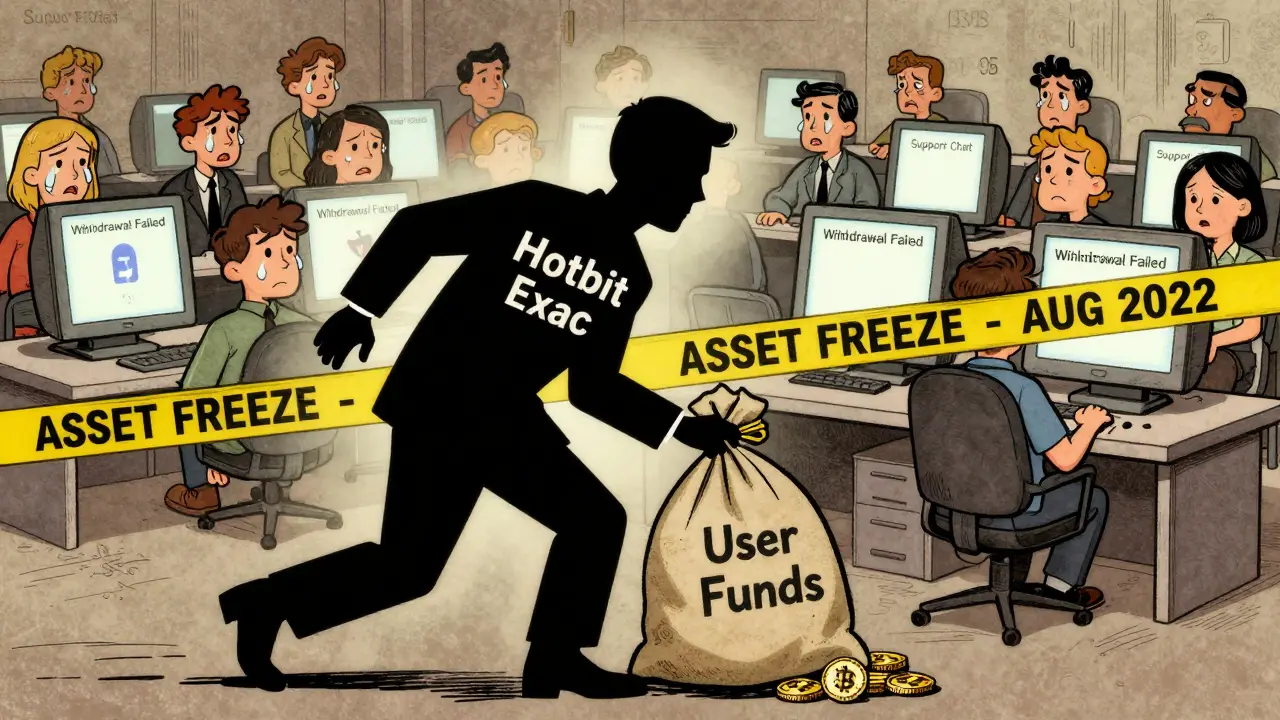
On August 15, 2022, everything changed. Law enforcement authorities froze Hotbit’s assets. Why? Because a former executive was under criminal investigation. No details were made public, but the message was clear: something illegal was happening behind the scenes.
After that, the platform went quiet. Withdrawals slowed to a crawl. Some users waited 60 days for a transaction that should’ve taken minutes. Customer support vanished. Emails went unanswered. Chatbots gave generic replies. The exchange was already dead - it just hadn’t announced it yet.
On May 22, 2023, Hotbit finally admitted the truth. In a short statement, it said it was shutting down permanently due to “deteriorating operating conditions, market instability, and a wave of fund outflows.” That’s corporate speak for “we ran out of money and got caught.”
Users were given until June 21, 2023, to withdraw their funds. But by then, the system was already broken. Many couldn’t access their accounts. Others tried to withdraw, only to be hit with the same 30 USDT fee - now even more impossible to pay.
Recovery Scams: The Aftermath
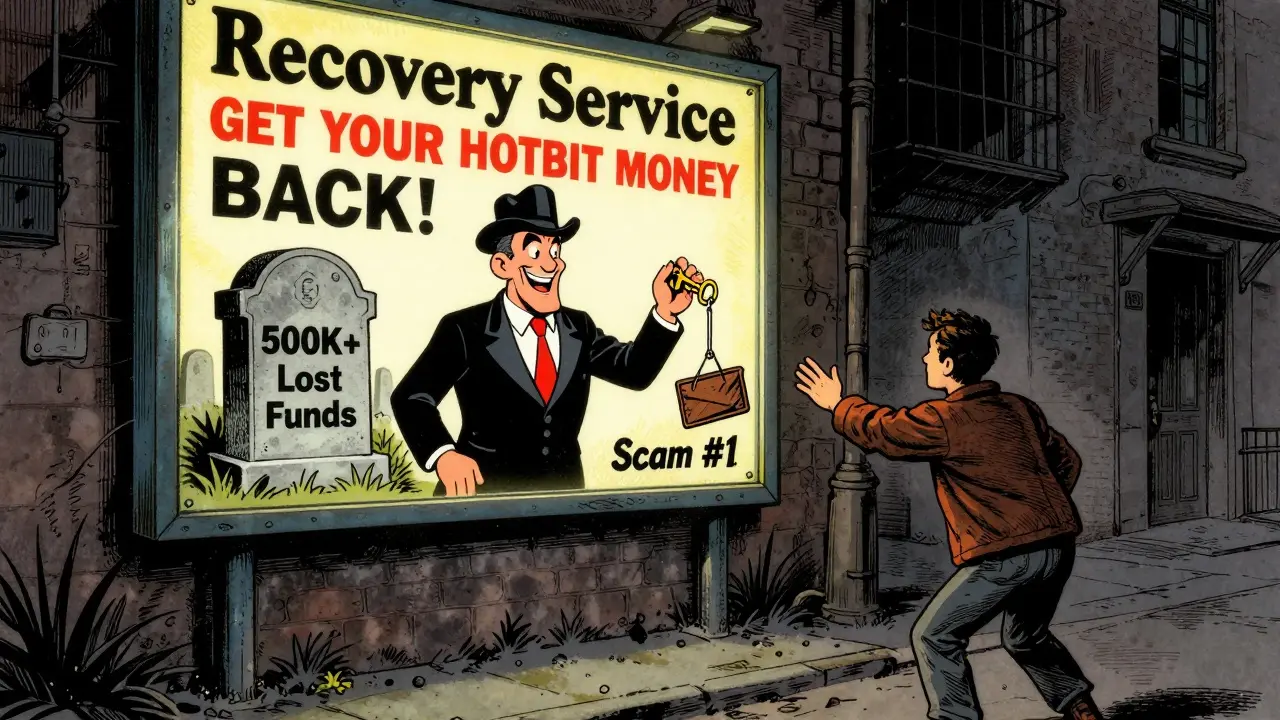
After the shutdown, something strange happened. Websites like hotbit.us.com popped up. They claimed to help users recover their lost funds. Some even posted fake testimonials: “I got my money back thanks to Presley Jossie!”
These aren’t recovery services. They’re scams.
The Financial Crimes Enforcement Network (FinCEN) issued a warning in July 2023 about “recovery scams targeting victims of exchange failures,” naming Hotbit specifically. TradersUnion.com found that 92% of these recovery agencies are fraudulent. They’ll ask you to pay an upfront fee - usually in crypto - to “unlock” your account. Then they disappear.
There is no legitimate way to recover your funds from Hotbit. The exchange is gone. The money is gone. And any service promising to get it back is just trying to steal from you again.
Hotbit vs. the Big Players
Here’s how Hotbit stacked up against the top exchanges before it died:
| Feature | Hotbit | Binance | Coinbase |
|---|---|---|---|
| Cryptocurrencies Listed | 2,800+ | 500+ | 200+ |
| Fiat Support | No | Yes | Yes |
| Withdrawal Fee (USDT) | 30 USDT | 1 USDT | 1.5 USDT |
| Regulation | None | Multiple jurisdictions | SEC, NYDFS, FinCEN |
| Customer Support Response | 7-10 days | Under 24 hours | Under 12 hours |
| Trust Score (Sitejabber) | 1.7/5 | 3.8/5 | 4.2/5 |
Hotbit’s only advantage was the number of coins. Everything else - security, fees, support, reliability - was worse. And when the market turned in late 2022 after the FTX collapse, unregulated exchanges like Hotbit were the first to fall.
Why This Matters Today
Hotbit is gone. But the lessons aren’t.
There are still hundreds of unregulated crypto exchanges out there - some with hundreds of coins, low trading fees, and flashy websites. They look safe. They sound legit. But if they don’t tell you where they’re registered, if they don’t list their regulatory status, if they don’t have clear customer support - walk away.
Don’t be tempted by the biggest coin list. Don’t trust the “low fees” if they’re only for trading, not withdrawals. Don’t assume “many users” means safe. Hotbit had 500,000-750,000 users before it shut down. That didn’t save anyone.
Only use exchanges that are transparent about regulation, charge reasonable fees, and have a proven track record of customer support. If you can’t find a license number or a physical address, it’s not worth the risk.
What to Do If You Used Hotbit
If you still have an account on Hotbit, close it. Log out. Delete any saved passwords. Do not respond to emails claiming to be from Hotbit support. They’re fake.
Do not pay any “recovery service.” They are scams. Period.
Report the loss to your local financial crime unit if possible. In New Zealand, that’s the Financial Markets Authority. In the U.S., file a report with the FTC. It won’t get your money back - but it helps track these scams and protect others.
Learn from this. The crypto world is full of opportunity - but also full of predators. Hotbit wasn’t an exception. It was the rule for unregulated platforms. Don’t let your next trade end the same way.
Is Hotbit still operating in 2026?
No, Hotbit permanently shut down on May 22, 2023. Its assets were frozen in August 2022 following a criminal investigation, and the platform has not resumed operations since. Any website claiming to be Hotbit today is a scam or a recovery fraud.
Can I recover my funds from Hotbit?
There is no legitimate way to recover funds from Hotbit. The exchange no longer exists, and its funds were either seized, stolen, or lost. Any service offering to get your money back for a fee is a scam. The Financial Crimes Enforcement Network (FinCEN) has warned users about these recovery frauds, with 92% of them being fraudulent.
Why did Hotbit charge 30 USDT to withdraw?
Hotbit charged 30 USDT per withdrawal to trap users with small balances and generate artificial revenue. This fee was 10-30 times higher than industry standards. It made it nearly impossible for users to move their funds, effectively locking them in. This was one of the key signs that Hotbit was more interested in profiting from users than serving them.
Was Hotbit regulated?
No, Hotbit was never regulated by any recognized financial authority. It operated without licenses from the SEC, FCA, or any other major regulator. This lack of oversight meant users had no legal protection, no insurance, and no recourse if something went wrong - which is exactly what happened.
How many users lost money on Hotbit?
Hotbit had an estimated 500,000-750,000 active users before its shutdown. The exact number of people who lost funds is unknown, but since the platform froze withdrawals and then shut down permanently, the vast majority of users were unable to access their accounts. Industry analysts estimate that less than 5% of users recovered any portion of their assets before the final closure.
Should I avoid exchanges with many coins?
Not necessarily - but you should be cautious. Exchanges with too many coins often list low-quality or scam tokens just to attract traders. The key isn’t the number of coins - it’s whether the exchange is regulated, has transparent fees, strong security, and reliable customer support. Always prioritize safety over selection.
Hotbit’s story is a warning. It wasn’t a glitch. It wasn’t bad luck. It was the result of a business built on deception, greed, and zero accountability. Don’t make the same mistake. If an exchange looks too good to be true - too many coins, too low fees, no regulation - it probably is.
carol johnson
January 22, 2026 AT 00:53Steve Fennell
January 22, 2026 AT 06:15Catherine Hays
January 22, 2026 AT 09:30Roshmi Chatterjee
January 24, 2026 AT 01:34Jen Allanson
January 25, 2026 AT 12:57Clark Dilworth
January 25, 2026 AT 21:15Brenda Platt
January 26, 2026 AT 04:50Arnaud Landry
January 27, 2026 AT 07:43Mark Estareja
January 28, 2026 AT 05:31Sara Delgado Rivero
January 29, 2026 AT 04:40Athena Mantle
January 30, 2026 AT 13:11Tselane Sebatane
February 1, 2026 AT 00:02Jonny Lindva
February 2, 2026 AT 11:05Adam Lewkovitz
February 3, 2026 AT 02:04Barbara Rousseau-Osborn
February 3, 2026 AT 16:19george haris
February 5, 2026 AT 04:51Margaret Roberts
February 6, 2026 AT 21:58Harshal Parmar
February 8, 2026 AT 08:46Darrell Cole
February 9, 2026 AT 12:11Dave Ellender
February 11, 2026 AT 08:23Adam Fularz
February 12, 2026 AT 02:51Linda Prehn
February 13, 2026 AT 12:10