How Bitcoin Mining Works: The Technical Process Explained
 Sep, 23 2026
Imagine trying to guess a specific seven-digit lottery number. You can’t look it up, you can’t calculate it backward, and you have no idea if the next ticket you buy will be the winner. Now imagine doing that not once, but trillions of times per second, while competing against millions of other people doing the exact same thing. That is Bitcoin mining in a nutshell. It’s not just about printing new money; it’s the engine that keeps the entire network secure, decentralized, and honest.
If you’ve ever wondered why your transaction takes ten minutes to confirm or where those shiny new bitcoins actually come from, you’re asking the right questions. Most people think mining is like digital gold panning-just dig until you find something. But it’s more like solving a cryptographic puzzle so hard that only the fastest computers on Earth stand a chance. Let’s break down exactly how this works, step by step, without getting lost in academic jargon.
The Core Concept: Proof of Work
At its heart, Bitcoin relies on a consensus mechanism called Proof of Work (PoW). Unlike traditional banks that trust a central authority to verify transactions, Bitcoin trusts math. PoW requires miners to expend real-world energy and computational power to solve a problem. This isn’t arbitrary busywork; it makes cheating expensive. To rewrite history or double-spend coins, an attacker would need to out-mine the entire rest of the network combined. That costs billions in electricity and hardware, making fraud economically unviable.
The system is designed as a competitive lottery. Every ten minutes, roughly, one miner wins the race to add the next block of transactions to the blockchain. The winner gets two things: the ability to claim the newly created bitcoins (the block subsidy) and the transaction fees paid by users included in that block. Everyone else? They go back to work on the next puzzle. This constant competition ensures that no single entity controls the ledger.
The Math Behind the Magic: SHA-256
You can’t understand mining without understanding SHA-256. This is the cryptographic hashing algorithm at the core of Bitcoin. Think of it as a blender for data. You throw in any amount of information-a single letter, a whole book, or a gigabyte of video-and it spits out a fixed-length string of 64 hexadecimal characters (a 256-bit number).
| Input Data | SHA-256 Hash Output |
|---|---|
| "Hello World" | b94d27b9934d3e08a52e52d7da7dabfac484efe37a5380ee9088f7ace2efcde9 |
| "hello world" | b94d27b9934d3e08a52e52d7da7dabfac484efe37a5380ee9088f7ace2efcde9 |
| "Hello WorlD" | a591a6d40bf420404a011733cfb7b190d64c7651b7edf13f5e0a0c0c0c0c0c0c |
Notice how changing just one capitalization changes the entire output? That’s the avalanche effect. It means the hash is unpredictable and irreversible. You cannot take a hash and figure out what went into it. Miners use this property to create a unique fingerprint for every block. If even one transaction in the block changes, the entire hash changes. This locks the blocks together in a chain-if someone tries to tamper with an old block, its hash changes, breaking the link to the next block, and invalidating everything that came after it.
Anatomy of a Block
Before we talk about guessing numbers, let’s look at what miners are actually hashing. A block header contains five critical pieces of data:
- Previous Block Hash: A reference to the block before it. This creates the chain.
- Merkle Root: A single hash that summarizes all the transactions in the current block. It allows quick verification of whether a transaction is in the block without downloading the whole thing.
- Timestamp: The time the block was started.
- Difficulty Target: A code representing how hard the puzzle currently is.
- Nonce: A random number that miners change over and over again.
The goal is simple: produce a hash for the block header that starts with a certain number of zeros. For example, if the target is "0000...", the hash must start with four zeros. If the target is "000000...", it needs six. The more zeros required, the harder the puzzle.
The Mining Process Step-by-Step
So, how does a miner actually do this? Here is the workflow that happens thousands of times per second on modern hardware:
- Gather Transactions: Miners pull pending transactions from the mempool. These are transactions broadcast to the network but not yet confirmed. Miners prioritize transactions with higher fees because those fees are part of their reward.
- Construct the Block: They build a candidate block containing these transactions and the previous block’s hash.
- Add the Coinbase Transaction: This is a special transaction at the start of every block where the miner pays themselves the block reward (currently 3.125 BTC post-2024 halving) plus fees.
- Hash and Guess: The miner runs the block header through SHA-256. They get a result. Is it below the target? Probably not. So they increment the nonce (change the number from 0 to 1, then 2, etc.) and try again.
- Repeat: This loop continues billions of times per second. There is no strategy here, no shortcut. It is pure brute force.
- Broadcast: When a miner finally finds a nonce that produces a valid hash, they shout it out to the network. Other nodes verify the solution instantly (verification is easy, finding is hard). If valid, the block is added to the chain.
Difficulty Adjustment: Keeping the Pace
What happens if everyone buys faster computers tomorrow? Blocks would fly by in seconds, flooding the market with new bitcoin too quickly. To prevent this, Bitcoin has a self-correcting mechanism called difficulty adjustment.
Every 2,016 blocks (which takes about two weeks), the network looks at how long it took to mine the last 2,016 blocks. If it took less than two weeks, the difficulty goes up. If it took longer, the difficulty goes down. This ensures that regardless of how much total computing power (hash rate) joins or leaves the network, the average time between blocks remains stubbornly close to ten minutes. This predictability is crucial for the monetary policy of Bitcoin.
Hardware Evolution: From CPUs to ASICs
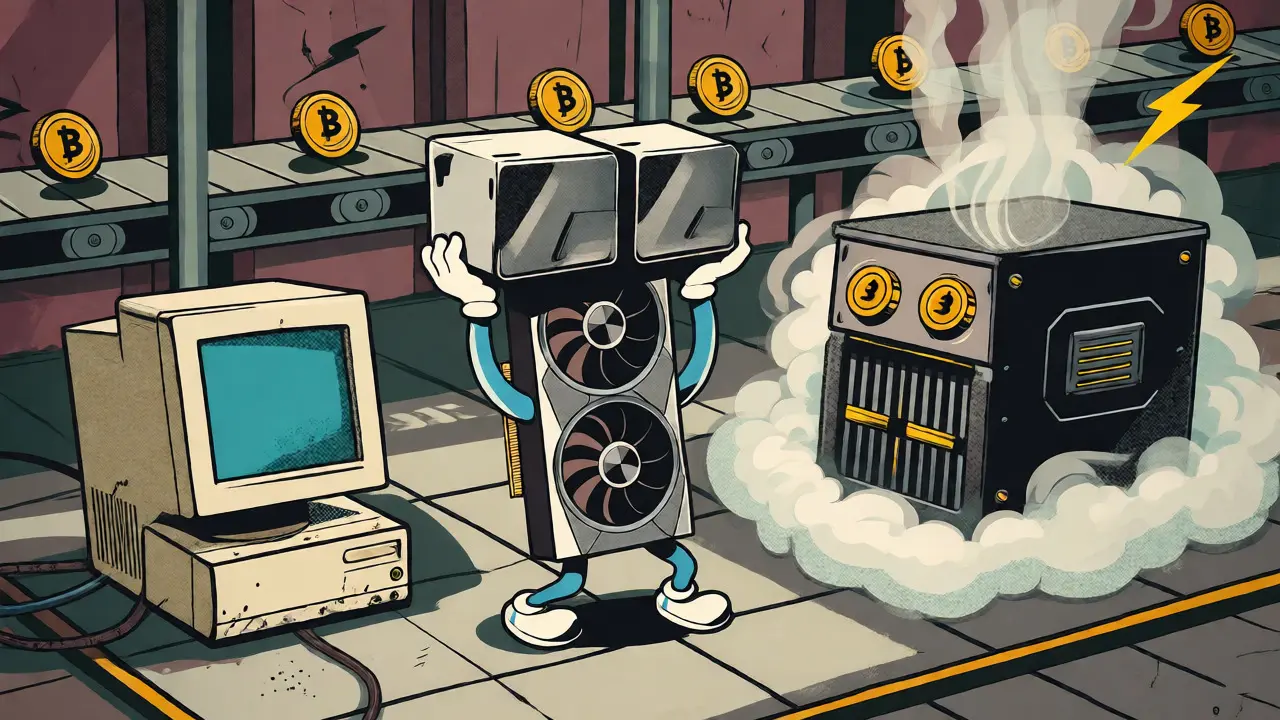
In 2009, you could mine Bitcoin on your laptop CPU. By 2011, GPUs took over. Today, general-purpose processors are useless for mining. We live in the era of ASICs (Application-Specific Integrated Circuits). These are chips designed solely to perform SHA-256 calculations. They are incredibly efficient but completely inflexible-you can’t use them to play games or browse the web.
| Hardware Type | Approx. Era | Efficiency (GH/s or TH/s) | Use Case |
|---|---|---|---|
| CPU | 2009-2010 | ~10 MH/s | Hobbyists |
| GPU | 2010-2013 | ~1 GH/s | Early Adopters |
| FPGA | 2012-2013 | ~10 GH/s | Transition Phase |
| ASIC | 2013-Present | 100+ TH/s | Industrial Scale |
Modern ASICs like the Antminer S21 run at over 200 terahashes per second. To put that in perspective, a terahash is one trillion hashes. Your home computer might manage a few million. The gap is astronomical.
Solo Mining vs. Mining Pools
With such high difficulty, solo mining is like buying one lottery ticket for a jackpot that pays out once every ten minutes. You might wait years for a win. Most miners join mining pools. In a pool, thousands of miners combine their hash rates. When the pool solves a block, the reward is split among participants based on how much work each contributed.
This smooths out income. Instead of erratic, rare payouts, pool miners receive small, frequent payments. However, pools charge a fee (usually 1-2%) for this service. It’s a trade-off: lower variance in earnings versus a small cut of profits.
The Economics: Halving and Energy
Mining rewards aren’t infinite. Approximately every four years, the block reward is cut in half. This event is known as the halving. In May 2020, the reward dropped to 6.25 BTC. In April 2024, it dropped to 3.125 BTC. The next halving is expected around 2028, reducing the reward to 1.5625 BTC.
This scarcity drives value, but it also squeezes miners. As rewards shrink, miners must become more efficient or rely on higher transaction fees. Electricity costs are the biggest operational expense. A miner paying $0.05 per kWh has a huge advantage over one paying $0.15. This is why many large operations locate near cheap hydroelectric power in places like Iceland, Canada, or parts of the US.
Why It Matters: Security Through Energy
Some critics argue that Bitcoin wastes energy. But consider this: the energy spent is the cost of security. It’s the price we pay for a global, permissionless, censorship-resistant financial system that doesn’t require trusting a bank or government. The proof-of-work mechanism aligns incentives: miners want the network to succeed because their investment in hardware and electricity depends on it. Attackers face the same energy costs, making attacks prohibitively expensive.
Understanding how Bitcoin mining works reveals that it’s not just tech-it’s economics, cryptography, and physics intertwined. It’s a system where trust is replaced by verifiable computation, ensuring that every satoshi you hold is backed by real-world effort.
Can I still mine Bitcoin at home?
Technically, yes, but practically, no. With current difficulty levels, a standard home GPU or CPU will likely spend more on electricity than it earns in Bitcoin. Home mining is now mostly a hobby or educational experiment rather than a profitable venture unless you have extremely cheap or free electricity.
What happens if a miner turns off their machine?
If enough miners turn off, the network's total hash rate drops. Within two weeks, the difficulty adjustment algorithm detects this slower pace and lowers the difficulty. This makes it easier for the remaining miners to find blocks, bringing the block time back to the ten-minute average.
Is Bitcoin mining bad for the environment?
It consumes significant energy, comparable to some small countries. However, a growing percentage of mining uses stranded renewable energy (like excess hydro or wind that would otherwise be wasted). Critics focus on carbon footprints, while proponents argue the energy secures a transparent financial layer that reduces inefficiencies elsewhere.
Do miners choose which transactions to include?
Yes. Miners generally select transactions with the highest fees per byte first. This incentivizes users to pay higher fees during times of network congestion to ensure their transactions are processed quickly. If you pay a low fee, your transaction might sit in the mempool for hours or days.
What is the 'nonce'?
The nonce is a random number included in the block header. Miners change this number repeatedly to generate different hash outputs. Since the rest of the block data is fixed, changing the nonce is the only way to alter the resulting hash. Finding the right nonce is the actual work of mining.