How Crypto Exchanges Detect VPNs: Multi-Layered Security Explained
 May, 20 2026
Imagine logging into your favorite cryptocurrency exchange from a coffee shop in Wellington, only to have your account instantly flagged or frozen. You didn't do anything wrong-you were just using a Virtual Private Network (VPN) to secure your connection. But for the exchange, that simple act looks like an attempt to bypass strict geographical restrictions. This isn't a glitch; it's a sophisticated, multi-layered defense system designed to catch you.
The landscape of crypto trading has changed dramatically since 2023. With global regulatory pressure mounting, exchanges are no longer just passive platforms. They are active enforcers of local laws, particularly in regions with heavy restrictions on digital assets. If you are trying to access services banned in your country, or even if you are just traveling and connecting through a public Wi-Fi network that routes through a known VPN server, you are walking into a minefield. Understanding how these detection systems work is not just about privacy-it’s about keeping your funds accessible.
The First Line of Defense: IP Address Blacklisting
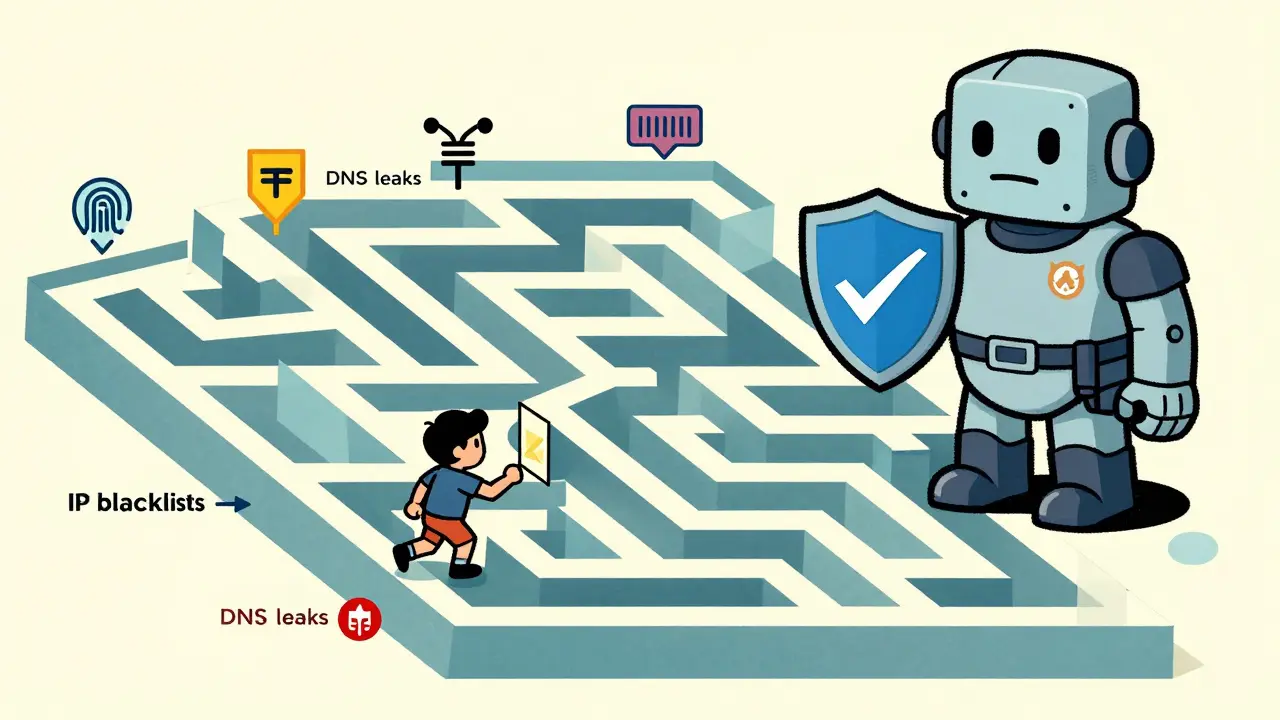
The most obvious way exchanges spot VPN users is by checking your IP address. It sounds simple, but the scale is massive. Centralized exchanges like Binance, Coinbase, and Kraken maintain constantly updated databases containing millions of IP ranges associated with known VPN providers. These lists include servers from major players like NordVPN and ExpressVPN.
When you connect, the exchange checks your IP against this blacklist. If there is a match, the alarm bells start ringing. The problem for users is that centralized VPNs share IP addresses among thousands of customers. This makes them easy targets. Free VPN services are almost universally detected because their limited pool of IPs is well-known and heavily monitored. Even premium services face high detection rates because their infrastructure is proprietary and concentrated. The exchange doesn't need to know who you are; they just need to know that your connection originates from a server that screams "proxy."
Deep Packet Inspection and Traffic Analysis
If IP blacklisting were the only method, savvy users could easily slip through by using obscure, residential proxies. But exchanges go deeper. They employ Deep Packet Inspection (DPI) technology. DPI allows the exchange to analyze the structure and patterns of your internet traffic, even if the content itself is encrypted.
VPNs leave subtle fingerprints. Encrypted traffic from a standard OpenVPN or WireGuard connection has specific packet sizes, timing intervals, and header structures that differ from normal web browsing. DPI tools scan for these characteristic signatures. For example, a sudden burst of data followed by a specific handshake protocol might indicate a VPN tunnel establishment rather than a direct browser request. Advanced systems can identify these patterns even when users try to obfuscate their traffic. This means that simply turning on a VPN app isn't enough to hide the fact that you are using one. The exchange sees the shape of your data, not just its destination.
DNS Leaks and Time Zone Mismatches
Sometimes, the technical details aren't enough, so exchanges look at contextual clues. One common mistake users make is relying on their default DNS settings while connected to a VPN. DNS leak detection monitors the Domain Name System resolvers your device uses. If your IP says you are in London, but your DNS queries are being resolved by a server in New York, the exchange flags this inconsistency immediately.
Another powerful tool is time zone analysis. Exchanges track when you log in and trade. If your account is registered in Japan, but you are consistently active during peak business hours in Brazil, the system raises a red flag. Behavioral analytics compare your activity patterns against expected regional norms. This isn't just about catching criminals; it's about risk management. A sudden shift in geographic behavior suggests potential account compromise or deliberate evasion of local regulations. For legitimate travelers, this can be frustrating, but for those trying to mask their location permanently, it's a significant hurdle.

Browser Fingerprinting and Device Characteristics
Your computer or phone leaves a trail of digital crumbs that can contradict your claimed location. Browser fingerprinting examines various attributes of your device, including screen resolution, installed plugins, operating system version, and even font libraries. These details create a unique identifier for your browser.
If your browser reports a language setting of Russian, but your IP address indicates you are connecting from Germany, the mismatch triggers suspicion. More advanced systems cross-reference this data with your KYC (Know Your Customer) information. If you provided identification documents from one country, but your digital footprint consistently points to another, the exchange may restrict your account pending further verification. This layer of detection is particularly effective because it requires users to meticulously configure every aspect of their device to align with their chosen IP location-a task that is difficult to maintain over time without errors.
The Role of Machine Learning in Detection
Traditional rule-based systems are static; they block what they know. Modern exchanges use Machine Learning algorithms to detect anomalies dynamically. These AI models analyze vast amounts of data to identify patterns that human programmers might miss. They look at typing speeds, mouse movements, and interaction timings. Automated bots or proxy services often exhibit different behavioral rhythms compared to human users.
For instance, if an account suddenly starts executing trades with millisecond precision across multiple markets, or if login attempts occur from disparate locations within minutes, the ML model flags this as suspicious. This goes beyond simple VPN detection; it's about understanding user behavior. The more data the exchange collects, the more accurate these models become. This creates a moving target for users trying to evade detection. What worked yesterday might be identified as anomalous today because the algorithm has learned new patterns.
| VPN Type | Detection Risk | Key Vulnerability | Best Use Case |
|---|---|---|---|
| Centralized VPN (e.g., NordVPN) | High | Known IP ranges, shared servers | General privacy, not bypassing strict bans |
| Free VPN Services | Very High | Limited IPs, widely blacklisted | Avoid for financial transactions |
| Decentralized VPN (e.g., NymVPN) | Low | Complex setup, slower speeds | Bypassing strict geo-restrictions |
| Residential Proxies | Medium | Cost, potential DNS leaks | Short-term access needs |
Why Exchanges Are So Aggressive
You might wonder why exchanges go to such lengths. The answer lies in compliance and liability. The global cryptocurrency exchange market is projected to grow significantly, reaching $57.3 billion by 2030. With this growth comes intense scrutiny from regulators. Exchanges face severe penalties if they allow users from restricted jurisdictions-such as China, Russia, or Turkey-to trade freely.
To avoid legal trouble, exchanges must prove they are enforcing geographic blocks. This drives the investment in sophisticated detection systems. It’s a delicate balance. If they are too aggressive, they lose legitimate users who are just traveling or concerned about privacy. If they are too lax, they risk fines or shutdowns. This tension fuels the technological arms race between exchanges and privacy advocates. Every new detection method prompts the development of new evasion techniques, leading to a cycle of continuous innovation.
Can You Beat the System?
The short answer is: it’s getting harder. Traditional methods like Double VPN (routing traffic through two servers) or Onion over VPN (combining Tor with a VPN) are increasingly ineffective against advanced DPI and behavioral analysis. Exchanges can now detect split tunneling, where only specific apps route through a VPN while others connect directly. This inconsistency is a dead giveaway.
Privacy advocates point to Decentralized VPNs like NymVPN as a potential solution. Unlike centralized services, Nym operates on a Noise Generating Mixnet architecture, routing traffic through multiple community-run nodes. This makes it much harder for exchanges to map IP addresses to specific users or identify consistent traffic patterns. However, these solutions come with trade-offs, including slower speeds and more complex setups. For the average user, the convenience of a centralized VPN often outweighs the security benefits of decentralization, leaving them vulnerable to detection.
Ultimately, the goal of these multi-layered systems is not just to block access, but to create a compliant environment. As regulatory frameworks evolve, we can expect even more sophisticated measures, potentially extending to decentralized exchanges (DEXs) and wallet providers. For now, if you are determined to bypass restrictions, you need to understand that you are up against some of the most advanced cybersecurity teams in the industry. And they are always learning.
Will using a free VPN get my crypto account banned?
It is highly likely. Free VPN services have very small pools of IP addresses that are widely known and frequently blacklisted by major exchanges like Binance and Coinbase. Using one increases your risk of immediate detection and potential account restriction.
What is Deep Packet Inspection (DPI) in the context of crypto?
DPI is a surveillance technology used by exchanges to examine the headers and patterns of your internet traffic. Even if your data is encrypted, DPI can identify the unique signatures of VPN protocols, allowing the exchange to detect your usage regardless of the content you are sending.
How does browser fingerprinting help exchanges find VPN users?
Browser fingerprinting collects data about your device, such as screen resolution, installed fonts, and language settings. If your browser reports a location or language that contradicts your IP address, the exchange flags the discrepancy as suspicious activity.
Are decentralized VPNs like NymVPN undetectable?
They are significantly harder to detect than centralized VPNs. Because they route traffic through a distributed network of nodes, they lack the fixed IP ranges and predictable traffic patterns that exchanges typically monitor. However, they are not completely immune to advanced behavioral analysis.
Why do exchanges care so much about VPN usage?
Exchanges must comply with local regulations to avoid heavy fines or legal action. Many countries ban or restrict cryptocurrency trading. By detecting and blocking VPN users, exchanges ensure they are not facilitating illegal activity in restricted jurisdictions, protecting their license to operate globally.