How Flash Loans Work Without Collateral: A Complete Guide to DeFi Atomicity
 Jul, 16 2026
Imagine borrowing $10 million in cryptocurrency without putting up a single penny as collateral. In traditional banking, this is impossible. The bank would demand assets, credit checks, and weeks of paperwork. But in the world of decentralized finance (DeFi), you can do it instantly-and pay it back before the transaction even finishes.
This isn't magic; it's code. It’s called a flash loan. It is one of the most powerful and misunderstood tools in blockchain technology. For years, these loans were reserved for elite developers and institutional traders. Now, with clearer documentation and more accessible protocols, they are opening doors that were previously locked.
If you have ever wondered how someone can move millions of dollars in seconds without risking their own capital, you are about to find out. We will break down the mechanics, the risks, and the real-world use cases of flash loans, stripping away the jargon to show you exactly how they work.
The Core Mechanism: Atomic Transactions
To understand why flash loans don’t need collateral, you first need to understand a concept called atomicity. In computer science, an atomic operation is one that either completes entirely or fails entirely. There is no middle ground. You cannot have half a transaction.
On blockchains like Ethereum, every transaction is atomic. When you send money from Wallet A to Wallet B, the entire process happens within a single block. If anything goes wrong during that process-say, Wallet A doesn’t have enough gas fees-the whole transaction is reverted. It’s as if nothing ever happened.
Flash loans exploit this feature. Here is the step-by-step logic:
- You request a loan from a protocol (like Aave).
- The protocol sends the funds to your smart contract.
- Your contract performs an action (like trading on Uniswap).
- Your contract repays the loan plus a small fee.
- If the repayment succeeds, the transaction is finalized.
- If the repayment fails, the entire transaction reverts. The protocol gets its money back instantly, and you lose only the gas fee.
Because the loan and the repayment happen in the same transaction, the lender faces zero risk. They never actually part with their assets permanently. This eliminates the need for collateral. You aren’t borrowing against your net worth; you are borrowing against the mathematical certainty of the blockchain’s atomic nature.
Who Uses Flash Loans and Why?
You might be thinking, "Why would I want to borrow money just to pay it back immediately?" The answer lies in capital efficiency. In traditional finance, if you wanted to execute a large arbitrage trade, you would need millions in cash sitting idle in your account, earning nothing. With flash loans, you can access that liquidity instantly without tying up your own capital.
Here are the three primary use cases where flash loans shine:
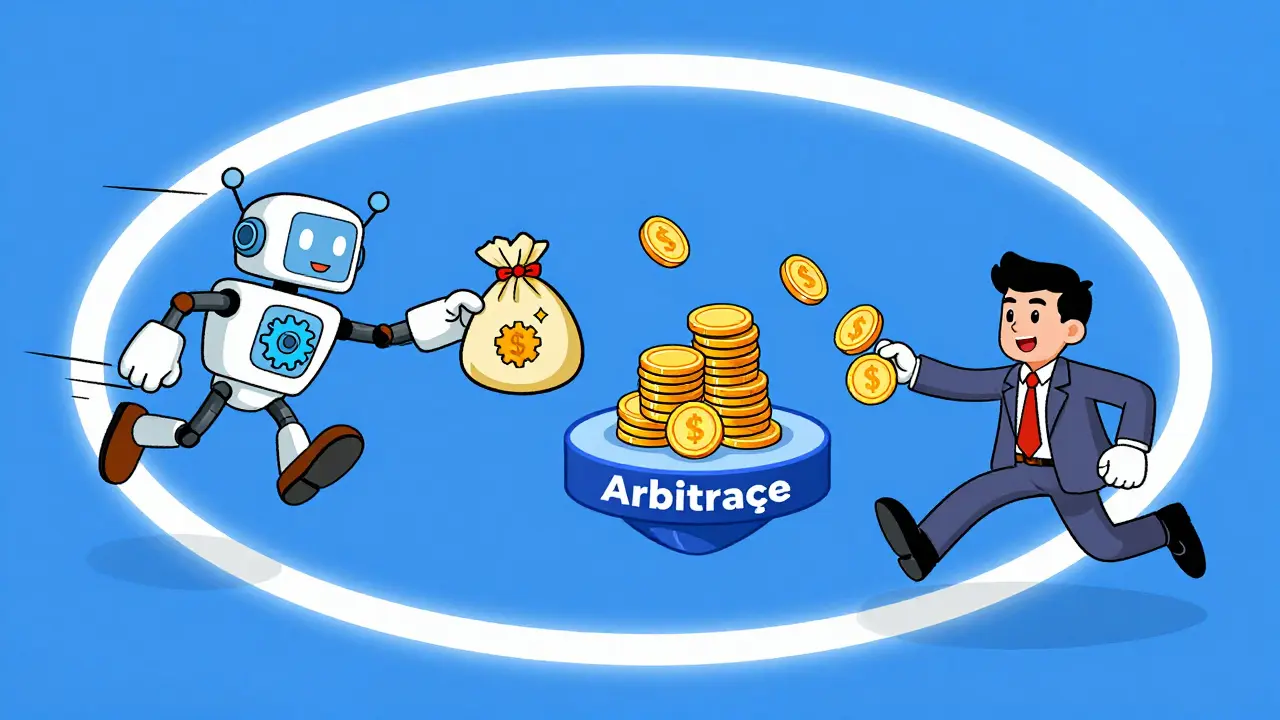
- Arbitrage: This is the most common use case. Imagine ETH is priced at $3,000 on Uniswap but $3,050 on Sushiswap. A trader can take a flash loan of 1,000 ETH, buy it on Uniswap, sell it on Sushiswap, repay the loan, and keep the $50 profit per ETH minus fees. All of this happens in seconds.
- Self-Liquidation: If you have a position in a lending protocol that is about to get liquidated due to a price drop, you can use a flash loan to repay your debt, reclaim your collateral, and avoid the steep liquidation penalties. You essentially save yourself from losing more money than necessary.
- Collateral Swaps: Suppose you hold BTC as collateral in a loan but want to switch to ETH. Normally, you’d have to repay the loan, wait for the transfer, and then reborrow. With a flash loan, you can swap the collateral type instantly within a single transaction, avoiding market volatility risks during the swap.
These strategies require precision. The margin for error is slim. One miscalculation in slippage or gas costs can turn a profitable trade into a loss. However, for sophisticated users, the ability to leverage millions of dollars with zero upfront capital is transformative.
Major Protocols: Where to Find Flash Loans
Not all DeFi platforms offer flash loans. The infrastructure requires specific smart contract implementations. Currently, a few major players dominate the space.
| Protocol | Typical Fee | Key Feature | Best For |
|---|---|---|---|
| Aave | 0.09% | Largest liquidity pools | High-volume arbitrage |
| Uniswap | 0.3% (Flash Swap) | Integrated directly into AMM pools | Token swaps and rebalancing |
| Balancer | Variable (0.01%-1%) | Customizable pool weights | Complex multi-asset strategies |
Aave remains the gold standard for flash loans. Since launching V2 in 2020, it has processed billions in volume. Its low fee structure (typically 0.09%) makes it attractive for tight-margin trades. Uniswap offers "Flash Swaps," which are slightly different. Instead of borrowing a token and returning the same token, you can borrow Token A, swap it for Token B elsewhere, and return Token B (plus fees) as long as the value is equivalent. This flexibility allows for more complex trading strategies.
Balancer provides a unique angle by allowing users to create custom pools. This means you can tailor the liquidity parameters to fit very specific niche strategies. While the fees can vary, the control it offers appeals to advanced developers building bespoke financial products.
The Risks: Security and Complexity
Flash loans are not for beginners. The barrier to entry is high because you must write or deploy a smart contract. You cannot simply click a button on a website. This technical requirement creates two major risks: human error and malicious exploitation.
First, let’s talk about security. Because flash loans provide massive amounts of capital instantly, they have become the weapon of choice for hackers. According to Chainalysis reports, a significant portion of DeFi hacks involve flash loans. Attackers borrow millions, manipulate the price of a token in a vulnerable protocol, drain funds using that inflated price, and then repay the loan. The famous Poly Network hack in 2021, where $600 million was stolen, utilized flash loans to amplify the attack vector.
Second, there is the risk of MEV (Miner Extractable Value). When you broadcast a flash loan transaction, bots monitoring the mempool (the waiting area for transactions) can see your strategy. If they detect a profitable arbitrage opportunity, they may front-run your transaction by submitting their own with higher gas fees. They execute the trade first, leaving you with no profit or even a loss. This is known as "sandwiching."
To mitigate these risks, experienced developers use techniques like private transaction relays (such as Flashbots) to hide their transactions from public view until they are mined. This prevents front-running but adds another layer of complexity to the setup.
How to Get Started: A Realistic Roadmap
If you are serious about exploring flash loans, here is a practical path forward. Do not start with real money. Start with code.
- Learn Solidity: You need to understand how to write smart contracts. Focus on interfaces like
IFlashLoanReceiverused by Aave. Understand how to handle errors and revert conditions safely. - Use Testnets: Deploy your contracts on Goerli or Sepolia testnets. These networks use fake ETH, so you can experiment without financial risk. Simulate arbitrage scenarios to see if your logic holds up.
- Analyze Gas Costs: Gas fees on Ethereum can be volatile. Your profit margin must exceed the cost of executing the transaction. Use tools like Etherscan to analyze past successful flash loans and estimate gas usage.
- Start Small: When you move to the mainnet, start with small amounts. Even though the loan itself is risk-free, the gas fees are not. A failed transaction still costs you money in gas.
- Monitor Oracles: Many flash loan attacks exploit price oracle manipulation. Ensure your strategies rely on robust, time-weighted average price (TWAP) oracles rather than spot prices, which can be easily manipulated.
Remember, the learning curve is steep. Most people who try to build flash loan bots fail initially. It requires a deep understanding of both coding and market dynamics. Treat it as a software engineering challenge first and a financial opportunity second.
The Future of Flash Loans
As DeFi matures, flash loans are becoming more integrated. We are seeing the rise of cross-chain flash loans, which allow users to borrow on one blockchain (like Ethereum) and repay on another (like Arbitrum). This expands the scope of arbitrage opportunities significantly.
Additionally, user interfaces are improving. While writing code is still the norm, some platforms are beginning to offer "no-code" flash loan interfaces for simple strategies. This democratization could bring flash loans to a broader audience, though the inherent risks remain.
Regulatory scrutiny is also increasing. Governments are watching how these uncollateralized loans impact financial stability. However, since flash loans are purely algorithmic and revert if unsuccessful, they pose less systemic risk than traditional leveraged loans. The focus will likely remain on preventing their use in malicious attacks rather than banning them outright.
Can I use a flash loan to make money easily?
No. Flash loans are not a get-rich-quick scheme. They require advanced programming skills, deep knowledge of DeFi markets, and significant computational resources to compete with professional bots. Most amateur attempts result in losses due to gas fees and failed executions.
What happens if I cannot repay the flash loan?
The transaction automatically reverts. You do not owe any money, but you do lose the gas fees paid to miners for processing the attempt. The protocol never loses its funds because the loan and repayment are part of the same atomic transaction.
Do I need my own capital to use a flash loan?
You do not need collateral for the loan itself. However, you do need a small amount of native currency (like ETH) to pay for gas fees. Additionally, you may need some capital to cover slippage or initial swap costs depending on your strategy.
Are flash loans legal?
Yes, flash loans are legal in most jurisdictions. They are simply a tool within decentralized finance. However, using them to exploit vulnerabilities in other protocols (hacking) is illegal. Legitimate uses like arbitrage and self-liquidation are fully compliant.
Which platform is best for beginners?
There is no "beginner-friendly" platform for flash loans because they require coding. However, Aave has the most comprehensive documentation and largest community support, making it the best place to start learning. Look for open-source examples on GitHub to study.