How Mining Difficulty Affects Bitcoin Miners' Profits and Survival
 Feb, 23 2026
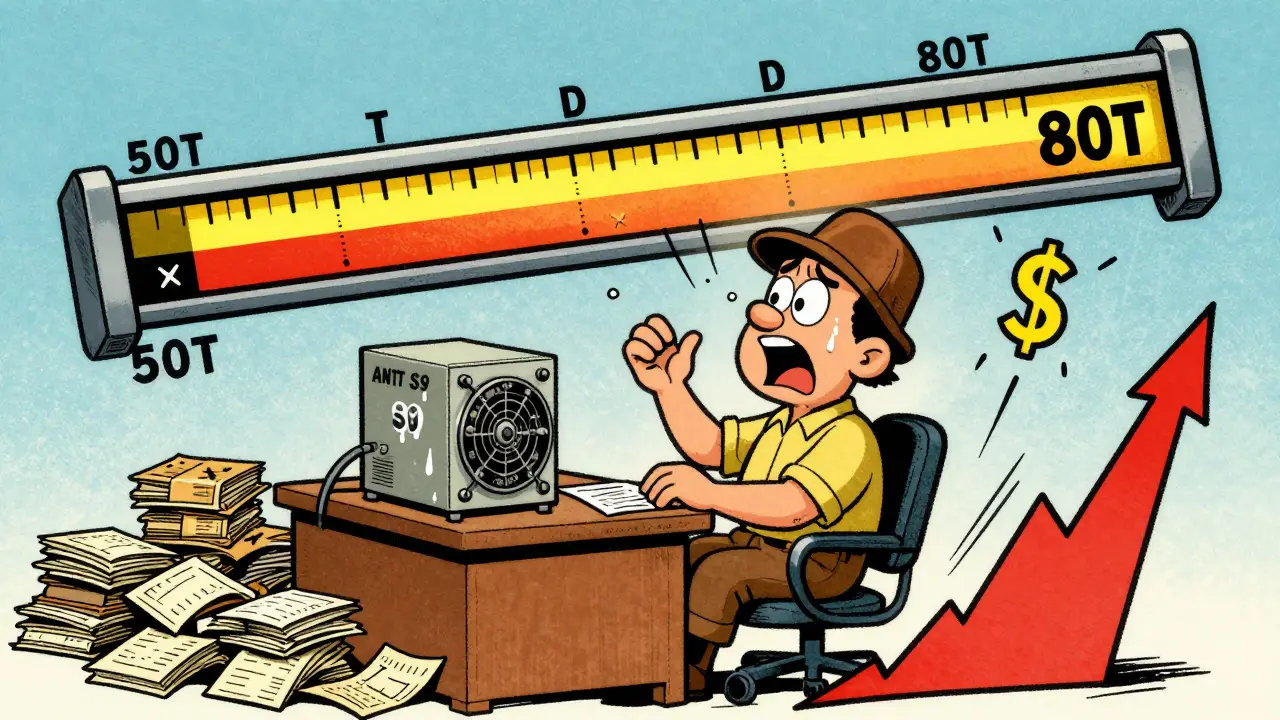
When you hear someone talk about Bitcoin mining, they often focus on the hardware - the loud ASICs, the cooling fans, the electricity bills. But behind all that noise is a quiet, automatic system that decides whether you make money or lose it: mining difficulty. It’s not something you can see, but it’s the reason some miners thrive while others shut down overnight.
What Mining Difficulty Actually Means
Mining difficulty isn’t a number you pick. It’s a self-adjusting target set by the Bitcoin network every two weeks. Think of it like a puzzle. To mine a block, your computer has to find a specific hash - a string of numbers and letters - that’s lower than a moving target. The lower the target, the harder the puzzle. That’s difficulty. When Bitcoin launched in 2009, the difficulty was 1. By December 2012, it hit 1.87 trillion. As of February 2024, it’s over 81.7 trillion. That’s more than 4,000 times harder than it was just over a decade ago. And it keeps climbing. This isn’t random. The network adjusts difficulty every 2,016 blocks - roughly every 14 days - to keep block production steady at about one every 10 minutes. If miners are solving blocks too fast, difficulty goes up. If they’re too slow, it goes down. It’s a feedback loop built into the code.How Difficulty Kills Profits
Here’s the brutal truth: more difficulty doesn’t mean more rewards. Bitcoin’s block reward is fixed. Right now, it’s 6.25 BTC per block. That’s it. No matter how many miners join, no matter how hard the puzzle gets, the total reward stays the same. So if 10 miners are competing for one block, each has a 10% chance. If 100 miners join? Each has a 1% chance. The math is simple: higher difficulty = lower odds of winning. And since electricity and hardware don’t get cheaper when difficulty rises, your profit margin shrinks. A miner with a $3,000 ASIC might break even when difficulty is 50 trillion. But if it jumps to 70 trillion? That same machine might now cost $12 a day in power but only earn $8. Suddenly, it’s a money pit. Many miners don’t realize this until they’re already deep in debt.The Hash Rate Domino Effect
The real driver behind difficulty changes? The total hash rate - the combined computing power of every miner on the network. When Bitcoin’s price spikes, new miners flood in. They buy ASICs, plug them in, and start hashing. The network detects blocks being found faster than every 10 minutes. So, two weeks later, difficulty spikes. Suddenly, the new miners aren’t winning more - they’re just making the puzzle harder for everyone. This creates a cycle:- Bitcoin price rises → more miners join
- Hash rate increases → blocks found too fast
- Difficulty increases → each miner’s chance drops
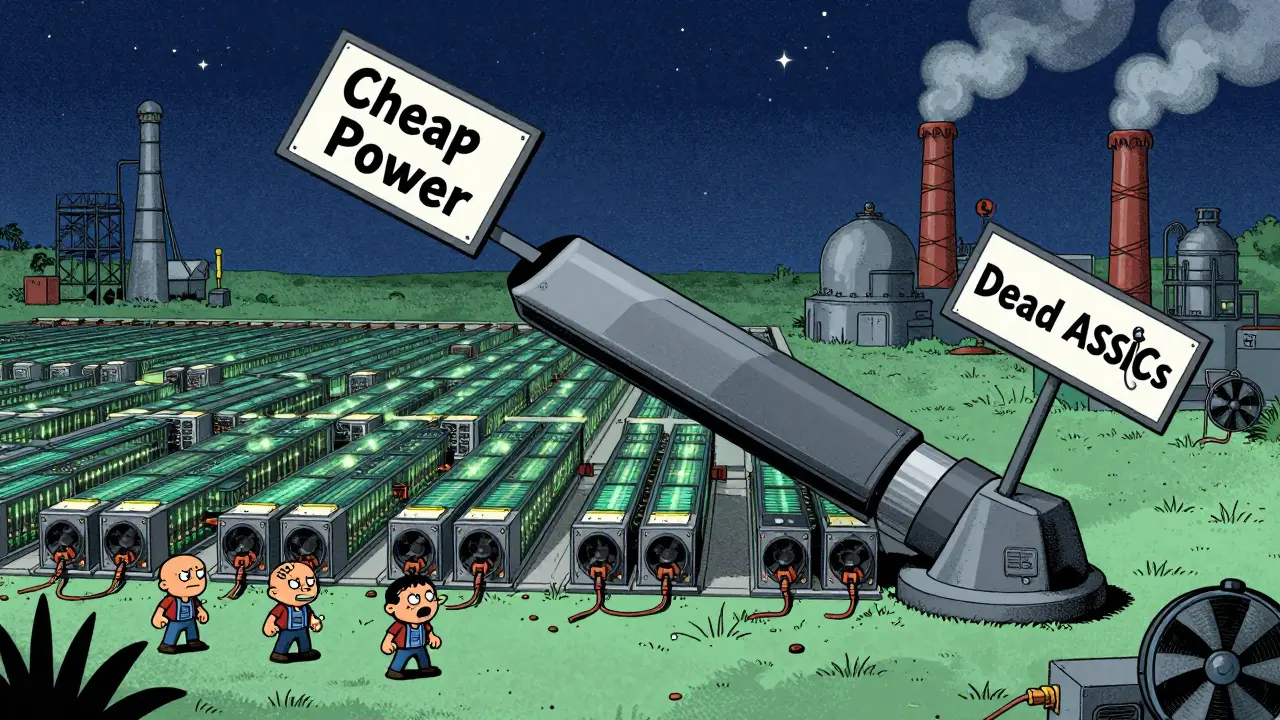
- Less efficient miners shut down
- Hash rate drops → difficulty lowers
- Surviving miners gain market share
Big Miners vs. Small Miners
This isn’t a level playing field. Large mining farms in places like Texas, Kazakhstan, or Georgia have advantages most individuals can’t match:- Access to cheap, surplus electricity (sometimes under $0.02/kWh)
- Industrial cooling systems that cut power waste
- Bulk buying on the latest ASICs (like the Bitmain Antminer S21)
- Teams monitoring difficulty trends and adjusting operations in real time
Hardware Gets Obsolete Fast
Your ASIC isn’t like a smartphone. You can’t just wait for the next model. When difficulty spikes, your machine doesn’t just slow down - it becomes a paperweight. A miner using an Antminer S9 (released in 2017) might have made good money in 2019. But by 2023, even with free electricity, it couldn’t cover its power draw. The efficiency gap between old and new hardware is massive. The S9 does about 14 TH/s (terahashes per second) using 1,320 watts. The latest S21 does 200 TH/s using 3,300 watts. That’s over 14 times more power per watt. So when difficulty climbs, the S9 isn’t just slower - it’s 20x less efficient. It’s not competitive. It’s dead.What Happens When Difficulty Falls?
Difficulty doesn’t only go up. It also drops - and that’s when the real opportunity appears. After Bitcoin’s 2024 halving, prices dipped. Many miners couldn’t cover costs. Thousands shut down. Network hash rate dropped by over 40% in six weeks. The system responded: difficulty fell by 20% in the next adjustment. Suddenly, the miners who stayed - the ones with cheap power and modern rigs - saw their profitability jump. Their hardware, which was barely breaking even, now earned 30-50% more. They didn’t buy new gear. They didn’t change anything. The network did it for them. This is the hidden rhythm of mining: hard times clear the field, then the survivors thrive.
How Miners Plan for Difficulty
Professional miners don’t guess. They calculate. They use tools like Minerstat or WhatsMiner’s profitability calculators to model:- Current difficulty trends
- Projected hash rate growth
- Electricity cost per kWh
- ASIC efficiency (TH/s per watt)
- Bitcoin price forecasts
Security and Centralization: The Dark Side
Higher difficulty makes Bitcoin more secure. It’s harder to attack a network with 800 exahashes of computing power than one with 100. But there’s a trade-off. When only big players can afford to mine, the network becomes vulnerable in a different way. If one company controls 40% of the hash rate, and they decide to go offline - maybe due to regulation, power outage, or internal conflict - the network could be paralyzed. That’s why some experts warn: difficulty doesn’t just affect profits - it affects decentralization. And decentralization is Bitcoin’s whole point.What’s Next?
Bitcoin’s next halving is expected in 2028. After that, the block reward drops again - to 3.125 BTC. Difficulty will keep climbing. Electricity costs won’t drop. ASIC efficiency gains are slowing. The mining industry is heading toward a two-tier system:- Industrial miners: Well-funded, low-cost, global operations
- Exiters: Everyone else
How often does Bitcoin mining difficulty change?
Bitcoin mining difficulty adjusts every 2,016 blocks, which takes about two weeks on average. The system checks how long it took to mine those blocks and compares it to the target of 20,160 minutes (10 minutes per block). If blocks were found faster, difficulty goes up. If slower, it goes down.
Can mining difficulty decrease?
Yes. If miners shut down because Bitcoin’s price drops or electricity costs rise, the network’s total hash rate falls. When blocks start taking longer than 10 minutes to mine, the algorithm automatically lowers difficulty to keep the 10-minute target. This happened after Bitcoin’s 2024 halving when over 40% of the network’s hash rate disappeared.
Why do ASICs become obsolete so quickly?
ASICs are designed for one thing: solving Bitcoin’s cryptographic puzzle as efficiently as possible. When difficulty rises, older ASICs can’t compete because they use more power per hash. For example, an Antminer S9 from 2017 uses 1,320 watts to produce 14 TH/s. Newer models like the S21 use 3,300 watts for 200 TH/s - over 14 times more efficient. When difficulty jumps, the S9 becomes unprofitable even with free electricity.
Is it still possible to mine Bitcoin profitably at home?
Almost never. To mine Bitcoin profitably today, you need electricity under $0.05/kWh, the latest ASIC hardware, and industrial cooling. Most home miners pay $0.10-$0.20/kWh and use outdated equipment. Even if Bitcoin’s price doubles, the math rarely works. Home mining is now a hobby - not a business.
Does higher mining difficulty make Bitcoin more secure?
Yes, but with a catch. Higher difficulty means more total computing power is needed to attack the network, making 51% attacks extremely expensive. However, if difficulty pushes small miners out and concentrates mining in just a few large pools, the network becomes vulnerable to centralized control. Security isn’t just about power - it’s about distribution.
Don B.
February 25, 2026 AT 05:44Arya Dev
February 26, 2026 AT 17:54Leslie Cox
February 28, 2026 AT 11:06Andrew Hadder
March 1, 2026 AT 22:29Derek Sasser
March 2, 2026 AT 21:24Neeti Sharma
March 3, 2026 AT 13:25Nadia Shalaby
March 3, 2026 AT 22:15Fiona Monroe
March 4, 2026 AT 22:30Molley Spencer
March 6, 2026 AT 14:15John Fuller
March 7, 2026 AT 08:30Lucy Simmonds
March 7, 2026 AT 19:40maya keta
March 8, 2026 AT 17:27Curtis Dunnett-Jones
March 8, 2026 AT 19:13bella gonzales
March 10, 2026 AT 10:44