How Mining Difficulty Affects Cryptocurrency Miners
 Feb, 23 2026
When you hear someone talk about Bitcoin mining, they often focus on the rewards - the shiny new coins that drop into a wallet. But behind every coin mined is a hidden force that decides who wins and who gets left behind: mining difficulty. It’s not just a number on a screen. It’s the invisible hand that controls how hard it is to earn those rewards, and it changes everything for miners.
What Mining Difficulty Actually Means
Miners don’t just "find" blocks like digging for treasure. They’re solving a math puzzle - one that requires guessing a number so perfect that when you run it through a cryptographic function, the output starts with a certain string of zeros. The more zeros required, the harder the puzzle. That’s what mining difficulty measures: how many guesses, on average, it takes to find that number.
Bitcoin was designed to produce a new block roughly every 10 minutes. If everyone on the network suddenly got faster computers, blocks would be found in 5 minutes instead. That’s a problem. Too many blocks too fast? The currency’s supply would inflate. Too few? Transactions would pile up. So Bitcoin built in a self-correcting system. Every 2,016 blocks - about every two weeks - the network looks back and asks: "Did we hit our 10-minute target?" If miners found all 2,016 blocks in 14 days, great. If they did it in 12 days? Difficulty goes up. If it took 16 days? Difficulty drops.
As of February 2026, Bitcoin’s difficulty sits at over 95 trillion. That means, on average, miners must try 95 trillion different guesses before one works. In 2012, it was under 2 trillion. That’s a 4,750% increase in just over a decade. That’s not progress - it’s pressure.
How Difficulty Kills Profitability
Let’s say you own a single ASIC miner that does 100 terahashes per second. In 2020, with difficulty at 15 trillion, your miner might have earned you 0.002 BTC per day. Today, with difficulty at 95 trillion, the same machine might only earn 0.0003 BTC per day - an 85% drop in revenue, even though your hardware hasn’t changed.
Why? Because the total hash power on the network has exploded. More miners, more machines, more competition. But the block reward hasn’t changed - it’s still 6.25 BTC per block (after the 2024 halving). That reward is now split among hundreds of thousands of miners instead of a few hundred. Your share? Tiny.
And here’s the kicker: electricity costs don’t go down. If your miner uses 3,200 watts and you pay $0.08 per kWh, you’re spending $7.68 per day just to run it. If it only earns $1.50 worth of Bitcoin, you’re losing $6.18 daily. That’s not mining - that’s paying to play.
The Hardware Arms Race
Miners don’t just sit and wait for difficulty to change. They fight back. Every time difficulty rises, the most efficient miners upgrade. New ASIC chips come out every 6-12 months, promising 30-50% more hash power for the same electricity. The Antminer S21? It does 200 TH/s. The S19? 95 TH/s. The S19 Pro? 110 TH/s. But here’s the trap: when you buy that shiny new miner, you’re not just competing against last year’s models. You’re competing against every other miner who bought one too.
Within 60 days of a major new ASIC launch, the network hash rate spikes. Difficulty follows. Within 90 days, the advantage you thought you had? Gone. You paid $5,000 for a machine that was profitable on day one - but by day 60, it’s barely breaking even. By day 120? It’s a paperweight.
This is why mining has become a business for corporations, not hobbyists. You need to buy in bulk, lock in cheap power, and run 24/7. A home miner with one machine? They’re not mining. They’re gambling.
Who Wins? Who Loses?
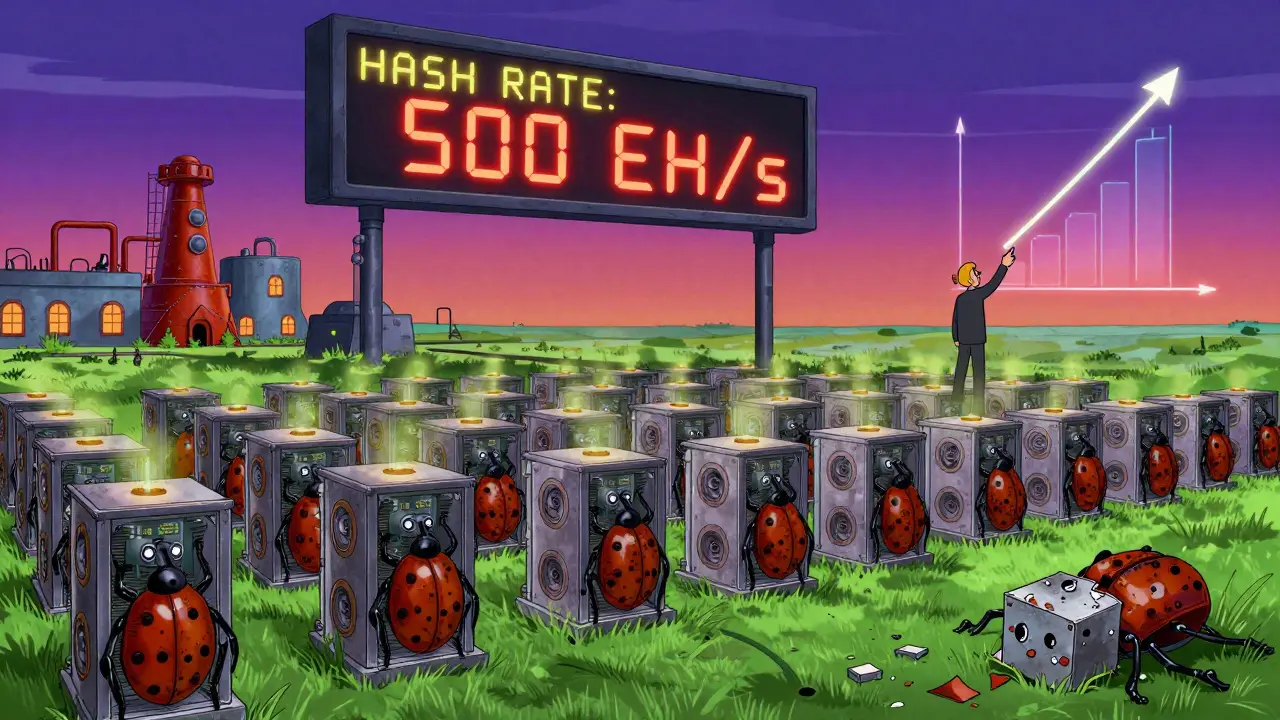
Large mining farms - the kind with warehouses full of ASICs, located near cheap hydroelectric dams in Texas, Kazakhstan, or Georgia - thrive on difficulty increases. They have contracts for electricity at $0.02 per kWh. They have cooling systems that recycle heat. They have teams monitoring difficulty trends and buying new hardware before it even hits the market.
Meanwhile, the solo miner in New Zealand, running a single Antminer in their garage? They’re already losing. Electricity here averages $0.25/kWh. Add in cooling, maintenance, and taxes, and their cost per hash is 3-4x higher than a farm in Canada. When difficulty jumps, they don’t upgrade. They shut down. And they’re not coming back.
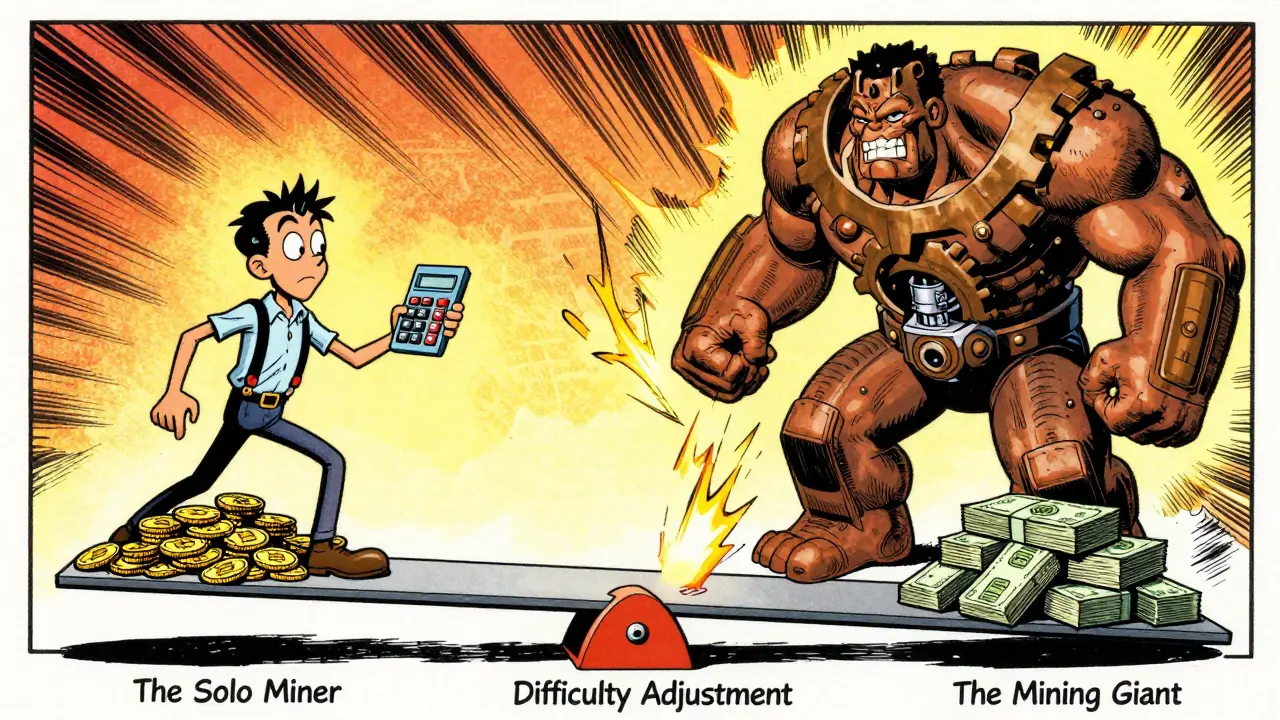
This isn’t just unfair - it’s structural. The system was designed to be decentralized. But difficulty adjustments, combined with hardware cycles, have turned mining into a capital-intensive oligopoly. The more difficulty rises, the fewer miners remain. And those who remain? They control more of the network.
What Happens When Difficulty Drops?
Difficulty doesn’t just go up. It also goes down. And when it does, it’s usually because the market crashed.
Remember 2022? Bitcoin dropped from $69,000 to $16,000. Miners who were barely profitable at $30,000? They couldn’t cover their bills. Thousands of machines were unplugged. Network hash rate fell by 40% in six months. Difficulty adjusted - and dropped 25% in one cycle.
That’s when the survivors came out. The ones with cheap power and efficient gear. They bought up cheap used ASICs from bankrupt miners. They doubled their hash rate. And when Bitcoin climbed back to $60,000? They were ready. They earned 3x more than before the crash.
Difficulty drops are rare. But when they happen, they’re golden. They’re the reset button. The moment the underdogs get a fighting chance.
Security vs. Centralization
Higher difficulty means a more secure network. To attack Bitcoin, you’d need to control over 51% of the total hash rate. At 95 trillion difficulty, that means owning billions of dollars in mining equipment. It’s nearly impossible.
But here’s the trade-off: if 80% of the network’s hash rate is controlled by three mining pools - say, Foundry USA, AntPool, and ViaBTC - then the system isn’t truly decentralized. It’s just centralized under fewer names. That’s a different kind of risk. One that doesn’t come from hackers. It comes from power.
Bitcoin’s design assumes many small miners. Reality? It’s a handful of giants. Difficulty didn’t break decentralization. It just made it harder for regular people to be part of it.
What Miners Can Do
If you’re still mining today, you’re not doing it for fun. You’re doing it because you’ve done the math.
Here’s what works:
- Know your cost per hash. Calculate your electricity cost per TH/s. If it’s above $0.03, you’re in danger.
- Track difficulty trends. Use tools like Minerstat or Blockchain.com’s mining dashboard. If difficulty is rising faster than hash rate, it’s a sign of incoming pressure.
- Don’t buy new hardware unless you’re sure. The ROI window is shrinking. If your new ASIC won’t pay for itself in 12 months, don’t buy it.
- Join a pool. Solo mining is dead. Pools give you steady, small payouts instead of waiting months for a lucky block.
- Plan for the next halving. The next Bitcoin halving is in 2028. That cuts the block reward to 3.125 BTC. If you’re not profitable at 6.25 BTC, you won’t be at 3.125.
Miners who survive aren’t the ones with the most powerful rigs. They’re the ones who understand the numbers - and walk away when the math doesn’t add up.
How often does Bitcoin mining difficulty change?
Bitcoin mining difficulty adjusts every 2,016 blocks, which takes about two weeks on average. The network calculates the total time it took to mine those 2,016 blocks and compares it to the target of 20,160 minutes (10 minutes per block). If blocks were found too quickly, difficulty increases. If too slowly, it decreases. This keeps block times stable even as miners join or leave the network.
Can mining difficulty go down?
Yes. If the total hash rate on the network drops significantly - usually because miners shut down due to low Bitcoin prices or high electricity costs - the difficulty will decrease in the next adjustment cycle. This happened in 2022 after Bitcoin’s price crash, when difficulty fell by over 25% in one cycle. A difficulty drop is often a sign that the market is resetting, giving remaining miners a temporary advantage.
Does higher difficulty mean more secure Bitcoin?
Yes, higher difficulty increases Bitcoin’s security. To launch a 51% attack, a malicious actor would need to control more than half of the network’s total hash power. With difficulty at over 95 trillion, that would require billions of dollars in mining hardware and massive electricity infrastructure - making such an attack economically unfeasible. However, if difficulty rises too much and pushes out small miners, it can lead to centralization, which introduces new security risks.
Why do mining profits drop even if Bitcoin’s price goes up?
When Bitcoin’s price rises, more miners join the network, increasing the total hash rate. This triggers a difficulty increase during the next adjustment cycle. Even though each Bitcoin is worth more, you’re now competing against far more miners. Your share of the block reward shrinks. If your mining equipment isn’t the most efficient, your profit per hash drops - sometimes below zero. Higher prices attract more competition, which can erase your gains.
Is it still worth mining Bitcoin in 2026?
For most individuals, no. Mining Bitcoin today requires access to electricity under $0.05/kWh, bulk-purchased ASICs, and advanced cooling systems. The only profitable operations are large-scale farms in regions with cheap power and favorable regulations. For anyone else - home miners, small setups, or those with standard grid power - the cost of running a miner exceeds its output. The era of profitable solo mining ended years ago. Today, mining is a corporate business, not a hobby.
Don B.
February 25, 2026 AT 05:53Arya Dev
February 26, 2026 AT 01:19Leslie Cox
February 27, 2026 AT 17:37Andrew Hadder
February 27, 2026 AT 22:59Derek Sasser
February 28, 2026 AT 07:19Neeti Sharma
March 1, 2026 AT 00:45Nadia Shalaby
March 1, 2026 AT 02:11Fiona Monroe
March 2, 2026 AT 00:14Molley Spencer
March 2, 2026 AT 17:40John Fuller
March 3, 2026 AT 01:27Lucy Simmonds
March 4, 2026 AT 02:31maya keta
March 4, 2026 AT 15:42Curtis Dunnett-Jones
March 5, 2026 AT 19:25