How OFAC Sanctions Block Iranian Crypto Access to Global Exchanges
 Aug, 3 2026
Imagine trying to send money from Iran to a friend in Europe using Bitcoin. In the early days of crypto, this might have seemed like a loophole around traditional banking restrictions. Today, it is a high-stakes game of cat and mouse. The Office of Foreign Assets Control (OFAC) is the U.S. Treasury Department agency responsible for administering and enforcing economic and trade sanctions based on foreign policy and national security goals has turned its full attention to digital assets. For anyone trying to understand how Iranians access global cryptocurrency markets in 2026, the answer lies in a complex web of blocked wallet addresses, exchange shutdowns, and sophisticated evasion tactics.
The landscape changed dramatically when regulators realized that blockchain transparency could be weaponized against sanctions evasion. What started as vague warnings has evolved into precise enforcement actions targeting specific Ethereum and Tron addresses. If you are an investor, a compliance officer, or simply curious about the intersection of geopolitics and crypto, understanding these mechanisms is crucial. This isn't just about government rules; it's about how technology adapts when pressured by state power.
The Evolution of OFAC’s Digital Enforcement Strategy
To understand where we are in August 2026, we have to look back at how OFAC began treating cryptocurrency not just as a commodity, but as a financial instrument subject to strict controls. The foundation was laid with the cyber-related sanctions program established on April 1, 2015. Initially, this targeted individuals responsible for malicious cyber-enabled activities. However, as ransomware attacks became more common, the focus shifted to how those criminals cashed out.
A pivotal moment occurred on November 28, 2018. The Treasury Department imposed sanctions on two Iranian individuals who facilitated bitcoin ransom payments for the SamSam ransomware scheme. This was historic because it marked the first time OFAC published specific digital currency addresses linked to sanctioned individuals. These facilitators helped convert bitcoin ransoms into Iranian rial, depositing proceeds into local banks. The victims included corporations, hospitals, and universities across the United States, United Kingdom, and Canada.
This move signaled a shift in technical capability. Regulators were no longer just blocking bank accounts; they were leveraging the public ledger of the blockchain. By publishing these addresses, OFAC created a permanent record that exchanges could use for screening. It also sent a clear message: if your wallet address appears on the Specially Designated Nationals (SDN) list, your funds are frozen, and any interaction with them is illegal for U.S. persons and entities.
Major Enforcement Actions in 2025-2026
The stakes have only risen since then. In September 2025, OFAC targeted a massive $600 million Iranian shadow banking network. This wasn't a small operation; it utilized cryptocurrency to launder over $100 million in oil proceeds for Iran's military apparatus, specifically benefiting the Islamic Revolutionary Guard Corps-Qods Force (IRGC-QF) and the Ministry of Defense and Armed Forces Logistics (MODAFL).
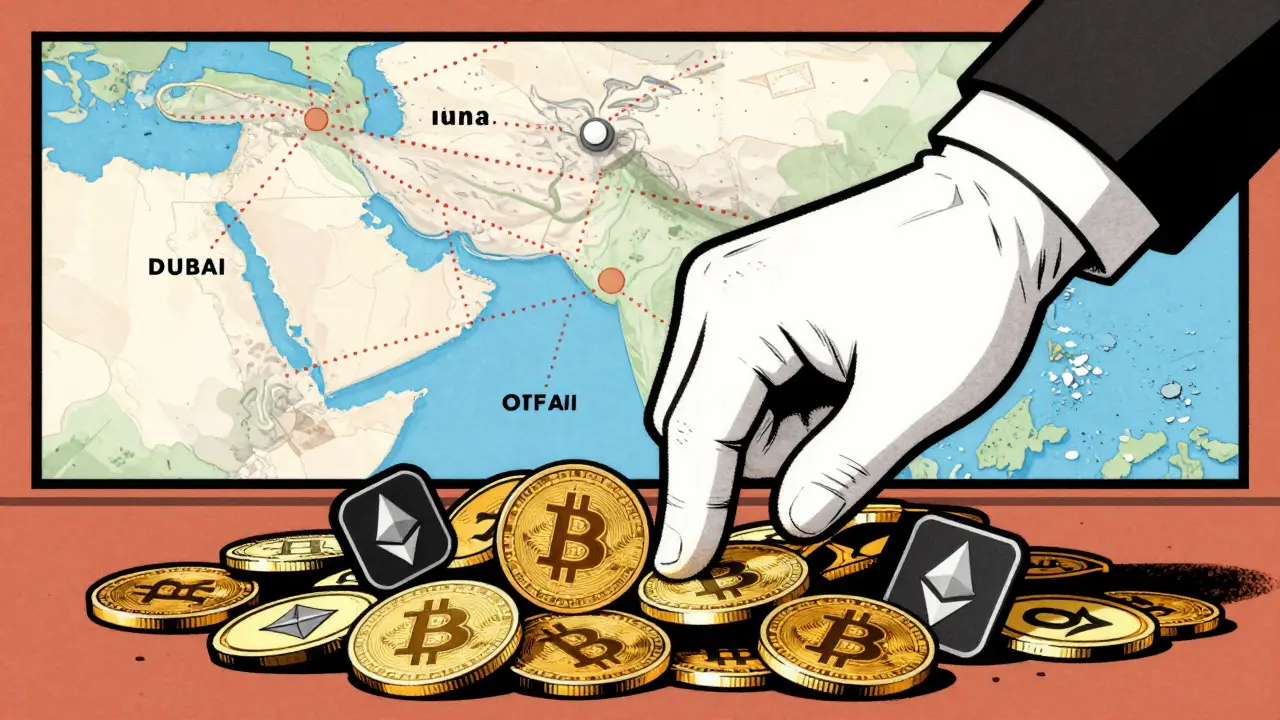
This network spanned multiple jurisdictions, including Hong Kong, the United Arab Emirates, and China. Companies like Shenzhen Jiasibo Technology Co. supplied dual-use military goods through mislabeled routes, while Alpha Trading Co. in Hong Kong served as a financial hub. Blue Sky General Trading LLC in Dubai leveraged the city's commercial status to funnel money while shielding Iranian beneficiaries. The complexity of these schemes highlights why simple geo-blocking is no longer enough for exchanges.
Another significant action involved Arash Estaki Alivand in September 2025. OFAC designated five specific cryptocurrency addresses associated with him:
- Two Ethereum addresses: 0xe3d35f68383732649669aa990832e017340dbca5 and 0x532b77b33a040587e9fd1800088225f99b8b0e8a
- Three Tron addresses: TYDUutYN4YLKUPeT7TG27Yyqw6kNVLq9QZ, TRakpsE1mZjCUMNPyozR4BW2ZtJsF7ZWFN, and TQ5H49Wz3K57zNHmuXVp6uLzFwitxviABs
These designations covered Bitcoin, Ether, Tether, and Tron holdings. This diversification shows how Iranian facilitators spread risk across different blockchains to move funds outside traditional banking systems. For exchanges, this means monitoring must happen across multiple chains simultaneously.
Exchange Compliance and High-Profile Penalties
Cryptocurrency exchanges face immense pressure to comply. Failure to screen transactions can result in crippling fines and operational shutdowns. A stark example is ShapeShift AG, founded by crypto-pioneer Erik Vorhees. On September 20, 2025, ShapeShift agreed to pay $750,000 to settle potential civil liability for sanctions violations spanning nearly two years.
Before ceasing operations in 2021, ShapeShift operated as both market maker and counterparty for transactions involving 79 different digital assets, handling approximately 20,000 daily transactions. Despite its size, it allowed users from Cuba, Iran, Sudan, and Syria to exchange approximately $12,570,956 in cryptocurrency. This case set a precedent: even non-custodial platforms or those claiming decentralization can be held liable if they fail to implement adequate sanctions screening.
| Entity | Date | Violation Type | Penalty/Outcome |
|---|---|---|---|
| ShapeShift AG | Sept 20, 2025 | Facilitating transactions for sanctioned nations (Iran, Cuba, etc.) | $750,000 settlement; ceased operations |
| Garantex/Grinex | March 6, 2025 | Serving sanctioned customers via successor platform | Platform designation; asset freezes |
| Arash Estaki Alivand | Sept 2025 | Shadow banking network facilitation | Designation of 5 specific crypto wallets |
The Rise of Successor Exchanges and Evasion Tactics
If one door closes, another opens-sometimes immediately. The creation of successor exchanges to evade sanctions represents an ongoing challenge for OFAC. When law enforcement took down Garantex on March 6, 2025, led by the U.S. Secret Service, the operators didn't disappear. Instead, they immediately created Grinex infrastructure to continue serving their clients.
Grinex explicitly stated in promotional materials that it was formed in response to sanctions affecting Garantex. Since its launch, the platform has facilitated billions of dollars in cryptocurrency transactions. The scheme involved moving Garantex customer deposits to Grinex and allowing users to regain access through the A7A5 token, a ruble-backed digital asset issued by a Kyrgyzstani firm. This level of agility forces regulators to constantly update their lists and teaches exchanges that static blacklists are insufficient.
Iranian users have also adapted. With major international exchanges implementing geo-blocking and enhanced due diligence, many have migrated to platforms offering enhanced privacy features. Decentralized exchanges (DEXs) and peer-to-peer (P2P) trading networks have become popular alternatives. Privacy-focused cryptocurrencies like Monero, Verge, or Bitcoin Private offer obfuscation tools that make tracking harder, though not impossible for advanced analytics firms.
How Exchanges Screen for Iranian Users
So, how does an exchange actually stop an Iranian user from trading? It’s not just about IP addresses. Sophisticated compliance teams use a multi-layered approach:
- Real-Time Wallet Screening: Every deposit address is checked against OFAC’s SDN list before funds are credited. If a wallet matches a sanctioned address, the transaction is halted.
- Blockchain Analytics Integration: Firms like Chainalysis or Elliptic monitor the history of incoming funds. Even if the immediate wallet isn’t sanctioned, if it received funds from a known Iranian entity months ago, it may be flagged.
- KYC/AML Checks: Know Your Customer (KYC) processes require identity verification. Biometric data, ID documents, and residential proof help determine nationality and residence.
- Behavioral Pattern Analysis: AI tools analyze transaction patterns. Frequent small transfers to/from regions known for sanctions evasion can trigger alerts.
However, these measures aren't perfect. Determined actors use mixers, cross-chain bridges, and privacy coins to obscure trails. This creates a constant arms race between compliance software and evasion techniques.

Impact on Liquidity and Market Access
The practical impact on Iranian crypto access has been substantial. Mainstream centralized exchanges like Coinbase, Binance (global), and Kraken effectively restrict Iranian users through geo-blocking. This pushes users toward smaller, less regulated platforms operating in jurisdictions with limited U.S. oversight.
The downside? Higher costs and lower liquidity. Trading on niche exchanges often means wider bid-ask spreads and slower execution. Additionally, the risk of platform insolvency or regulatory crackdown is higher. For everyday Iranians trying to preserve savings against inflation, this adds friction and cost to what should be a seamless digital process.
Yet, the decentralized nature of cryptocurrency ensures that access never fully disappears. Peer-to-peer networks allow direct trades without intermediaries. While risky, these methods keep the flow of capital alive, albeit in the shadows.
Future Outlook: AI and Enhanced Detection
As we move further into 2026, industry observers predict continued escalation. Blockchain analytics firms are integrating artificial intelligence and machine learning to detect subtle patterns in transaction flows. These tools can identify clustering behaviors typical of Iranian facilitators, even when they use new addresses.
At the same time, privacy-focused cryptocurrencies and decentralized finance (DeFi) protocols present ongoing challenges. DeFi’s permissionless nature makes it hard to enforce sanctions directly on smart contracts. Regulators may need to target the front-end interfaces or stablecoin issuers instead.
For now, the balance tips slightly toward enforcement. The publication of specific wallet addresses creates a lasting deterrent. But as long as there is demand for financial freedom and tools exist to bypass borders, the game will continue.
Can Iranian citizens legally use cryptocurrency exchanges?
Technically, most major global exchanges prohibit Iranian residents due to OFAC sanctions. While owning crypto isn't illegal in Iran itself, accessing U.S.-linked platforms is restricted. Users often resort to P2P networks or offshore exchanges with laxer KYC requirements, though these carry higher risks.
What happens if an exchange accidentally processes a transaction from a sanctioned Iranian wallet?
The exchange faces significant penalties. As seen with ShapeShift, fines can reach hundreds of thousands of dollars. Additionally, the specific funds may be frozen, and the exchange could lose its license to operate in key jurisdictions. Immediate reporting to authorities is required.
How effective is geo-blocking in preventing Iranian access?
Geo-blocking is a first line of defense but easily bypassed using VPNs or proxies. Therefore, exchanges rely more on KYC documentation and blockchain analytics. If a user hides their location but sends funds from a known Iranian wallet cluster, they will still be caught.
Are privacy coins like Monero banned for Iranians?
Not explicitly banned, but heavily scrutinized. Because Monero obscures transaction details, exchanges are hesitant to support it for users from sanctioned countries. Using privacy coins increases the likelihood of being flagged for manual review or having accounts suspended.
What is the SDN list and why does it matter for crypto?
The Specially Designated Nationals (SDN) list includes individuals and companies owned or controlled by, or acting for or on behalf of, targeted countries. For crypto, it includes specific wallet addresses. Any interaction with these addresses by U.S. persons or entities is prohibited, making it a critical tool for enforcement.