How Smart Contracts Work on Ethereum: A Simple Guide
 May, 29 2026
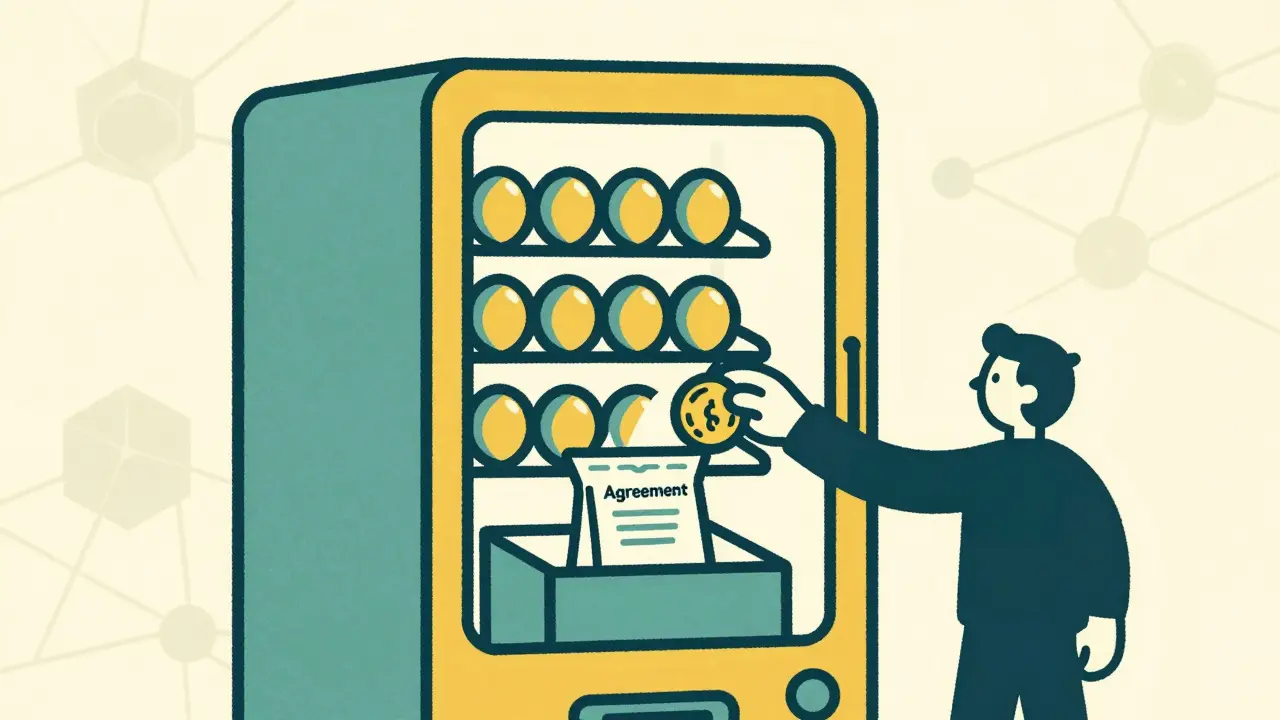
You don't need a lawyer to enforce a digital agreement anymore. You just need code. That is the core promise of smart contracts, which are self-executing programs stored on the Ethereum blockchain that automatically trigger actions when specific conditions are met. Think of them like a vending machine. You put in money and press a button. If the machine has the snack and you paid enough, it gives you the item. No clerk, no negotiation, no waiting for approval. Just pure, automated logic.
This technology changed how we think about trust on the internet. Instead of trusting a bank or a middleman to hold your funds until a deal is done, you trust the code running on a decentralized network. But how does this actually work under the hood? Let’s break down the mechanics without getting lost in heavy jargon.
The Engine Room: The Ethereum Virtual Machine (EVM)
To understand smart contracts, you first have to understand where they live. They don’t run on standard servers like AWS or Google Cloud. They run on the Ethereum Virtual Machine (EVM), a global, decentralized computer that exists across thousands of nodes worldwide. Every node on the Ethereum network runs a copy of the EVM. This means every transaction and contract execution is verified by everyone, everywhere, simultaneously.
When you deploy a smart contract, you aren’t sending an email. You are uploading bytecode-a compiled version of your code-to this global state. Once it’s there, it’s immutable. You can’t change the code after deployment. If you find a bug, you can’t patch it easily; you usually have to deploy a new contract and migrate users over. This permanence is both a feature and a risk.
The EVM processes transactions in a deterministic way. If I send 1 ETH to a contract in New York, and you send 1 ETH to the same contract in Tokyo, the result must be exactly the same for both of us. This consistency is what allows strangers to interact with these contracts safely, knowing the outcome will be predictable based on the inputs.
Anatomy of a Smart Contract
A smart contract isn’t magic. It’s essentially a collection of two things:
- Code (Functions): These are the instructions. What happens if someone sends money? What happens if they try to withdraw before a certain date?
- Data (State): This is the memory. Who owns what? How much balance is left? What is the current price?
These contracts reside at a specific address on the blockchain, just like your personal wallet address. However, unlike a wallet, a contract address has associated code. When you interact with it, you’re calling one of its functions.
For example, imagine a simple escrow contract. The state variables might include `buyerAddress`, `sellerAddress`, and `escrowBalance`. The functions might include `deposit()`, `releaseToSeller()`, and `refundToBuyer()`. The logic inside `releaseToSeller()` might check if the buyer has confirmed receipt. If yes, it moves the funds from the contract’s state to the seller’s wallet. If no, it does nothing. Simple, right?
Writing the Logic: Solidity and Vyper
You can’t write smart contracts in Python or JavaScript directly. The EVM speaks its own language, called EVM bytecode. To make life easier for developers, we use high-level programming languages that compile down to this bytecode. The most popular is Solidity, an object-oriented language similar to JavaScript or C++. Another option is Vyper, a Pythonic language designed for security and simplicity.
In Solidity, you define your contract structure clearly. You specify who can call which functions using modifiers like `onlyOwner` or `require(msg.sender == minter)`. The `msg.sender` variable is crucial-it tells the contract who initiated the transaction. This allows for permission controls within a permissionless system.
Here is a simplified mental model of how the code looks:
- Define State: Set up variables to track balances or ownership.
- Define Functions: Write the logic for interacting with those variables.
- Add Checks: Use `require()` statements to ensure conditions are met before any action occurs. For instance, `require(balance >= amount)` ensures you can’t spend more than you have.
Before deployment, this code must be compiled. Tools like Remix IDE, Hardhat, or Foundry help developers write, test, and compile their contracts. Compilation converts human-readable Solidity into machine-readable bytecode that the EVM can execute.
Deployment and Gas Fees
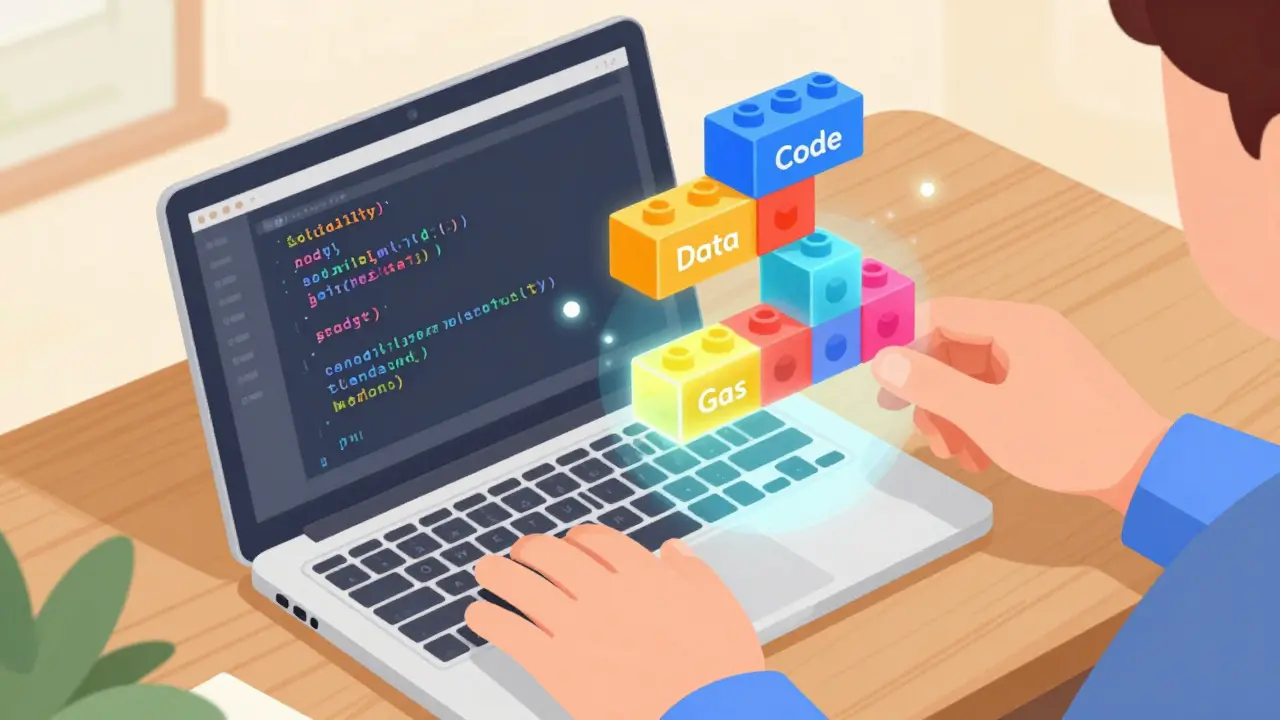
Deploying a smart contract is technically a transaction. You write the code, compile it, and send it to the Ethereum network. Because this requires computational power from the network’s nodes, you have to pay for it. This payment is called gas, measured in Gwei (a fraction of Ether).
Gas fees cover two costs: storage and computation. Storing data on the blockchain is expensive because every node must keep a copy forever. Computation is cheaper but still costs gas. Deploying a complex contract can cost hundreds of dollars during peak times, while a simple transfer might cost pennies. This economic layer prevents spam and abuse. If someone tried to clog the network with infinite loops, they would quickly go bankrupt paying gas.
Once deployed, the contract gets a permanent address. It lives on the blockchain forever (or until the network shuts down). Anyone can find it, read its code, and interact with it. There is no "private" smart contract on Ethereum. Transparency is mandatory.
Composability: Money Legos
One of the most powerful features of Ethereum smart contracts is composability. Since all contracts are public and standardized, one contract can easily call another. Developers often call this "Money Legos."
Imagine a decentralized exchange (DEX) like Uniswap. It doesn’t need to build its own token standards. It uses existing ERC-20 tokens. A lending protocol like Aave doesn’t need to create its own oracle for prices; it connects to Chainlink. A DAO doesn’t need to build voting from scratch; it uses OpenZeppelin’s governance libraries.
This interoperability creates a rich ecosystem. New applications can be built rapidly by combining existing, battle-tested components. If a new DeFi protocol launches, it can immediately integrate with liquidity pools, staking platforms, and NFT marketplaces simply by calling their public interfaces.
| Component | Function | Key Characteristic |
|---|---|---|
| EVM | Execution Environment | Global, deterministic, runs on every node |
| Solidity | Programming Language | High-level, compiles to bytecode, widely used |
| Gas | Currency for Computation | Paid in ETH, prevents spam, varies by demand |
| Oracle | Off-chain Data Bridge | Feeds real-world data (prices, weather) to contracts |
Limitations and Real-World Data
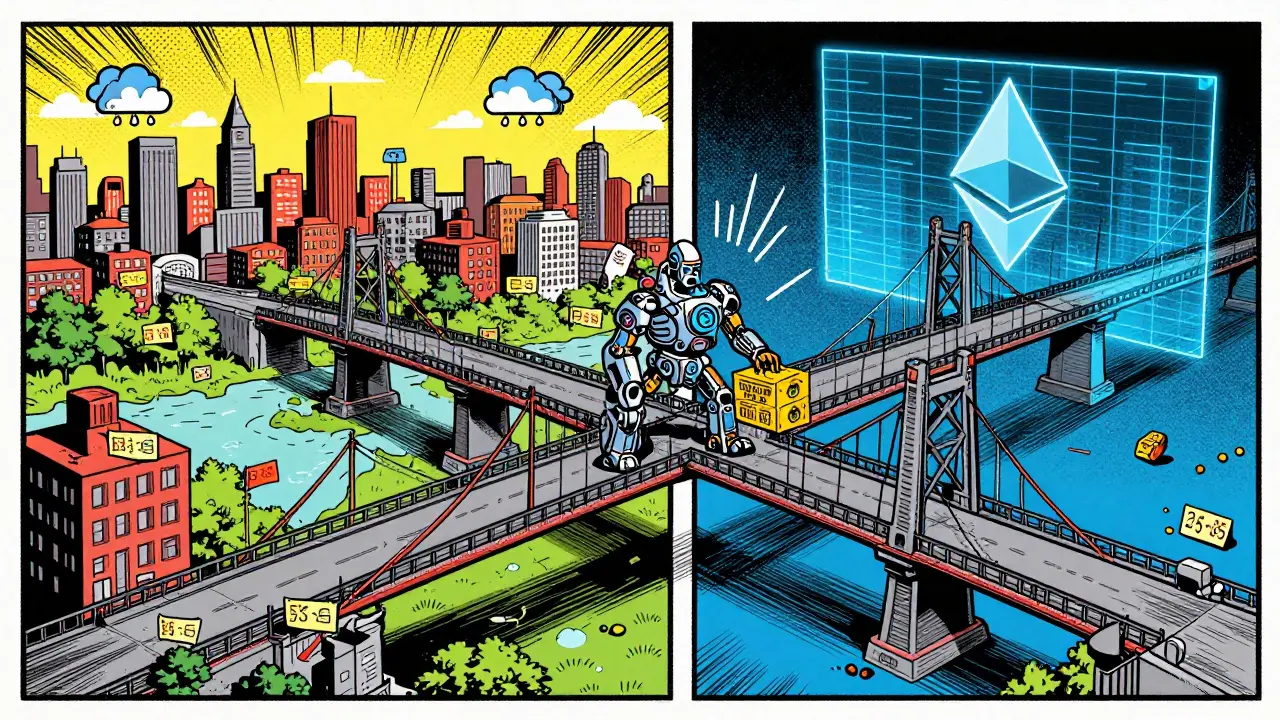
Smart contracts are powerful, but they are not omniscient. A major limitation is that they cannot access off-chain data directly. A contract cannot look up the current price of Bitcoin, check the weather in Wellington, or verify if a shipment arrived. Doing so would break consensus-nodes couldn’t agree on the truth if they relied on external, unverified sources.
To solve this, we use oracles, specialized services that fetch data from the outside world and feed it into the blockchain. Chainlink is the most prominent oracle network. It aggregates data from multiple sources to ensure accuracy and security. Without oracles, smart contracts would be isolated islands, unable to react to real-world events.
Another hard limit is the contract size. Ethereum imposes a maximum bytecode size of 24KB. If your contract exceeds this, it fails to deploy. Developers work around this by splitting logic into multiple smaller contracts or using proxy patterns, where a small contract points to a larger implementation library.
Security and Immutability Risks
Because smart contracts are immutable, bugs are catastrophic. You can’t issue a hotfix. If a hacker finds a vulnerability, they can drain the funds, and there’s no customer support line to call. Several billion dollars have been lost due to coding errors, reentrancy attacks, and integer overflows.
This is why auditing is critical. Before deploying, professional firms review the code line-by-line. They look for edge cases and logical flaws. Even then, risks remain. The principle of "code is law" means the code executes exactly as written, not necessarily as intended. Always assume that once deployed, your contract is set in stone.
Token Standards: ERC-20 and ERC-721
Most interactions on Ethereum involve tokens. These tokens are just smart contracts following specific rules, known as standards. The two most common are:
- ERC-20: The standard for fungible tokens. Each unit is identical and interchangeable, like US Dollars or Bitcoin. Used for currencies, governance tokens, and stablecoins.
- ERC-721: The standard for non-fungible tokens (NFTs). Each token is unique, like a deed to a house or a rare trading card. Used for art, collectibles, and property rights.
These standards ensure compatibility. Any wallet or exchange that supports ERC-20 can handle any ERC-20 token without needing custom integration. This uniformity drives adoption and ease of use across the entire ecosystem.
Next Steps for Developers
If you want to start building, begin with Remix IDE. It’s a browser-based tool that lets you write, compile, and deploy contracts without installing anything. Start with a simple "Hello World" contract that stores and retrieves a string. Then move to a basic ERC-20 token. Test everything on a testnet like Sepolia or Goerli before touching mainnet ETH.
Learn to read error messages. Understand gas optimization. Study past hacks to avoid repeating mistakes. The barrier to entry is low, but the mastery curve is steep. With practice, you’ll see how these digital agreements can automate trust, reduce friction, and create entirely new economic models.
What is a smart contract in simple terms?
A smart contract is a self-executing program on the blockchain that automatically enforces the terms of an agreement when predefined conditions are met, eliminating the need for intermediaries.
Can smart contracts be hacked?
Yes. If the code contains vulnerabilities, hackers can exploit them. Since contracts are immutable, stolen funds are often unrecoverable. Audits and rigorous testing are essential to minimize risk.
Why do smart contracts need gas fees?
Gas fees compensate miners and validators for the computational power and storage required to process and store the contract's execution on the network. They also prevent spam and denial-of-service attacks.
What is the difference between Solidity and Vyper?
Solidity is a feature-rich, JavaScript-like language widely used for complex contracts. Vyper is a Pythonic language focused on simplicity and security, stripping away complex features that could lead to bugs.
How do smart contracts get real-world data?
They use oracles, such as Chainlink, which act as bridges between the blockchain and external APIs, feeding verified off-chain data into the smart contract securely.