How to Buy Crypto for Fiat in Russia: 2026 Guide
 Apr, 20 2026
Whether you are looking to hedge against inflation or move funds across borders, you need a strategy that doesn't get your bank account flagged. You can't just wing it with a random transfer. You need to understand the current 'color-coded' banking system and which platforms actually maintain liquidity in 2026.
| Method | Best For | Avg. Speed | Typical Fees |
|---|---|---|---|
| P2P Trading | Large amounts & best rates | 10-30 mins | 0.5% - 2.0% |
| Instant Card/Wallet | Small amounts & speed | 5-15 mins | 1.5% - 3.9% |
| Physical Cash | Maximum privacy/High value | Instant (at office) | Varies |
Choosing Your Gateway: Where to Buy
Not all platforms are created equal when it comes to the Ruble. Depending on your risk tolerance and the amount of money you're moving, you'll want to pick a different door.
For those who want a "set it and forget it" experience, Bitget Wallet is a non-custodial gateway that supports over 130 blockchains and integrates directly with the National Payment Card System (NSPK) . This means you can often use your MIR card for instant processing. If you're looking for something even faster and don't care about trading tools, ChangeNOW offers a streamlined path where you can swap fiat for crypto in about 5 minutes without even creating an account.
Then there are the heavy hitters. Bybit has become the dominant force in the P2P market. They don't hold your money; instead, they connect you directly with other users who have RUB. For those who prefer the old-school approach, Bitbanker is a native Russian exchange that actually has physical offices in Moscow, Dubai, and Bishkek. If you have a suitcase of cash and want Bitcoin, this is your best bet.
The P2P Playbook: Mastering the 'Color Codes'
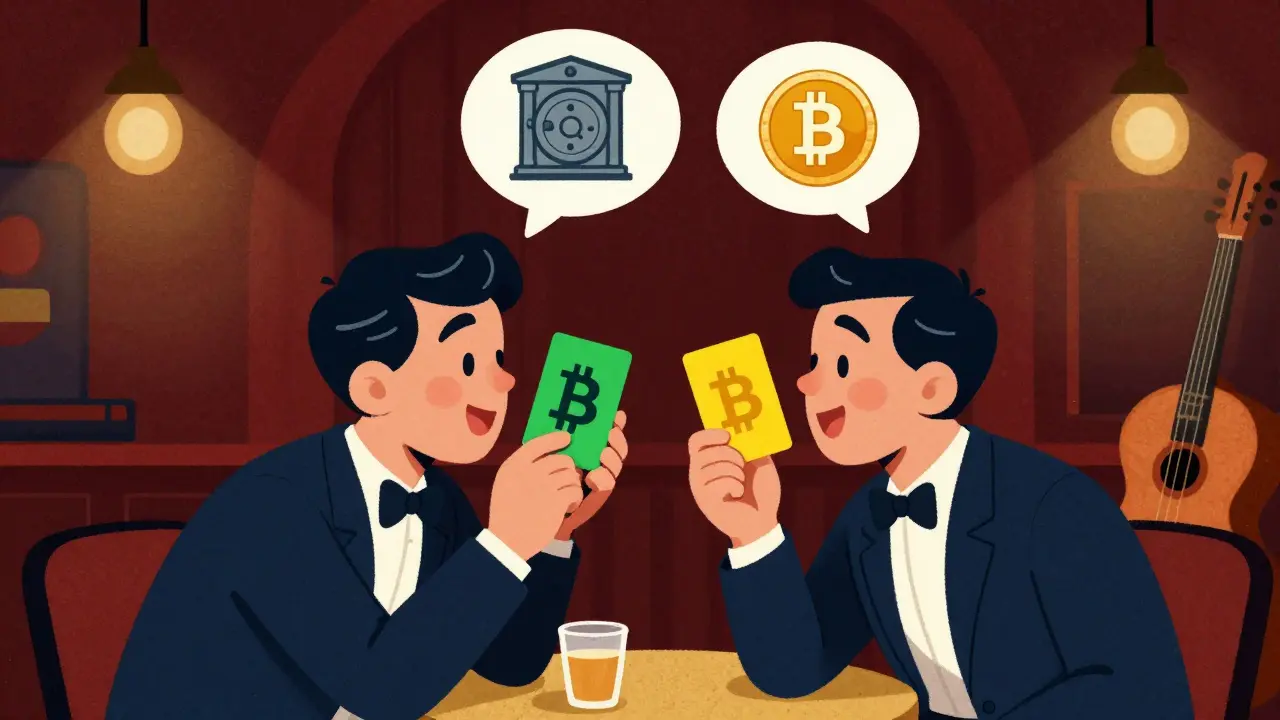
If you've decided to use a P2P (Peer-to-Peer) marketplace, you'll notice something strange in the payment methods. You won't always see the bank's name explicitly listed. Instead, you'll see colors. Why? Because it's a subtle way to navigate banking restrictions.
In the current ecosystem, "Green Card" almost always refers to Sberbank, while "Yellow Card" is the shorthand for T-Bank (formerly Tinkoff). Knowing this is critical because choosing the wrong one can lead to a failed transaction or, worse, a blocked account. Based on community data, T-Bank generally has a higher success rate-around 92%-compared to Sberbank's 87%.
To stay safe during a P2P trade, follow these three non-negotiable rules:
- Check the Completion Rate: Never trade with someone who has less than a 95% completion rate.
- Verify Volume: Ensure the seller has completed at least 50 transactions.
- Never Release Early: Do not click "Release Crypto" until you have physically seen the money arrive in your bank app and verified the sender's name.
Navigating KYC and Legal Limits
You can't stay completely anonymous if you're using fiat. Russian law, specifically Federal Law No. 115-FZ, requires exchanges to verify who you are. This is the Know Your Customer (KYC) process.
To get verified, you'll need your Russian passport and your INN (Taxpayer Identification Number). If you skip this, you're severely limited. Non-verified accounts are generally capped at 600,000 RUB per day. Once you're fully verified, that limit jumps to 5,000,000 RUB. Be prepared for a wait; verification typically takes between 12 and 48 hours, though some users report delays up to 28 hours during peak volatility.
It is also worth mentioning the Digital Ruble. Launched by the Central Bank, this isn't a replacement for Bitcoin or Tether. Instead, it's a state-backed digital currency. While it's great for domestic payments, most people still use private cryptocurrencies for cross-border moves because the Digital Ruble is designed for internal sovereignty, not global fluidity.
Step-by-Step: Buying Your First USDT
Let's walk through the most common path: buying USDT on a P2P platform like Bybit.
- Account Setup: Register and complete your KYC verification. You can't touch the P2P market without it.
- Navigate to P2P: Go to 'Buy Crypto' and select 'P2P Trading'.
- Filter Your Search: Select 'Buy' and choose USDT as the coin. Set your currency to RUB.
- Pick Your Bank: Filter by the 'color' of your card (e.g., Yellow for T-Bank).
- Select a Reputable Seller: Look for that 95%+ completion rate and 50+ trades.
- Initiate the Trade: Enter the amount of RUB you want to spend. The platform will lock the crypto in escrow.
- Send the Payment: Transfer the RUB via your banking app to the seller's provided details.
- Confirm and Receive: Once the seller confirms receipt, the crypto is released to your wallet.

Common Pitfalls and How to Avoid Them
The biggest mistake beginners make is the "payment mismatch." This happens when you select a Sberbank seller but try to pay from a T-Bank account. This is a huge red flag for sellers and often leads to instant cancellations or disputes. Always match your bank to the seller's requested method.
Another issue is the "reverse payment" scam. Some fraudulent buyers try to trick you into releasing the crypto and then immediately call their bank to claim the transfer was an error. This is why the escrow system is your best friend. Never move the transaction off-platform. If a seller asks you to chat on Telegram or WhatsApp to "save on fees," walk away immediately.
Finally, keep an eye on the tax man. Currently, there is a lot of confusion regarding how to declare crypto assets. While ownership is legal, the lack of clear guidelines means about 78% of users are unsure how to report their gains. Keep a detailed log of every transaction and the RUB exchange rate at the time of purchase to make your life easier when tax season hits.
Is it legal to own cryptocurrency in Russia in 2026?
Yes, owning cryptocurrency is legal. However, using it as a direct means of payment for goods and services within Russia remains restricted. It is primarily treated as a digital asset for investment or transfer purposes.
Which Russian bank is best for buying crypto?
T-Bank (formerly Tinkoff) is generally preferred by the community due to its higher transaction success rate (approx. 92%) and more user-friendly interface for P2P transfers compared to Sberbank.
How long does KYC verification typically take?
Most platforms like Bitbanker or Bybit take between 12 and 48 hours to verify a Russian passport and INN, though it can occasionally take longer during periods of high market volatility.
What is the 'Green Card' and 'Yellow Card' system?
This is an informal coding system used on P2P platforms to identify banks without naming them. Green typically represents Sberbank, and Yellow represents T-Bank (Tinkoff).
Can I buy crypto without KYC?
Limited options exist. Services like ChangeNOW allow some instant swaps without an account, but for any significant volume or use of a centralized exchange's P2P market, KYC is mandatory under Federal Law No. 115-FZ.
What's Next?
If you're moving large sums, your next step should be exploring non-custodial wallets like Trust Wallet to ensure you have full control over your private keys. If you're a high-net-worth individual, consider scheduling a visit to a physical cash-to-crypto office in Moscow to avoid the digital paper trail of bank transfers.
For those worried about the evolving legal landscape, keep an eye on Federal Bill No. 45877-8. Once passed, it should clarify the tax treatment of digital assets, making it much easier to manage your portfolio without fearing a surprise audit from the tax authorities.
Sarah Fisher
April 21, 2026 AT 15:42The whole concept of 'color-coding' banks to avoid detection is such a fascinating glimpse into how humans adapt to systemic pressure. It's almost like a digital secret language evolving in real-time to preserve financial autonomy.
Mike Krasner
April 22, 2026 AT 15:46who actually trusts bybit these days lol
Greg Reynolds
April 24, 2026 AT 03:28The assertion that T-Bank has a higher success rate is purely anecdotal based on 'community data,' which is hardly a statistically significant metric. One should consider the liquidity depth and the actual settlement times rather than just a percentage of successful transfers.
Jennifer Taylor
April 25, 2026 AT 23:51This is all just a trap. The government wants you to use these apps so they can track every single cent you move. Once the Digital Ruble is fully pushed, they will just flip a switch and freeze everyone who tried to be smart with USDT.
praveen subbiah
April 26, 2026 AT 17:43Truly incredible to see how the world tries to copy the brilliance of Indian digital payment systems! My India is leading the way in UPI and digital transformation, and it is simply marvelous that other nations are now struggling to implement similar peer-to-peer efficiencies in their own markets!
Robert Mosolygo
April 27, 2026 AT 17:37Anyone following the 115-FZ updates knows that the 'verification' process is just a data harvesting exercise for the FSB. You are essentially handing over your INN and passport to a platform that will inevitably leak your data during the next state-mandated audit. The risk-to-reward ratio here is abysmal for anyone who actually understands how the current geopolitical surveillance apparatus operates.
Liz Ariza
April 28, 2026 AT 20:33Just a little reminder to everyone to be super careful with those P2P trades! 🌟 Please double-check those names before hitting send so you don't get caught in a funky situation 💖 Stay safe and keep your assets sparkling! ✨
Kathleen Bergin
April 29, 2026 AT 09:08Everyone knows that Bitbanker is the only real way to do this if you have actual cash. P2P is too risky for people who don't know what they are doing.
Ali Tate
April 29, 2026 AT 12:23Imagine needing a 'color code' just to move your own wealth across a border how absolutely plebeian. In the colonies we just call this basic survival but the sheer lack of sophistication in the RUB market is practically poetic
Alex Wan
May 1, 2026 AT 09:52I must laement the fact that many novvices may overlook the importance of the escrow system. It is absolutly vital that one does not release funds prematurly, as the dramatic loss of capital can be truly devastating to a beginnner's portfolio!
Tony Gurley-Ward
May 3, 2026 AT 03:46The 'Digital Ruble' is just a fancy mirror for the same old cage. Why do we believe that a state-backed token is any different from a bank entry? It's just electronic lipstick on a pig, my friends. Let's embrace the chaos of the decentralization instead of trusting a government's version of a blockchain.
Gary Lingrel
May 3, 2026 AT 07:33honestly who cares about the tax man when the whole system is rigged anyway :)
Lisa Camp
May 4, 2026 AT 17:08STOP OVERTHINKING AND JUST BUY THE DIP! Either you use the P2P market or you stay broke while the rest of us make moves! Get your KYC done and stop complaining about 'privacy' while you're using a smartphone!
Clair Geary
May 5, 2026 AT 16:53The part about the physical offices in Moscow is so interesting... it's kind of wild that in 2026 we're still talking about suitcases of cash for the best privacy! Love how the old world and new world are smashing together here
Alex Hunter
May 7, 2026 AT 10:15For those who are nervous about the KYC process, just remember that the limits for non-verified accounts are actually quite generous for small-scale investors. It's a good way to dip your toes in without feeling completely exposed right away. Just take it slow and verify your sources.
Mike Word
May 7, 2026 AT 10:17The mention of Federal Bill No. 45877-8 is quite a specific detail. It would be interesting to see if the actual implementation aligns with the promised tax clarifications or if it just adds more layers of bureaucracy to the reporting process.