Hyperliquid Crypto Exchange Review: Speed vs Security in Decentralized Trading
 Feb, 16 2026
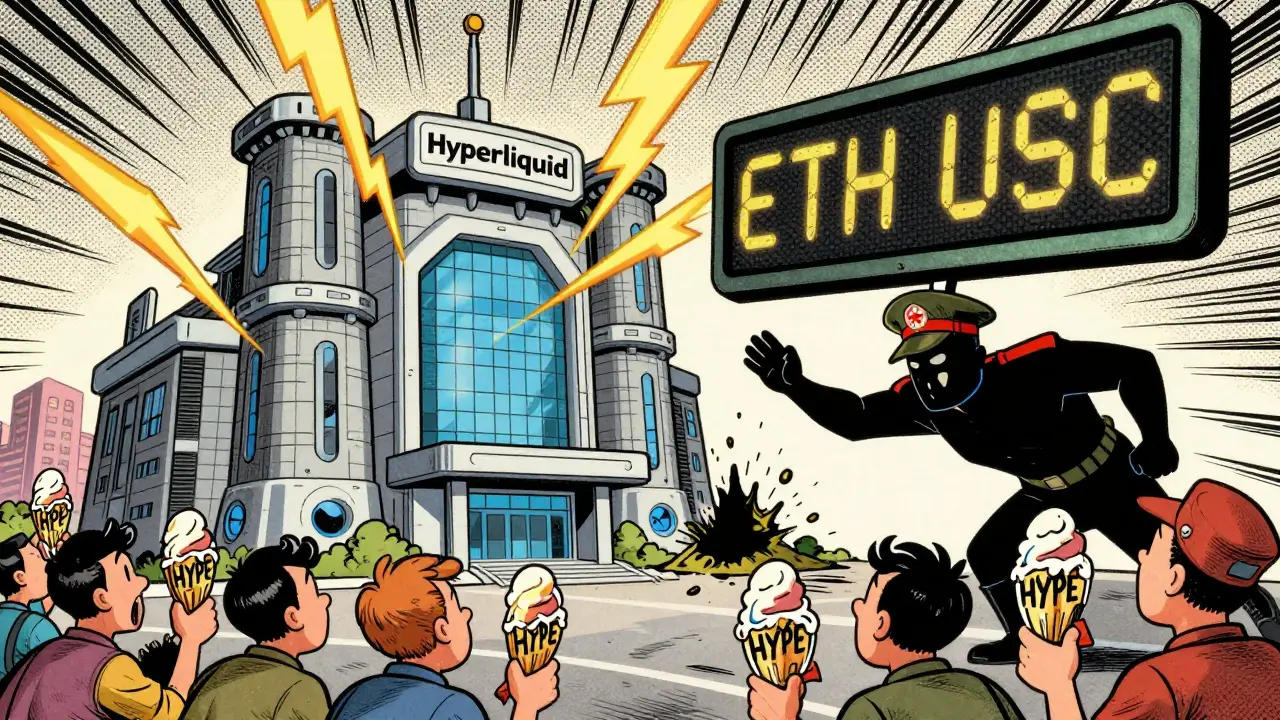
When you hear "hype crypto exchange," chances are you're thinking of Hyperliquid. It’s not just another decentralized exchange (DEX). It’s built on its own blockchain, promises lightning-fast trades, and claims to blend Ethereum’s familiarity with next-gen speed. But here’s the real question: is it safe to use? After a $700,000 hack by North Korean hackers in December 2024, the answer isn’t as clear as the platform’s marketing suggests.
What Is Hyperliquid?
Hyperliquid is a decentralized exchange built on its own Layer 1 blockchain, not Ethereum, Solana, or any other existing network. That’s unusual. Most DEXs rely on established chains to get users and security. Hyperliquid chose to build from scratch. Why? To control every layer - from transaction speed to fee structure.
It supports top cryptocurrencies: Bitcoin, Ethereum, Solana, Avalanche, and Sui. You can trade spot and perpetual futures with up to 100x leverage. Its two core protocols - HyperEVM and a custom Ethereum Virtual Machine designed for high throughput and HyperBFT and a Byzantine Fault Tolerance consensus engine that processes blocks in under 500 milliseconds - are meant to handle thousands of trades per second. That’s faster than most centralized exchanges.
But speed doesn’t mean safety. And that’s where things get messy.
The HYPE Token Crash: A $700,000 Hack That Shook the Market
In December 2024, Hyperliquid was hit. Not by a random hacker. Not by a script kiddie. By North Korean state-sponsored cybercriminals - the same group behind the $600 million Ronin Bridge heist and the $100 million Axie Infinity attack.
They didn’t break into a server. They didn’t exploit a bug in the code. They used a technique called "front-running" - placing trades ahead of large orders to manipulate prices. Because Hyperliquid’s validator nodes were too centralized, a small group of nodes could see, delay, and reorder transactions. The hackers exploited this to steal over $700,000 in ETH and USDC.
The fallout was immediate. The HYPE token, which had been trading at $27.45, dropped 18.7% in 24 hours. Trading volume plunged. Users started pulling funds. The incident exposed a fatal flaw: a DEX can be fast, but if its validation system is centralized, it’s just a centralized exchange with a blockchain label.
Why Validator Centralization Is a Dealbreaker
Decentralization isn’t just a buzzword. It’s the whole point of a DEX. If one or two validators control the network, they can:
- Delay your trades
- Reorder them to profit
- Freeze withdrawals
- Even censor transactions
Hyperliquid had around 20 validators at the time of the hack. A few of them were controlled by the same entity. That’s not decentralization. That’s a single point of failure - and hackers know where to strike.
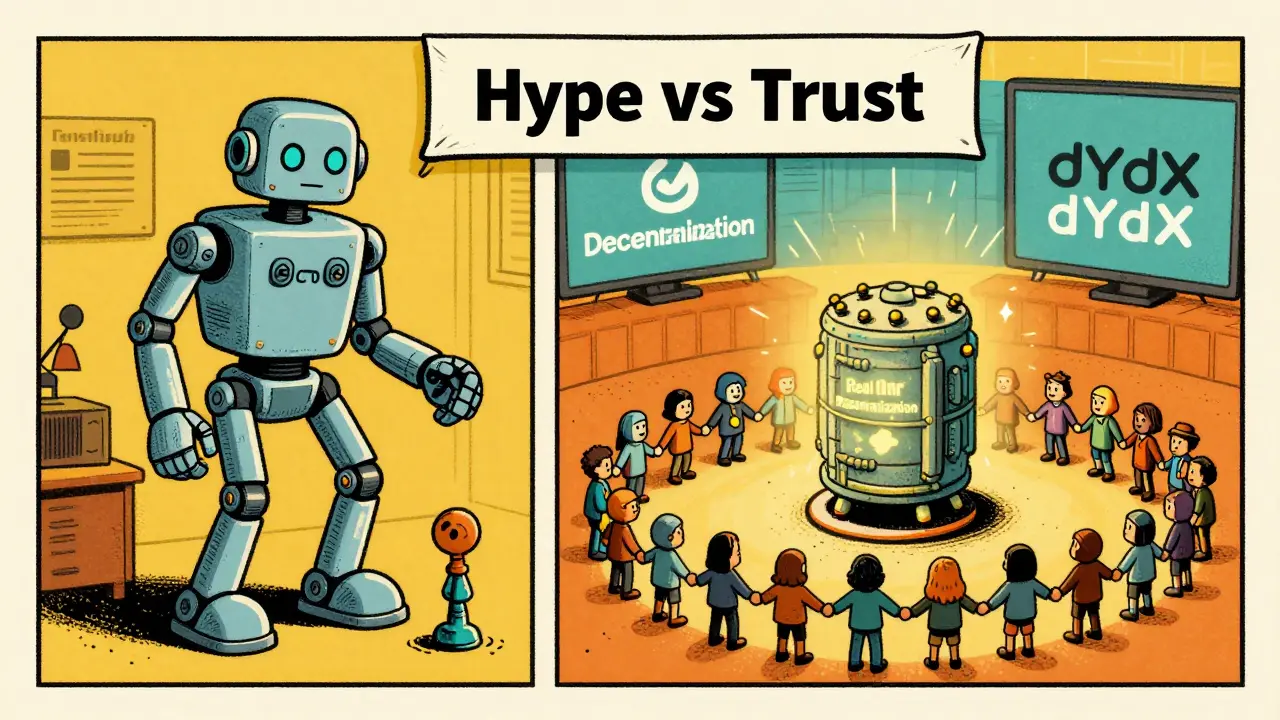
Compare that to Uniswap or dYdX. They use hundreds of independent validators spread across continents. Even if one goes down, the network keeps running. Hyperliquid’s setup is more like a private club than a public network.
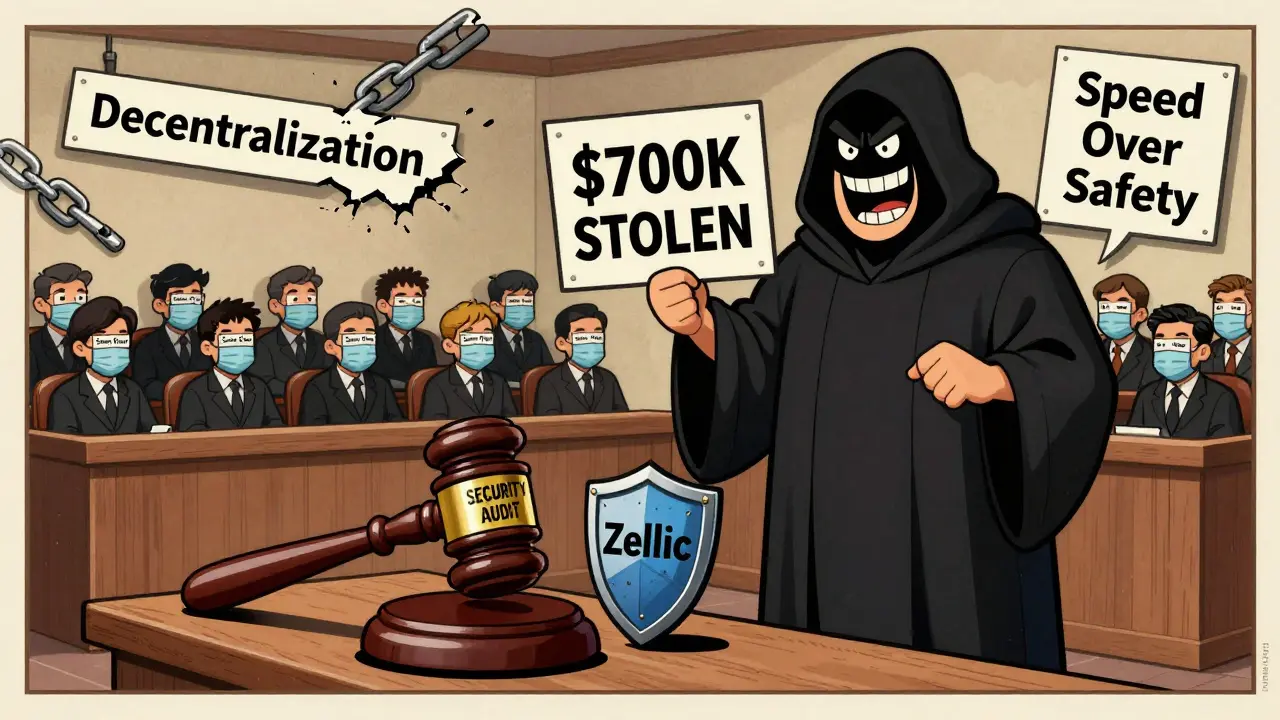
Security Audits: Did Zellic Really Protect You?
Hyperliquid claimed it was audited by Zellic - a respected firm. But audits are snapshots. They check code at one moment in time. They don’t predict how a nation-state actor will adapt months later.
Zellic’s audit didn’t cover validator behavior. It didn’t test for front-running under real market conditions. It didn’t simulate coordinated attacks. And that’s the problem. Many DEXs rely on audits like a seatbelt - it helps, but it won’t save you if you’re driving into a wall at 100 mph.
Real security isn’t about one audit. It’s about:
- Continuous monitoring
- Behavioral anomaly detection
- On-chain transaction filtering
- Multi-layered defense
Hyperliquid had none of that.
What Should You Do Before Using Hyperliquid?
Here’s how to protect yourself if you’re still considering Hyperliquid:
- Never store large amounts on the exchange. Use a cold wallet - Ledger, Trezor, or a hardware device you control. Hot wallets on exchanges are easy targets.
- Enable 2FA everywhere. Google Authenticator or Authy, not SMS. SMS can be intercepted.
- Check the URL. Phishing sites look identical. Bookmark the real site: https://hyperliquid.xyz. Never click links from Twitter or Discord.
- Watch for reimbursement policies. Did Hyperliquid promise to cover losses? No. Unlike Kraken or Coinbase, which have insurance funds, Hyperliquid leaves users on their own.
- Monitor news. The December 2024 hack wasn’t the end. If validator decentralization hasn’t improved by early 2026, avoid it.
How Hyperliquid Compares to Other Exchanges
| Exchange | Layer | Validators | 2FA Support | Reimbursement Policy | Recent Security Incidents |
|---|---|---|---|---|---|
| Hyperliquid | Custom Layer 1 | ~20 (centralized) | Yes | No | $700K hack (Dec 2024) |
| Uniswap | Ethereum | 1000+ (decentralized) | Yes (wallet-level) | No | None |
| dYdX | Ethereum Layer 2 | 100+ (decentralized) | Yes | No | None |
| Kraken | Centralized | N/A | Yes | Yes (insurance fund) | $35M hack (2022) - reimbursed |
Notice something? The most secure exchanges aren’t the fastest. They’re the ones with distributed infrastructure, proven track records, and user protections. Hyperliquid trades speed for risk. And right now, that risk isn’t worth it.
The Bigger Picture: Why New DEXs Keep Failing
Hyperliquid isn’t alone. Every year, a dozen new DEXs launch with bold claims. Most fail within months. Why?
- They focus on features, not fundamentals.
- They skip decentralization to save time.
- They assume audits = safety.
- They ignore that hackers evolve faster than code.
The best exchanges - like Kraken, Coinbase, and even Uniswap - didn’t become trusted overnight. They built trust slowly: by getting hacked, learning, and improving. Hyperliquid hasn’t shown that kind of resilience. It’s still in the "hype" phase. And hype doesn’t pay your losses.
Final Verdict: Avoid - For Now
Hyperliquid has the tech. It has the speed. But it lacks the security DNA. Until it:
- Increases validator count to 100+ with true decentralization
- Adopts Distributed Validator Technology (DVT)
- Starts reimbursing users after hacks
- Shares real-time security logs publicly
…you shouldn’t trade on it.
If you want high-speed decentralized trading, try dYdX or Uniswap V3. They’re slower than Hyperliquid, but they’ve survived years of attacks. They’ve earned their trust. Hyperliquid? It’s still trying to prove it deserves yours.
Is Hyperliquid a safe crypto exchange?
No, not currently. After a $700,000 hack by North Korean hackers in December 2024, Hyperliquid’s validator centralization and lack of reimbursement policy make it a high-risk platform. While it has fast trading and Ethereum compatibility, its security infrastructure hasn’t proven resilient against sophisticated attacks.
What happened to the HYPE token after the hack?
The HYPE token dropped 18.7% in 24 hours following the December 2024 hack. This sharp decline reflected investor panic over asset security. Token price is still volatile, and recovery depends on whether Hyperliquid implements meaningful security upgrades.
Can I trust Hyperliquid’s audits by Zellic?
No, not fully. Audits check code at a single point in time. They don’t predict how attackers adapt. Zellic’s audit didn’t test validator behavior or front-running risks - the exact flaws exploited in the hack. Audits are a starting point, not a guarantee.
Should I use Hyperliquid for long-term holding?
Never. Never store crypto you can’t afford to lose on any exchange - especially Hyperliquid. Use a hardware wallet like Ledger or Trezor. Exchanges are for trading, not storage. And Hyperliquid has no insurance or reimbursement policy.
What’s the best alternative to Hyperliquid?
For decentralized trading, use dYdX or Uniswap V3. Both run on Ethereum’s secure infrastructure, have hundreds of validators, and have never suffered major hacks. If you want centralized exchange security with insurance, Kraken or Coinbase are safer bets.
How do I protect myself if I still use Hyperliquid?
Only trade with small amounts you’re willing to lose. Enable 2FA using Google Authenticator. Never use SMS. Bookmark the official site. Check URLs before logging in. Avoid clicking links from social media. Monitor news for updates on validator decentralization.
jennifer jean
February 17, 2026 AT 20:07Sasha Wynnters
February 19, 2026 AT 12:09george chehwane
February 19, 2026 AT 12:40Scott McCrossan
February 19, 2026 AT 22:30Geet Kulkarni
February 20, 2026 AT 17:12James Breithaupt
February 22, 2026 AT 17:02Alex Williams
February 23, 2026 AT 15:061. Only risk what you’re okay losing.
2. Use a separate wallet just for it-don’t mix with your main holdings.
3. Enable 2FA with Authy, not Google Authenticator if you’re on iOS-because Apple’s backup syncs can leak TOTP.
4. Watch the validator list on their docs page. If it drops below 50 independent nodes by Q2 2025, bail.
5. Don’t trust the HYPE token price. It’s a sentiment indicator, not a value metric.
They’re not evil. They’re just young. And young things break. But they can also learn.
Ian Plunkett
February 24, 2026 AT 06:46Angela Henderson
February 25, 2026 AT 03:02Lauren Brookes
February 25, 2026 AT 12:50Chris Thomas
February 27, 2026 AT 12:36Sarah Shergold
March 1, 2026 AT 07:11Andrew Edmark
March 3, 2026 AT 02:41