International Cooperation on Crypto Crime Enforcement: How Global Agencies Fight Borderless Fraud
 Apr, 16 2026
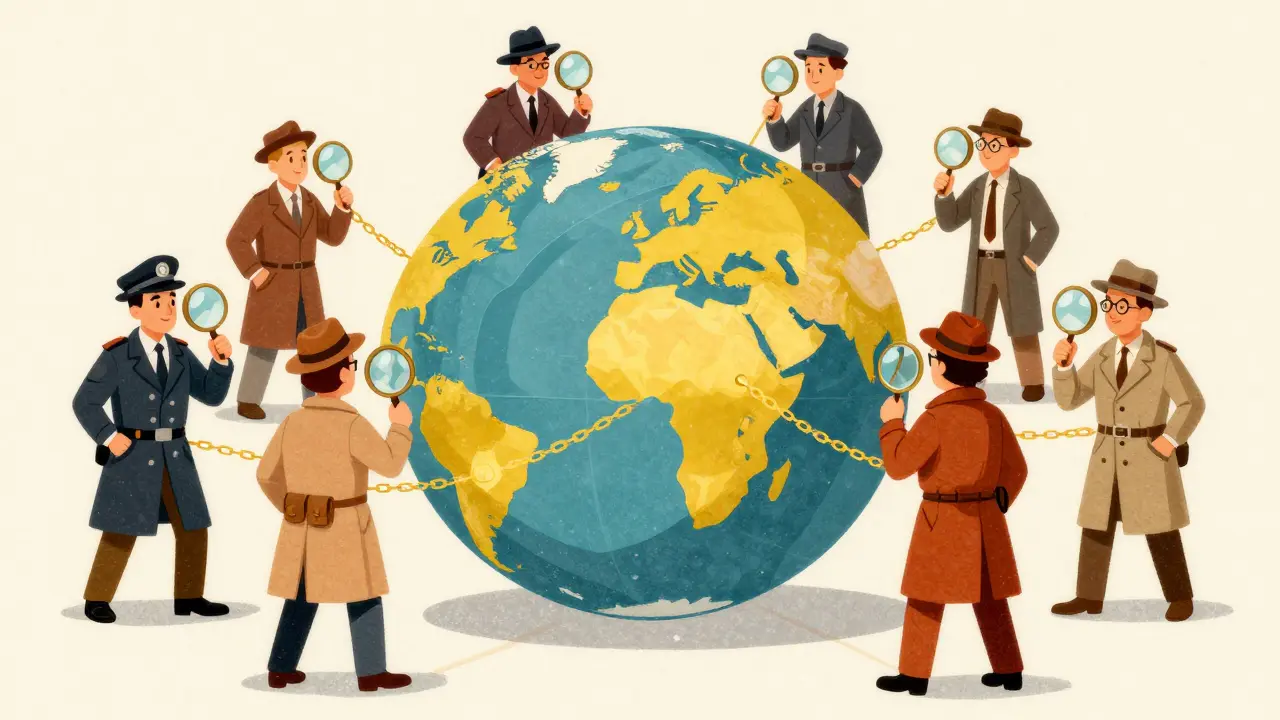
Crime doesn't stop at a border, and neither does a digital wallet. When a scammer in one country steals millions from victims in another using a blockchain, the traditional "police report" often hits a brick wall. For years, the biggest advantage for cybercriminals wasn't just the technology-it was the fragmentation of global law enforcement. But the tide is turning. From dismantling massive mining hubs in Africa to recovering hundreds of millions in romance scams, crypto crime enforcement is moving from isolated national efforts to a coordinated global dragnet.
The New Era of Coordinated Takedowns
In the past, if you were defrauded by a crypto investment scheme, the chances of getting your money back were slim. Most people assumed that once funds hit the blockchain, they were gone. However, recent operations prove that recovery is possible when countries actually talk to each other. INTERPOL is the central coordinating body connecting 195 member countries to fight international crime. Through its Global Financial Crime Programme, they've shifted the strategy from "watch and wait" to active, multi-jurisdictional strikes.
Take Operation Serengeti 2025 as an example. In August 2025, authorities in Angola didn't just track a few wallets; they dismantled 25 cryptocurrency mining centers. What made this operation a success was the borderless approach. Investigators found that criminals were arrested in Côte d'Ivoire for crimes that actually started in Germany. This shows a clear pattern: the criminals are operating globally, so the police have to do the same.
Another massive win was Operation HAECHI VI, which ran from April to August 2025. This effort targeted everything from voice phishing to romance scams. The result? Over $439 million recovered. When you compare this to standalone national operations from 2024, the recovery rate was 78% higher. The lesson is simple: cooperation isn't just a "nice to have"-it's the only way to actually catch the money.
The Tech Stack Powering the Hunt
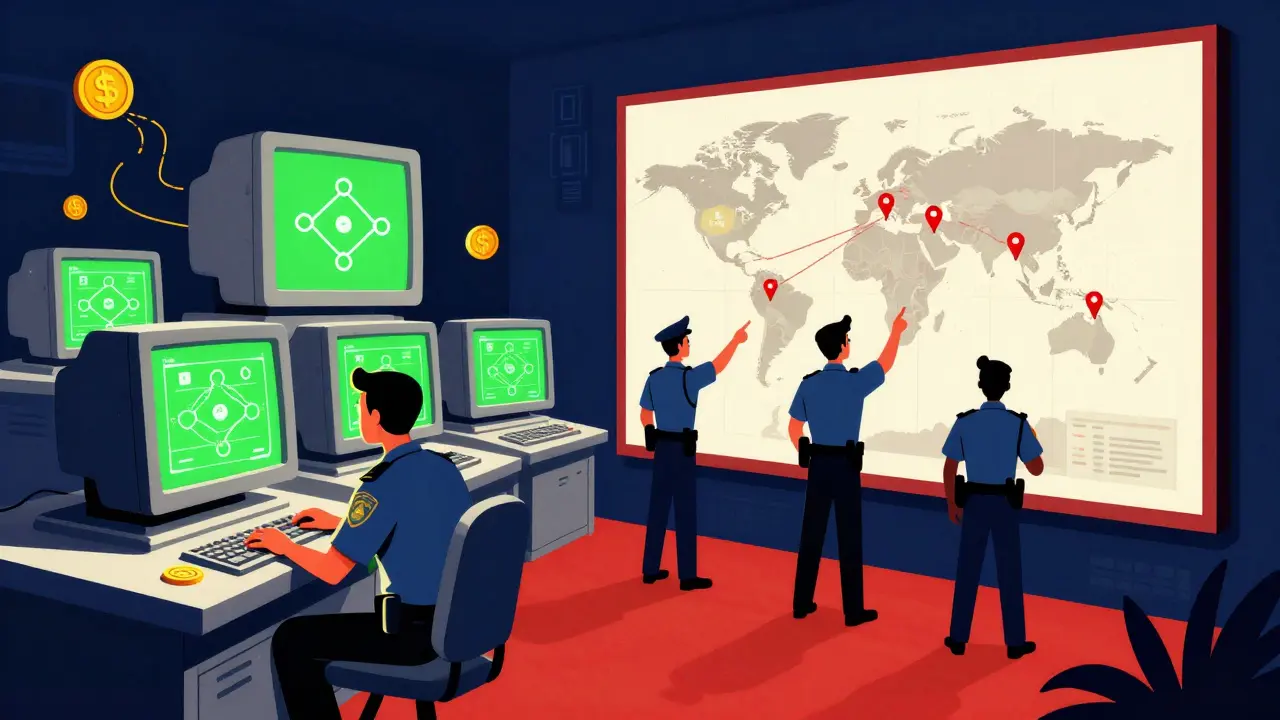
You can't fight a blockchain-based crime with a paper trail. Law enforcement agencies have had to completely overhaul their technical toolkits. A major breakthrough is the I-GRIP (Global Rapid Intervention of Payments), a stop-payment mechanism launched by INTERPOL in 2022. This allows financial intelligence units to communicate in real-time, essentially "freezing" the movement of illicit funds before they can be tumbled or swapped into different coins.
Beyond government tools, the private sector has become an essential partner. Firms like Chainalysis, Elliptic, and TRM Labs provide the "eyes" on the chain. These companies use advanced blockchain analytics to trace transactions across different networks. For instance, while Bitcoin still dominates illicit balances (about 75% as of 2025), criminals are increasingly using other assets to hide their tracks.
| Entity | Primary Focus | Key Contribution to Law Enforcement |
|---|---|---|
| Chainalysis | Illicit Entity Tracking | Identified $15B held by illicit entities in 2025 |
| Elliptic | Cross-Chain Screening | Specializes in tracing funds through bridges and DEXs |
| TRM Labs | Threat Actor Identification | Provides real-time intelligence on sanctioned entities |
The "Cross-Chain" Problem: The Next Frontier
Despite the wins, criminals are getting smarter. They've realized that staying on one blockchain (like just using Bitcoin) makes them an easy target for analytics tools. Now, they use "cross-chain" methods. This means they move funds across bridges or use decentralized exchanges (DEXs) and no-KYC (Know Your Customer) swap services to jump from one coin to another.
Elliptic's 2025 research highlighted a staggering $21.8 billion in illicit crypto laundered using these cross-chain methods. This creates a massive headache for investigators. If a criminal moves money from Ethereum to Solana via a bridge, the trail can go cold if the agency doesn't have the tools to follow that jump. The current goal for international agencies is to move from manual, hour-long investigations to automated cross-chain tracing that takes mere minutes.
Different Regions, Different Playbooks
Not every country fights crypto crime the same way. While INTERPOL handles the big, coordinated sweeps, national agencies have their own styles. In the U.S., the Department of Justice (DOJ) focuses heavily on criminal prosecution. For example, in October 2024, they targeted a group using bots to manipulate the volume of "meme coins," showing that they aren't just after hackers, but also market manipulators.
The U.S. Securities and Exchange Commission (SEC) usually takes a different route, using civil lawsuits to penalize companies that break the rules. Meanwhile, in Europe, Europol emphasizes the link between crypto laundering and organized crime, such as the online recruitment of minors, treating crypto as a tool for wider criminal enterprises rather than just a financial crime.

Real-World Impact and Recoveries
To see if this is actually working, look at the numbers. In one specific instance, the Korean National Police Agency teamed up with authorities in the UAE to recover KRW 6.6 billion (about $3.91 million) that had been sent to a fake bank account in Dubai. The fraud started with forged shipping documents sent to a Korean steel company. This wasn't a high-tech hack, but a classic scam enabled by crypto; the recovery only happened because two different governments decided to collaborate.
However, there is a troubling trend. Direct transfers from illicit wallets to exchanges have plummeted from 40% in 2021 to around 15% in 2025. This tells us that criminals are avoiding centralized exchanges because they know those platforms cooperate with the law. Instead, they are building their own cash-out infrastructures and using shorter-lived addresses to stay invisible.
Closing the Gap: What Happens Next?
The fight against crypto crime is essentially an arms race. As law enforcement gets better at tracing, criminals get better at hiding. To keep up, agencies are investing in massive training programs. During Operation Serengeti, participating officers underwent 120 hours of specialized training just to understand how to trace cryptocurrency. This level of expertise is becoming the new baseline for police work.
We are also seeing the rise of the Cybercrime Atlas, hosted by the World Economic Forum. This project aggregates intelligence from various sources to give law enforcement a real-time map of where the threats are coming from. The long-term play is to move toward a world where the "border" doesn't matter-where a freeze request in New Zealand can be executed in a Dubai exchange in seconds.
Can stolen cryptocurrency actually be recovered?
Yes, although it is difficult. Operations like HAECHI VI have recovered hundreds of millions of dollars by coordinating with exchanges and using tools like I-GRIP to stop payments before they are laundered. Recovery is most likely when the funds are moved to a centralized exchange that requires KYC.
What is "cross-chain laundering"?
Cross-chain laundering occurs when criminals move funds between different blockchains (e.g., from Bitcoin to Ethereum) using bridges or decentralized exchanges. This is done to break the linear trail that blockchain analytics tools follow, making it harder for investigators to track the money.
How does INTERPOL help in crypto crime cases?
INTERPOL acts as a global hub for 195 member countries. They provide the communication infrastructure, a stop-payment mechanism (I-GRIP), and coordinate large-scale operations like Operation Serengeti to ensure simultaneous arrests and seizures across different continents.
Why are criminals avoiding centralized exchanges?
Centralized exchanges usually have strict KYC (Know Your Customer) rules and cooperate with law enforcement agencies. Because of this, criminals have shifted toward decentralized exchanges (DEXs) and specialized cash-out services that don't require identification.
What is the role of the private sector in enforcement?
Private firms like Chainalysis and TRM Labs provide the sophisticated software needed to analyze the blockchain. They help law enforcement identify clusters of wallets belonging to the same entity and flag transactions associated with sanctioned groups or known scams.
Nishant Goyal
April 17, 2026 AT 21:28Pretty cool to see the tech catching up with the scammers. It's about time we got some global momentum on this.
Trudy Morse
April 18, 2026 AT 07:55It's basically a digital game of cat and mouse. The blockchain was designed for anonymity, so it's almost poetic that we're using its own transparency to trap people.
Kevin Lư
April 19, 2026 AT 21:07Honestly, some of these people deserve to lose every penny they have if they're dumb enough to trust a 'meme coin' bot. Just saying!
Shannon Kelly Smith
April 21, 2026 AT 09:14The I-GRIP system is a total game changer! 🚀 We need more of this energy in every financial sector to stop the bad actors! 🛡️✨
Saurav Bhattarai
April 22, 2026 AT 22:17Oh please, as if a few 'coordinated strikes' in Africa actually matter when the real whales are hiding in plain sight. Purely theatrical.
John and Lauren Busch
April 23, 2026 AT 15:18Sure, the police are 'catching up'. I'm sure the criminals aren't already three steps ahead with some new protocol we've never heard of.
Adedamola Oyebo
April 23, 2026 AT 17:49Cross-chain bridges are the weakest link right now!!! If we can standardize the monitoring there, it's game over for the fraudsters!!!
Kaitlyn Wu
April 25, 2026 AT 06:22We need to stop glamorizing the 'arms race' and start demanding stricter regulations on the bridge providers themselves.
nikki krinkin
April 26, 2026 AT 05:43It's just a relief to know there are people actually working on this behind the scenes.
Kim Smith
April 27, 2026 AT 18:39It's kinda wild when u think about the flow of value across these digital voids, like, we're basically re-inventing the concept of a border in a space that was meant to have none, and yet here we are, tryin to put fences back up because humans just can't stop stealing from each other no matter what the tech is... it's just such a loop of human nature and the more we automate the tracing, the more we just automate the greed, don't u think it's all just a bit circular in the end?
Mark Pfeifer
April 28, 2026 AT 22:06The collaboration between the Korean police and UAE is the real takeaway here. That's the blueprint.
Sean Mitchell
April 30, 2026 AT 21:37The sheer audacity of these scammers is almost admirable, though their execution is usually laughably clumsy! Absolute chaos!
Thomas Jewett
May 2, 2026 AT 20:21Why are we letting these foreign agencies run around our networks? We should be leading the charge with American strength and stop relying on INTERPOL to do the heavy lifting while others just ride our coattails... its a disgrace how we handle our own borders in the digital age when the real criminals are just laughing at us from across the ocean with no real consequences for their actions against us citizens!!
Michael Harms
May 3, 2026 AT 18:00Keep it up everyone! It's great to see these agencies finally talking to each other. More wins coming soon!
Anna Grealis
May 4, 2026 AT 23:18Tbh this is just a cover for more government surveillance. They aren't 'stopping crime', they're just building a better map of who owns what so they can seize it later. Wake up ppl.
Karen Mogollon Gutierrez
May 6, 2026 AT 19:38The disparity between the SEC's civil approach and the DOJ's criminal focus is quite striking. It creates a fragmented legal landscape that is frankly exhausting to navigate for the average observer.
Tracy Sperandio
May 7, 2026 AT 12:58Absolutely smashing it! We need to incinerate these scam networks with the heat of a thousand suns! Let's get those funds back!
Ankit Sindhu
May 9, 2026 AT 05:29If anyone is struggling to understand the cross-chain part, just think of it like changing your clothes to hide in a crowd.
nathan jones
May 10, 2026 AT 12:24Interesting stuff. Definitely changes how I look at DEXs.
Gillian Kent
May 11, 2026 AT 11:35im just glad they are helpng people get money back. too many people get scammed and just give up because they dont know who to call.