Interoperability Protocols and Standards in Blockchain
 Feb, 22 2026
Blockchain networks were never meant to exist in isolation. Early blockchains like Bitcoin and Ethereum were built as standalone ledgers - secure, but silent to each other. Today, as more chains emerge - from Solana to Polygon to Cosmos - the real challenge isn’t just building a chain, it’s making them talk to each other. That’s where interoperability protocols and standards come in. Without them, your crypto assets are stuck. Your smart contracts can’t react to events on another chain. Your dApp is limited to one ecosystem. Interoperability isn’t a luxury anymore; it’s the foundation of a working web3 economy.
What Interoperability Actually Means in Blockchain
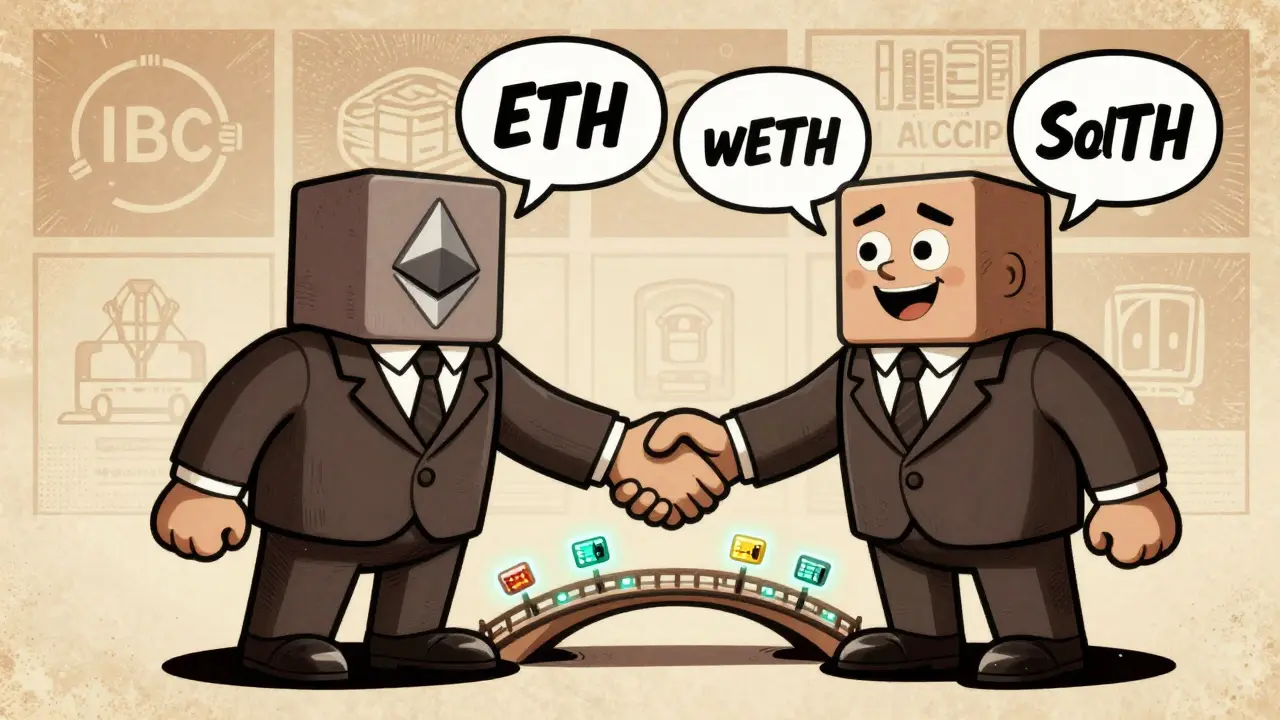
Interoperability in blockchain isn’t just about sending tokens from Chain A to Chain B. It’s about trust, meaning, and consistency across systems. Think of it like two people speaking different languages. If one says "I owe you 5 ETH," and the other hears "I owe you 5 apples," nothing works. Interoperability ensures that the meaning stays the same - no matter which chain you’re on. There are four levels of interoperability in blockchain:- Foundational - just moving data packets. Chain A sends a message; Chain B receives it. No checking if it makes sense.
- Structural - both chains use the same format. Like JSON or XML for transaction data. Now the message is readable, but still no context.
- Semantic - both chains understand what the data means. "ETH" on Ethereum means the same as "wETH" on Polygon. Tokens, balances, and contract events are interpreted correctly.
- Organizational - governance, rules, and incentives align. Who pays for cross-chain gas? Who verifies the proof? Who handles disputes? This is where most projects fail.
Most blockchains today only reach structural interoperability. True semantic and organizational interoperability? That’s still rare.
How Cross-Chain Communication Works
There are three main ways blockchains connect:- Relays - One chain reads the state of another by verifying proofs. For example, Ethereum can verify Bitcoin blocks using a lightweight client. This is secure but slow and expensive.
- Validators - A group of independent nodes (a bridge) monitors both chains and confirms transfers. Think of Chainlink’s CCIP or Cosmos IBC. Faster, but relies on trust in the validator set.
- Atomic swaps - Two parties exchange assets directly using time-locked contracts. No third party. Used in early DeFi, but only works for simple token swaps, not complex data.
Each method has trade-offs. Relays are trustless but heavy on gas. Validators are fast but centralized. Atomic swaps are peer-to-peer but limited. The best systems combine them.
Key Interoperability Standards in Use Today
Several standards have emerged as the backbone of cross-chain communication:- IBC (Inter-Blockchain Communication) - Developed by Cosmos. Uses light clients and packet relaying to enable trustless communication between Tendermint-based chains. IBC is the most widely adopted standard for sovereign blockchains.
- ERC-6551 - A token standard that allows NFTs to own other tokens or assets. This creates "account abstraction" across chains. An NFT on Ethereum can hold a token from Solana - a huge leap in composability.
- CCIP (Cross-Chain Interoperability Protocol) - By Chainlink. Uses decentralized oracles to send messages between any EVM and non-EVM chain. Designed for enterprise use, with built-in security and fee payment in LINK.
- LayerZero - Uses an ultra-light client and oracle network to verify state across chains. It’s modular, so developers can plug it into any chain. Popular in DeFi and gaming.
- Polkadot’s XCMP - Cross-chain message passing. Allows parachains in the Polkadot ecosystem to exchange data directly. Only works within Polkadot’s shared security model.
These aren’t just tools - they’re protocols. They define how data is formatted, how it’s verified, and who’s responsible when things go wrong.
Why Most Bridges Fail
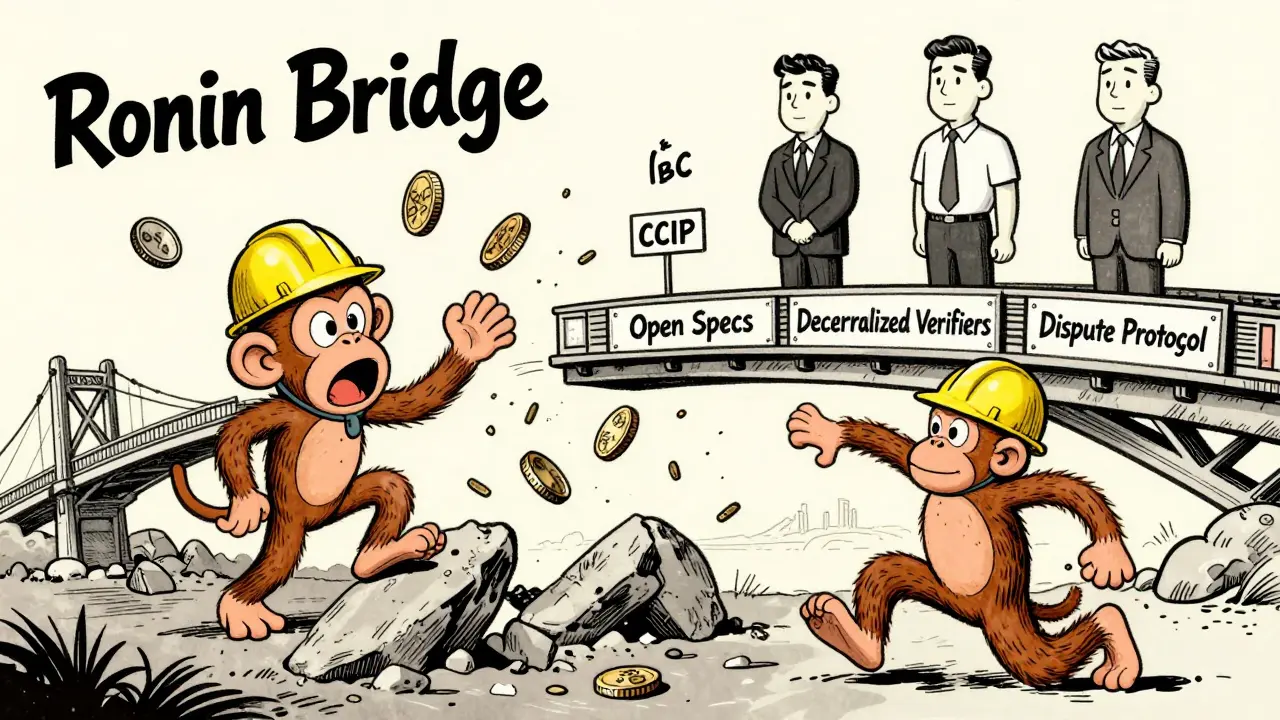
You’ve probably heard about bridges getting hacked. In 2022, the Ronin Bridge lost $625 million. In 2023, Wormhole was exploited for $325 million. Why does this keep happening? Because most bridges aren’t standards - they’re custom code. They’re built by small teams with no formal audit, no governance, and no clear responsibility. A bridge that relies on 5 signers is not interoperability - it’s a single point of failure. True interoperability standards have three things:- Open specifications - Anyone can read, implement, and audit them.
- Decentralized verification - No single entity controls the validation.
- Clear error handling - What happens if a message is lost? Who compensates? Standards define this upfront.
Projects like IBC and CCIP include these. Most custom bridges don’t.
The Role of Data Formats and APIs
At the lowest level, interoperability depends on data. If one chain uses JSON and another uses CBOR, even if they talk, they won’t understand each other. That’s why standards like JSON-LD and GraphQL are becoming critical. APIs are the glue. A wallet like MetaMask doesn’t just connect to Ethereum - it uses standardized APIs to fetch balances on Arbitrum, Polygon, and Base. These APIs follow the ERC-20 and ERC-721 specs - which are themselves interoperability standards. Even blockchain explorers like Etherscan now support multiple chains because they follow open data schemas. No more switching sites. One dashboard, all chains.What’s Missing? Governance and Incentives
Here’s the truth: we have the tech. But we don’t have the rules. Who pays for cross-chain gas? Should the sender pay? The receiver? A third-party relayer? There’s no standard. What if a transaction gets stuck? Who resolves it? A DAO? A court? A multisig? Most protocols ignore these questions. They assume users will figure it out. That’s why users get burned. The next wave of interoperability won’t be built by coders - it’ll be built by lawyers, economists, and governance designers. We need standardized dispute resolution, fee markets, and accountability frameworks.
Real-World Use Cases
Interoperability isn’t theoretical. It’s already changing how we use crypto:- DeFi - You can borrow on Aave using collateral from a Solana NFT, thanks to LayerZero.
- Gaming - An item bought in a game on Ethereum can be used in a game on Polygon because of ERC-6551.
- Identity - A Verifiable Credential issued on Polygon can be verified on Ethereum - no re-issuance needed.
- Payments - A merchant in Brazil accepts USDC on Solana, but settles in EUR on Ethereum - all automated via CCIP.
These aren’t demos. They’re live, in production, and used by real people every day.
What to Look For in a Cross-Chain Project
Not all interoperability is equal. Here’s what to check:- Is it built on an open standard (like IBC or CCIP), or is it a proprietary bridge?
- How many validators or relayers are there? More than 10? Good. Less than 5? Red flag.
- Is there a formal dispute mechanism? Can users appeal if a transfer fails?
- Are fees predictable? Or do they spike unpredictably?
- Has it been audited by at least two independent firms? And were the reports public?
If the answer to any of these is "I don’t know," walk away.
What’s Next?
The future of blockchain isn’t one chain to rule them all. It’s a web of chains - each specializing, each secure, each talking to the others. That future depends on standards, not hacks. We’re still early. Right now, interoperability is a patchwork. In five years, it’ll be invisible - like HTTP or TCP/IP. You won’t think about it. You’ll just use it.Until then, choose projects that build on open standards. Demand transparency. Avoid bridges that look like magic. Real interoperability doesn’t hide - it documents.
What’s the difference between interoperability and a bridge?
A bridge is a specific tool - usually a smart contract or service - that lets you move assets between two blockchains. Interoperability is the broader concept: the ability of any two systems to exchange and use data meaningfully. Bridges are one way to achieve interoperability, but not the only way. True interoperability includes shared standards, data meaning, governance, and security - not just a transfer function.
Can I use any blockchain with any wallet?
Not automatically. Most wallets support Ethereum and EVM-compatible chains out of the box. For non-EVM chains like Solana or Cosmos, you need a wallet that specifically supports their protocols. Wallets like Phantom or Keplr support multiple chains because they follow interoperability standards like IBC or WalletConnect. Always check if your wallet explicitly lists support for the chain you want to use.
Why do cross-chain transactions take so long?
Because they require confirmation on two separate networks. If you’re sending from Ethereum to Solana, the system must wait for Ethereum to finalize the transaction, then relay that proof to Solana, which must then validate it. This can take 5 to 30 minutes. Fast bridges use optimistic models to speed this up, but they trade security for speed. True interoperability with full finality always takes time.
Are there any blockchain standards bodies?
Yes, but they’re decentralized. Groups like the Ethereum Foundation, Cosmos SDK team, and Chainlink Labs publish open specifications. There’s no single authority like ISO, but the community acts as one. Standards emerge through adoption - if enough projects use a protocol, it becomes the default. That’s why IBC and ERC-6551 are gaining traction: they’re used by dozens of major projects.
Can interoperability make blockchains more secure?
Yes - but only if done right. When chains share security (like Polkadot’s relay chain), they become harder to attack. But when they rely on weak bridges or centralized validators, they become more vulnerable. The most secure interoperable systems are those that use decentralized verification, open code, and minimal trust assumptions. Interoperability itself doesn’t guarantee security - the design does.
Dianna Bethea
February 22, 2026 AT 18:36Interoperability isn't just about tech it's about trust and consistency
When you send ETH from Ethereum to Polygon and it still means ETH not just a token with the same name that's when you know standards matter
We've seen too many bridges collapse because they skipped semantic alignment
It's not enough to move assets you need to move meaning
ERC-6551 is a game changer because it lets NFTs carry value across chains without losing context
That's the future not just another bridge
Felicia Eriksson
February 23, 2026 AT 01:16This is actually really well explained
Love how you broke down the four levels
Most people just say 'bridges are bad' without understanding why
Jeff French
February 23, 2026 AT 01:24IBC is the only standard that actually enforces state verification via light clients
Everything else is either a validator set or an oracle which is just another attack surface
LayerZero is slick but it's still a two-party system
True decentralization means no single entity can halt or manipulate the flow
That's why Cosmos got it right
Everything else is just a glorified escrow
Danny Kim
February 23, 2026 AT 17:01So you're telling me the entire web3 ecosystem is just one big house of cards held together by IBC and CCIP
And if those two fail we all go back to trading JPEGs on Discord
Thanks for the reality check
Cathy Sunshine
February 24, 2026 AT 06:26Oh honey
You think standards are the answer
But who writes the standards
Big Labs
Big VCs
Big DAOs with 0% voter turnout
Interoperability is just the new branding for centralized control
It's the same old game with new syntax
And you're drinking the Kool-Aid
Brian Lemke
February 25, 2026 AT 15:09Man I love how you tied in governance and incentives
Most devs just build the pipe and leave the water bill to the user
But real interoperability means someone has to pay for the lights
And someone has to say who gets fined when a message drops
That's where lawyers and economists come in
Not just coders
We need cross-chain dispute courts
Like arbitration for crypto
Imagine a decentralized tribunal that handles stuck transfers
With staked arbitrators and transparent rulings
That’s the next frontier
And honestly? It’s way more interesting than another NFT collection
lori sims
February 26, 2026 AT 15:09Reading this made me realize I’ve been using interoperability without even knowing it
Every time I swap USDC from Polygon to Arbitrum in MetaMask
I’m not just moving money
I’m riding on years of standards work
And honestly
It’s beautiful
Like HTTP for finance
When it works
You don’t notice it
That’s the goal
Shannon Holliday
February 28, 2026 AT 10:18Love this so much 🙌
IBC is the OG
CCIP is the enterprise MVP
ERC-6551 is the wild card that could blow up gaming
And LayerZero? Still the most flexible but also the sketchiest
But yeah
We need more standards
Less magic bridges
More transparency
Amanda Markwick
February 28, 2026 AT 16:35What’s wild is how we’ve normalized broken systems
We accept 30-minute cross-chain waits like it’s normal
But if your bank took half an hour to transfer $10
You’d be on the phone screaming
Why are we so chill about crypto friction
Because we think it’s inevitable
But it’s not
We just haven’t demanded better
Standards exist
So why are we still using 2021-era bridges?
Because we’re lazy
And the UX is still easier
Time to upgrade
Sriharsha Majety
March 1, 2026 AT 19:52Very good explanation
I am from India
Here most people dont understand the difference between bridge and standard
They just want to send coins fast
But they dont care about security
This post will help
Vishakha Singh
March 3, 2026 AT 13:27This is one of the clearest breakdowns I’ve read
Especially the part about organizational interoperability
Most people focus on the technical layer
But governance is where the real battle is
We need standardized fee mechanisms
And clear liability rules
Otherwise
Every cross-chain failure becomes a tragedy
And no one is held accountable
aaron marp
March 5, 2026 AT 01:58Just want to say thank you
For writing this without the usual hype
You didn’t say ‘the future is here’
You said ‘we’re still early’
And that’s refreshing
Most of us are just chasing the next 100x
But this
This is about building something that lasts
And that’s rare
Samantha Stultz
March 5, 2026 AT 16:38Let me break this down for the people still stuck in 2021
ERC-6551 doesn’t just let NFTs hold tokens
It lets them hold entire wallets
Imagine a CryptoPunk that owns a Solana token
And that token can be used as collateral on Aave
And that collateral can be liquidated if the NFT drops below a floor price
That’s composability
That’s not a bridge
That’s a chain reaction of smart contracts across ecosystems
And LayerZero? It’s the plumbing
CCIP? It’s the billing system
IBC? It’s the constitutional framework
Stop calling every bridge ‘interoperability’
You’re not helping
You’re confusing people
Mae Young
March 6, 2026 AT 13:55Oh so now we’re pretending that IBC is the answer?
Who built IBC?
Cosmos
Who controls Cosmos?
Interchain GmbH
Who’s their biggest investor?
Andreessen Horowitz
So let me get this straight
We’re replacing one centralized bridge
With a decentralized standard
That’s funded by the same VCs who backed every bridge that got hacked
Brilliant
Just brilliant
It’s the same people
Just with better lawyers
Colin Lethem
March 8, 2026 AT 03:44^ this is why we need more public audits
Not just code audits
But governance audits
Who sits on the IBC upgrade council?
Who votes on fee parameters?
Are they staked?
Can they be slashed?
Without transparency
Even ‘open standards’ become traps
Good comment btw
Trenton White
March 9, 2026 AT 05:46Agree with the above
Standards are only as good as their enforcement
IBC is great
But if no one is monitoring the relayers
It’s just a fancy API
Transparency isn’t optional
It’s the core
Cheryl Fenner Brown
March 9, 2026 AT 18:41so like
if i send usdc from eth to solana
and it gets stuck
who do i yell at
the bridge? the oracle? the validator? the chain?
and why is there no chatbot for this??
im so confused 😭
Mary Scott
March 10, 2026 AT 15:19Interoperability? More like inter-opportunity for hackers
Every bridge is a honeypot
Every standard is a target
They’re not fixing security
They’re just making it look prettier
And you’re all drinking the kool-aid
Wake up
Michael Teague
March 11, 2026 AT 17:56Why does this even matter?
Can’t we just use one chain?
Ethereum’s fine
Why do we need 100 chains talking?
Feels like overengineering
Just let me buy ETH and move on
Cory Derby
March 12, 2026 AT 17:17Michael
You raise a fair point
But the beauty of multiple chains
Is specialization
Ethereum for security
Solana for speed
Polygon for accessibility
And interoperability lets them play together
Without forcing everyone into one mold
That’s innovation
Not overengineering
christopher luke
March 13, 2026 AT 01:53Yessss 🙌
This is why I love web3
It’s not about one winner
It’s about ecosystems that talk
And I’m so tired of people acting like bridges are the endgame
They’re the middle step
Standards are the finish line
Keep pushing
It’s worth it
Tabitha Davis
March 13, 2026 AT 12:27Wow
So you’re saying the real problem isn’t the tech
It’s that we don’t have a blockchain court system
Like… a blockchain Supreme Court?
Who picks the judges?
Do they get paid in ETH?
Can they be bribed?
And what if the DAO votes to ignore a dispute?
Who’s watching the watchers?
Who watches the watchers who watch the watchers?
…
Never mind
I’m going back to NFTs
Megan Lavery
March 14, 2026 AT 21:41Just used ERC-6551 to link my NFT to a Solana token
It worked
First time ever
Feels like magic
But also… so simple
Why did it take so long?
Kristi Emens
March 15, 2026 AT 18:42Great breakdown
I’ve been building on Cosmos
And IBC really is the gold standard
It’s not flashy
But it works
And that’s rare
Michael Rozputniy
March 17, 2026 AT 04:08Interoperability is a government psyop
They want us to believe chains can talk
But they’re all controlled by the same entity
Chainlink
Cosmos
Ethereum Foundation
Same donors
Same investors
Same agenda
They’re not building freedom
They’re building a single global ledger
And you’re helping them