Interoperability Solutions in 2025: Breaking Data Silos in Blockchain and Healthcare
 Jul, 13 2026
Imagine trying to send a text message from an iPhone to an Android phone in the early 2000s. It simply didn't work. Now, imagine if your bank account couldn't talk to your investment portfolio, or worse, if your doctor's records were invisible to the specialist treating you. In 2025, this fragmentation is no longer just an inconvenience; it is a critical failure point for industries ranging from finance to healthcare. The concept of Interoperability is the ability of different information systems, applications, and devices to seamlessly exchange, interpret, and use data in coordinated ways has moved from a nice-to-have technical feature to a strategic imperative.
We are living in an era where data is the new oil, but only if it can flow. If your data is trapped in silos, it’s useless. Whether you are dealing with blockchain networks trying to communicate across chains or hospitals struggling to share patient records, the solution lies in robust interoperability frameworks. This article breaks down the specific solutions that defined 2025, why they matter, and how they are reshaping our digital infrastructure.
The Core Problem: Why Systems Can't Talk
To understand the solutions, we first need to grasp the problem. For decades, technology companies built walled gardens. They created proprietary formats that locked users in. In healthcare, this meant that a lab result from one hospital system often had to be manually re-entered into another system at a different facility. In enterprise IT, it meant that moving data between Amazon Web Services (AWS) and Microsoft Azure required complex, error-prone manual coding.
This lack of communication creates three major issues:
- Latency and Cost: Manual data entry and custom integration code slow down operations and burn cash.
- Data Errors: When humans translate data from one format to another, mistakes happen. In medicine, these mistakes can be fatal.
- Innovation Stagnation: Artificial Intelligence (AI) needs massive amounts of clean, connected data to learn. Siloed data starves AI models.
In 2025, the shift wasn't just about connecting wires; it was about ensuring that when System A sends data to System B, System B actually understands what it means. This is known as Semantic Interoperability is ensuring that different systems interpret exchanged data in the same way using standardized codes and terminology.
Healthcare: Saving Lives Through Standardized Codes
No sector feels the pain of poor interoperability more than healthcare. In 2025, the focus shifted heavily toward semantic interoperability. It’s not enough to move a file from one Electronic Health Record (EHR) system to another. The receiving system must know exactly what the data represents.
Two key standards drove this change:
- SNOMED CT (Systematized Nomenclature of Medicine Clinical Terms): This provides a universal language for clinical terms. If a doctor writes "heart attack," SNOMED CT translates that into a specific code that every other system recognizes globally.
- RxNorm: This standardizes medication names. It ensures that when a prescription is transferred, the dosage and drug identity are preserved accurately, preventing dangerous misinterpretations.
Consider a real-world scenario. A patient visits an emergency room in New York, then travels to London for treatment. Without semantic interoperability, the London doctors might see a list of medications but struggle to verify dosages or interactions due to formatting differences. With SNOMED CT and RxNorm, the data arrives structured and clear. The receiving system automatically categorizes each drug, reducing medication errors and improving patient safety.
Furthermore, APIs (Application Programming Interfaces) are software intermediaries that allow two applications to communicate with each other even if they were not originally designed to integrate became the bridge between legacy systems and modern platforms. Instead of replacing entire monolithic EHR systems, hospitals used APIs to extract specific data points-like blood pressure trends-and feed them into AI-driven analytics tools. This microservices approach allowed providers to upgrade individual parts of their infrastructure without disrupting patient care.
| Approach | Description | Key Benefit | Limitation |
|---|---|---|---|
| Legacy File Transfer | Moving PDFs or CSV files via email or secure servers | Simple to implement initially | No semantic understanding; high risk of human error |
| API Integration | Real-time data exchange using standardized endpoints | Immediate access to live data | Requires robust security and management platforms |
| Semantic Standards (SNOMED/RxNorm) | Coding data so meaning is preserved across systems | Enables AI analysis and accurate clinical decisions | High initial effort to map existing data to standards |
Enterprise IT: Taming the Multi-Cloud Chaos
While healthcare fought for patient safety, the corporate world fought for efficiency. By 2025, most large enterprises operated in multi-cloud environments. They used AWS for storage, Google Cloud for AI, and Azure for productivity tools. The problem? These clouds were not built to talk to each other easily.
Enter Cloud Routing Solutions are networking technologies that facilitate seamless data exchange between different cloud providers at the network level. These solutions eliminated the need for manual workarounds. Instead of building custom bridges between clouds, companies deployed routing platforms that made disparate cloud environments act like a single, unified network. This reduced latency and simplified application deployment.
A parallel challenge emerged in networking hardware: Software-Defined WAN (SD-WAN). SD-WAN allows organizations to manage wide area networks through software rather than physical hardware, offering flexibility and cost savings compared to traditional Multiprotocol Label Switching (MPLS). However, a major hurdle appeared in 2025: there were no universal standards for interoperability between different SD-WAN vendors.
If a company used Vendor A’s SD-WAN for its offices and Vendor B’s for its remote workers, the two systems often couldn't communicate securely. This forced many businesses into vendor lock-in. The market response was the rise of bridging technologies-middleware solutions that translated commands between competing SD-WAN ecosystems. This ensured that encrypted, end-to-end connections remained intact regardless of the underlying provider.
Blockchain: Connecting Isolated Ledgers
You might wonder why blockchain is mentioned here. Blockchain is inherently decentralized, which sounds like the opposite of a centralized database. However, this decentralization created its own silos. Bitcoin cannot natively talk to Ethereum. Solana doesn't speak Polkadot. In 2025, blockchain interoperability became crucial for the maturity of the crypto economy.
Just as healthcare uses SNOMED CT, blockchains needed common protocols to transfer assets and data across chains. Solutions like cross-chain bridges and atomic swaps allowed users to move value from one ledger to another without relying on centralized exchanges. This prevented the fragmentation of liquidity and enabled complex decentralized finance (DeFi) applications that spanned multiple networks.
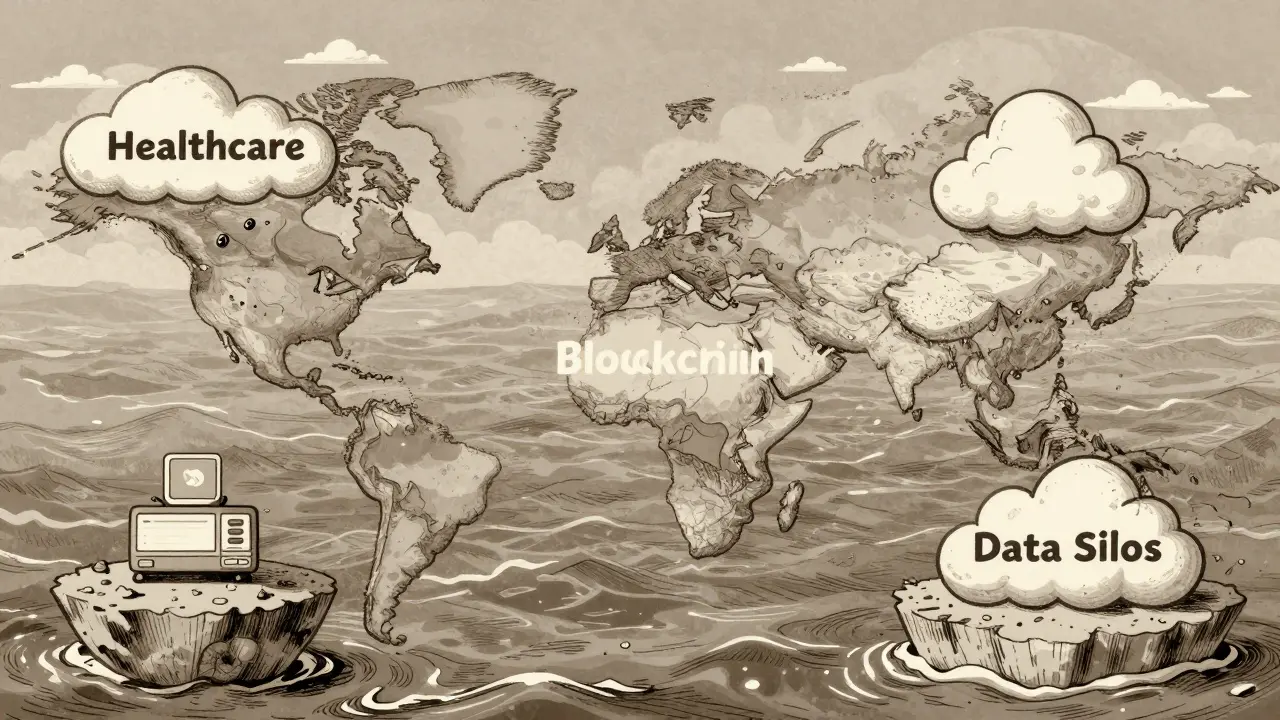
The principle remains the same: without interoperability, you have isolated islands of value. With it, you have a global, interconnected financial system. The technical mechanisms differ-from cryptographic proofs in blockchain to API calls in healthcare-but the goal is identical: seamless, trusted data exchange.
The Role of AI in Bridging Gaps
Artificial Intelligence didn't just benefit from interoperability; it helped create it. In 2025, AI-based solutions were widely used to improve data extraction from legacy systems. Old databases often contain unstructured text or outdated formats. AI models could read this messy data, identify key entities (like patient names or transaction dates), and transform them into structured, machine-readable formats.
This automation streamlined workflows significantly. Instead of hiring teams of data engineers to manually clean datasets, organizations deployed AI tools that handled the heavy lifting. This paved the way for deeper insights. For example, in healthcare, AI-powered clinical decision support systems analyzed past patient cases across multiple hospitals to suggest optimal treatment pathways. But this only worked because the underlying data was interoperable and standardized.
Future Outlook: What Comes After 2025?
As we look beyond 2025, the trend is clear: interoperability is becoming invisible. Users shouldn't have to think about whether their apps connect; they should just expect them to. The next frontier involves autonomous devices. Imagine self-driving cars communicating with traffic lights, other vehicles, and cloud-based mapping services in real-time. This requires ultra-low latency and flawless routing, often referred to as Multi-AI routing.
Regulatory bodies are also playing a bigger role. Governments are mandating interoperability standards to ensure fair competition and public safety. In healthcare, this means stricter enforcement of data portability rights. In tech, it could mean open standards for IoT devices. The companies that thrive will be those that embrace openness rather than locking users in.
Ultimately, interoperability is not just a technical fix. It is a cultural shift. It requires organizations to agree on standards, share data responsibly, and prioritize collaboration over control. Whether you are a developer building APIs, a hospital administrator implementing EHRs, or a blockchain engineer designing bridges, your work contributes to a more connected, efficient, and safer world.
What is the difference between syntactic and semantic interoperability?
Syntactic interoperability means systems can exchange data in a compatible format (e.g., both use JSON). Semantic interoperability goes further, ensuring that the receiving system understands the meaning of the data (e.g., knowing that "MI" stands for "Myocardial Infarction" in a medical context). Semantic interoperability requires standardized terminologies like SNOMED CT.
Why is SD-WAN interoperability difficult in 2025?
There are currently no universal industry standards for interoperability between different SD-WAN vendors. Each manufacturer uses proprietary protocols, making it hard for networks from different providers to communicate seamlessly without additional bridging middleware.
How do APIs help with legacy system integration?
APIs act as translators between old and new software. Instead of replacing an entire legacy system, organizations can build APIs that extract specific data points from the old system and deliver them to modern applications in real-time, enabling gradual upgrades without downtime.
What role does AI play in data interoperability?
AI helps automate the extraction and transformation of unstructured or messy data from legacy systems into standardized, machine-readable formats. This reduces the manual effort required to prepare data for exchange and enables advanced analytics and clinical decision support.
Is blockchain interoperability similar to healthcare interoperability?
Conceptually, yes. Both aim to allow isolated systems to exchange value or data securely. However, the technical methods differ. Healthcare relies on centralized standards and APIs, while blockchain uses cryptographic proofs, cross-chain bridges, and decentralized protocols to enable trustless communication between independent ledgers.