Is Crypto Regulated in China? The Complete Ban Explained (2026)
 Jun, 12 2026
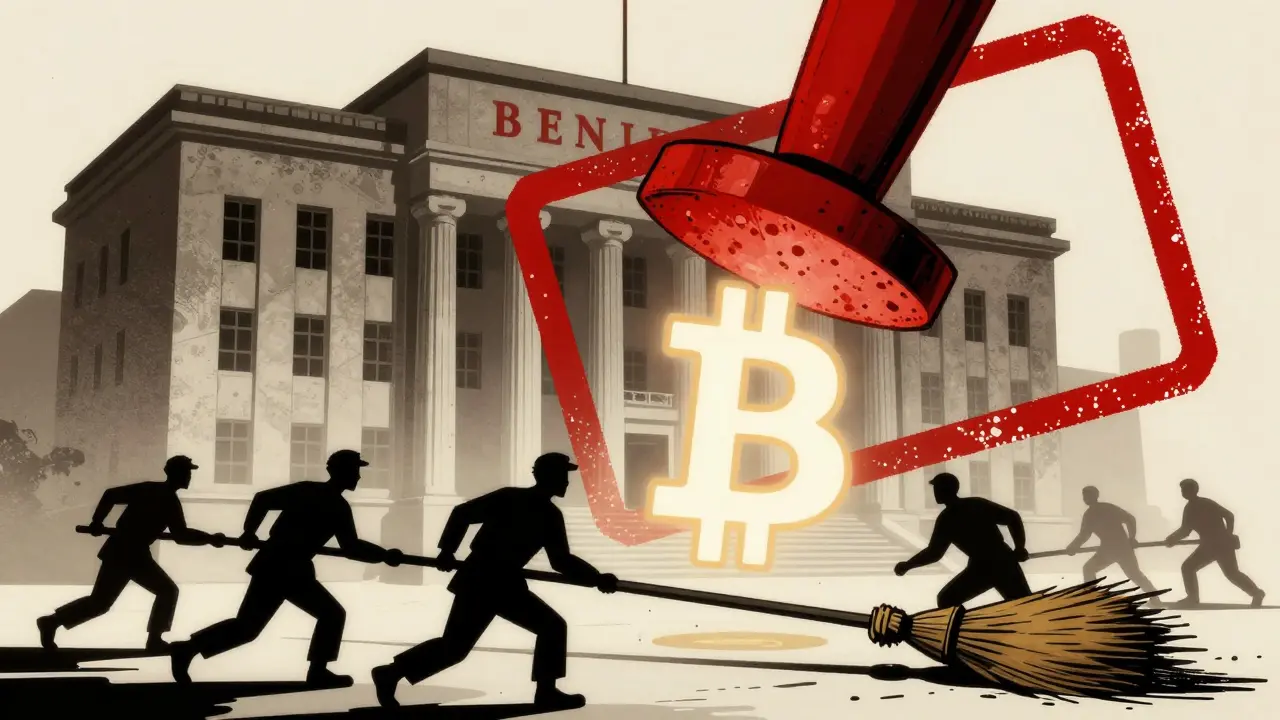
You might have heard rumors that China is slowly opening up to Bitcoin or Ethereum. Maybe you saw a headline about stablecoins and wondered if the door is finally cracking open. Here is the hard truth: as of June 2026, cryptocurrency is not just regulated in China-it is completely banned. If you are holding crypto while physically located in mainland China, you are breaking the law. There is no gray area left.
This isn't a new twist. It is the final chapter of a decade-long crackdown that started in 2013 and culminated in a sweeping decree on May 30, 2025. That order made it illegal to trade, mine, or even own digital assets like Bitcoin. For anyone trying to navigate this space, understanding exactly what is off-limits-and what the government is pushing instead-is critical to avoiding serious legal trouble.
The Final Nail: The 2025 Total Prohibition
For years, the rules were messy. You could buy Bitcoin on an exchange until 2017. You could mine it until 2021. But on June 1, 2025, the People's Bank of China (PBOC) issued a directive that closed every remaining loophole. This wasn't just a warning; it was a criminalization of private crypto ownership.
Under this framework, any transaction involving virtual currencies is treated as illegal financial activity. This means:
- Trading: Buying or selling Bitcoin, Ethereum, or any altcoin on domestic or overseas exchanges is prohibited.
- Mining: Operating mining hardware within Chinese borders is strictly forbidden.
- Ownership: Simply holding crypto in a wallet can trigger legal penalties if discovered during audits or investigations.
The PBOC didn't do this alone. They coordinated with the Ministry of Public Security, the Cyberspace Administration, and the Ministry of Industry and Information Technology. Together, they created a surveillance net that tracks both online transactions and offline physical activities. Internet companies are mandated to block crypto-related content and report suspicious user behavior. Financial institutions must monitor all customer funds for links to virtual currency trading.
How Far Back Does This Go? A Timeline of Crackdowns
To understand why the 2025 ban feels so absolute, you have to look at how China systematically dismantled its crypto market over ten years. It wasn't overnight panic; it was a calculated strategy.
| Date | Action Taken | Impact |
|---|---|---|
| Dec 2013 | Banks banned from Bitcoin transactions | Cut off institutional funding |
| Apr 2014 | PBOC ordered closure of trading accounts | Exchanges struggled to operate legally |
| Sep 2017 | ICO ban and exchange shutdowns | Domestic trading halted; markets moved offshore |
| Jun 2021 | Mining operations targeted | Miners relocated to US, Kazakhstan, etc. |
| Sep 2021 | Comprehensive ban on trading/mining | De facto end of private crypto market |
| Jun 2025 | Full criminalization of ownership | Holding crypto becomes a crime |
By 2022, courts began denying investor claims in civil disputes related to crypto losses, signaling that the state would not protect those who participated in the black market. In 2023, blockchain technology was allowed to continue-but only under strict centralized oversight, stripped of any decentralized finance (DeFi) elements.

Real Consequences: What Happens If You Get Caught?
Let’s be clear: this isn’t a regulatory suggestion. It’s enforced with teeth. The Chinese judicial system has established precedents that make crypto involvement risky.
Consider the case of Liu, sentenced in August 2024 by the Beijing No. 2 Intermediate People's Court. Liu facilitated cryptocurrency transactions involving stolen funds, selling USDT tokens worth 200,000 yuan ($27,850). Even though Liu claimed ignorance about the source of the money, the court applied the "should have known" standard. The result? Three and a half years in prison and a fine of 40,000 yuan ($5,570).
In August 2024, China's Supreme Court revised anti-money laundering laws to explicitly recognize crypto transactions as methods of money laundering. This change gave prosecutors a clearer path to charge individuals not just for fraud, but for concealing criminal proceeds through digital assets. Asset seizures are common, and multi-year prison sentences are now standard for significant violations.
The Exception: Enter e-CNY
If everything is banned, why does China still talk about digital money? Because there is one exception: the e-CNY, also known as the Digital Yuan. This is a Central Bank Digital Currency (CBDC) issued directly by the People's Bank of China.
The e-CNY is fundamentally different from Bitcoin or Ethereum. It is centralized, fully controlled by the state, and designed to replace physical cash and bank transfers. Unlike decentralized cryptocurrencies, the e-CNY offers transparency to regulators. Every transaction can be traced, which aligns perfectly with China’s goals of financial stability and capital control.
While private crypto is crushed, the e-CNY is being aggressively promoted. Businesses are encouraged to accept it, and citizens are incentivized to use it through subsidies and integration into daily payment apps like Alipay and WeChat Pay. This dual approach shows that China doesn't hate digital currency technology-it hates losing control over it.

Is Any Softening Coming? The 2025 Debates
Rumors always circulate when regulations tighten. In July 2025, the Shanghai State-owned Assets Supervision and Administration Commission held meetings to discuss strategic responses to stablecoins and digital currencies. Some experts suggested that the rapid global evolution of digital assets might force China to reconsider its stance.
However, as of mid-2026, no concrete policy changes have materialized. These discussions appear to be internal evaluations rather than signals of imminent liberalization. The government remains committed to its zero-tolerance policy toward private cryptocurrencies. Any hope for a reversal should be viewed with extreme skepticism unless official decrees change.
What Should You Do?
If you are a resident of mainland China, the advice is simple: stay away from private cryptocurrencies. Do not attempt to trade on overseas exchanges, do not run mining rigs, and do not hold wallets containing Bitcoin or Ethereum. The monitoring systems are comprehensive, combining online tracking with offline inspections. Financial institutions are required to report any suspicious activity linked to virtual currencies.
If you are a business operating in China, ensure your compliance protocols reflect the absolute prohibition. Your Anti-Money Laundering (AML) systems must flag any potential crypto links. Know Your Customer (KYC) requirements focus on prevention-you must identify and block customers attempting to engage in virtual currency trading.
For international investors, remember that Chinese citizens are explicitly banned from using overseas exchanges. Any platform serving Chinese residents risks being blocked or sanctioned. The enforcement mechanism includes asset seizure and criminal penalties, making the risk far outweigh any potential reward.
Can I legally own Bitcoin in China in 2026?
No. As of June 1, 2025, the People's Bank of China banned individual ownership of cryptocurrencies. Holding Bitcoin or other digital assets is considered illegal financial activity and can lead to legal penalties, including fines and imprisonment.
Is the e-CNY the same as Bitcoin?
No. The e-CNY (Digital Yuan) is a Central Bank Digital Currency issued by the Chinese government. It is centralized, fully regulated, and designed to replace cash. Bitcoin is decentralized, private, and banned in China. The e-CNY is legal and encouraged; Bitcoin is illegal.
Can Chinese citizens use overseas crypto exchanges?
No. Overseas exchanges are explicitly banned from serving Chinese residents. Using these platforms violates Chinese law and can result in account freezes, asset seizures, and criminal prosecution for facilitating illegal financial transactions.
What happens if I get caught mining crypto in China?
Mining cryptocurrency is strictly prohibited. Enforcement includes confiscation of mining equipment, heavy fines, and potential criminal charges. The Ministry of Public Security actively targets mining operations as part of anti-money laundering efforts.
Will China ever lift the crypto ban?
There is no current indication that China will lift the ban. While some internal discussions occurred in 2025 regarding stablecoins, the official stance remains a complete prohibition on private cryptocurrencies. The government prioritizes financial stability and capital control over decentralized finance.
John Doe
June 13, 2026 AT 05:16It is absolutely terrifying to think about the level of surveillance required to enforce this. The fact that they are tracking offline physical activities alongside online transactions shows a total disregard for privacy that most of us in the West can barely comprehend. It feels like living in a dystopian novel where your very existence is monitored by an algorithm designed to crush dissent and financial freedom. I can’t help but feel a deep sense of empathy for anyone caught in the crossfire of these draconian laws. The human cost of such rigid control must be immense, stripping people of their autonomy and forcing them into a corner where even holding digital assets becomes a criminal act.
Mekz Wheoki
June 13, 2026 AT 11:47Oh, look at you, crying over crypto bans as if it’s the end of the world. Typical Western melodrama. China knows exactly what it’s doing while everyone else is busy chasing rainbow charts and hoping for a moonshot. The e-CNY isn’t a ‘crackdown’; it’s efficiency. You guys call it oppression, I call it getting off your high horse and accepting that centralized systems actually work without crashing every Tuesday because some anon lost their seed phrase.
Skm Shubham
June 14, 2026 AT 13:06The timeline provided is accurate but lacks the nuance of the underlying economic strategy. This was never just about Bitcoin. It was about capital flight prevention on a massive scale. By criminalizing ownership, they have effectively plugged the hole that allowed wealth to leave the country unnoticed. The 'should have known' legal standard applied in the Liu case is a classic tool for broadening net enforcement, ensuring that ignorance is no longer a shield. It is a brutal but highly effective method of maintaining monetary sovereignty. Any analyst who thinks this will reverse is ignoring the fundamental incentives of the PBOC.
Rob Aronson
June 14, 2026 AT 14:51From a regulatory compliance standpoint, the integration of AML protocols with KYC requirements here is unprecedented. 🚫💸 The mandate for financial institutions to monitor customer funds for virtual currency links creates a closed-loop system that leaves zero room for error. Businesses operating in this jurisdiction need to update their risk assessment matrices immediately. The use of AI-driven transaction monitoring tools is likely already in place to flag any anomalous behavior before it escalates to a legal issue. It’s a textbook example of state-controlled financial infrastructure dominating the market. 📉🔒
Kwon Bill
June 14, 2026 AT 17:47In many Asian markets, the concept of digital currency is viewed through the lens of national security rather than individual liberty. The e-CNY represents a technological leap that aligns with broader goals of social credit integration and streamlined fiscal policy. While Western narratives focus on the loss of anonymity, the local perspective often prioritizes stability and the elimination of black-market activities. Understanding this cultural divergence is crucial for anyone trying to interpret these policies objectively. It is not merely a ban; it is a redefinition of money itself within the Chinese context.
Danna Charris
June 15, 2026 AT 10:11Really? You’re still talking about Bitcoin like it’s relevant? Please. The smart money moved to stablecoins or traditional assets years ago. If you’re holding BTC in 2026, you’re either delusional or stupid. The e-CNY is the future because it’s backed by actual governance, not hype. Wake up.
Fede Faith
June 16, 2026 AT 13:00Let’s break this down simply so everyone understands the stakes. If you are in China, do not touch crypto. Period. The consequences are real prison time, not just fines. For those outside, understand that this isolationism might create opportunities elsewhere as miners and exchanges flee. Stay informed, stay safe, and don’t let FOMO drive your decisions. Knowledge is power, especially when the rules change overnight. Keep your assets secure and your head clear.
Josh Dodson
June 16, 2026 AT 18:03its crazy how fast things changed man. i thought we were gonna see more adoption but nope. guess its back to basics for china. hope everyone stays safe out there!
Suman Patil
June 17, 2026 AT 08:02We need to look at this from a global perspective. The decentralization movement is resilient, and banning it in one region only pushes it underground or offshore. However, the impact on local innovation is significant. Blockchain tech for supply chain management is still viable, but DeFi is dead in the water there. Let’s keep the conversation open and supportive for those navigating these complex regulations. We are all learning together in this evolving landscape. 🌏🤝
Kumaran sowkarpet
June 19, 2026 AT 07:17Actually, my friends in Shanghai say the enforcement is super strict now. 😬 They check everything. Even just having a wallet app can get you flagged if you try to transfer anything. It’s better to just use the Digital Yuan like everyone else. Don’t risk it! 😅
Mauricio Contreras Loredo
June 20, 2026 AT 11:59Sure, tell me again how much freedom I have when my bank freezes my account because I bought a coffee with a token. Oh wait, I can’t buy coffee with tokens anymore because the government decided I’m too dumb to manage my own money. Thanks for the reminder that I’m basically a child in the eyes of the state. Real helpful.
sreeja boora
June 21, 2026 AT 00:08India has its own challenges with crypto regulation, but watching China’s absolute ban serves as a stark warning. The formal approach taken by Beijing highlights the importance of adhering to national financial policies. It is essential for citizens to respect these boundaries to maintain social order. Any deviation from the prescribed financial pathways is detrimental to the collective economic health. We must prioritize stability over speculative gains.
Grace Newman
June 22, 2026 AT 02:59One must consider the deeper implications of this prohibition. Is it truly about financial stability, or is it a mechanism to suppress alternative narratives and control information flow? The correlation between the crackdown on crypto and the tightening of internet censorship is too coincidental to ignore. The e-CNY allows for perfect traceability, enabling a level of social control previously unimaginable. Those who question this narrative are often dismissed, yet the evidence points towards a grander design of total surveillance. Beware the illusion of choice.
Annemarie Fitzgerald
June 22, 2026 AT 03:26the nature of value is a social construct anyway so why does it matter if the state controls it? perhaps we are missing the point entirely. the drama surrounding crypto is just a reflection of our collective anxiety about losing agency. but in reality, we never had it. the ban is just making the invisible chains visible. interesting times indeed. or maybe im just tired lol
Abby Sivertsen
June 22, 2026 AT 21:15I’ve seen firsthand how difficult it is for expats to navigate this. The cultural expectation is to comply without question. When you push back, even slightly, the response is immediate and severe. It’s not just about money; it’s about demonstrating loyalty to the system. If you’re thinking of moving there or doing business, tread very carefully. The walls are higher than they appear.
Benjamin Eisen
June 23, 2026 AT 12:06i wonder if this will eventually force a split in the global blockchain community. like one side fully regulated and the other completely anonymous. seems inevitable really. lets hope the tech evolves to handle both worlds peacefully. curious to hear others thoughts on this potential bifurcation.
Kenneth Riley
June 24, 2026 AT 23:33you people are sleeping on the obvious truth here. this isnt just a ban its a war on privacy. the pboc doesnt care about your portfolio they care about controlling every cent you spend. the e-cny is a trojan horse for total societal control. wake up sheeple. the mining ban was just the appetizer the main course is your data being sold to the highest bidder. dont let them win