Long-Term Viability of Memecoins: Will They Survive the Next Cycle?
 Sep, 10 2026
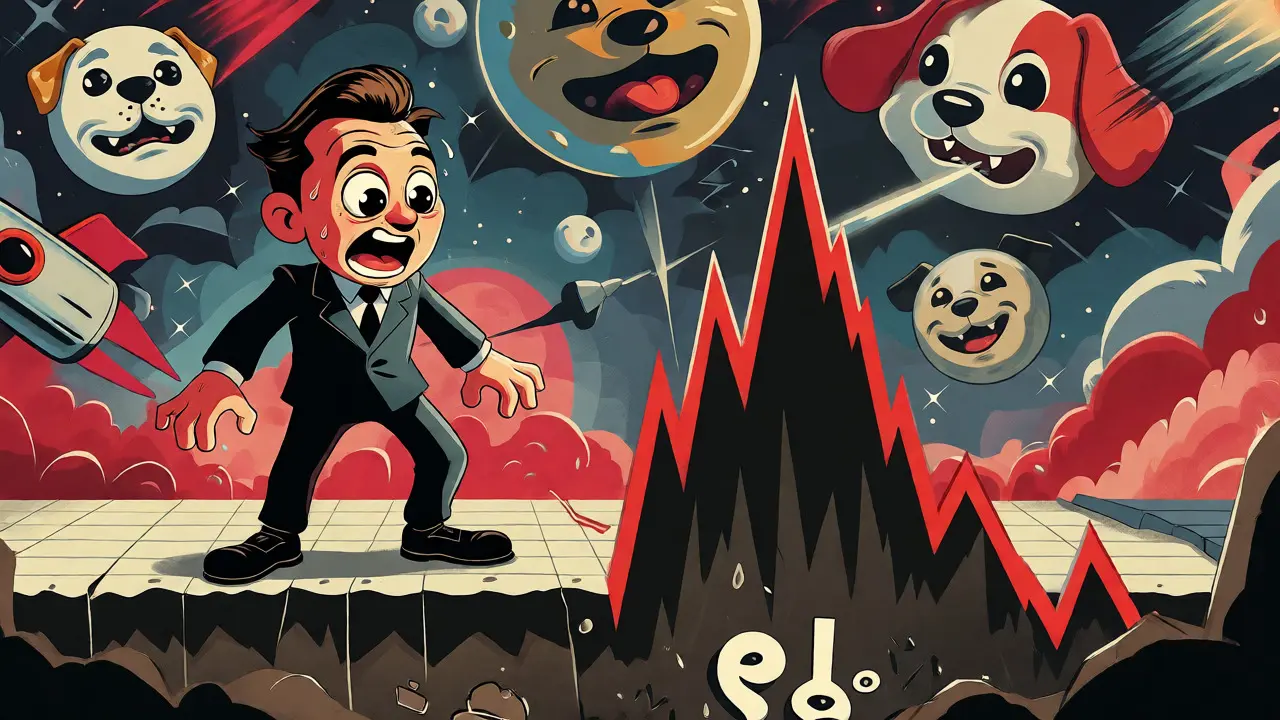
You bought a memecoin because it was funny. Maybe it had a dog on it, or a cat, or a politician’s face. You watched the price spike 500% in a week and felt like a genius. Then, two weeks later, you’re down 80%, wondering if you just donated money to a stranger’s vacation fund. This isn’t an anomaly; it’s the default setting for most meme coins. But with Dogecoin still hanging around after more than a decade, some of us are asking: is there actually a path to long-term viability here, or are we all just gambling with extra steps?
The short answer? Most memecoins will die. The data backs this up hard. A study by Fidelity Investments’ Digital Assets Research team in August 2025 found that only 12% of meme coins launched in the last five years remained actively traded with a market cap over $1 million. The median lifespan for the failures? Just 87 days. That’s less time than it takes to get a new phone contract sorted out. If you’re looking at the broader picture, the University of Chicago’s Booth School of Business published a longitudinal study showing that 94.7% of these tokens lose 90% of their value from their all-time highs within 18 months. So, why do they keep popping up? And more importantly, can any of them actually stick around?
The Anatomy of a Meme Coin
To understand where they’re going, you have to look at what they are. Unlike Bitcoin or Ethereum, which derive value from network security, smart contract functionality, or institutional adoption, memecoins rely almost entirely on cultural resonance and community hype. They are cryptocurrencies created for comedic purposes rather than serious technological development. Take Dogecoin, the grandfather of them all. Created in December 2013 by Billy Markus and Jackson Palmer as a joke about cryptocurrency hype, it now sits comfortably in the top 10 with a market cap of $22.3 billion as of late 2025. It has no fixed supply limit, issuing 5 billion new coins annually, creating an inflation rate of about 3.8%. Contrast that with Shiba Inu, which started as a "Dogecoin killer" but evolved into its own ecosystem with a fixed supply of 1 quadrillion tokens (half burned immediately).
Most newer memes don’t even bother building their own blockchains. About 68% of new meme coins in 2024-2025 were built on Solana because it’s fast and cheap. Ethereum-based memes make up another 22%. Why? Because when you’re trying to buy a token named after a trending tweet, you don’t want to wait ten minutes for a confirmation or pay $50 in gas fees. Solana processes transactions in roughly 0.4 seconds. Dogecoin, running on its own legacy code, takes about a minute. Speed matters when you’re chasing pumps.
Utility vs. Vibes: The Value Proposition
Here is the uncomfortable truth: most meme coins have zero utility. The SEC’s February 2025 staff statement explicitly classified them as "akin to collectibles," noting they typically have "limited or no use or functionality." They don’t generate yield. They don’t convey rights to future profits. They are essentially digital baseball cards that might go up in value if enough people think they should.
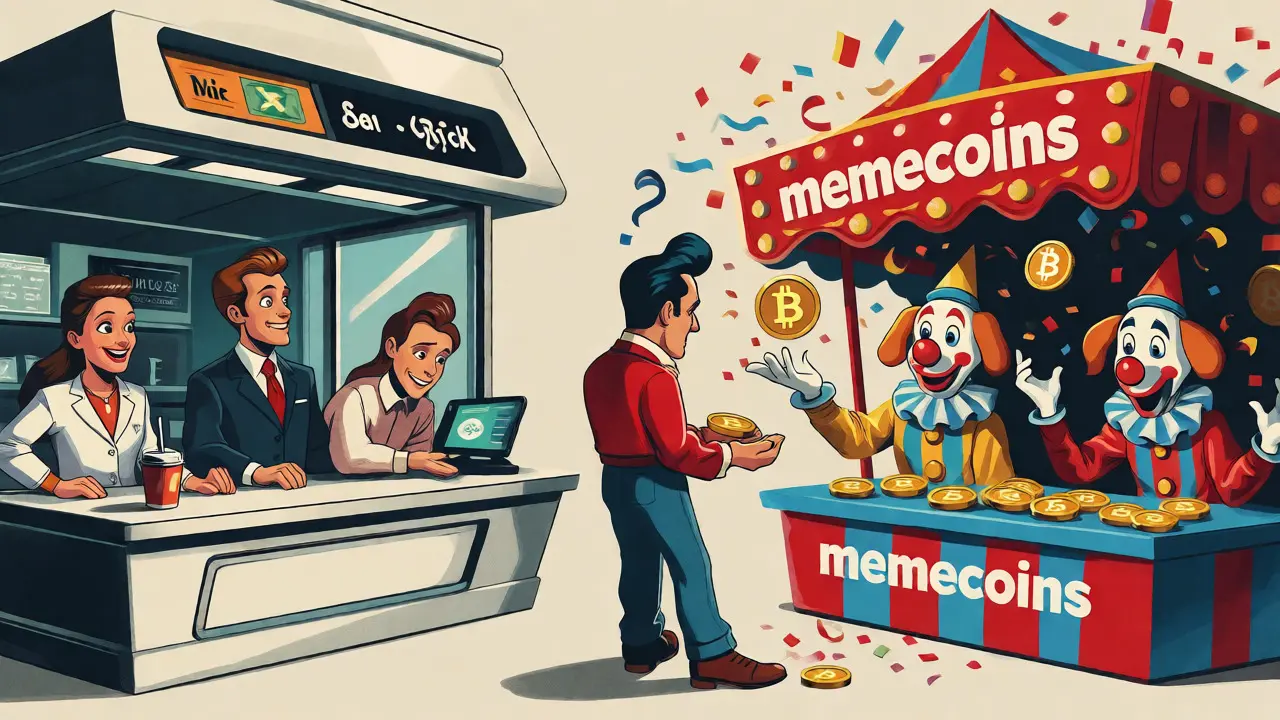
But there are exceptions. Memecoin (MEME), the native token of the Memeland platform, offers staking rewards, NFT purchasing capabilities, and governance voting. Shiba Inu launched Shibarium, a Layer-2 solution, which has processed 247 million transactions with average fees of $0.0003. These moves attempt to bridge the gap between "joke" and "asset." However, even with these efforts, merchant adoption remains abysmal. Only 0.7% of cryptocurrency-accepting merchants accept meme coins beyond Dogecoin, according to BitPay’s 2025 survey. You can’t buy coffee with most of them. You can barely buy a sticker.
| Metric | Bitcoin | Ethereum | Dogecoin | Average New Meme Coin |
|---|---|---|---|---|
| Market Cap Share | 38.4% | 16.1% | ~0.9% | <0.01% |
| Annual Volatility | 48.7% | 56.2% | ~70% | 82.3% |
| Primary Value Driver | Store of Value | Smart Contracts | Community/Culture | Social Media Hype |
| Avg. Daily Transactions | ~45M | ~1.2M | 350K | <1K |
| Security Audits | Rigorous | Rigorous | Legacy Code | 73% Unaudited |
The Survivorship Bias Trap
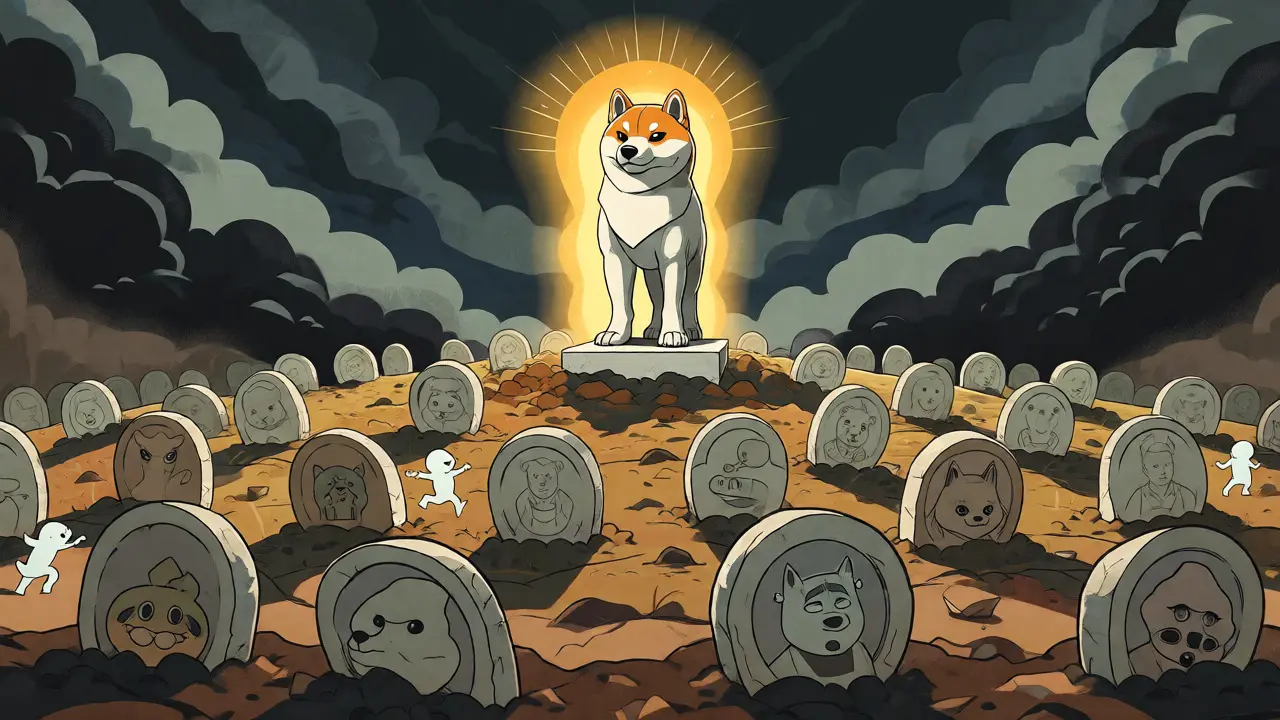
We remember Dogecoin because it survived. We remember Shiba Inu because it got huge. We forget the thousands of others that vanished. This is survivorship bias. When you see a chart of DOGE going up since 2021, you aren’t seeing the graveyard. According to Chainalysis, "rug pulls"-where developers abandon projects after raising funds-account for 31% of failed meme coins. Another 64% of new meme coins experience price drops of over 90% within 30 days.
Consider the case of the $Trump memecoin. In January 2025, three days before his inauguration, it hit a $27 billion market cap. By February, investors had collectively lost $2 billion as the price crashed. It wasn’t a technology failure; it was a hype cycle exhaustion. Early buyers who got in before October 2020 saw returns exceeding 1,000,000% on SHIB, but those gains have diminished to roughly 15,000% by late 2025. If you missed the first wave, you’re likely holding the bag.
Regulatory Headwinds and Institutional Silence
If you’re hoping institutions will save your favorite meme coin, don’t hold your breath. Dr. Emily Chen, Chief Economist at the IMF, testified in early 2025 that meme coins represent "speculative excesses... with little to no fundamental value." While the SEC clarified that meme coins aren’t securities (which avoids some legal headaches), it also signaled they aren’t serious investment vehicles. The CFTC filed 17 enforcement actions against meme coin promoters in the first nine months of 2025 alone, up from just 3 in all of 2024. Regulators are watching the scams closely.
Institutional adoption is virtually nonexistent. Deloitte’s 2025 Digital Currency Adoption Survey shows only 0.2% of businesses accepting crypto payments take meme coins, mostly for novelty marketing. Tesla does accept Dogecoin, processing about $4.2 million monthly, but that’s a unique relationship driven by Elon Musk’s personal affinity, not broad corporate strategy. Financial advisors are equally skeptical: 92% of those surveyed by Morningstar recommend keeping meme coins under 1% of your portfolio. Treat them like lottery tickets, not blue-chip stocks.
Who Is Actually Holding These Tokens?
The demographic profile of a meme coin investor tells you everything about their longevity. CryptoCompare’s November 2025 survey of over 12,000 users found that 68% of meme coin investors are under 35. More telling: 54% identify as "casual investors" making small speculative bets. The average purchase amount is $147, compared to $1,850 for Bitcoin investors. This suggests that for most people, buying a meme coin is entertainment spending, not wealth building.
Holding patterns confirm this. Glassnode reports that 87% of meme coin holders sell within 90 days. Compare that to Bitcoin, where 58% hold longer, and Ethereum, where 63% do. People flip meme coins quickly. They chase the pump, sell the peak, and move on to the next trend. This high turnover creates liquidity but prevents the kind of long-term accumulation that stabilizes a currency’s value. Unless you have a community as strong as Dogecoin’s 2.3 million monthly engaged users, your token is likely a passing fad.
The Path Forward: Evolution or Extinction?
So, what happens next? Bernstein Research predicts that 95% of existing meme coins will become worthless within five years. But they also suggest the top 3-5 survivors could maintain relevance through community strength and gradual utility development. We might see a consolidation phase where only the strongest brands remain. Dogecoin has already integrated with Tesla’s payment system. Shiba Inu is building its own Layer-2. Memecoin is expanding staking rewards.
The most optimistic view comes from Raoul Pal, who argues that community-owned assets with strong cultural resonance could persist as a new asset class. He projects that while 99% fail, the survivors might capture 3-5% of the retail crypto market. This means the era of random animal-themed coins dying overnight might be ending, replaced by a smaller set of established "meme brands" that function more like social networks than currencies. But for every Dogecoin, there are thousands of dead cats and dogs.
Frequently Asked Questions
Can a memecoin ever replace traditional money?
It is highly unlikely. Traditional money requires stability, widespread merchant acceptance, and trust in monetary policy. Memecoins suffer from extreme volatility (averaging 82.3% annual volatility) and minimal merchant adoption (less than 1%). They are better suited for speculation and tipping than for buying groceries.
Why do so many memecoins fail so quickly?
Most fail due to a lack of utility and unsustainable hype cycles. Data shows 94.7% of memecoins lose 90% of their value within 18 months. Common causes include "rug pulls" (31% of failures), where developers abandon the project, and simple market saturation where attention shifts to the next viral trend.
Is Dogecoin different from other memecoins?
Yes, primarily due to its age and brand recognition. Launched in 2013, it has survived multiple market cycles and gained significant mainstream visibility, including integration with Tesla. It has a larger, more active community (2.3 million monthly users) than almost any other meme coin, giving it a level of staying power that newer tokens lack.
What percentage of my portfolio should be in memecoins?
Financial experts generally recommend keeping memecoins below 1% of your total crypto portfolio. Given their high risk and speculative nature, treating them as entertainment or high-risk gambling rather than core investments helps protect your overall financial health.
Do memecoins have any real utility?
Generally, no. The SEC classifies them as "collectibles" with limited functionality. Exceptions exist, such as Shiba Inu’s Shibarium Layer-2 for lower transaction fees or Memecoin’s staking features, but the vast majority serve no practical purpose beyond trading and community engagement.