Node Requirements for Different Blockchain Networks: Bitcoin, Ethereum, Solana Compared
 Feb, 28 2026
Running a node on a blockchain isn’t just about installing software. It’s about choosing the right hardware, understanding the trade-offs, and accepting the real-world costs that come with helping secure a decentralized network. Not all blockchains are built the same. What works for Bitcoin won’t cut it for Solana, and what Ethereum needs today is already changing. If you’re thinking about running a node-whether for security, profit, or just to be part of the network-you need to know what you’re signing up for.
Bitcoin: The Original Full Node
Bitcoin’s full node is the gold standard for decentralization. It stores the entire blockchain history-every transaction since January 2009. By 2025, that’s over 500 gigabytes of data. You need a solid-state drive (SSD), not a traditional hard drive. SSDs handle the constant read/write cycles much better, and if you try to use an HDD, you’ll end up waiting hours just to sync up.
Bandwidth matters too. A Bitcoin full node downloads about 10-20 GB per month just to stay current. That’s like streaming 5 HD movies every month, but for blockchain data. You don’t need a crazy CPU-Bitcoin mining is handled by specialized hardware, but your node still needs enough power to verify each block, which means a modern quad-core processor is the bare minimum.
Why run it? Because Bitcoin’s security relies on people running full nodes. They’re the ones who reject invalid transactions. If no one ran full nodes, anyone could fake a transaction and the network would have no way to stop it. Full nodes don’t earn rewards, but they give you total control. You don’t need to trust anyone else. You verify everything yourself.
There’s also the pruned node option. It only keeps the last 500 MB of blockchain data. It still validates transactions and enforces rules, but it doesn’t store the full history. That’s perfect if you’re short on disk space but still want to contribute to network integrity.
Ethereum: The Shift to Proof-of-Stake
Ethereum changed everything in September 2022 when it switched from proof-of-work to proof-of-stake. That meant miners were replaced by validators. Now, instead of using electricity to solve math problems, you lock up 32 ETH to become a validator. But that’s just the start.
Running an Ethereum full execution node requires:
- 16 GB of RAM (minimum, 32 GB recommended)
- 1 TB SSD for storage (and growing)
- High-speed internet (10 Mbps minimum, 100 Mbps preferred)
- Uptime (if you go offline too often, you get penalized)
Unlike Bitcoin, Ethereum’s data doesn’t just grow-it explodes. Every smart contract, every NFT, every DeFi trade adds to the state. That’s why Ethereum is working on something called stateless clients. The idea? Let nodes verify transactions without storing the entire state. That could cut RAM needs down to 8 GB or even less in the next few years.
Light clients exist, but they’re not widely used yet. Most people run full nodes because they want to be sure. And if you’re staking ETH, you’re already running a validator node. That’s not optional-you’re part of the consensus layer.
Solana: Speed at a Cost
Solana promises 65,000 transactions per second. But that speed comes with a price. To keep up, validators need serious hardware. By early 2025, the minimum requirements were:
- 128 GB of RAM
- 16-core CPU (high clock speed, like AMD EPYC or Intel Xeon)
- 2 TB NVMe SSD (faster than regular SSDs)
- 1 Gbps dedicated internet connection
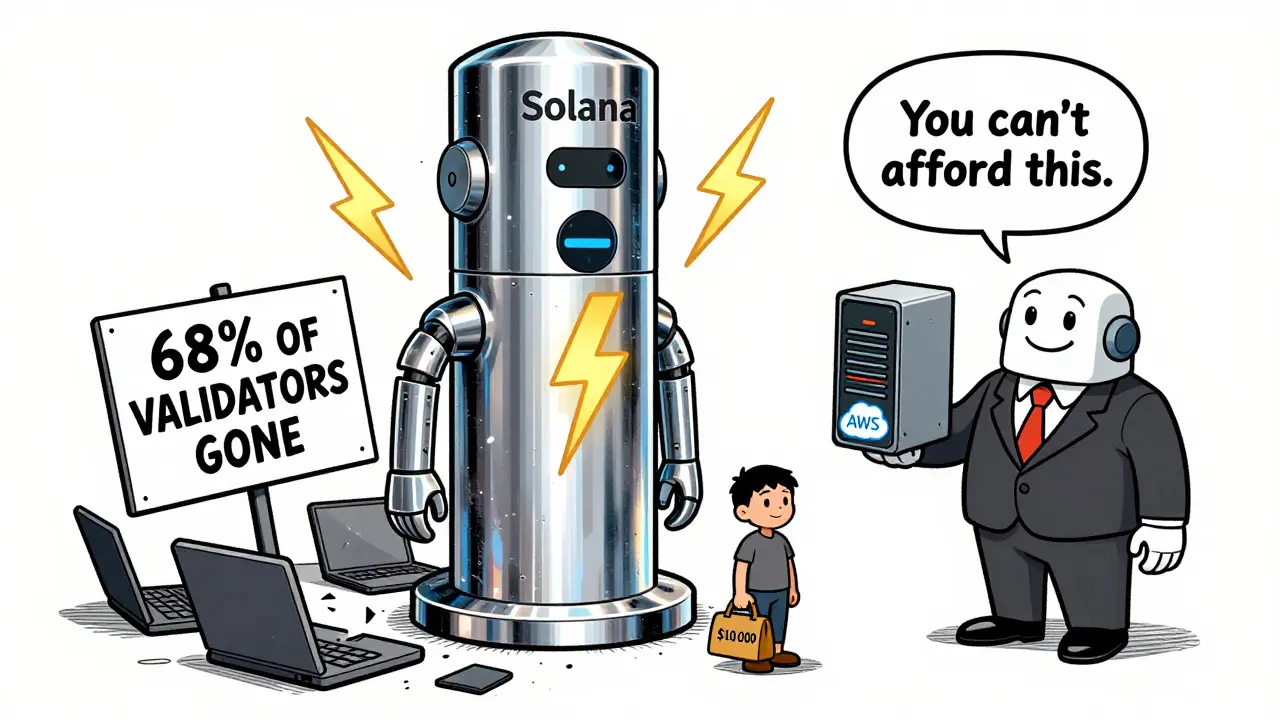
That’s not a home setup. That’s a server rack. And it’s why Solana’s validator count dropped by 68% between 2023 and 2025. Smaller operators just couldn’t afford the upgrades. The network became more centralized-not because of design, but because of cost.
Why does this matter? Because decentralization isn’t just a buzzword. It’s the whole point. If only big companies and crypto funds can run validators, then Solana isn’t really decentralized-it’s just a fast private database with a blockchain label.
There are workarounds. Some people use cloud providers like AWS or Google Cloud to run validators. But that introduces new risks. What if the cloud provider goes down? Or changes its terms? You lose control. And that defeats the purpose of blockchain.

Other Node Types: What’s Really Out There
Not every node is a full node. Here are the others you might hear about:
- Light nodes (SPV): These download only block headers. Great for mobile wallets. They’re fast and cheap, but they rely on full nodes for accuracy. If all the full nodes you connect to are lying, you might get tricked. Use multiple trusted full nodes as anchors.
- Pruned full nodes: Like Bitcoin’s version, these keep only recent data. They’re a sweet spot for people who want to validate but can’t afford terabytes of storage.
- Miner nodes: Only for proof-of-work chains like Bitcoin. These are the ones doing the heavy computational work. They get rewarded with new coins and fees. But since Ethereum moved to proof-of-stake, miner nodes are mostly a thing of the past.
- Super nodes: These are high-performance nodes that help relay data across the network. Often run by exchanges or infrastructure providers. They’re not required for consensus, but they make the network faster.
- Lightning nodes: These aren’t on the main blockchain. They’re part of off-chain networks like the Bitcoin Lightning Network. They enable instant, cheap micropayments. You don’t need much hardware for these-just enough to run the software.
Consensus Matters: How the Rules Change the Game
The type of consensus your blockchain uses shapes your node requirements.
- Proof-of-Work (PoW) - Bitcoin: Needs powerful mining rigs. High electricity. Low barrier to entry for full nodes, but high barrier for miners.
- Proof-of-Stake (PoS) - Ethereum: Needs capital (32 ETH) and solid hardware. Lower energy use, but high entry cost for validators.
- Proof-of-Authority (PoA) - Private blockchains: Only approved nodes can validate. You need identity verification, not hardware. Used in enterprise systems. Very centralized by design.
- IBFT / Raft - Permissioned chains: Require an odd number of nodes (3, 5, 7). Used in enterprise setups. No mining, no staking. Just trust a few known entities.
Here’s the truth: blockchains that want to be decentralized can’t have node requirements that only big companies can meet. Solana’s model is a warning. Ethereum’s stateless project is a step toward sustainability. Bitcoin’s full node is the ideal-simple, resilient, but demanding.
What Should You Run?
If you’re a hobbyist:
- Run a Bitcoin pruned node. It’s cheap, secure, and meaningful.
- Use an Ethereum light client if you just want to check balances or send ETH.
If you’re serious about supporting the network:
- Run a full Bitcoin node. It’s the backbone of decentralization.
- Stake ETH and run a validator on Ethereum-but make sure you have the RAM and uptime.
If you’re thinking about Solana:
- Ask yourself: Do you have $10,000+ in hardware? A dedicated server room? A 24/7 power supply?
- If not, you’re not helping decentralization-you’re just paying for a fast database.
There’s no one-size-fits-all. But there is a rule: the harder it is to run a node, the less decentralized the network becomes. If only corporations can participate, then the blockchain isn’t for the people-it’s for the powerful.
Do I need to run a full node to use cryptocurrency?
No. Most people use wallets that connect to public nodes run by companies like MetaMask, Coinbase, or Infura. These wallets are easy and fast. But if you want to verify transactions yourself, without trusting anyone, then running your own node is the only way.
Can I run a Bitcoin and Ethereum node on the same computer?
Yes, but it’s not easy. Bitcoin needs around 500 GB of storage. Ethereum needs over 1 TB and 16 GB of RAM. Running both on a single machine will max out your CPU, RAM, and disk I/O. Most people run them on separate machines or use cloud servers. If you try to run both on a home PC, expect slowdowns and crashes.
Why does Solana need so much RAM compared to Bitcoin?
Solana processes blocks every 400 milliseconds. To do that, it keeps the entire state of every smart contract, account, and token in memory. Bitcoin doesn’t do that-it just checks if transactions are valid. Solana’s speed comes from keeping everything loaded in RAM, which is fast but expensive. Bitcoin’s simplicity makes it slower but far more sustainable.
Are light nodes safe?
Light nodes are safe enough for everyday use-like checking your wallet balance. But they’re not fully secure. They assume the full nodes they connect to are honest. If you only connect to one malicious full node, you could be tricked into thinking a transaction happened when it didn’t. Always connect to multiple trusted full nodes if you’re doing anything important.
What’s the future of node requirements?
The trend is toward reducing requirements. Ethereum’s stateless clients, Bitcoin’s pruning, and new data compression techniques aim to let phones and low-cost devices run nodes. If blockchain is meant to be decentralized, then the goal isn’t to make nodes more powerful-it’s to make them accessible to everyone.
Final Thought
Running a node isn’t about being a tech expert. It’s about choosing where you stand. Do you want to trust others? Or do you want to verify everything yourself? The hardware requirements are just the cost of that choice. And as networks grow, the ones that keep their nodes accessible will survive. The ones that become exclusive? They’ll fade into corporate infrastructure-fast, but not free.
Cheryl Fenner Brown
March 1, 2026 AT 05:22Brian Lemke
March 1, 2026 AT 23:26Colin Lethem
March 2, 2026 AT 07:59Deborah Robinson
March 3, 2026 AT 05:34Kaitlyn Clark
March 3, 2026 AT 05:37Michael Teague
March 4, 2026 AT 04:34kati simpson
March 5, 2026 AT 06:42Sriharsha Majety
March 7, 2026 AT 00:58lori sims
March 7, 2026 AT 07:13Cory Derby
March 8, 2026 AT 14:40Michelle Mitchell
March 9, 2026 AT 05:09Mary Scott
March 10, 2026 AT 10:02christopher luke
March 11, 2026 AT 19:15Kristi Emens
March 13, 2026 AT 08:38Reggie Fifty
March 13, 2026 AT 17:29