North Macedonia Crypto Ban Explained: 2026 Regulatory Shift and MiCA Alignment
 May, 23 2026
Is North Macedonia banning cryptocurrency? The short answer is no, but the reality is messy. If you are holding Bitcoin or trading altcoins in Skopje right now, you aren't breaking any specific law by owning them. However, using them to buy coffee or paying for services with Ethereum is effectively off-limits because they lack legal tender status. This creates a confusing "legal gray zone" that has kept investors on edge since 2018.
As of May 2026, this ambiguity is finally starting to clear up. The country is moving away from its cautious, warning-heavy stance toward a structured regulatory framework aligned with European Union standards. For locals and foreign investors alike, understanding this shift is crucial. It’s not just about whether you can trade; it’s about how your assets will be taxed, protected, and integrated into the broader financial system as North Macedonia prepares for potential EU accession.
The Current Status: A Legal Gray Zone
To understand where we are today, we have to look at what hasn’t happened. There is no single law in North Macedonia that explicitly criminalizes the possession or trading of cryptocurrencies like Bitcoin is a decentralized digital currency that operates without a central authority. You can hold a wallet, you can send funds abroad, and you can trade on international platforms. But there is also no law that protects you if those platforms collapse or if you get scammed.
This vacuum exists because cryptocurrencies do not have legal tender status is official recognition of a currency as valid for settling debts and taxes within a jurisdiction. In practical terms, this means a shopkeeper in Bitola cannot legally accept Dogecoin for groceries. They must use Macedonian Denars (MKD) or Euros. Attempting to use crypto for everyday payments violates general financial regulations regarding currency exchange and payment processing.
The National Bank of the Republic of North Macedonia is the central bank responsible for monetary policy and financial stability in the country (NBRM) has been the primary voice of caution here. Since issuing its first public warnings in 2018, the NBRM has consistently highlighted two major risks: extreme price volatility and the high potential for fraud. They haven’t banned the assets, but they have made it very difficult for local banks to interact with them. Most local banks will block transactions linked to known cryptocurrency exchanges to avoid violating anti-money laundering (AML) rules.
Why the Confusion Exists
You might hear conflicting reports online. Some sources claim a total ban, while others suggest full freedom. This confusion stems from the difference between ownership and commercial activity. Owning crypto is tolerated. Running an unlicensed exchange or mining operation is where the trouble starts.
Because there was no dedicated legislation until recently, authorities relied on general financial laws. These laws were designed for traditional banking, not blockchain technology. When a business tried to operate a crypto exchange locally without a license, regulators shut it down under existing AML/CFT (Anti-Money Laundering/Combating the Financing of Terrorism) frameworks. This led many to believe crypto itself was banned, when in reality, only unregulated commercial activities were being targeted.
For the average user, this meant relying on offshore exchanges. You couldn’t easily deposit MKD from a local bank account to Binance or Kraken. You had to use peer-to-peer (P2P) methods, gift cards, or wire transfers through third countries. This friction limited market growth and pushed much of the activity underground, making it harder for the government to track economic flows or protect consumers.
The 2024-2026 Policy Shift
Something changed with the political landscape. The right-wing government formed in 2024 identified cryptocurrency regulation as a key priority. Their goal wasn’t to crush innovation, but to attract foreign capital and align with European standards. North Macedonia is an EU candidate country, and Brussels has made it clear that member states must have robust digital asset regulations.
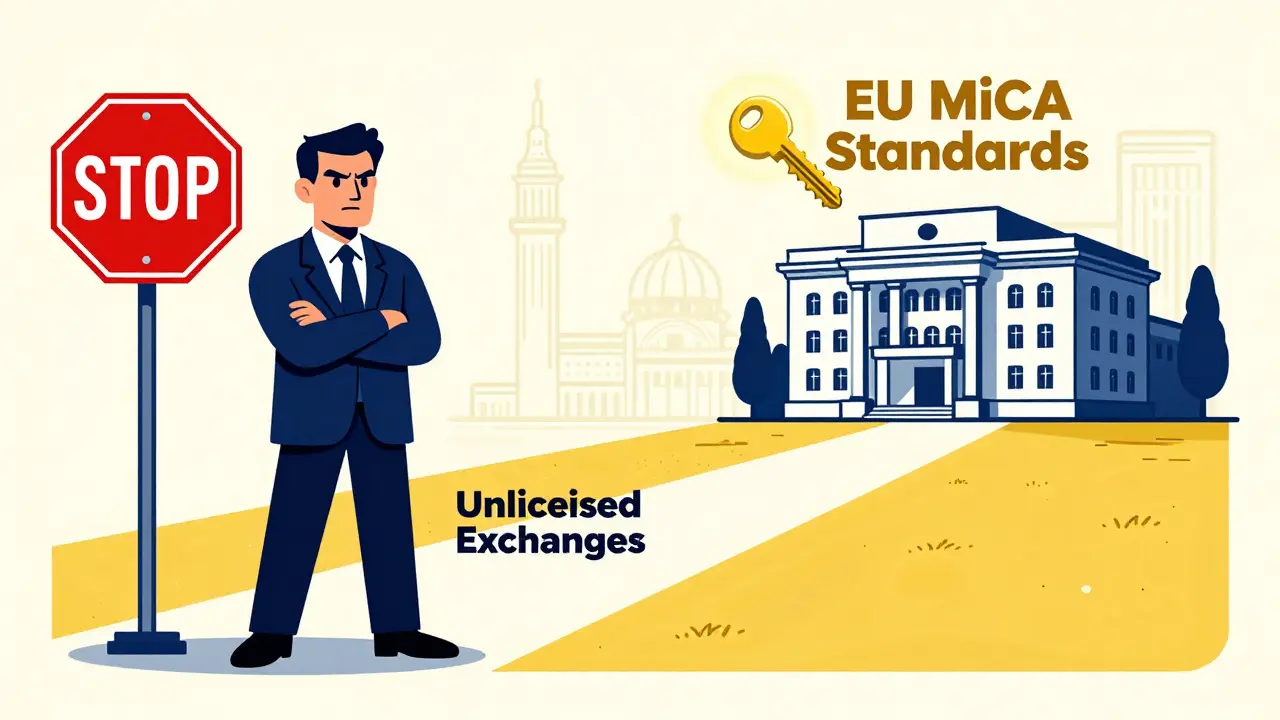
This alignment centers on the Markets in Crypto-Assets (MiCA) is a comprehensive regulatory framework adopted by the European Union to govern crypto-assets across member states (MiCA) framework. MiCA provides a unified set of rules for issuers and traders of crypto-assets. By adopting these principles, North Macedonia aims to create a predictable environment for businesses. Draft laws incorporating MiCA elements were expected in late 2025, and by early 2026, the groundwork for licensing local exchanges began to take shape.
The plan involves creating a licensing system for cryptocurrency exchanges between 2025 and 2026. This is a massive shift. Instead of blocking all crypto-related banking activity, the NBRM will soon supervise licensed entities. These entities will need to prove they have strong cybersecurity, sufficient capital reserves, and effective AML procedures. For users, this means safer platforms. For businesses, it means a clear path to operate legally within the country.
Taxation and Financial Obligations
One of the biggest questions hanging over every investor is: Do I have to pay taxes on my gains? Currently, the rules are murky. There is no specific "cryptocurrency tax" law. However, the general tax code applies.
If you treat crypto as property or a financial instrument, profits from selling it may be subject to capital gains tax. The Public Revenue Office is the state agency responsible for collecting taxes and enforcing tax laws in North Macedonia (Javna Poreska Uprava) has indicated that income generated from digital assets should be declared. Failure to do so could result in penalties during audits. While enforcement has been inconsistent due to the lack of clear guidelines, the upcoming regulatory framework is expected to clarify these obligations.
Expect clearer reporting requirements once the new laws pass. Licensed exchanges will likely be required to report user transactions to tax authorities, similar to how stock brokers operate in developed markets. This increases transparency but reduces the ability to hide large profits. For freelancers paid in crypto, income tax rates will apply to the value of the assets received at the time of transaction.
Comparison with Regional Neighbors
| Country | Crypto Status | Legal Tender? | Regulatory Framework | EU Alignment |
|---|---|---|---|---|
| North Macedonia | Partial Restriction / Evolving | No | MiCA-aligned drafts (2025-2026) | High (Candidate) |
| Estonia | Fully Regulated | No | Established Virtual Currency Act | Full Member |
| Bulgaria | Restricted Banking Access | No | General AML Laws | Full Member |
| Serbia | Licensed Trading Only | No | Digital Assets Law | Candidate |
Looking at the table above, North Macedonia sits in an interesting middle ground. Estonia embraced crypto early, becoming a hub for exchanges before tightening rules later. Bulgaria remains restrictive, largely blocking bank accounts for traders. Serbia has moved closer to North Macedonia’s current path, establishing a formal licensing regime. As North Macedonia finalizes its MiCA-aligned laws, it positions itself to compete with Serbia for fintech investment, offering a gateway to the EU market with potentially lower operational costs than Western Europe.

Practical Implications for Users and Businesses
So, what does this mean for you? If you are a casual trader, keep your records clean. Document your purchases, sales, and holdings. With the end of the gray zone approaching, retroactive scrutiny is possible. Use reputable offshore exchanges for now, but watch for announcements of locally licensed platforms. Once those launch, moving your funds to a regulated entity within North Macedonia will offer better consumer protection and easier fiat on-ramps.
For businesses, the opportunity is significant. Several local startups have already begun exploring blockchain for supply chain management and digital identity verification. One notable example is a fintech startup that launched a blockchain-based remittance service. Given North Macedonia’s high emigration rate, sending money home is a huge industry. Traditional banks charge high fees and slow processing times. Blockchain allows expatriates to send funds instantly at a fraction of the cost. Under the new framework, such services could operate openly, boosting efficiency and reducing costs for families.
However, caution is still advised. The transition period brings uncertainty. Regulations might change slightly before final passage. Ensure any business model involving crypto includes compliance checks for AML/KYC (Know Your Customer) standards. Ignoring these could lead to severe penalties once the new laws are fully enforced.
Future Outlook: Toward EU Accession
The ultimate driver of this change is North Macedonia’s desire to join the European Union. Projections suggest membership talks could intensify, with possible accession around 2030. To achieve this, the country must harmonize its laws with EU directives. Crypto regulation is a small but necessary part of this puzzle.
By implementing MiCA standards now, North Macedonia avoids having to make drastic changes later. It signals to Brussels that the country is serious about financial stability and consumer protection. This proactive approach could accelerate other aspects of the accession process. For investors, this means long-term stability. A country aligned with EU regulations is less likely to experience sudden policy reversals or arbitrary bans.
Experts remain divided on the pace of adoption. Some worry that strict MiCA rules might stifle local innovation, pushing startups to more friendly jurisdictions like Malta or Lithuania. Others argue that clarity is better than chaos. Without rules, big players won’t enter the market. With rules, institutional money can flow in safely. The next 12 months will be critical in determining which view proves correct.
Is it illegal to own Bitcoin in North Macedonia?
No, it is not illegal to own Bitcoin or other cryptocurrencies. The government has not passed a law banning personal possession. However, using them as legal tender for payments is prohibited, and trading must eventually occur through licensed platforms under the new regulatory framework.
When will North Macedonia implement its crypto licensing system?
The government plans to introduce a licensing system for cryptocurrency exchanges between 2025 and 2026. Draft laws aligned with the EU's MiCA framework were expected in late 2025, with implementation phases rolling out throughout 2026 to prepare for eventual EU accession.
Do I have to pay taxes on cryptocurrency profits?
Yes, you likely do. While there is no specific crypto tax law yet, general tax codes apply. Profits from selling crypto may be subject to capital gains tax, and income earned in crypto is taxable. The Public Revenue Office expects these earnings to be declared, and future regulations will likely enforce stricter reporting via licensed exchanges.
Can I use crypto to pay for goods in shops?
No. Cryptocurrencies do not have legal tender status in North Macedonia. Shops and businesses are required to accept Macedonian Denars (MKD). Using crypto for direct payments violates current financial regulations regarding currency usage.
How does the new regulation affect local banks?
Previously, most local banks blocked transactions related to crypto exchanges due to fear of violating AML rules. Under the new framework, banks will be able to serve licensed crypto businesses legally. This will make it easier for users to deposit and withdraw fiat currency from regulated platforms.