Norway’s Data Center Restrictions on Crypto Mining: What You Need to Know in 2026
 Feb, 3 2026
By early 2026, Norway has become the most restrictive country in Europe when it comes to cryptocurrency mining - not because it’s against the technology, but because it’s against the electricity. While countries like Iceland and Finland still welcome crypto miners with cheap hydropower, Norway flipped the script. It didn’t ban mining outright. Instead, it built a system to choke it slowly - through registration, oversight, and a hard stop on new power-hungry data centers.
How Norway’s Crypto Mining Ban Actually Works
The rules that took effect in autumn 2025 aren’t what you’d call a blanket ban. They’re surgical. The government didn’t shut down existing mines. It just said: no new ones. And if you want to run one, you better be ready to tell the government everything about it. The Norwegian Communications Authority (Nkom) now runs a mandatory national registry for all data centers. If your facility uses more than a certain amount of power - even if you don’t say you’re mining crypto - you’re required to register. You need to provide your company name, physical address, legal structure, and a contact person. You also have to list your customers. That’s right: if you’re renting space to a Bitcoin miner, you have to name them. No hiding behind vague terms like "cloud hosting" or "server farm." Existing data centers had until July 1, 2025, to comply. New ones? No registration, no construction. Skip this step and you could face fines up to 5% of your annual revenue. For a mid-sized mining operation, that’s millions of kroner.Why Norway Is Targeting Crypto Mining
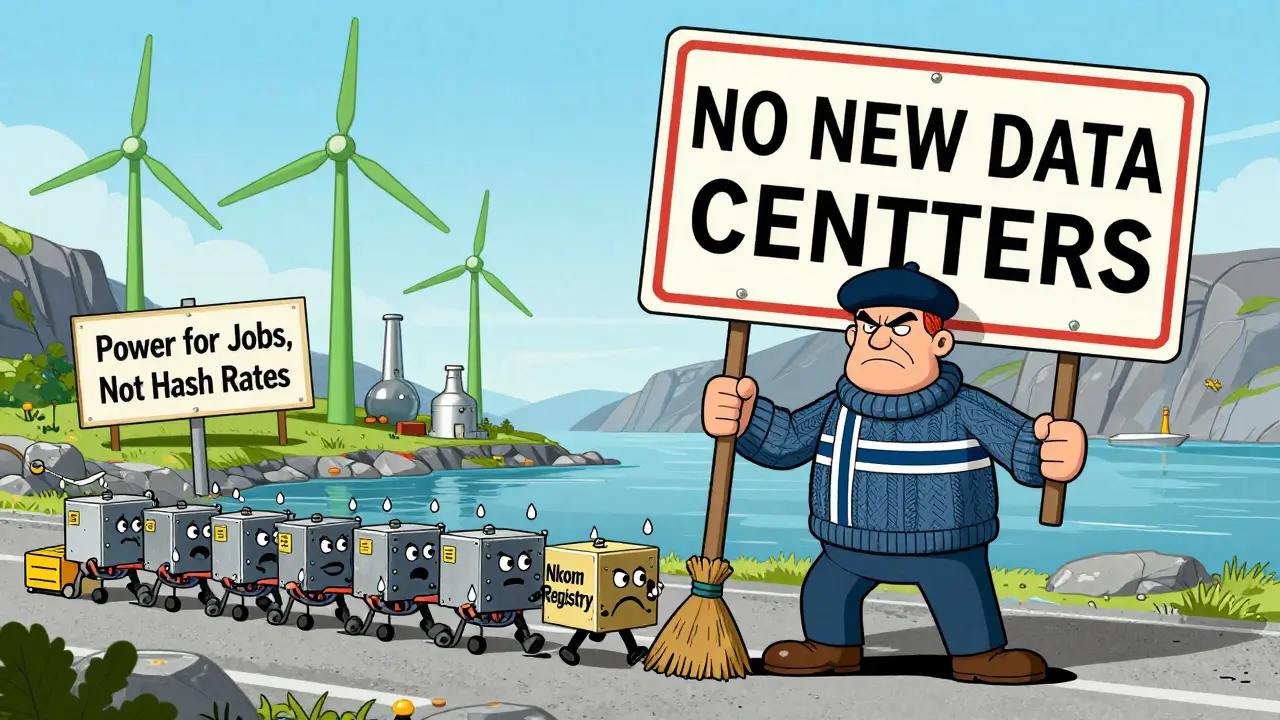
Norway generates nearly 100% of its electricity from hydropower. It’s clean, renewable, and abundant. So why not let miners use the surplus? The government’s answer is simple: it’s not about the energy source - it’s about the value. Minister Karianne Tung of the Ministry of Digitalization said it plainly: crypto mining is "very power-intensive and generates little in the way of jobs and income for the local community." Think about it. A Bitcoin mining farm in Hamar might use as much electricity as a small town. But it doesn’t hire local electricians. It doesn’t pay local taxes. It doesn’t build schools or roads. It just churns through power, sends digital coins overseas, and leaves behind heat and noise. Meanwhile, Norway’s manufacturing sector, green hydrogen projects, and aluminum smelters - industries that create real jobs and export goods - are struggling to get enough power. The government decided: if you’re going to use our electricity, you better be building something that stays here.What’s Different About Norway’s Approach?
China banned crypto mining in 2021 - outright. No exceptions. Norway didn’t go that far. It kept the existing mines running. That’s a key difference. This isn’t about stopping Bitcoin. It’s about stopping growth. It’s about saying: we’ve already given you enough space. Now stop taking more. Compare that to Sweden or Finland. They still offer low electricity prices and minimal oversight. Miners flock there. Norway’s move has already triggered a domino effect. Companies that planned to build data centers in Oslo or Trondheim are now looking at Iceland, Canada, and even parts of the U.S. with cheap renewables - places like Texas or Washington State. Norway’s registration system is also unique. No other European country requires this level of transparency for data centers. Even under the EU’s MiCA regulations, which roll out fully in 2026, you don’t have to disclose your customers. Norway does. That’s why mining operators call it the most intrusive regulatory framework in Europe.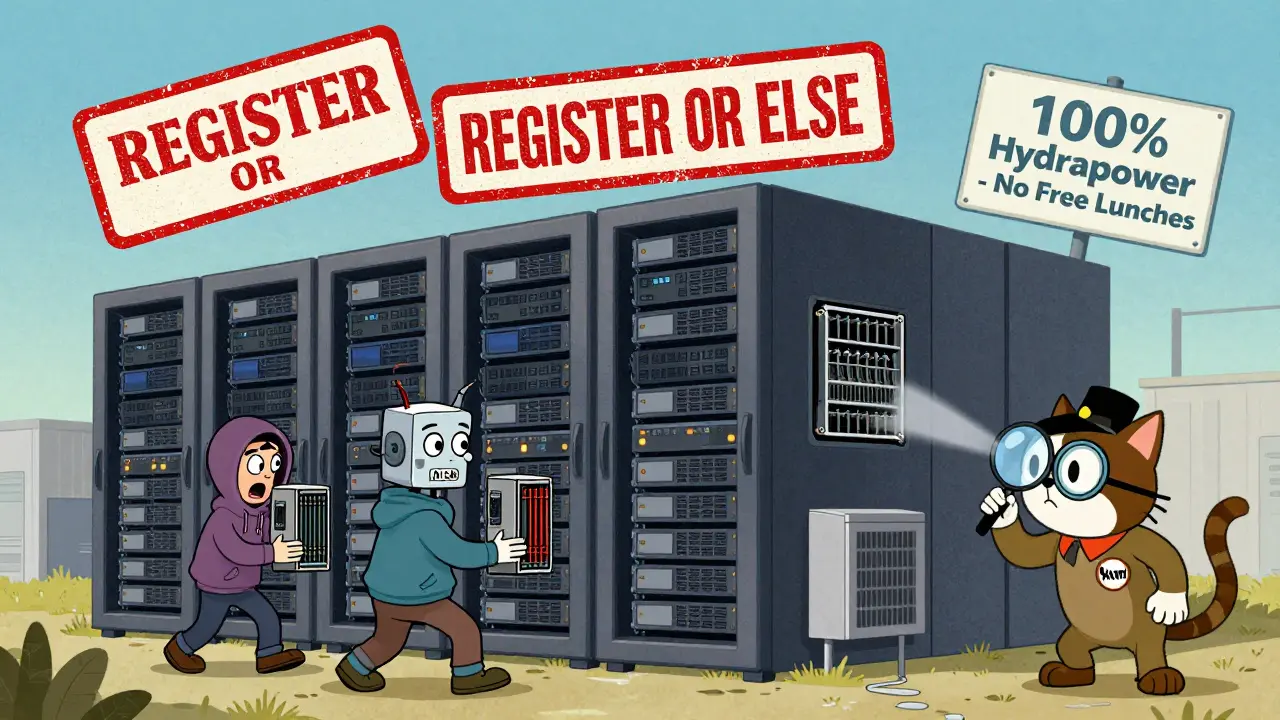
Who’s Getting Hit the Hardest?
It’s not just the big players. Small-scale miners - the ones running a few hundred rigs in a garage or warehouse - are feeling the pinch too. Registration costs aren’t just about paperwork. You need lawyers to fill out forms correctly. You need auditors to verify your power usage. You need ongoing reporting systems. For a solo miner with 50 ASICs, that’s a $10,000-$20,000 annual compliance cost. Most can’t afford it. Some have already shut down. Even larger operations are nervous. The energy threshold for the ban hasn’t been made public. Is it 10 MW? 20 MW? No one knows. That uncertainty makes long-term planning impossible. One operator told a local newspaper they’re now running at 80% capacity just to stay under the radar - even if they’re not technically breaking the rules.The Ripple Effect: Global Mining Shifts
Norway’s restrictions are changing where Bitcoin is mined. Before 2025, Norway accounted for about 1.2% of the global Bitcoin hash rate. That’s not huge, but it was growing fast. Now, that growth has stopped. Some rigs have been moved to Iceland, where electricity is still cheap and the government hasn’t imposed registration rules. Others went to Georgia, Kazakhstan, or even Paraguay. The result? The global mining map is shifting away from Northern Europe. That’s not just a business problem - it’s a decentralization problem. Bitcoin’s strength comes from having miners spread across many countries. If mining becomes concentrated in just a few places with lax rules, the network becomes more vulnerable. Norway doesn’t care. To them, it’s not about Bitcoin’s security. It’s about their power.What Comes Next?
The current ban only applies to new data centers. But government officials have hinted this might not be the end. Minister Terje Aasland of the Ministry of Energy said in a December 2025 interview: "We’re watching. If we see mining consuming more than we can reasonably spare, we’ll act." That means existing mines aren’t safe forever. There’s talk of introducing power caps for all data centers, not just new ones. Or requiring mining operators to pay a surcharge on electricity used for crypto. Or even mandating that a portion of their energy output be sold back to the grid at fixed rates. The Norwegian Financial Supervisory Authority (FSA) is also tightening financial rules under MiCA. By mid-2026, mining firms may need licenses just to operate - not just for energy, but for financial activity. That’s a whole new layer of bureaucracy.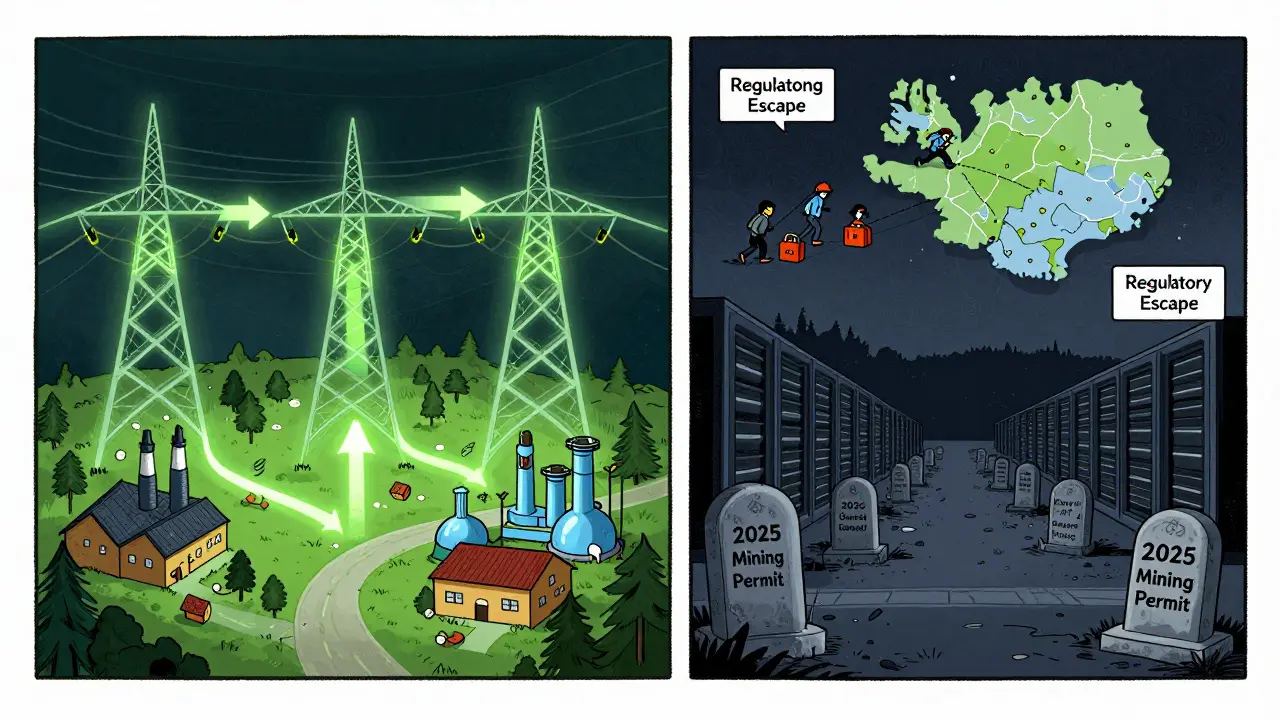
Is There Any Way Around It?
Technically, yes. But it’s risky. Some operators tried to reclassify their data centers as "AI research labs" or "quantum computing test sites." The government caught them. Nkom now cross-checks power usage patterns against known mining signatures. If your facility runs 24/7 at 98% load with no cooling system for servers - you’re flagged. Others moved their rigs to private homes. But Norway has strict zoning laws. Residential power limits are low. You can’t legally run a mining rig in a basement without exceeding your household contract. The authorities have already issued warnings to homeowners. There’s no legal loophole. Not anymore.What This Means for Miners and Investors
If you’re thinking of setting up a crypto mining operation in Europe, Norway is off the table. It’s not just difficult - it’s designed to push you out. For investors, this is a warning sign. Norway is proving that even countries with clean energy won’t let crypto mining take priority over their own economic goals. If Norway - with its hydropower and low carbon footprint - says no, then what hope is there for other nations? The message is clear: if your business model relies on cheap, unused power, you’re no longer welcome in the most responsible economies. You’ll have to go where rules are weak - and that’s not a sustainable future for crypto.What About the Environment?
Environmental groups in Norway are celebrating. They see this as a win for climate accountability. The country’s goal is to cut emissions by 55% by 2030. Crypto mining doesn’t help with that. Even if the power is renewable, the energy is still being used for something that doesn’t benefit society. Norway isn’t saying crypto is bad. It’s saying: don’t use our resources for something that doesn’t pay us back. And that’s a line more countries might draw soon.Is cryptocurrency mining still legal in Norway?
Yes, but only for existing operations. New cryptocurrency mining data centers are banned as of autumn 2025. Existing mines can keep running, but they must register with the Norwegian Communications Authority (Nkom) and comply with strict reporting rules. Failure to register can result in fines up to 5% of annual turnover.
Why did Norway ban new crypto mining data centers?
Norway generates nearly all its electricity from hydropower, but the government decided that crypto mining uses too much energy for too little return. Unlike manufacturing, mining doesn’t create local jobs, pay significant taxes, or produce physical goods. Officials want to prioritize power for industries that benefit the economy and society, such as green hydrogen, aluminum production, and public services.
Do I need to register my data center if I’m not mining crypto?
Yes. Norway’s data center registry applies to all facilities above a certain power threshold, regardless of use. If your center consumes significant electricity - even for AI, cloud services, or web hosting - you must register. The government uses this system to identify and monitor high-energy users, including those secretly running crypto mining rigs.
What happens if I don’t register my data center?
Non-compliance can lead to fines of up to 5% of your annual revenue. Authorities can also shut down operations, cut off power, or take legal action. The Norwegian Communications Authority (Nkom) cross-references power usage data with registration records and uses AI tools to detect mining patterns, making evasion increasingly difficult.
Can I move my mining equipment to another Nordic country?
Yes, and many have. Iceland, Sweden, and Finland still offer lower regulatory barriers and competitive electricity prices. However, these countries are watching Norway closely. If crypto mining grows too fast, they may adopt similar restrictions. Relocating is possible, but not necessarily a long-term solution.
Will Norway ban existing mining operations in the future?
It’s possible. While the current ban only targets new data centers, government officials have said they’re monitoring energy use and may expand restrictions. Future measures could include power caps, energy surcharges, or mandatory grid contributions from mining operators. No official timeline exists, but policy reviews are ongoing.
How does Norway’s rule compare to the EU’s MiCA regulation?
MiCA focuses on financial compliance - licensing crypto asset service providers, preventing money laundering, and protecting consumers. Norway’s rules go further by regulating energy use and requiring full transparency of data center operations. While MiCA will apply in Norway from 2026, the country’s data center registry and mining ban are stricter and more invasive than anything required by the EU.
Are small-scale miners affected by these rules?
Yes. Even home-based or small warehouse miners must register if their power usage exceeds thresholds. Many small operators can’t afford the legal and administrative costs - estimated at $10,000-$20,000 per year - so they’ve shut down. The rules don’t distinguish between hobbyists and large firms; if you use enough power, you’re regulated.
What’s the future of crypto mining in Europe?
Europe is becoming a divided continent. Countries like Norway and Denmark are prioritizing energy for domestic industries and may restrict mining further. Others like Iceland and Portugal are still open, but they’re under pressure. The trend is clear: if your mining operation doesn’t contribute to local economic growth, you won’t be welcome. The future belongs to miners who can prove their energy use creates real value - not just digital coins.
Can I still mine crypto in Norway using solar panels or wind power?
No. The ban applies to the energy source - not how it’s generated. Whether you use hydropower, wind, or your own solar array, if you’re running a crypto mining data center, you’re subject to the same rules. The government regulates based on power consumption and purpose, not the type of energy. Even off-grid mining requires registration and falls under the new restrictions.
Michelle Anderson
February 4, 2026 AT 04:16This is just socialist energy hoarding dressed up as "climate responsibility." They don't hate crypto-they hate wealth that doesn't bow to their bureaucracy. 🤡
sabeer ibrahim
February 5, 2026 AT 01:23USA still lets miners burn coal power and calls it freedom but Norway gets called harsh? Lmao. India would never waste hydropower on useless digital gambling. 💀
David Bain
February 6, 2026 AT 14:20What Norway is doing is a fascinating case study in energy sovereignty as a form of economic protectionism. The state is redefining utility not as mere access, but as conditional participation in a social contract. Crypto mining, in this framework, is an externality without reciprocal value creation. It's not anti-innovation-it's anti-free-riding.
Kieren Hagan
February 6, 2026 AT 20:03Let me be clear: this isn't about banning Bitcoin. It's about prioritizing industries that create tangible economic returns-jobs, exports, infrastructure. If you're using public resources to generate digital assets that vanish into offshore wallets, you're not contributing-you're extracting. Norway's policy is rational, not punitive.
Olivette Petersen
February 8, 2026 AT 19:23Imagine if we treated energy like a shared community garden-everyone gets a fair share, but no one hoards it for something that doesn't feed anyone. This feels like the right kind of grown-up decision. 💚
Deeksha Sharma
February 9, 2026 AT 15:33It's beautiful how Norway is choosing long-term societal health over short-term tech hype. We're all so obsessed with mining coins-but what are we really mining? Time? Energy? Attention? Maybe it's time to ask what we're building with it.
Freddie Palmer
February 10, 2026 AT 14:32Wait-so if you're running a data center for AI, cloud, or even web hosting, you still have to register? That's... actually kind of smart. It prevents loopholes. But how do they even measure if it's mining or not? Do they monitor heat signatures? Power spikes? This is wild.
Taybah Jacobs
February 11, 2026 AT 22:14While the policy may appear restrictive, it reflects a mature, values-driven approach to resource allocation. Energy is not an infinite commodity-even when renewable. Prioritizing industries that generate domestic employment and technological advancement is not merely prudent-it is ethically defensible.
Alisha Arora
February 13, 2026 AT 17:26So you’re telling me I can’t mine Bitcoin in my basement anymore? But I paid for my own solar panels! That’s not fair! I’m just trying to make some extra cash! 😭
Mrs. Miller
February 14, 2026 AT 17:35Oh wow, Norway’s like the mom who says "no candy before dinner"-but instead of candy, it’s digital gold. And guess what? She’s right. We all want free energy, but someone’s gotta pay for the lights on the whole damn block. 🌍⚡
Michael Sullivan
February 16, 2026 AT 05:47They’re not banning mining-they’re banning laziness. 🤖💥 If you can’t build something real with your power, you don’t deserve it. Bitcoin’s just a glorified electric heater with a blockchain logo. 💸🔥
Reda Adaou
February 16, 2026 AT 21:57I think this is a model other countries should study. Not to copy blindly, but to ask: what kind of energy economy do we want? One that fuels speculation-or one that builds the future? This isn’t anti-tech. It’s pro-society.
Matt Smith
February 16, 2026 AT 23:41So Norway bans mining… and suddenly everyone’s like "oh no the decentralization is dying!" Bro. The network’s fine. Miners moved to Iceland. The blockchain didn’t collapse. Stop acting like your ASICs are sacred relics. 🤷♂️
Ryan Chandler
February 17, 2026 AT 19:58They’re not stopping mining. They’re stopping free riders. If your business model relies on stealing public energy to make offshore profits, you’re not an entrepreneur-you’re a parasite. And Norway just kicked you out. 👏
Ajay Singh
February 17, 2026 AT 20:53India should do this too. Let the west waste their power on crypto. We need electricity for schools hospitals factories. Let them pay for their own hype