Peer-to-Peer Crypto Trading in China After the 2021 Ban: How It Still Works
 Mar, 17 2026
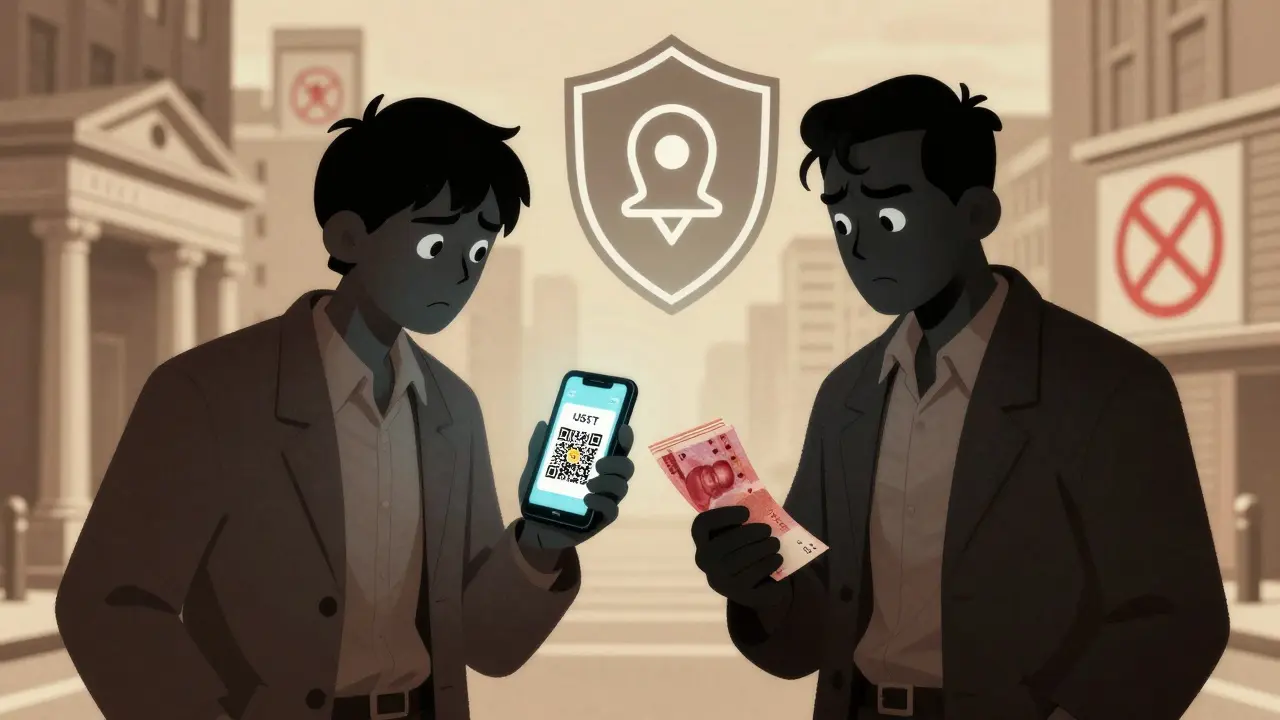
When China banned all cryptocurrency trading and mining in September 2021, most people assumed the door was shut. Banks blocked transactions. Exchanges were forced offline. The government said it was done. But inside China, something else was happening - quietly, carefully, and with surprising resilience. Peer-to-peer crypto trading didn’t disappear. It adapted.
Here’s the reality: you can’t ban something that doesn’t need a central server. No exchange. No app. Just two people, a phone, and a bank transfer. That’s what P2P trading is. And in China, it’s still going strong - even after five years of crackdowns.
How China’s Ban Actually Worked
The People’s Bank of China didn’t just shut down exchanges like Huobi and OKX. They went further. Banks were ordered to freeze accounts linked to crypto. WeChat and Alipay were told to block payments for digital assets. The government called it a move to stop financial crime and capital flight. But the real reason? People were moving money out.
Chainalysis data shows over $50 billion left East Asia through crypto channels between 2019 and 2020. That’s not just speculation. That’s people using Bitcoin, USDT, and other coins to move wealth overseas - bypassing China’s strict capital controls. When the ban came, it wasn’t about stopping tech. It was about stopping escape routes.
Here’s the twist: the ban didn’t make owning crypto illegal. Chinese courts have ruled since 2018 that cryptocurrencies are protected as virtual property. That means if you hold Bitcoin, you’re not breaking the law. But if you trade it through a platform? That’s where the trouble starts.
How P2P Trading Survived
So how do people still trade? They went underground - and got clever.
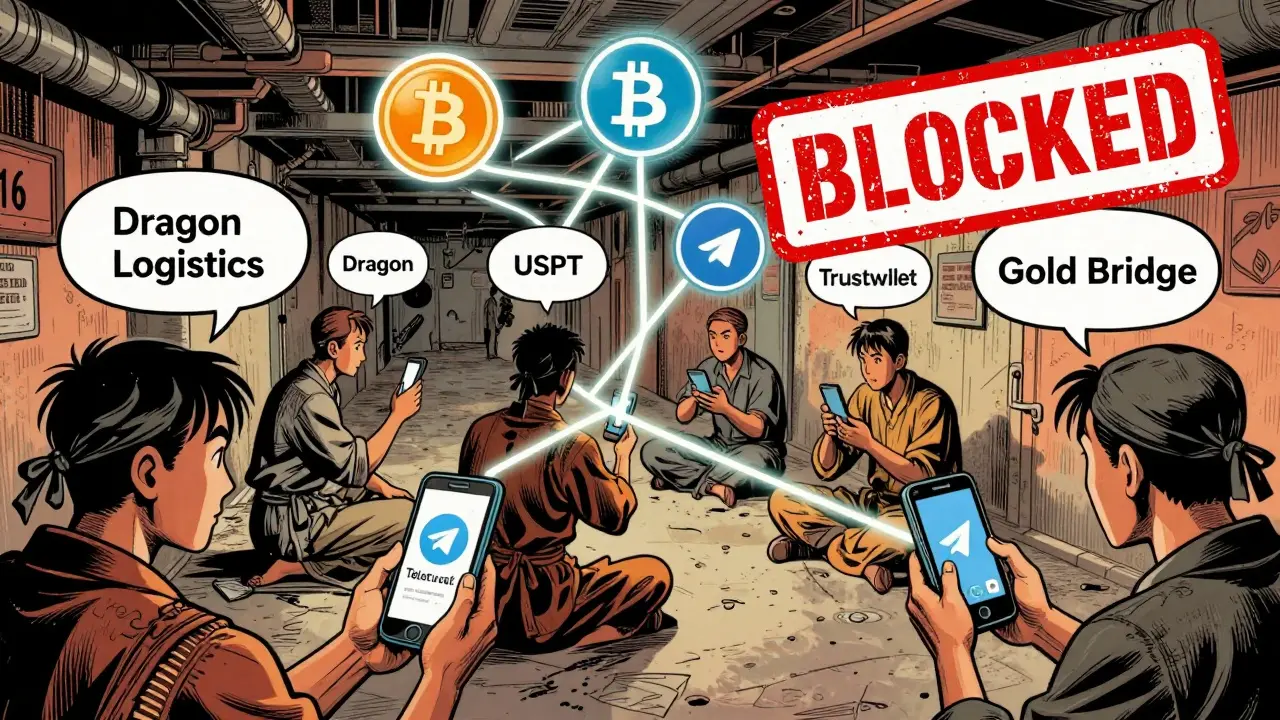
Instead of using centralized apps, traders now connect through encrypted messaging apps like Telegram and WeChat. Groups operate under code names - “Dragon Logistics,” “Gold Bridge,” “Skyline Transfers.” No logos. No websites. Just private chats.
Transactions happen in three steps:
- Buyer and seller agree on price and amount - usually in USDT (Tether), because it’s stable and easy to move.
- Buyer sends yuan via Alipay or bank transfer. Sellers avoid large transfers - anything over 50,000 RMB triggers bank alerts.
- Once payment is confirmed (with a screenshot), the seller sends the crypto to the buyer’s wallet.
Most traders use non-Chinese wallets - like Exodus or Trust Wallet - to avoid detection. They also use VPNs to access international P2P platforms like LocalBitcoins and Paxful. Without a VPN, the Great Firewall blocks them.
And yes - it’s risky. In 2022, a user on Reddit lost $25,000 after a seller sent a fake bank screenshot. That’s not rare. Trustpilot data shows Paxful’s rating among Chinese users dropped from 4.3 stars to 2.7 stars in under a year. Scams are common. Disputes? There’s no customer service. No chargebacks. You’re on your own.
Why USDT Rules the Underground
Bitcoin is volatile. Ethereum is slow. But USDT? It’s fast, stable, and widely accepted. In China, it’s the unofficial currency of the underground crypto economy.
Why? Because 1 USDT = $1 USD. No price swings. No delays. You can send it anywhere in minutes. And since it’s built on blockchain networks like TRON and Ethereum, it doesn’t rely on Chinese banking systems.
According to Chainalysis, USDT accounted for over 80% of all P2P volume in China in 2023. Traders use it to buy goods abroad, pay for education overseas, or even send money to family in Canada or Australia. It’s not just speculation - it’s survival.
Even banks know. In 2023, China’s State Administration of Foreign Exchange (SAFE) reported 1,247 crypto-related cases investigated. Most involved USDT transfers.
The Hidden Costs
It’s not free. Before the ban, P2P fees were around 0.5% to 1%. Today? They’re 3% to 5%. Why? Risk.
Traders charge more because:
- Banks freeze accounts randomly - 38.7% of users report this happening.
- Scammers use “flash freezing” - they send fake payment proof, then report the transaction as fraud to freeze your account.
- There’s no legal recourse. If you get scammed, the police won’t help.
Some traders have built workarounds. One popular method is “transaction splitting.” Instead of sending 200,000 RMB in one go, they split it into four 50,000 RMB transfers over a few days. Banks don’t flag small amounts.
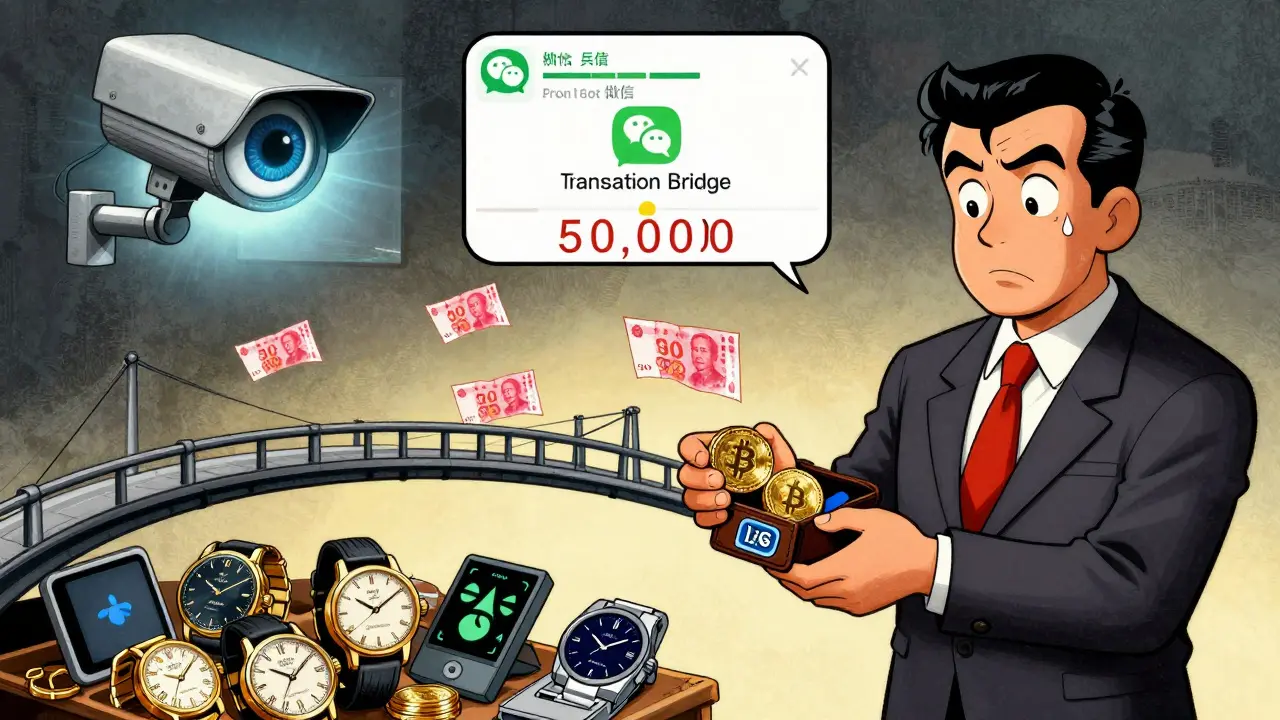
Another trick? “Transaction bridges.” You use a trusted third party - someone you know - to hold the crypto while the yuan clears. It adds a layer of safety. But it also adds trust risk.
Who’s Still Trading?
It’s not students or street vendors. It’s professionals.
A 2022 study from Peking University found that 87% of active P2P traders in China are between 25 and 45. Most have university degrees. Many work in tech, finance, or international trade. Some have family abroad. Others own businesses that need to pay overseas suppliers.
They’re not gambling. They’re managing risk. China’s economy is slowing. The yuan is weak. Property values are falling. For many, crypto is the only way to preserve value.
And they’re not alone. Despite the ban, China still accounts for 4.2% of global cryptocurrency transaction volume - down from 23% in 2020, but still higher than most countries with legal crypto markets.
The Government’s Next Move
The crackdown hasn’t stopped. In January 2023, the PBOC issued Notice No. 2023-017, expanding monitoring to cover “any form of decentralized transaction.” That means even direct wallet-to-wallet transfers are now under suspicion.
Traders are adapting again. Some are turning to NFTs - buying digital art or virtual land as a way to move value. Others are using “crypto barter”: trading Bitcoin for electronics, gold, or even luxury watches. No bank involved. No digital trail.
HSBC Research says it best: “The cat is out of the bag.” China can’t shut down P2P trading without shutting down its own citizens’ ability to move money - and that would hurt real business.
Meanwhile, the Chinese Academy of Social Sciences is pushing for more surveillance tech - AI that scans WeChat messages, bank logs, and IP addresses to catch traders. But as Kim Grauer of Chainalysis pointed out: “We saw a 300% year-over-year increase in P2P volume from Chinese IP addresses in early 2022. Regulation doesn’t stop demand. It just makes it harder.”
The Bottom Line
China didn’t ban crypto. It banned exchanges. And in doing so, it created the world’s largest underground crypto market.
Today, P2P trading in China is a mix of desperation, innovation, and sheer will. People aren’t trading for fun. They’re trading because they have no other choice.
It’s risky. It’s messy. And it’s not going away.
If you think the ban ended crypto in China - you’re wrong. It just made it quieter. And smarter.
Is peer-to-peer crypto trading illegal in China?
Owning cryptocurrency is not illegal in China - courts have ruled it’s protected as virtual property. But trading it through exchanges or platforms is banned. P2P trading exists in a gray zone: the government doesn’t criminalize ownership, but it aggressively targets transactions. If you’re caught trading, you could face fines, account freezes, or even criminal charges - especially if large sums are involved.
Can Chinese citizens still buy Bitcoin today?
Yes - but not through apps like Binance or Huobi. People use international P2P platforms like LocalBitcoins or Paxful, accessed via VPNs. They pay in yuan via bank transfer or Alipay, then receive Bitcoin or USDT directly into their non-Chinese wallets. It’s slow, risky, and requires technical skill, but it’s possible.
Why is USDT so popular in China’s crypto underground?
USDT is stable, fast, and doesn’t rely on Chinese banks. Since 1 USDT = $1 USD, it’s ideal for moving value across borders without currency conversion. It’s also easier to transfer than Bitcoin because it runs on networks like TRON, which have low fees and quick confirmations. Over 80% of P2P trades in China now use USDT.
How do traders avoid getting caught?
They use multiple layers: VPNs to access foreign platforms, burner phones, non-Chinese email accounts, and wallets with no Chinese language interface. They split large transfers into smaller ones under 50,000 RMB to avoid bank alerts. Many use encrypted messaging apps like Telegram instead of WeChat. Some even use trusted intermediaries - known as “transaction bridges” - to hold funds temporarily.
What are the biggest risks of P2P crypto trading in China?
The biggest risks are scams, bank account freezes, and no legal protection. Scammers often send fake payment screenshots. Banks can freeze your account if they detect crypto-related activity. And if you lose money, the police won’t help - because the transaction itself is technically illegal. Fees have also jumped from 1% to 5% due to higher risk.
Will China ever fully shut down P2P crypto trading?
Unlikely. Even with advanced surveillance, P2P trading is decentralized - there’s no server to shut down, no company to target. As long as people need to move money out of China, they’ll find ways. The government can make it harder, but not impossible. Experts agree: the ban exposed a fundamental truth - you can’t stop decentralized networks with laws alone.
Anastasia Thyroff
March 17, 2026 AT 19:03Kira Dreamland
March 18, 2026 AT 17:42shreya gupta
March 20, 2026 AT 04:56Derek Lynch
March 20, 2026 AT 15:00Shreya Baid
March 20, 2026 AT 21:18Robert Kunze
March 21, 2026 AT 06:27Sarah Zakareckis
March 21, 2026 AT 15:59Sarah Hammon
March 21, 2026 AT 20:45iam jacob
March 22, 2026 AT 09:09Jesse Pals
March 24, 2026 AT 01:56Diane Overwise
March 24, 2026 AT 16:21Ann Liu
March 25, 2026 AT 18:50Dionne van Diepenbeek
March 26, 2026 AT 13:04Graham Smith
March 26, 2026 AT 18:13