Proof of Stake Energy Efficiency: Why It Beats Mining
 Sep, 8 2026
Imagine running a network that processes billions of dollars in transactions while using less electricity than a small town. That’s not a sci-fi dream; it’s the reality for networks using Proof of Stake (PoS). For years, the biggest knock against cryptocurrency was its massive carbon footprint, driven by the brute-force energy consumption of Proof of Work (PoW). But the landscape has shifted dramatically. If you’re looking to understand why PoS is winning the sustainability argument, or if you’re wondering whether your favorite coin’s environmental impact actually matters, this breakdown cuts through the noise with hard data and clear comparisons.
The Core Difference: Computing Power vs. Economic Skin-in-the-Game
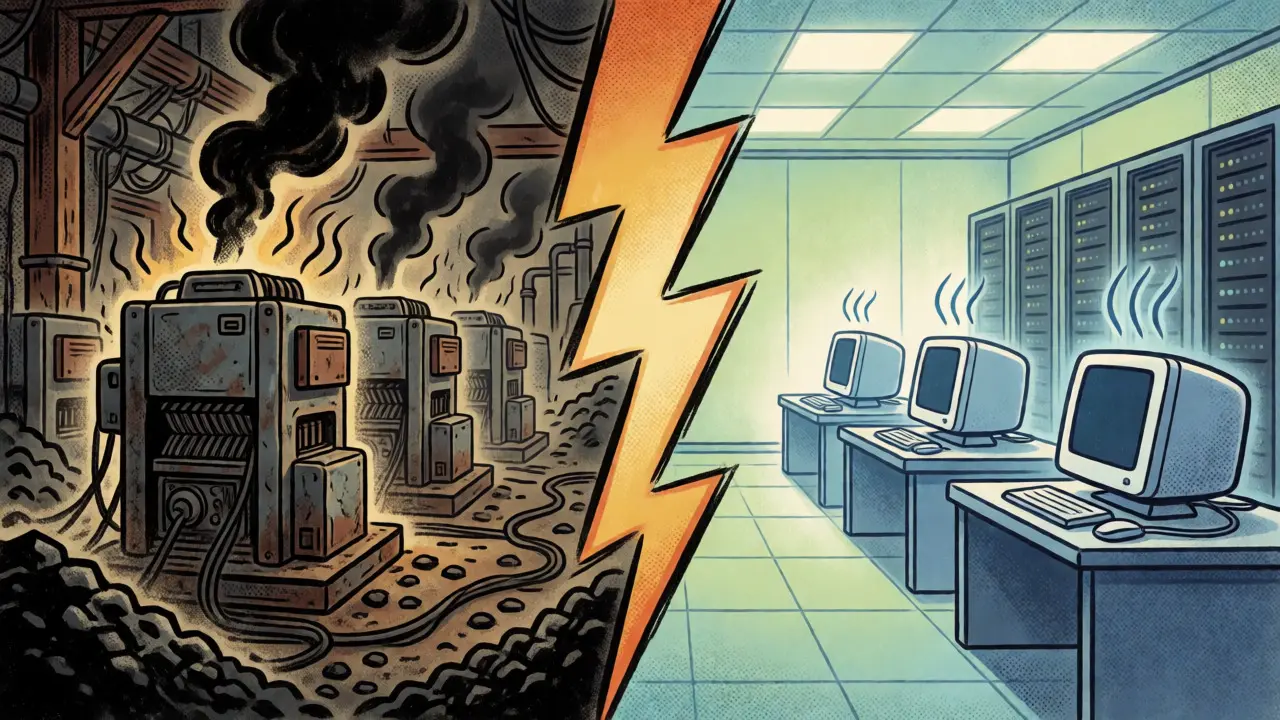
To grasp the energy savings, you first need to understand what changed under the hood. In traditional Bitcoin-style mining (PoW), thousands of computers race to solve complex mathematical puzzles. The winner gets to add the next block and earn rewards. This race requires specialized hardware called ASICs, which guzzle electricity-often consuming between 1,000 and 3,000 watts per unit. It’s essentially an energy arms race where higher power usage equals better odds of winning.
Proof of Stake flips this model on its head. Instead of burning electricity to prove you did work, validators lock up their own cryptocurrency as collateral. Think of it like putting down a security deposit. If you validate transactions honestly, you earn fees. If you try to cheat the system, you lose your deposit. Because there’s no computational race, the heavy lifting of solving puzzles disappears. Validation can happen on standard computer hardware with as little as 8 GB of RAM. You aren’t paying for raw processing speed; you’re paying for trust and economic alignment.
Ethereum’s Merge: A Real-World Case Study
The most significant test of PoS efficiency came when Ethereum transitioned from PoW to PoS in September 2022, an event known as "The Merge." Before the switch, Ethereum consumed roughly 5.13 gigawatts of continuous power-more than some small countries. After moving to PoS, that number dropped to about 2.62 megawatts. That’s a reduction of over 99.9%, according to technical assessments by the Ethereum Foundation.
Why does this matter? Because Ethereum is the second-largest blockchain by market cap. When a network of that size slashes its energy use by nearly 2,000 times, it sends a shockwave through the entire industry. Data from FTSE Russell confirmed that the PoS version of Ethereum used approximately 2,000 times less energy than its PoW predecessor. This isn’t just a theoretical win; it’s a measurable operational shift that made Ethereum viable for institutional investors who have strict Environmental, Social, and Governance (ESG) mandates.
| Metric | Bitcoin (PoW) | Ethereum Post-Merge (PoS) |
|---|---|---|
| Annual Energy Consumption | ~112 TWh | ~0.0026 GW continuous draw |
| Energy Per Transaction | ~830 kWh | ~0.036 kWh |
| Hardware Requirement | Specialized ASIC Miners | Standard PC / Server |
| Carbon Footprint (Annual) | ~62.5 Million Tonnes CO2e | Negligible relative to PoW |

Beyond Ethereum: How Other Networks Stack Up
Ethereum gets the headlines, but other major chains have been running on PoS or similar mechanisms for years, offering even more extreme efficiency examples. Take Cardano, which uses a protocol called Ouroboros. Or look at Polkadot and Solana. According to the Crypto Carbon Ratings Institute (CCRI), Polkadot’s annual emissions are around 33 tonnes of CO2e, while Solana sits at roughly 934 tonnes. To put that in perspective, Bitcoin emits over 62 million tonnes annually. The difference is staggering.
Some might argue that Solana uses more energy than Cardano, and they’d be right. However, Solana’s throughput is significantly higher. Efficiency isn’t just about total wattage; it’s about energy per transaction. Even high-throughput PoS networks like Solana consume a fraction of the energy required by Bitcoin to process the same volume of value transfer. When you combine the energy use of the top five PoS networks, their total annual consumption is roughly equivalent to 200 US households. Compare that to Bitcoin’s consumption, which exceeds the entire national grid of Norway.
The Hidden Costs: Hardware and Accessibility
Energy efficiency isn’t just about the environment; it’s also about accessibility. Running a PoW miner today is expensive and technically demanding. You need to buy a Bitmain Antminer S21 Hydro, which costs thousands of dollars and consumes 5,352 watts constantly. You also need cheap electricity and good cooling. If your local power rates spike, your profitability vanishes overnight.
In contrast, setting up a validator for Ethereum PoS requires 32 ETH (a significant capital investment) but only standard hardware specs: a modern CPU, 16+ GB of RAM, and an SSD. Your electricity bill looks like that of a gaming PC or a home server, not an industrial warehouse. For users who don’t want to run hardware themselves, staking pools allow participation with as little as $10. This lowers the barrier to entry, allowing regular people to secure the network without needing a garage full of humming machines.

Regulatory and Institutional Shifts
Why are banks and governments suddenly caring about this? Because regulations are tightening. The European Union’s MiCA regulations treat PoS validators differently from miners, often viewing them as service providers rather than commodity producers. In the US, senators have introduced legislation specifically to clarify the legal status of PoS assets, distinguishing them from securities in ways that benefit holders.
Institutional money follows compliance. Fidelity and Grayscale have both cited Ethereum’s move to PoS as a key reason for increasing their crypto allocations. Their clients-pension funds, insurance companies, and family offices-can’t justify buying an asset that burns coal to verify transactions. By switching to PoS, blockchains became compatible with ESG portfolios. A recent Deloitte survey showed that 67 of the top 100 financial institutions now support PoS-based assets, up from just 29 before The Merge.
Is Proof of Stake Perfect?
No technology is flawless. Critics point out that PoS introduces new risks. Since wealthier users can stake more coins, there’s a concern about centralization-could rich whales control the network? While theoretically possible, major networks haven’t seen significant centralization issues yet. Additionally, the complexity of solo staking means many users rely on third-party providers like Lido or Coinbase. If these providers fail, it could impact network stability.
However, the trade-off seems worth it for most observers. The environmental benefits are immediate and quantifiable. As Gartner predicts, by 2027, 95% of enterprise blockchain implementations will likely use PoS or variants. The momentum is clearly away from energy-intensive mining and toward sustainable validation.
How much energy does Proof of Stake save compared to Proof of Work?
Proof of Stake typically reduces energy consumption by over 99.9% compared to Proof of Work. For example, Ethereum’s transition to PoS reduced its energy usage by approximately 99.95%, dropping from gigawatt-scale consumption to megawatt-scale.
Do I need special hardware to mine or validate on Proof of Stake?
No, you do not need specialized ASIC hardware. Standard computer hardware with sufficient RAM (typically 8-16 GB) and storage is usually enough to run a validator node on most PoS networks like Ethereum or Cardano.
Is Proof of Stake completely green?
While significantly greener than PoW, it is not zero-emission. Validators still consume electricity, and the source of that electricity matters. However, the overall carbon footprint is negligible compared to PoW networks, making it a viable option for net-zero goals.
Can anyone participate in Proof of Stake?
Yes, though requirements vary. Some networks require a minimum stake (like 32 ETH for Ethereum solo staking), while others allow delegation via exchanges with very low minimums, sometimes as little as $10.
Why do institutions prefer Proof of Stake assets?
Institutions face pressure to meet ESG (Environmental, Social, and Governance) criteria. PoS assets have a drastically lower carbon footprint, making them easier to include in regulated portfolios and corporate treasuries compared to energy-intensive PoW assets.