Regulatory Challenges for Real Estate NFTs
 Feb, 21 2026
Real estate NFTs sound like the future: buy a house with a single click, split ownership into fractions, and transfer deeds instantly across borders. But behind the hype is a tangled mess of legal uncertainty. While blockchain tech promises to cut out middlemen and make property deals faster, governments are still trying to figure out how to even classify these digital deeds. Right now, the biggest barrier isn’t technology-it’s regulation.
What Exactly Is a Real Estate NFT?
A real estate NFT is a digital token on a blockchain that represents ownership of a physical or virtual property. It’s not just a picture or a link-it’s a verifiable record of who owns what, stored on a public ledger. These tokens are built on networks like Ethereum, Polygon, or Solana, and they can stand for full ownership or fractional shares. For example, one NFT might represent a 1/10th stake in a commercial building in Berlin, while another might be the deed to a condo in Dubai.
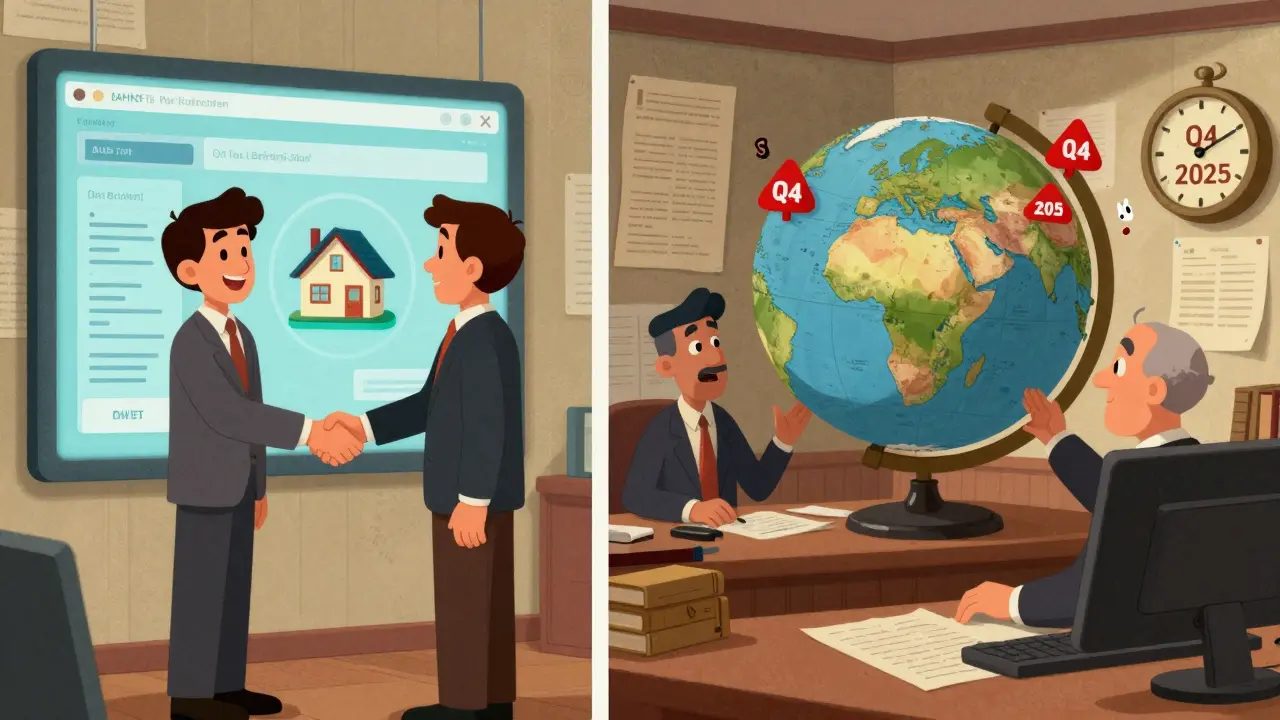
Smart contracts automate everything: rent collection, maintenance payments, even resale terms. When you buy a real estate NFT, you’re not just buying a digital file-you’re buying a legally binding agreement encoded in code. This removes the need for paper deeds, notaries, and weeks of paperwork. In theory, a transaction that normally takes 45 days could wrap up in under 72 hours.
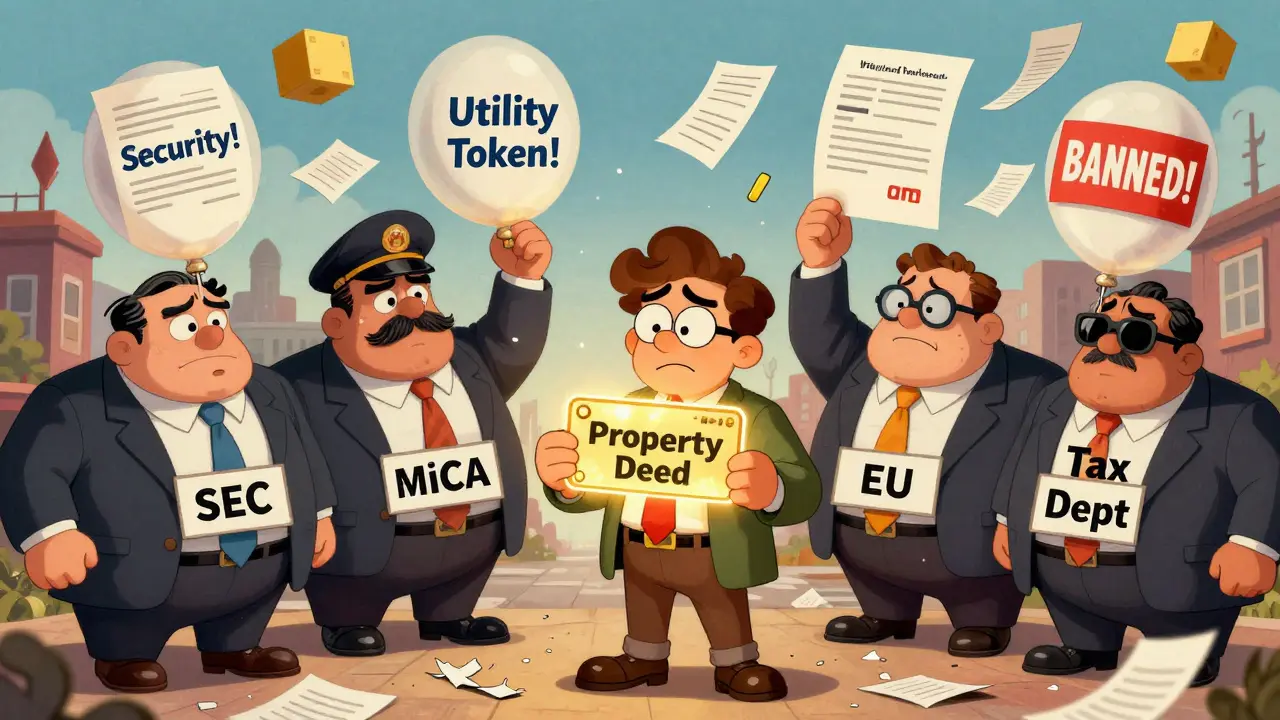
But here’s the catch: governments don’t all agree on whether these NFTs are property, securities, or something else entirely. That’s where things fall apart.
The Patchwork of Global Regulations
There’s no global rulebook for real estate NFTs. Each country has its own take, and often, those takes contradict each other. In the U.S., the SEC is still deciding whether tokenized property counts as a security. If it does, then every sale must follow strict registration rules-like selling stocks. That’s a huge hurdle for startups. In March 2025, a platform called TokenHomes shut down after the SEC ruled its NFTs were unregistered securities, leaving 1,200 investors stuck with $8.7 million in frozen assets.
In the European Union, the MiCA regulation came into effect in December 2024. It brought some clarity to crypto assets, but it doesn’t specifically address real estate NFTs. That leaves 45% of projects unsure if they’re breaking the law. Even worse, EU member states interpret MiCA differently. Germany treats these tokens as financial instruments. France sees them as digital goods. Italy hasn’t made up its mind. This patchwork makes cross-border deals risky.
Meanwhile, countries like Switzerland and Singapore have taken a more open approach. They’ve created sandbox environments where blockchain-based property deals can be tested under regulatory supervision. Georgia has been running a blockchain land registry since 2016 and has processed over 1.2 million transactions with zero fraud. Sweden’s Lantmäteriet agency has been digitizing property records since 2017 and rates its system a 4.7 out of 5 for clarity.
But in places like China, Egypt, or Nigeria, crypto is banned outright. No NFTs. No blockchain deeds. No exceptions. That means if you own a tokenized property in Georgia and try to sell it to someone in Egypt, the deal can’t even go through.
Why Legal Classification Matters
The confusion starts with how regulators classify NFTs. Are they:
- Utility tokens? Just a key to access a service?
- Payment tokens? Like Bitcoin, meant to be spent?
- Security tokens? Like stocks, where investors expect profit from others’ efforts?
If a real estate NFT is seen as a security, then it’s subject to heavy oversight: disclosure requirements, licensed brokers, investor limits. That’s expensive and slow. Most platforms don’t have the resources to comply. So they operate in a gray zone-and that’s where investors get hurt.
A Reddit user from Germany posted in June 2024 about losing $120,000 after trying to transfer a property NFT between two EU countries. One country said the token was legal. The other said it violated securities law. The transaction was frozen. No one knew who to contact. No one could help.
Even basic things like taxes get messy. If you sell a fractional NFT stake in a Miami condo, do you pay capital gains tax in the U.S.? In your home country? In both? Tax authorities haven’t updated their systems to handle blockchain deeds. Most users are flying blind.
Technical Hurdles That Make Regulation Harder
It’s not just laws that are behind. The tech itself has blind spots. Most property registries are still paper-based or run on old, siloed digital systems. They can’t talk to blockchains. To bridge the gap, you need middleware-extra software that translates between the two worlds. That adds 15-25% to implementation costs and creates new points of failure.
Transaction delays are another problem. On Ethereum, gas fees can hit $12, and confirmations take 15 minutes during peak times. That’s fine for trading a digital artwork, but not for closing a home sale. Polygon is cheaper and faster, but it’s not as secure. And if you buy a property on Polygon but your buyer only uses Ethereum? The deal stalls.
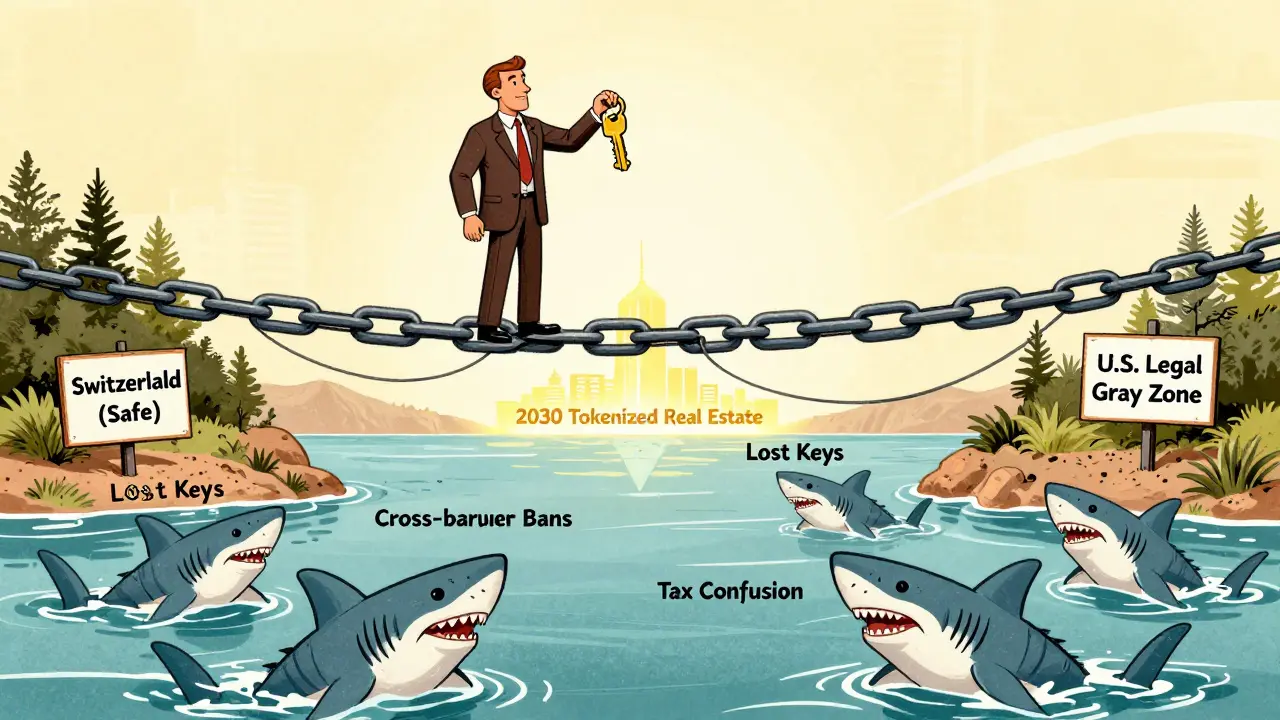
Then there’s identity. Most platforms require KYC-know your customer-verification. But blockchain is supposed to be anonymous. So platforms force users to upload ID documents, which defeats part of the point. And if your private key gets lost or stolen? No one can recover it. Chainalysis reports that 23% of lost crypto assets come from poor key management. With real estate NFTs, that could mean losing a house.
Who’s Winning-and Who’s Losing
The winners are in places with clear rules. In Switzerland, 19% of commercial real estate deals now involve NFTs. Singapore’s government actively encourages blockchain property projects. The UAE has created free zones where crypto real estate is fully legal. Even JPMorgan is testing its Onyx blockchain for commercial deals.
But the losers are everyday investors and small platforms. A Trustpilot survey of real estate NFT platforms shows an average 3.2 out of 5 rating. Two-thirds of negative reviews blame regulatory confusion. One user on Reddit said they tried to sell a $200,000 fractional stake in a Texas property but couldn’t find a buyer because the bid-ask spread was 22%. No one trusted the legal status of the token.
Smaller startups can’t afford lawyers to navigate 15 different interpretations of MiCA. They can’t build compliance teams like JPMorgan. So they delay launches, raise less funding, or shut down. In Q1-Q2 2025, 30% of new real estate NFT startups delayed their launch due to regulatory uncertainty. KYC and AML costs rose 20-35% year-over-year, according to CoinLaw.
The Road Ahead: What’s Coming
Change is coming-but slowly. The SEC is expected to release its official framework for real estate token classification by Q4 2025. The EU is drafting a Digital Property Rights Directive for 2026. The European Central Bank is running a pilot with 12 Eurozone countries to test cross-border NFT property transfers.
New companies like TitleToken and BlockTitle are building blockchain-native escrow services, backed by $185 million in funding. These aren’t just tech startups-they’re trying to build legal infrastructure from the ground up.
Long-term, Gartner predicts 15-20% of commercial real estate transactions will involve tokenization by 2030-if regulators get their act together. JPMorgan’s estimate is more conservative: 5-8% under current uncertainty.
One thing’s clear: the tech works. Fractional ownership reduces entry barriers. Smart contracts cut costs. Transactions happen in hours, not weeks. But until governments agree on how to treat these digital deeds, real estate NFTs will remain a niche experiment-not a revolution.
What You Need to Know Right Now
- Only buy real estate NFTs in jurisdictions with clear rules-Switzerland, Singapore, Georgia, Sweden.
- Avoid platforms that don’t explain how they handle taxes, securities law, or cross-border transfers.
- Use multi-signature wallets. They’re used by 68% of institutional platforms and add a layer of protection.
- Never store your private keys online. Lose them, and you lose the property.
- Don’t assume your home country recognizes foreign NFT deeds. Check local laws first.
The future of property ownership is on the blockchain. But until the rules catch up, tread carefully.
Are real estate NFTs legal?
It depends on where you are. In countries like Switzerland, Singapore, and Georgia, they’re fully legal and regulated. In the U.S., the SEC is still deciding whether they count as securities. In China, Egypt, and several other nations, crypto is banned, so real estate NFTs are illegal. There’s no global answer-only local ones.
Can I use a real estate NFT to buy a house in another country?
Technically yes-but legally, it’s risky. Even if both countries allow crypto, they may have conflicting rules about property ownership, taxation, or securities law. A transaction that works in Germany might be blocked in France. Cross-border deals often require manual legal review, which defeats the purpose of blockchain speed.
What happens if I lose my private key for a real estate NFT?
You lose access to the property permanently. Unlike traditional deeds, there’s no central authority to reset your password or recover your key. Chainalysis reports that 23% of lost crypto assets are due to poor key management. Treat your private key like the original deed to your house-keep it offline, backed up, and secure.
Do I have to pay taxes on real estate NFT sales?
Yes-in most cases. If you sell a real estate NFT for a profit, you likely owe capital gains tax. But tax authorities haven’t standardized how to track these transactions. You’ll need to report the sale in your home country, and possibly in the country where the property is located. Keep detailed records of purchase price, sale price, date, and jurisdiction.
Why aren’t more big real estate companies using NFTs?
Because the legal risks outweigh the benefits-for now. Large firms need certainty. They can’t afford to be sued or fined for violating unclear regulations. Even though NFTs could cut costs and speed up deals, most are waiting for clearer laws. JPMorgan and a few others are testing it, but widespread adoption won’t happen until regulators give a green light.
McKenna Becker
February 22, 2026 AT 10:16precious Ncube
February 22, 2026 AT 17:33Jan Czuchaj
February 24, 2026 AT 10:18There’s a deeper philosophical problem here. Ownership has always been a social contract, not a technical one. A blockchain ledger can prove who holds a token, but it can’t prove who has the moral or social right to that property. That’s why every jurisdiction reacts differently-because they’re not just regulating tokens, they’re negotiating legitimacy.
Switzerland and Singapore aren’t winning because they’re tech-savvy. They’re winning because they’ve redefined property as a functional right, not a physical one. The rest of the world is still stuck in the idea that land must be tied to soil.
And that’s why we see these contradictions: Germany treats it as a financial instrument because they see value in the income stream. France treats it as a digital good because they see it as a consumable asset. Italy’s hesitation? That’s not bureaucracy-that’s existential uncertainty about what property even means anymore.
Meanwhile, everyday users are left scrambling because they don’t have the luxury of philosophical debates. They just want to buy a house. But if the system can’t answer whether their asset is a security, a commodity, or a key, then no amount of smart contracts will save them.
We need to stop asking ‘Is this legal?’ and start asking ‘What should it be?’ The tech is ready. The law isn’t. And until we treat regulation as a design problem-not a compliance checkbox-we’ll keep seeing 30% of startups delay launches because lawyers are arguing over semantics.
Tokenized property isn’t about replacing notaries. It’s about reimagining how society assigns value. That’s a cultural shift, not a technical upgrade.
Tracy Peterson
February 24, 2026 AT 18:38George Suggs
February 25, 2026 AT 09:05Dianna Bethea
February 26, 2026 AT 03:36Most people think the problem is regulation. It’s not. It’s communication.
Every platform claims to be ‘legal’ but none explain how their system interacts with local tax codes, inheritance laws, or cross-border enforcement. You buy a token in Georgia, but if you’re a US citizen, the IRS still wants its cut. No one tells you that until you get audited.
And then there’s the identity paradox: you need KYC to prove you’re real, but blockchain was supposed to remove identity. So now you’re uploading your passport to a website that says ‘decentralized’-which is just irony with a whitepaper.
Multi-signature wallets? Great. But if you don’t understand how to back them up, you’re just as vulnerable as someone who stores their key in a Google Doc. The tech is only as good as the person using it.
Real estate NFTs aren’t failing because they’re too new. They’re failing because they’re sold like a product, not a system. You don’t just buy a deed. You buy into a legal ecosystem. And most users don’t even know what ecosystem they’re in.
Startups need to stop saying ‘blockchain solves everything’ and start saying ‘here’s how this works under German tax law, French property code, and US SEC guidelines.’ If they did that, adoption would jump overnight.
But they won’t. Because explaining complexity doesn’t sell. Simplified hype does. And that’s why we’re still here-trapped between innovation and ignorance.
KingDesigners &Co
February 27, 2026 AT 22:11aaron marp
March 1, 2026 AT 03:03It’s funny how we treat blockchain like it’s revolutionary, but ignore the fact that every major property market still relies on paper records. Why? Because trust isn’t built in code. It’s built in institutions.
Sweden’s Lantmäteriet works because they didn’t replace their system-they enhanced it. The blockchain is just the audit trail. The land registry is still the authority. That’s the model everyone should copy.
Instead, we’re trying to burn down the whole system and rebuild it from scratch. That’s not innovation. That’s arrogance.
And don’t get me started on the ‘no central authority’ myth. When your NFT gets frozen because two countries disagree, who do you call? No one. That’s not freedom. That’s abandonment.
Real estate isn’t about speed. It’s about certainty. And certainty comes from institutions with history, not from a smart contract with 120 lines of code.
Maybe the future isn’t tokenization. Maybe it’s hybrid. A blockchain that logs the deed, but the title office still holds the final authority. That’s not backward. That’s smart.
Stop trying to replace the system. Fix the gaps. The tech can help. But it can’t carry the whole thing.
And if you think governments are slow, wait until you try to explain to a judge why your Ethereum transaction from 2023 should override a 1987 deed recorded in county court.
Phillip Marson
March 2, 2026 AT 10:59Alyssa Herndon
March 3, 2026 AT 04:19Ifeanyi Uche
March 4, 2026 AT 04:27Jeff French
March 4, 2026 AT 11:53Kenneth Genodiala
March 4, 2026 AT 15:32Danny Kim
March 6, 2026 AT 12:05Cathy Sunshine
March 8, 2026 AT 02:07Shannon Black
March 8, 2026 AT 16:00Richard Cooper
March 9, 2026 AT 10:05Dee Resin
March 11, 2026 AT 05:44Sony Sebastian
March 13, 2026 AT 04:45kati simpson
March 13, 2026 AT 10:08I think people miss the point. The problem isn't that governments don't understand NFTs. It's that they don't understand the people using them.
Most buyers aren't tech experts. They're just trying to get into real estate without a 20% down payment. They don't care about securities law. They care about having a roof.
But instead of meeting them where they are, the system demands they become legal scholars first.
That's not progress. That's exclusion.
The solution isn't more regulation. It's better education. Simple guides. Clear labels. One page that says: 'If you're in X country, here's what you need to know.' Not 15 whitepapers.
And maybe, just maybe, if we stopped treating users like criminals and started treating them like customers, this whole thing would actually work.
But we won't. Because convenience doesn't sell venture capital.
Cory Derby
March 13, 2026 AT 21:10Colin Lethem
March 14, 2026 AT 05:50