Remittances and Cryptocurrency Usage for Cross-Border Payments: Navigating Restrictions in 2026
 May, 7 2026
Have you ever sent money to a family member overseas and watched nearly 7% of it vanish into fees before it even arrived? You are not alone. For decades, sending money across borders has been expensive, slow, and frustratingly opaque. But in 2026, the landscape is shifting dramatically. Cryptocurrency, specifically stablecoins pegged to major currencies like the US dollar, is rewriting the rules of cross-border payments.
The numbers are staggering. In 2024, stablecoins moved $15.6 trillion in value-matching the annual volume of giants like Visa. By early 2025, these digital assets handled about 3% of global cross-border payments, which totaled roughly $200 trillion. Yet, despite this explosive growth, many people still hesitate. Why? Because navigating the complex web of regulations, banking restrictions, and technical hurdles can feel overwhelming. This guide breaks down exactly how crypto remittances work, where they shine, and the real-world restrictions you need to watch out for.
Why Traditional Remittances Are Failing You
To understand why blockchain is gaining traction, you first need to see what’s wrong with the old system. When you send money via traditional banks or services like Western Union, your cash doesn’t just fly over an ocean. It travels through a tangled web of intermediary banks. Your bank pays its correspondent bank, which then credits the recipient’s bank. Each step takes time, and each step charges a fee.
According to the World Bank’s September 2024 report, the average global cost to send a $200 remittance was approximately 6.62%, or about $13.24. That might sound small, but for families relying on every cent, it’s a massive burden. On top of that, settlement times can stretch from days to weeks. The Bank for International Settlements notes that none of these intermediate steps actually move physical money across borders; they just update ledgers. It’s inefficient, costly, and outdated.
How Stablecoins Change the Game
Stablecoins are cryptocurrencies designed to maintain a stable value by being pegged to an asset like the US dollar. Unlike volatile coins such as Bitcoin, stablecoins offer predictability. They operate on blockchain networks, which act as territory-agnostic systems. Anyone with an internet connection and a digital wallet can transact without needing access to local banking infrastructure.
The speed difference is night and day. While traditional transfers take days, blockchain-based stablecoin transactions often settle in under a minute. More importantly, the costs plummet. On high-throughput Layer 2 networks, transaction fees can drop below $0.01. That is a reduction of 60-80% compared to traditional systems. For a business paying suppliers in Singapore or a person supporting relatives in Nigeria, these savings add up quickly.
The Reality of Banking Restrictions and Regulations
If crypto is so efficient, why isn’t everyone using it? The answer lies in restrictions. Regulatory uncertainty remains the biggest hurdle. Governments worldwide are still figuring out how to classify and control digital assets. In the United States, frameworks are still developing, while the European Union has implemented the Markets in Crypto-Assets (MiCA) regulation. Major Asia-Pacific hubs have their own distinct rules.
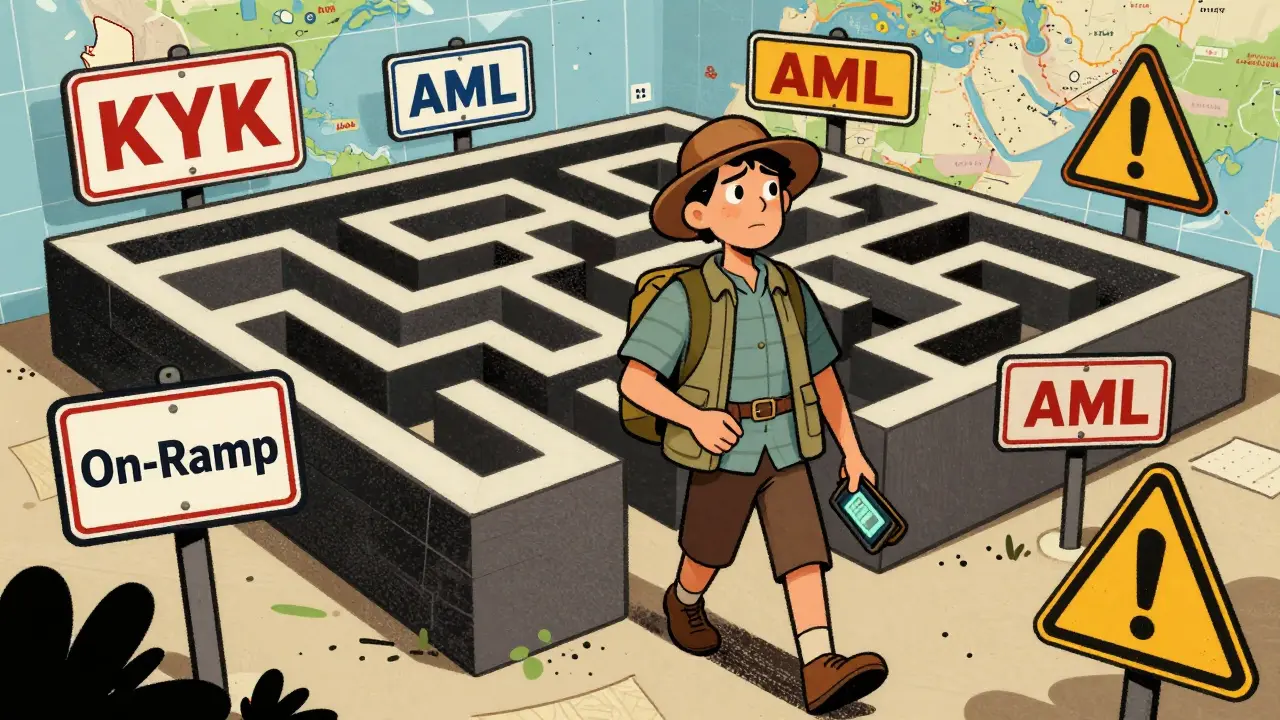
This fragmentation creates friction. As Pham Thi Ngoc Anh from the Bank for Investment and Development of Vietnam noted, while blockchain offers lower costs, implementation requires navigating varying regulatory approaches. You cannot simply ignore compliance. Anti-Money Laundering (AML) and Know Your Customer (KYC) requirements are strictly enforced. Platforms must implement the Travel Rule, passing originator and beneficiary information during transfers. If you try to bypass these checks, you risk having your funds frozen or your accounts shut down.

Technical Hurdles: Interoperability and On-Ramps
Beyond laws, there are technical barriers. One major issue is interoperability. Not all blockchains talk to each other smoothly. J.P. Morgan experts warn that unless one network becomes the global standard, we risk replicating the siloed payment problems of traditional banking. However, solutions are emerging. Circle’s Cross-Chain Transfer Protocol (CCTP), launched in 2024, allows users to burn USDC on one chain (like Ethereum) and mint it on another (like Solana) while preserving its value. This makes moving funds between different networks easier than before.
Another critical restriction is the "on-ramp" and "off-ramp" problem. Sending crypto is cheap, but converting it back to local currency can be tricky. A user on Reddit shared that while their family in Nigeria could receive stablecoins, converting them to Naira required third-party services charging 3-5% fees. This negates some of the cost benefits. Without reliable fiat gateways in emerging markets, the full potential of crypto remittances remains locked.
| Feature | Traditional Banks/Wire Transfers | Crypto/Stablecoin Payments |
|---|---|---|
| Average Fee ($200 transfer) | $13.24 (6.62%) | <$0.01 (on Layer 2) |
| Settlement Time | 1-5 Business Days | Under 1 Minute |
| Regulatory Clarity | High (Established Frameworks) | Low to Medium (Fragmented) |
| Access Requirements | Bank Account Needed | Internet & Wallet Only |
| Fiat Conversion Ease | Seamless | Variable (Depends on Region) |
Who Should Use Crypto for Remittances?
Not everyone needs to jump on the crypto bandwagon yet. The technology excels in specific scenarios. Business-to-business (B2B) transactions are seeing rapid adoption. Thirty-eight percent of Fortune 500 companies now use blockchain for at least some cross-border payments. Suppliers who accept digital currencies like USDC benefit from instant settlement and reduced administrative overhead.
For individual consumers, the decision depends on your destination corridor. Regions with high traditional remittance costs, such as Southeast Asia and Africa, are seeing the fastest growth. The Philippines reported a 217% year-over-year increase in cryptocurrency remittances in 2024. If you are sending money to a region with poor banking infrastructure but growing crypto awareness, stablecoins are a powerful tool. However, if your recipient relies solely on cash and lacks access to trusted exchange platforms, the hassle may outweigh the savings.
Navigating the Future: CBDCs and Harmonization
The conversation isn’t just about private stablecoins anymore. Central Bank Digital Currencies (CBDCs) are entering the mix. About 90% of central banks globally are working on CBDCs. Projects like the Bank for International Settlements’ mBridge pilot show that cross-border CBDC payments can achieve finality in seconds. These state-backed digital currencies aim to combine the efficiency of blockchain with the regulatory certainty of fiat money.
However, experts caution that blockchain will complement, not replace, existing systems in the short term. McKinsey analysts point out that legacy institutions still incur material costs for transaction monitoring. The path forward requires both technical innovation and regulatory harmonization. Until jurisdictions agree on common standards, users must remain vigilant about compliance and choose partners with licenses in key operating regions.
Practical Steps for Getting Started
If you decide to try crypto remittances, follow these steps to minimize risk:
- Choose a Licensed Provider: Partner with platforms that offer hosted wallets and auto-conversion features. Look for companies with clear compliance frameworks.
- Verify Recipient Access: Ensure your recipient has a way to convert stablecoins to local currency without excessive fees. Ask them directly about their preferred exchange method.
- Start Small: Test the process with a small amount to understand the timeline and hidden costs before sending larger sums.
- Check Regulatory Status: Confirm that both your country and the recipient’s country allow for crypto transactions. Avoid corridors with strict bans or ambiguous laws.
- Use Established Stablecoins: Stick to widely accepted tokens like USDC or USDT, which have better liquidity and support across multiple networks.
Is it legal to send remittances using cryptocurrency?
Legality varies significantly by country. In many nations, including much of the EU under MiCA and parts of Asia, it is legal provided you comply with AML/KYC regulations. However, some countries impose strict bans or heavy restrictions. Always check the current laws in both your home country and the recipient's country before transferring funds.
Are stablecoins safer than traditional bank transfers?
Stablecoins eliminate counterparty risk associated with failing intermediaries, but they introduce new risks. You rely on the issuer’s reserve backing and the security of the blockchain network. Additionally, if you lose your private keys, there is no customer service to recover your funds. Traditional banks offer deposit insurance and fraud protection, which crypto currently lacks.
What happens if I send crypto to the wrong address?
Transactions on public blockchains are irreversible. If you send funds to an incorrect address, you likely cannot get them back. This is a significant risk for beginners. Always double-check addresses and consider sending a small test transaction first to ensure the recipient can receive funds on the correct network.
Do I need to pay taxes on crypto remittances?
Tax treatment depends on your jurisdiction. In many places, exchanging fiat for crypto or vice versa is a taxable event. Even if you are just sending money to family, tax authorities may view the conversion as a disposal of an asset. Consult a local tax professional to understand your obligations regarding capital gains and foreign income reporting.
Which stablecoin is best for international transfers?
USDC (USD Coin) and USDT (Tether) are the most widely supported. USDC is often preferred for its transparency and regulatory compliance, especially in business contexts. USDT has higher liquidity in some emerging markets. Choose based on where your recipient can easily sell the token for local currency.
Jan Gilmore
May 9, 2026 AT 01:35You guys are missing the forest for the trees here. The real issue isn't the fees, its the liquidity fragmentation across different chains. Everyone talks about USDC on Solana being cheap, but have you actually tried moving that to a recipient in a country with strict capital controls? They dont accept crypto, they need cash in hand. So you still need an off-ramp agent who is basically running a money mule operation. The tech is great, the infrastructure is garbage. We are building a high-speed train on tracks that only go to three cities.
Mike S
May 9, 2026 AT 15:48Oh look, another tech bro pretending he understands global finance.
The article says what everyone already knows: banks are slow and expensive. But your solution is to trust a private company called Circle to not rug pull you? Please. The regulatory framework is fragmented because governments know exactly what is happening and they hate it. MiCA is just a band-aid on a bullet hole. You think stablecoins are safe? Try losing your private key and see how fast 'customer service' helps you out. Spoiler alert: they wont. It's every man for himself in the wild west of blockchain.
Tricia Alach
May 11, 2026 AT 04:22i totally get what you mean about the off ramps being tricky though! my cousin sends money home to the philippines and she always complains about the fees eating up her paycheck. i tried explaining this whole stablecoin thing to her once but she looked at me like i was speaking alien language lol. maybe if we made it easier for normal people to understand it would help? like a simple app that just does the conversion automatically without us having to worry about which chain we are on. sounds like a dream right?
Kiran CS
May 12, 2026 AT 17:45One must question the very premise of relying on volatile digital assets for something as fundamental as familial support. The notion that a 'stablecoin' is stable is a comforting fiction for those who do not understand the underlying mechanics of algorithmic pegs and reserve audits. In India, we have seen enough financial scandals to know that when the music stops, someone pays. The average person sending remittances is not equipped to handle the risk of a bridge exploit or a smart contract failure. This is not progress; it is gambling disguised as efficiency.
Caique Muniz
May 13, 2026 AT 11:27nah its all hype man. ive been using western union for years and sure its slow but at least i know my money will show up eventually. crypto is just for nerds who want to lose their savings in some random token crash. plus the government is gonna crack down soon anyway so why bother learning all this stuff now? save yourself the headache and just pay the fee like a normal person
Bradley Geldenhuys
May 14, 2026 AT 02:34you are thinking too small bradley. the problem is systemic. traditional banking is a relic of the industrial age trying to run on digital rails. it doesnt work. yes there are risks but staying in the old system guarantees you lose 6% every time. thats guaranteed loss. crypto offers a chance to keep your money. sure you might lose it to a scam or a bad address but at least you had a shot. stop being lazy and learn the tech. its not hard. just read the docs and use a hardware wallet. stop whining and start adapting or get left behind by the future
H F
May 14, 2026 AT 08:36I think there is a middle ground here that people are ignoring. The CBDC angle mentioned in the post is actually fascinating. If central banks can figure out the interoperability issues with projects like mBridge, we could get the speed of crypto with the safety of fiat. Imagine sending pounds to dollars instantly without needing to buy Bitcoin first. That would be a game changer for small businesses. We need to push for better regulation rather than just bashing the current system. Let's hope the EU gets it right with MiCA.
Bijan Das
May 14, 2026 AT 19:42oh please spare me the lecture from the 'expert'. i live in india and i see these crypto scams every day. people think they are going to be rich overnight and then they lose everything. remittances are serious business. my parents send money for my education and they dont care about blockchain technology. they care about getting the rupees into the bank account. so until crypto can do that seamlessly without me needing a degree in computer science to understand it, i am sticking to wire transfers. shut up and listen to reality
Michael Berggren
May 16, 2026 AT 17:26Hey everyone! 👋 I've been testing this out for my small business suppliers in Vietnam. The difference in settlement time is insane. Instead of waiting 3 days for the funds to clear, they get paid instantly. It really helps with cash flow. 🚀
The key is using USDC on a Layer 2 network like Arbitrum. Fees are pennies. Just make sure your supplier has a way to off-ramp easily. I use a local exchange partner there. It's not perfect yet but it's way better than the old way. Give it a try with a small amount first! 💡
Ashley Rodriguez
May 18, 2026 AT 01:14i mean its kind of interesting how the fees are so low on paper but then you realize you still have to convert it back to cash which costs money again so its not really saving that much unless you are sending huge amounts or something. i tried sending money to my friend in nigeria once and she said she had to go to a shop downtown to get the naira and they charged her a bit more than expected so it felt kinda pointless in the end even though the transfer itself was super fast. maybe it works better for bigger transactions i guess
Bridget Coogle
May 19, 2026 AT 23:16its really important to check the laws in both countries before doing this. i had a friend who got his account frozen because he didnt declare the crypto transaction properly. it was a huge stress for him. take your time and verify everything. dont rush it just to save a few dollars. peace and love to all of you navigating this complex world 🌍
Zara Zaman
May 21, 2026 AT 22:13This is a threat to national sovereignty. Foreign entities controlling our payment rails is unacceptable. The US needs to ban these unstable crypto schemes immediately. We should rely on our own strong dollar and our own banking institutions. These foreign influences are trying to undermine our economic stability. Keep your money in American banks where it belongs. Don't fall for the hype.
Larry Port
May 22, 2026 AT 23:49I wonder if the travel rule compliance will become standardized globally soon. It seems like the biggest bottleneck for adoption among smaller exchanges. If every platform requires different KYC data, it creates friction for users. Maybe a universal identity standard could solve this? Just a thought. The tech is promising but the human element of regulation is always the hardest part to predict.