Self-Regulatory Organizations in Crypto: How Industry Groups Are Shaping Crypto Compliance
 Dec, 10 2025
Crypto SRO Compliance Cost Calculator
Estimate the costs of joining a crypto self-regulatory organization and implementing compliance measures based on your exchange size and transaction volume. Based on data from industry reports including Delphi Digital and Blockchain Association.
Compliance Cost Estimate
Cost Breakdown
Industry Context
Small exchanges spend an average of $187,000 annually on compliance (Delphi Digital)
SRO membership fees can exceed $50,000/year for small exchanges
Cost Comparison
Note: The average small exchange spends $187,000 annually on compliance according to Delphi Digital. Your estimated cost may be higher or lower depending on your specific operations.
When you trade Bitcoin on an exchange, who makes sure the platform isn’t laundering money or hiding risky trades? Governments are slow to catch up, and crypto moves too fast for traditional rules. That’s where self-regulatory organizations in crypto come in. These aren’t government agencies. They’re groups made by crypto companies themselves to set rules, enforce standards, and build trust in a wild west market.
What Exactly Is a Crypto SRO?
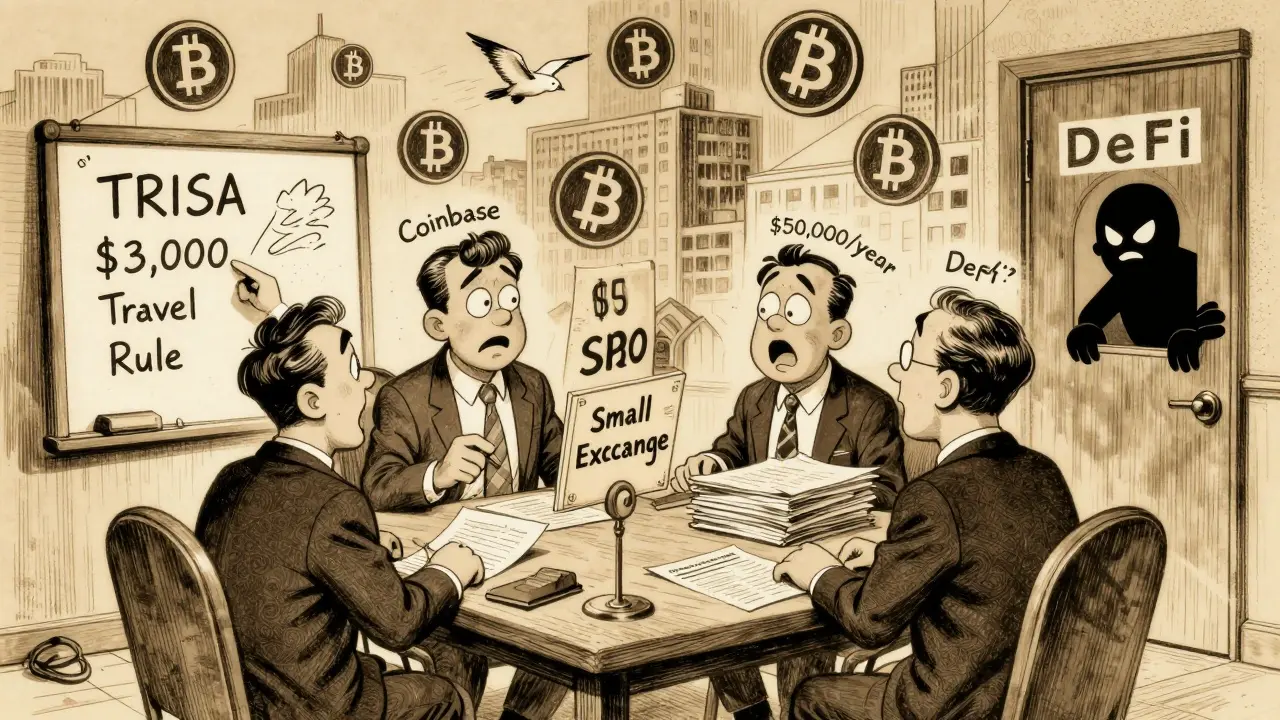
A self-regulatory organization (SRO) in crypto is a private group created by exchanges, wallet providers, and other crypto businesses to police themselves. Think of it like a club with rules everyone agrees to follow - but with real consequences if you break them. The idea isn’t new. In traditional finance, FINRA has been doing this for brokers since 2007. But crypto is different. It’s global, decentralized, and moves at internet speed. So crypto SROs had to be built from scratch. The first serious push came in 2018, when Brian Quintenz, a commissioner at the U.S. Commodity Futures Trading Commission (CFTC), said the industry needed its own watchdog. He called it a Cryptocurrency Self-Regulatory Organization (CSRO). His point? Government regulators can’t keep up. The market was growing too fast - from $2.9 trillion in transaction volume in 2020 to $15.8 trillion by 2022. Waiting for Congress to pass laws wasn’t an option. Crypto SROs focus on three big things: stopping money laundering, making markets fair, and setting technical standards. One of the biggest challenges? The FATF’s Travel Rule. It says any crypto transfer over $3,000 must include sender and receiver info. That’s easy if you’re using Coinbase or Binance - they know who you are. But what if you’re sending crypto from a non-custodial wallet? That’s 63% of Ethereum activity, according to the Ethereum Foundation. Most SRO tools can’t handle that yet.How Do They Work? The Swiss Model vs. the U.S. Proposal
Switzerland got ahead of the curve. In January 2020, its financial regulator FINMA officially recognized six SROs to oversee crypto businesses. If you wanted to operate legally in Switzerland, you had to join one. By Q3 2023, 178 crypto firms were covered by these groups. The SROs didn’t have thousands of staff - they had fewer than 150 combined. They used smart, lean systems: automated AML checks, shared databases, and clear penalties for rule-breakers. The U.S. is still playing catch-up. There’s no single SRO yet. Instead, there are competing proposals. The Virtual Commodity Association (VCA), first floated in 2018, wanted to be the main U.S. SRO. It planned to include exchanges, OTC desks, and trading platforms. But membership was voluntary. That’s a problem. If only 30-40% of the market joins, bad actors just stay outside the system. That’s called regulatory arbitrage - and it undermines the whole idea. Then came the FIT21 Act, passed by the U.S. House in May 2024. It encourages - but doesn’t require - crypto SROs. The Senate hasn’t agreed yet. Without legal teeth, most big exchanges won’t commit. Coinbase supports the idea but warns: don’t make membership too expensive. Small exchanges told surveys they couldn’t afford $50,000 a year in fees. If only the giants join, the SRO becomes a cartel, not a watchdog.The Tech Behind the Rules: TRISA and the Travel Rule
One of the most concrete achievements so far is TRISA - the Travel Rule Information Sharing Alliance. It’s not a full SRO. It’s a technical protocol. Think of it like WhatsApp for crypto compliance. Exchanges connect to TRISA’s network and automatically send required customer info for transactions over $3,000. No paperwork. No delays. TRISA launched its live network in January 2023. By September 2023, it had processed over 1.2 million compliant transactions across 43 exchanges. That’s progress. But it’s still limited. Only 87 firms are members as of December 2023. And it doesn’t work for decentralized finance (DeFi). Over $50 billion is locked in DeFi protocols - and 54% of that has no legal entity behind it. You can’t enforce rules on code that runs on thousands of computers worldwide. This is the core tension: SROs work best when they can identify who’s doing what. Crypto’s biggest innovation - anonymity - is also its biggest regulatory headache.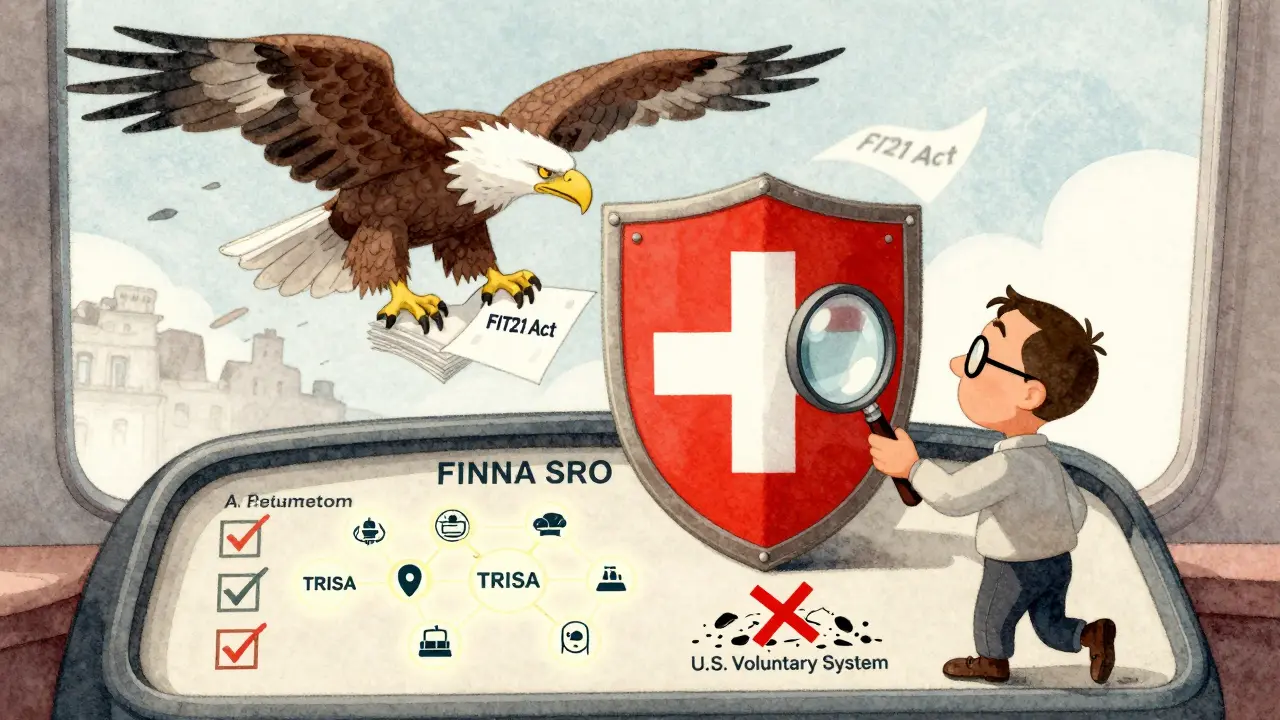
Who Supports It? Who Opposes It?
Supporters say crypto SROs are the only way to scale compliance without crushing innovation. Guidehouse, a consulting firm, says the case for self-regulation is compelling. “The pace of innovation outstrips regulatory capacity,” wrote David M. DeVito in 2023. Exchanges want to avoid being slapped with fines or shut down. Regulators want to avoid another Mt. Gox or FTX collapse. SROs offer a middle ground. But critics aren’t convinced. Professor Hillard M. English from Duke University pointed out the incentive problem: Why would a small exchange pay thousands to join if the big ones don’t have to? And what happens when the SRO’s board is made up of Coinbase, Kraken, and Binance? A July 2022 Twitter poll by the Blockchain Association showed 57% of respondents believed SROs would mainly serve big players. Brian Brooks, former Acting Comptroller of the Currency, warned: “Without proper governance structures, crypto SROs risk becoming cartels that stifle innovation.” That’s not paranoia. In Japan, the Virtual Currency Exchange Association lost its enforcement power after the Ronin Network hack in 2022 - $630 million stolen, no real consequences for the exchange that didn’t secure its hot wallet. The SRO didn’t act fast enough. Trust collapsed.Barriers to Entry: Cost, Training, and Expertise
Joining an SRO isn’t just about signing a form. It’s about hiring staff, buying tools, and learning new systems. Exchanges need blockchain forensics experts - Chainalysis Reactor certification costs $2,500 a year. They need AML specialists with CAMS certification ($1,695). And if they’re dealing with smart contracts, they need Solidity auditors trained by OpenZeppelin ($1,200 per course). The average small exchange spends $187,000 a year on compliance, according to Delphi Digital. That’s a huge chunk of their budget. Compare that to FINRA, which spends $1.2 billion annually and employs 3,600 people. Crypto SROs can’t match that scale. Switzerland’s model works because it’s focused and minimal. U.S. proposals try to do too much too soon. Training alone takes 120-150 hours per employee, based on Blockchain Association surveys. That’s less than the 500+ hours needed for traditional securities compliance - but still a massive lift for teams already stretched thin.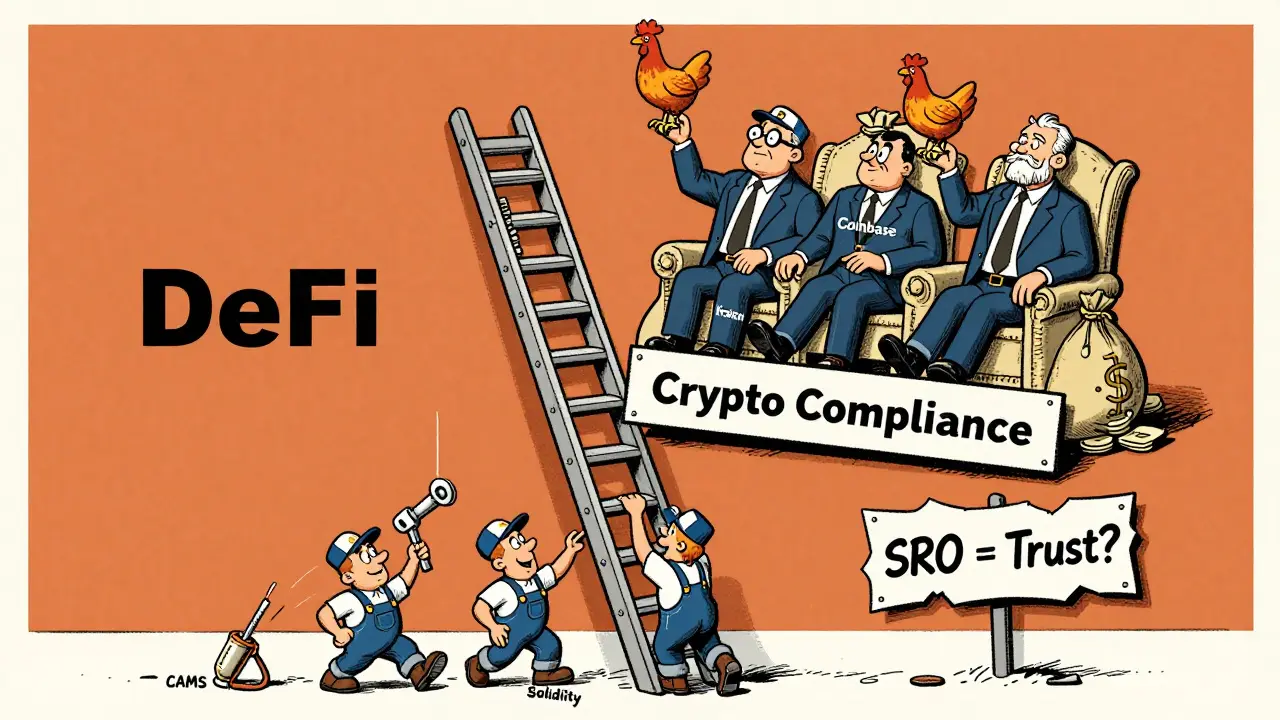
The Global Picture: MiCA, EU, and the Road Ahead
The European Union’s MiCA regulation, which took effect in June 2024, is changing everything. It doesn’t mandate SROs - but it requires crypto firms to be under “adequate regulatory oversight.” Industry analysts at Fidelity International predict this will force the creation of SROs across all 27 EU countries. That’s a huge shift. Meanwhile, the Global Digital Finance (GDF) initiative plans to launch a cross-border SRO in Q1 2025. Its goal? Standardize rules so a crypto firm in Germany doesn’t need 27 different compliance systems. That’s the real promise: global consistency. But here’s the catch: no SRO can work unless governments back it. Switzerland’s model succeeded because FINMA made membership mandatory. The U.S. still treats it as optional. Without legal weight, SROs are just suggestion boxes.Will Crypto SROs Survive?
The answer isn’t yes or no. It’s “maybe - but only if they change.” Right now, crypto SROs are stuck between two worlds. They want to be like FINRA - structured, powerful, respected. But crypto isn’t Wall Street. It’s open-source code, anonymous wallets, and global nodes. You can’t regulate what you can’t see. The path forward? Start small. Focus on custodial exchanges first. Build tools that work for real-world transactions - not theoretical ones. Make membership affordable. Include small players. Let regulators audit the SRO, not just the members. And above all, stop pretending SROs can fix DeFi. If they do that, they might earn trust. If they try to control everything - including the uncontrolled - they’ll fail. The market doesn’t need another bureaucracy. It needs a partner that moves as fast as it does.Are crypto self-regulatory organizations legally binding?
In most cases, no - not yet. In the U.S., proposed SROs like the Virtual Commodity Association rely on voluntary membership. Rules are enforced through contracts between members, not government law. But in Switzerland, SROs are legally recognized by FINMA, and membership is mandatory for regulated firms. The EU’s MiCA regulation may soon make SROs a de facto requirement for firms operating in Europe. Legal power depends on jurisdiction and government backing.
How do crypto SROs handle the Travel Rule?
Crypto SROs use technical protocols like TRISA (Travel Rule Information Sharing Alliance) to automate compliance. When a user sends more than $3,000 in crypto, the sending exchange transmits the sender’s and recipient’s identifying info through TRISA’s secure network. The receiving exchange verifies the data before accepting the transaction. This replaces manual paperwork and reduces errors. However, TRISA only works for custodial exchanges - it doesn’t apply to non-custodial wallets, which make up a large portion of crypto activity.
Why aren’t all crypto exchanges part of an SRO?
Three main reasons: cost, voluntary participation, and distrust. Membership fees can exceed $50,000 a year - too expensive for small exchanges. Since U.S. SROs aren’t mandatory, many platforms avoid them to save money and avoid scrutiny. Others fear SROs will be dominated by big players like Coinbase and Binance, creating unfair rules. Some simply don’t believe SROs can be trusted to act independently from industry interests.
Can SROs regulate decentralized finance (DeFi)?
Not currently. DeFi protocols run on smart contracts with no central company or legal entity behind them. SROs regulate people and organizations - not code. Until there’s a way to identify who deploys or updates a DeFi protocol, SROs can’t enforce rules on them. Some experts suggest regulating the developers or the interfaces (like wallets or dApps) that interact with DeFi, but no workable model exists yet.
What’s the difference between a crypto SRO and a government regulator?
A government regulator (like the SEC or FINMA) has legal authority to make and enforce laws. A crypto SRO is created by industry members and operates under delegated or voluntary authority. SROs can create detailed technical rules faster than governments, but they can’t issue fines or shut down companies unless backed by law. Governments set the framework; SROs fill in the details - if they’re allowed to.
Ike McMahon
December 11, 2025 AT 05:28TRISA is a start, but it’s still just a band-aid. If you can’t track non-custodial wallets, you’re ignoring 63% of the market. That’s not regulation, that’s wishful thinking.
JoAnne Geigner
December 13, 2025 AT 01:32I get why people are skeptical… but what’s the alternative? Letting wild west chaos keep running? I’ve seen too many small devs get crushed by vague regulations. If SROs can be lean, fair, and include small players-maybe they’re the bridge we need. Not perfect, but better than nothing.
Anselmo Buffet
December 14, 2025 AT 07:56Switzerland’s model is the only one that makes sense. Minimal bureaucracy, real enforcement. The U.S. keeps overcomplicating everything.
Patricia Whitaker
December 15, 2025 AT 08:39Of course the big exchanges support this. They’re the ones who’ll run it. Small players get squeezed. Classic.
Joey Cacace
December 15, 2025 AT 15:40While I appreciate the structural insights presented in this article, I must emphasize the importance of equitable access to compliance infrastructure. Without financial inclusivity, self-regulation risks becoming a mechanism of exclusion rather than empowerment.
Taylor Fallon
December 17, 2025 AT 14:10you know… i think people forget that crypto was built to be free from banks and gov’t control. now we’re trying to build our own version of the same system? kinda ironic. also, trisa? sounds like a brand of energy drink. not a compliance solution 😅
Sarah Luttrell
December 17, 2025 AT 22:37Oh wow, another ‘let the big boys police themselves’ fantasy. Next you’ll tell me the mafia runs a better neighborhood watch than the police. 🤡
PRECIOUS EGWABOR
December 19, 2025 AT 13:33Let’s be real-this isn’t about compliance. It’s about legitimizing crypto for Wall Street’s next profit grab. The ‘innovation’ narrative is just lipstick on a pig.
Kathleen Sudborough
December 20, 2025 AT 23:22I’ve talked to dozens of small exchange operators. They’re terrified-not of regulation, but of being priced out. If the SRO costs $50k/year, they’ll just go offshore. And then who’s left? The same giants. That’s not progress. That’s consolidation.
Toni Marucco
December 21, 2025 AT 09:56The fundamental tension lies in the ontological dissonance between decentralized architectures and centralized governance paradigms. SROs, as presently conceived, are epistemologically incompatible with permissionless systems. Until regulatory frameworks evolve to accommodate non-custodial autonomy, any compliance architecture will remain structurally deficient.
Kathryn Flanagan
December 22, 2025 AT 04:35So here’s the thing. Small exchanges can’t afford the training, the tools, the certifications. It’s not that they don’t want to be safe. They just don’t have the money. And if the big guys make all the rules, then the little guys get left behind. And then the whole system falls apart because nobody trusts it. It’s like trying to build a house with only half the bricks. You just end up with a wobbly mess.
amar zeid
December 22, 2025 AT 23:29Interesting perspective. In India, we have SEBI’s self-regulatory bodies for stock brokers. They work because they’re backed by law. Without legal teeth, crypto SROs are just discussion forums with logos. We need mandatory membership, not suggestions.
Alex Warren
December 23, 2025 AT 23:59TRISA handles custodial transfers. That’s correct. But the real issue is the 63% of Ethereum activity from non-custodial wallets. No technical protocol can solve that without identity infrastructure. And identity contradicts decentralization. This isn’t a gap-it’s a paradox.
Claire Zapanta
December 24, 2025 AT 03:06Of course the EU wants this. They’re trying to control everything. Meanwhile, the U.S. is still pretending crypto isn’t already global. This isn’t regulation-it’s imperialism dressed up as compliance.
Ian Norton
December 25, 2025 AT 01:29Who’s on the SRO board? Who funds them? Who audits them? You think Binance isn’t already drafting the rules? This isn’t self-regulation. It’s corporate capture with a fancy name.
Sue Gallaher
December 26, 2025 AT 16:01Why should we trust a group made by the same companies that got us into FTX? They lied before. They’ll lie again. SROs are just a delay tactic until the government finally steps in