Singapore as Asian Crypto Hub: How Regulation Shapes Its Dominance
 Mar, 18 2026
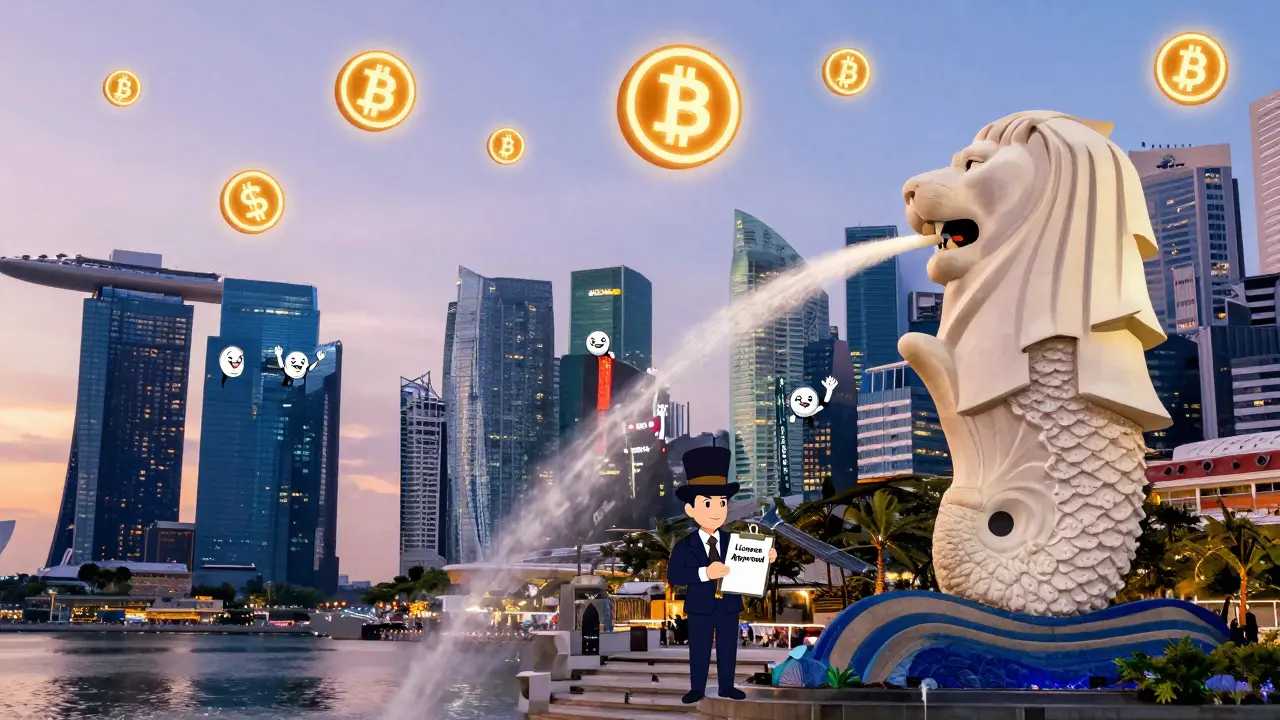
When you think of Asia’s crypto scene, Hong Kong used to be the name on everyone’s lips. But today, that title belongs to Singapore - and it didn’t happen by accident. The city-state didn’t just welcome crypto. It built a system around it. A system so clear, so structured, that global giants like BlackRock, Circle, and Coinbase didn’t just show up - they set up headquarters. And behind it all? A regulatory approach that’s as precise as it is bold.
Why Singapore, Not Another City?
It’s not just about taxes or internet speed. Singapore stands out because it made crypto predictable. While other countries swung between banning crypto and pretending it didn’t exist, Singapore said: ‘We see this. Let’s build rules for it.’ The Monetary Authority of Singapore (MAS) didn’t try to stop innovation. It gave it structure. That meant clear licenses for crypto exchanges, strict rules for custody, and real consequences for non-compliance. By June 30, 2025, unlicensed firms had to shut down. It wasn’t a soft warning - it was a clean cut. And guess what? The market didn’t collapse. It got stronger.Why? Because the ones who stayed were the ones who could prove they were trustworthy. Institutional investors don’t gamble. They need to know where the guardrails are. Singapore gave them a map.
The Numbers Don’t Lie
Look at the data. Singapore ranks #1 globally on the Henley Crypto Adoption Index with a score of 45.7 out of 60. That’s higher than the U.S., Switzerland, or even El Salvador. Why? Because everyday people are using crypto - not just as speculation, but as real money.Stablecoins are the quiet engine behind this. Between June 2024 and June 2025, $2.4 trillion in stablecoin activity flowed through Asia - and over half of it touched Singapore. The Singapore-China corridor is now the busiest stablecoin route on Earth. Companies like Wetrip, Capella Hotels, and Ginza Xiaoma now accept stablecoins as payment. No credit card fees. No 3-day settlements. Just instant, low-cost transactions.
Corporate use jumped from under $100 million in early 2023 to over $3 billion by early 2025. That’s not startups. That’s established businesses replacing wires and checks with blockchain.
Who’s Really Running Things Here?
Forget the influencers. The real power players are institutions. BlackRock chose Singapore as its Asian tokenization hub. SWIFT is testing CBDC bridges with Singaporean banks. Circle, the issuer of USDC, opened its Asia office in May 2025 - right in the heart of the financial district. These aren’t PR moves. They’re long-term bets.Why? Because Singapore’s rules let them operate without fear of sudden crackdowns. MAS doesn’t say ‘no’ to innovation. It says ‘prove it’s safe.’ Tokenized real estate, bonds, even art - all are being tested under MAS-approved frameworks. By 2030, tokenized assets could unlock $2 trillion in new liquidity. And Singapore is the test lab.
Even the big names in crypto moved here. Changpeng Zhao of Binance, Gary Or and Bobby Bao of Crypto.com - all relocated key operations to Singapore. Not because it’s cheap. Not because it’s trendy. Because the system works.

The Tax Advantage That Changed Everything
Here’s something most people miss: Singapore doesn’t tax crypto gains. Ever. No capital gains tax. No tax on staking rewards. No tax on mining. Not even on trading. That’s rare. The U.S. taxes every trade. Germany taxes crypto as income. Singapore? Zero. It’s not just friendly - it’s a magnet.This isn’t a loophole. It’s policy. The government made a choice: if you’re building the future of money, you’re welcome here. And that’s why crypto executives, fund managers, and developers are moving their lives to Singapore. They’re not just working here. They’re living here.
The Event That Said It All
TOKEN2049 Singapore 2025 wasn’t just another conference. It was a declaration. 25,000 people from 160 countries. 500+ exhibitors. 300+ speakers. Sold out. Held across all five floors of Marina Bay Sands. Title sponsors? Coinbase, OKX, Circle, TRON, Bitget - the biggest names in crypto. This wasn’t a gathering of speculators. It was a summit of builders, regulators, and institutions all in the same room.That event didn’t happen in Dubai because Dubai’s rules are looser. It didn’t happen in Hong Kong because its political climate is too unstable. It happened in Singapore because it’s the only place in Asia where everyone - from a small startup to a global bank - feels they can play by the same rules.

What’s Next? The Real Test
Singapore’s model is working - but it’s not perfect. The crackdown on unlicensed firms pushed some liquidity offshore. Smaller players struggled to meet the compliance costs. And while institutional adoption is booming, retail users still face hurdles: complex KYC, limited access to DeFi, and few local crypto banking options.That’s the next challenge. Can Singapore scale its model to include everyday users without losing the trust it built with institutions? Can it make DeFi accessible without compromising security? Can it keep its edge as other countries - like the UAE and Switzerland - copy its playbook?
The answer may lie in how MAS handles tokenized assets. If they can make it easy for a Singaporean to tokenize their apartment or buy a share of a Singaporean mall using crypto - and do it legally, safely, and instantly - then Singapore won’t just be a crypto hub. It’ll become the first true crypto-first economy.
Why This Matters Beyond Asia
Singapore isn’t just a local success story. It’s a blueprint. Other countries are watching. The U.S. is still stuck in political gridlock. The EU is drowning in red tape. Singapore shows that regulation doesn’t have to kill innovation - it can fuel it. When you give clear rules, smart people find ways to build within them.For investors, it means Singapore is the safest bet in Asia for crypto exposure. For developers, it’s the place to launch a compliant product. For businesses, it’s the easiest place to adopt crypto payments without legal risk. And for anyone wondering where the next wave of crypto innovation will come from - look east. It’s already here.
Is crypto legal in Singapore?
Yes, crypto is fully legal in Singapore. The Monetary Authority of Singapore (MAS) regulates it under the Payment Services Act. Exchanges and service providers must obtain a license, but owning, trading, or using crypto is not restricted. The government actively encourages innovation as long as firms comply with anti-money laundering and consumer protection rules.
Does Singapore tax cryptocurrency?
No, Singapore does not tax capital gains from cryptocurrency trading, staking rewards, or mining. There is no capital gains tax, income tax, or GST on crypto transactions between individuals. This makes it one of the most tax-friendly jurisdictions for crypto holders in the world. Businesses, however, must still report crypto as an asset on their financial statements.
Why are so many crypto companies based in Singapore?
Singapore offers a rare combination: regulatory clarity, political stability, strong infrastructure, and zero capital gains tax. Unlike other regions that swing between bans and vague guidelines, MAS provides predictable licensing rules. This attracts institutional investors, fintech talent, and global firms like BlackRock and Circle who need certainty before committing billions. It’s not just about being crypto-friendly - it’s about being trustworthy.
Can I use crypto to pay for goods in Singapore?
Yes, and it’s growing fast. Companies like Wetrip (travel), Capella Hotels, and Ginza Xiaoma (luxury retail) now accept stablecoins like USDC for payments. These transactions are faster and cheaper than credit cards, with near-instant settlement. While not yet widespread across all retailers, adoption is accelerating among mid-to-large businesses looking to cut costs and appeal to global customers.
Is Singapore a better crypto hub than Hong Kong?
As of 2025, Singapore has pulled ahead. Hong Kong has strong liquidity and a global financial reputation, but its regulatory environment has been more volatile, especially after political shifts in recent years. Singapore, by contrast, has maintained consistent policy, attracted institutional players like BlackRock and Circle, and led in stablecoin volume. The 2025 Crypto-Friendly Cities Index ranked Singapore higher than Hong Kong, and major events like TOKEN2049 now center on Singapore, not Hong Kong.
What role does MAS play in Singapore’s crypto success?
MAS is the architect. It doesn’t just regulate - it designs. It created licensing categories for payment token services, defined custody standards, and set clear compliance benchmarks. It also works directly with firms to test new technologies like tokenized assets and CBDC bridges. MAS doesn’t try to predict every innovation - it builds frameworks that let innovation happen safely. That’s why institutions trust it more than any other Asian regulator.
What’s the biggest risk to Singapore’s crypto hub status?
The biggest risk is becoming too rigid. While regulation has brought trust, it’s also created high barriers for small startups. If MAS doesn’t find ways to support grassroots innovation while maintaining institutional safety, it could lose its edge to more agile hubs like Dubai or Switzerland. The next challenge is balancing scale with inclusion - letting retail users participate without compromising the system’s integrity.
Arlene Miles
March 20, 2026 AT 03:23Let’s be real-Singapore didn’t just get lucky. They took the chaos of crypto and turned it into a precision instrument. Most countries treat innovation like a threat. Singapore treats it like a patient needing a structured treatment plan. No panic. No bans. Just clear pathways. And guess what? People show up when they know where the guardrails are. It’s not about being crypto-friendly-it’s about being civilization-friendly.
Jessica Beadle
March 20, 2026 AT 19:29The MAS regulatory framework operates under a strict compliance-by-design paradigm, leveraging AML/CFT protocols embedded within a tokenized asset infrastructure that prioritizes KYC-verified on-chain identity verification. This is not mere policy-it’s a systemic architecture for financial sovereignty.
Tony Weaver
March 21, 2026 AT 23:54Of course Singapore’s winning. They have zero capital gains tax, a colonial-era legal system, and a population that doesn’t question authority. Meanwhile, the U.S. is still arguing whether Bitcoin is a currency or a commodity. Pathetic. You can’t build a future on TikTok debates and congressional hearings.
Patty Atima
March 23, 2026 AT 13:31Looks like it’s actually working. Nice.
Lucy de Gruchy
March 25, 2026 AT 06:41Regulation? More like surveillance with a smile. MAS doesn’t want innovation-they want control. Every stablecoin transaction tracked. Every wallet monitored. This isn’t freedom-it’s a velvet cage. And don’t tell me about ‘trust.’ Trust is what you lose when you hand over your keys to a government.
Lauren J. Walter
March 26, 2026 AT 02:57Wow. So Singapore’s the new Dubai. Just… without the sand. And the camels. And the actual fun.
Carol Lueneburg
March 26, 2026 AT 12:54This is the kind of future we need. 🌟 Clear rules. Real innovation. No fear. People are building, not just speculating. Singapore’s proving that good regulation doesn’t kill crypto-it gives it wings. Let’s hope more places follow. The world needs this.
Brenda White
March 28, 2026 AT 10:08wait so no tax on crypto? like at all? even if u make 100mil? thats not right. someone needs to tax these rich tech bros. also why is everyone moving there? its so humid
Tobias Wriedt
March 30, 2026 AT 02:46Zero capital gains? That’s moral bankruptcy. Crypto isn’t a game. It’s a revolution. And revolutions need to be taxed. If you profit from chaos, you owe society. Singapore’s just enabling greed dressed up as innovation. 🙄
Ernestine La Baronne Orange
March 31, 2026 AT 15:48Let me tell you something-this isn’t progress, it’s a calculated manipulation. The MAS isn’t ‘supporting innovation’-they’re creating a regulatory monoculture where only institutions with billions can survive. Small devs? Forget it. They’re crushed under compliance costs. And let’s not pretend stablecoin adoption is organic-it’s fueled by corporate subsidies and tax arbitrage. This isn’t a hub. It’s a corporate tax haven with fiber optics.
And don’t get me started on TOKEN2049. 25,000 people? More like 25,000 marketers in designer sneakers. The real builders? They’re in Bucharest, in Tbilisi, in Lagos-working in basements with no press coverage because they can’t afford a MAS license. Singapore didn’t build a future. It built a stage.
And now you’re all clapping like it’s genius? It’s not. It’s exclusion disguised as excellence. You think tokenized real estate is democratizing finance? It’s just making the rich richer while the rest of us pay for the infrastructure. This isn’t innovation-it’s institutional capture.
And the worst part? Everyone’s too dazzled by the shiny lights to notice the cage. The MAS doesn’t want you to be free. They want you to be compliant. And compliant people don’t ask questions. They just follow the rules… and pay their taxes.
So go ahead. Move to Singapore. Buy your tokenized apartment. Stake your USDC. But don’t pretend this is justice. It’s just capitalism with better PR.
Manali Sovani
April 2, 2026 AT 12:28The regulatory framework of Singapore is commendable from a governance perspective. However, one must acknowledge that the absence of capital gains taxation may inadvertently encourage speculative behavior, which is antithetical to sustainable economic development. The institutional adoption observed is largely attributable to macroeconomic arbitrage rather than genuine innovation.
Konakuze Christopher
April 4, 2026 AT 00:07They’re not building a hub. They’re building a fortress. And the gatekeepers? MAS. The rest of us? Just peasants with wallets.
S F
April 5, 2026 AT 08:08USA still leads in innovation. Singapore just got lucky with a tax loophole and a good PR team. Don’t let them fool you.
Angelica Stovall
April 6, 2026 AT 09:48Of course it’s ‘stable.’ Everyone’s scared to break the rules. That’s not innovation. That’s obedience. And obedience doesn’t build the future. It just keeps the lights on.
Taylor Holloman.
April 7, 2026 AT 15:49There’s something quietly beautiful about how Singapore handled this-no fanfare, no panic, just steady hands. It’s rare to see a government that doesn’t treat tech like a threat. They didn’t try to control it-they created space for it to breathe. And that’s how real progress happens. Not with bans. Not with hype. With patience.
I’ve watched crypto go from ‘get rich quick’ to ‘build something real.’ Singapore didn’t win because they’re rich. They won because they understood that trust is built one rule at a time.
And yeah, maybe it’s not perfect. But for the first time, I feel like maybe… just maybe… we’re not all going to burn it down together.
Bryan Roth
April 7, 2026 AT 22:50I’ve been in this space since 2017. Seen it all. The crashes. The scams. The hype cycles. And honestly? Singapore’s approach is the first one that feels… sustainable. Not because they’re perfect. But because they didn’t try to be everything to everyone. They picked their lane: institutional trust. And they ran with it. No drama. No politics. Just clear rules.
And yeah, small devs are getting squeezed. But that’s not the end of the story. The real innovation isn’t in the big firms-it’s in the tools they’re building. APIs. Wallets. Compliance stacks. Those are the invisible engines. And they’re being built everywhere. Singapore didn’t create the future. It gave it a home.
Maybe the next step isn’t more regulation. Maybe it’s more bridges. To the devs in Nigeria. To the builders in Mexico. To the students in Manila. Because if this is the future of money, it shouldn’t just belong to the ones who can afford a MAS license.
sai nikhil
April 9, 2026 AT 06:40Singapore's regulatory clarity provides a conducive environment for blockchain innovation. However, the absence of retail-centric initiatives may hinder inclusive growth. A balanced approach between institutional adoption and grassroots participation is essential for long-term sustainability.
Sahithi Reddy
April 9, 2026 AT 13:17Clear rules good. Tax free better. More cities should copy this
George Hutchings
April 9, 2026 AT 19:28What’s wild is how this isn’t about crypto at all. It’s about governance. Singapore didn’t choose crypto-they chose clarity. And in a world full of noise, that’s the rarest thing of all. You don’t need to love blockchain to love this. You just need to believe that systems should work.
Steph Andrews
April 11, 2026 AT 08:25It’s funny how everyone’s shocked that a place with clean streets and good public transport also has smart policy. Maybe we should stop treating governments like villains and start treating them like architects
Anastasia Thyroff
April 12, 2026 AT 23:08They’re not building a hub. They’re building a museum. Everything’s preserved. Nothing’s changing. Innovation dies in a museum.