SpartaDEX Review: Is This Gamified Crypto Exchange Worth Your Money?
 Aug, 11 2026
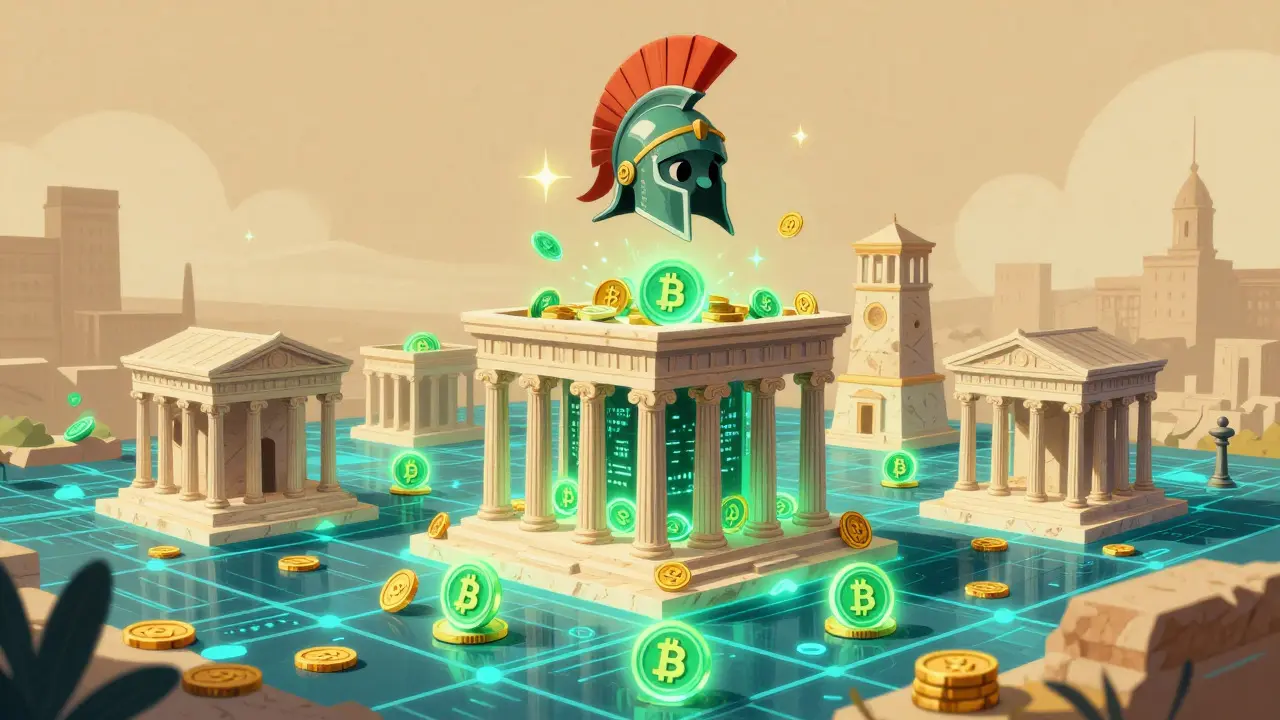
Have you ever felt like providing liquidity in decentralized finance is just... boring? You deposit tokens, wait for yields, and hope the market doesn't crash. It’s passive, often stressful, and frankly, a bit dull. What if your financial strategy could feel more like playing a game of Age of Empires? That is exactly the promise behind SpartaDEX, a platform that tries to merge the high-stakes world of ancient Greek warfare with the mechanics of a cryptocurrency exchange.
Launched in 2023, SpartaDEX positions itself as the first truly gamified decentralized exchange (DEX) on the Arbitrum blockchain. Instead of just clicking "swap" or "provide liquidity," you mint a city-state NFT called a Polis. You build it up, defend it from raids, and level up its Senate. The catch? Every military victory and economic upgrade directly boosts your financial returns. But does this clever gimmick actually make money, or is it just another complex wrapper around thin liquidity?
How SpartaDEX Actually Works
To understand SpartaDEX, you have to forget what you know about traditional exchanges like Binance or even standard DEXs like Uniswap. Here, the interface looks like a strategy game. When you connect your wallet, you aren't just a trader; you are a ruler of an ancient polis.
The core loop involves three main activities:
- Minting a Polis: You start by creating your city-state NFT. This is free but acts as your identity and progress tracker within the ecosystem.
- Providing Liquidity: To play, you must deposit at least $100 into whitelisted liquidity pools. Currently, these include pairs like WETH/USDC.E. This isn't optional; without liquidity, your city has no economy.
- Gaming Mechanics: As you provide liquidity, you earn experience points (EXP). You use EXP to upgrade your Polis through seven Senate levels. Higher Senate levels unlock better features and, crucially, increase your Annual Percentage Rate (APR) by up to 33.3%.
It sounds simple enough, but there is a twist. Your city can be raided by other players. If your defenses are weak, you might lose resources or face penalties. This means you have to balance economic development (which boosts yield) with military expansion (which protects your assets). It turns the usually passive act of staking into an active management task requiring daily attention.
The Token Economy: SAS vs. SPARTA
SpartaDEX operates on a dual-token system, which can be confusing if you aren't paying attention. Understanding the difference between these two tokens is critical for managing your expectations.
| Token | Symbol | Primary Function | Supply Details |
|---|---|---|---|
| SAS | SAS | Governance and utility. Used for voting on protocol changes and accessing premium features. | Not specified in initial docs, likely inflationary based on governance needs. |
| SPARTA | SPARTA | Reward token. Earned through gameplay and liquidity provision. Can be traded on external markets. | Capped at 1 billion total supply. Circulating supply was ~5.3 million in Q3 2023. |
The SPARTA token is where most users focus their attention because it represents tangible earnings. However, with a capped supply and a relatively small circulating amount early on, volatility can be extreme. The SAS token, on the other hand, holds the keys to the kingdom regarding protocol decisions. If you plan to stay long-term, holding SAS gives you a voice in how the platform evolves, including future cross-chain expansions.
Fees, Liquidity, and Trading Volume
Let's talk numbers, because games don't pay bills-yields do. SpartaDEX charges a bid-ask spread averaging 0.615%. For casual traders, this might seem negligible, but for high-frequency traders used to centralized exchanges charging 0.1%, it adds up quickly.
As of late 2023 data, the platform reported a 24-hour trading volume of approximately $488,000. While this places it in the top tier for niche DEXs, it pales in comparison to giants like Uniswap, which processes over $1 billion daily. Why does this matter? Because lower volume often leads to higher slippage. If you try to swap a large amount of ETH for USDC on SpartaDEX, you might get a worse price than you would on Uniswap due to thinner order books.
Currently, SpartaDEX supports only eight listed coins and eight active trading pairs. This limited selection is both a strength and a weakness. On one hand, it keeps the ecosystem focused and manageable. On the other hand, if your favorite altcoin isn't supported, you can't trade it here. The WETH/USDC.E pair dominates the volume, accounting for nearly 36% of all trades, indicating that most users are sticking to stable, low-risk pairs while they figure out the game mechanics.
Security and Trust: Should You Worry?
In crypto, security is everything. SpartaDEX is built on Arbitrum, a Layer 2 scaling solution known for its robust security inheritance from Ethereum. Transactions are fast and cheap, with gas fees significantly lower than on the mainnet. However, the smart contracts powering the game mechanics are separate entities.
Here is the elephant in the room: as of Q3 2023, comprehensive third-party audits from firms like CertiK were not publicly finalized for all contract modules. Security researcher Alexei Volkov noted that integrating game logic with financial protocols increases the attack surface. Complex code means more potential bugs. While the team claims rigorous internal testing, the lack of a widely publicized audit report should give cautious investors pause.
Additionally, the team behind SpartaDEX remains anonymous, incorporated in Estonia. Estonia offers a clear regulatory framework for crypto businesses, which is a positive sign. However, anonymity always carries risk. If something goes wrong, who do you sue? Who do you hold accountable? In the world of DeFi, reputation is currency, and an anonymous team starts with zero trust capital.
User Experience: The Good, The Bad, and The Ugly
I spent time looking at user feedback across Reddit, Twitter, and Trustpilot to get a real sense of what it feels like to use SpartaDEX. The experiences are polarized.
On the positive side, users love the engagement factor. One Redditor, 'CryptoSpartan23', reported earning $127 in rewards during their first month by dedicating 20-30 minutes daily to manage their Polis. They described the gameplay as "addictive" and claimed it made DeFi less intimidating. The community Discord, with over 12,000 members, is active and helpful, offering strategies for maximizing yields during bear markets.
However, the complaints are significant. Many beginners found the $100 minimum liquidity requirement too high for a test drive. Worse, several users reported losing money to impermanent loss before they fully understood the game mechanics. One user on CryptoSlate mentioned losing 15% of their initial investment due to poor timing and lack of knowledge about pool dynamics. Customer support is also a pain point, with average response times hovering around 72 hours-a eternity in crypto when prices are moving fast.

Who Is SpartaDEX For?
SpartaDEX is not for everyone. If you are an institutional trader looking for deep liquidity and advanced charting tools, look elsewhere. This platform will frustrate you with its limited pairs and game-heavy interface.
It is designed for:
- DeFi Gamers: People who enjoy strategy games and want their hobby to potentially generate income.
- Liquidity Providers Seeking Engagement: Users tired of passive staking who want to feel involved in their investments.
- Arbitrum Enthusiasts: Those already invested in the Arbitrum ecosystem looking for novel ways to utilize their assets.
If you fall into these categories, SpartaDEX offers a unique value proposition. If you just want to swap tokens quickly and efficiently, stick to established DEXs like Uniswap or PancakeSwap.
Future Outlook: Can It Survive?
The roadmap for SpartaDEX includes cross-chain expansion to Optimism and Base by early 2024, along with AI-powered strategy advisors. These are ambitious goals. The broader GameFi-DeFi hybrid market is projected to reach $4.3 billion by 2025, suggesting there is room for growth. However, competition is fierce. Projects like Yield Guild Games and Illuvium are also vying for attention in the gaming space.
Analysts remain divided. Some predict the SPARTA token could see massive gains if the platform hits its target of 50,000 daily active users. Others warn that the complexity of the model may limit mass adoption. Only time will tell if SpartaDEX can maintain its edge or fade into obscurity like many other meme-driven DEXs.
Is SpartaDEX safe to use?
Safety depends on your risk tolerance. While it runs on the secure Arbitrum network, the specific smart contracts governing the game mechanics lacked comprehensive third-party audits as of late 2023. Always start with small amounts you can afford to lose.
What is the minimum deposit for SpartaDEX?
You need a minimum of $100 in liquidity provision to whitelisted pools to begin gameplay and mint your Polis NFT.
How do I earn rewards on SpartaDEX?
Rewards come from providing liquidity to pools, which generates transaction fees and SPARTA token emissions. Additionally, leveling up your Polis through gameplay can boost your APR by up to 33.3%.
Does SpartaDEX charge high fees?
The platform uses a bid-ask spread averaging 0.615%, which is higher than traditional CEXs but comparable to many DEXs. Gas fees on Arbitrum are generally low, but peak times can see increased costs.
Can I trade any cryptocurrency on SpartaDEX?
No. As of late 2023, SpartaDEX supports only eight listed coins and eight trading pairs, primarily focusing on major assets like ETH and USDC.