Spot Market Liquidity and Execution in Blockchain Trading
 Mar, 11 2026
When you trade Bitcoin on a spot market, you’re not betting on what the price might be next week. You’re buying or selling it right now, at the price it’s trading at this second. That’s the core of spot markets: immediate exchange. No futures, no options, no waiting. You pay, you get the asset. In blockchain trading, this is how most retail and institutional traders start - and often, how they stay. But here’s the thing: spot market liquidity isn’t just a buzzword. It’s what makes your trade go through cleanly or leave you stuck with a bad fill.
What Spot Market Liquidity Really Means
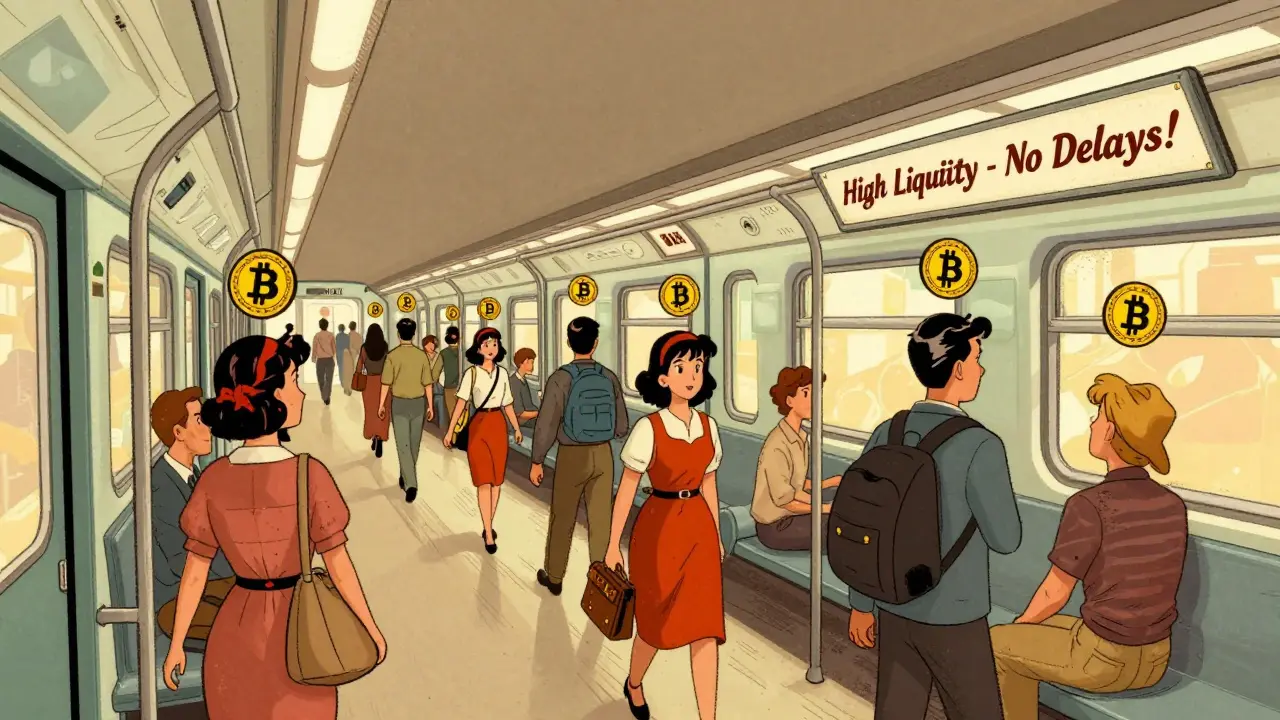
Liquidity isn’t about how much volume is happening. It’s about how easily you can buy or sell without moving the price. Think of it like a crowded subway at 8 a.m. - people are flowing in and out, no one’s blocking the doors. That’s high liquidity. Now imagine that same subway at 3 a.m. on a Sunday. You wait. No one’s getting on. No one’s getting off. That’s low liquidity. In spot markets, liquidity is measured by two things: the bid-ask spread and trading volume. The bid is the highest price someone is willing to pay. The ask is the lowest price someone is willing to sell for. The gap between them? That’s the spread. In highly liquid markets like EUR/USD or BTC/USDT, that spread can be as tight as 0.1 pips or 0.01%. In less liquid pairs - say, SOL/BNB or an obscure altcoin - it can be 5%, 10%, even more. That’s not just a cost. That’s money you lose before you even open a trade. Volume tells you how many trades are happening. High volume usually means tight spreads. But volume alone doesn’t guarantee liquidity. You could have 10,000 trades of $10 each - that’s $100,000 in volume. But if no one’s willing to take a $100,000 order? You’re still stuck. Real liquidity means deep order books: buyers and sellers lined up at multiple price levels, ready to absorb large orders without flipping the market.Why Liquidity Matters for Execution
Execution is where the rubber meets the road. You place an order. You expect it to fill. But what if it doesn’t? Or worse - it fills at a worse price than you expected? That’s slippage. Slippage happens when there isn’t enough liquidity to match your order at the price you want. Say you want to buy 5 BTC at $60,000. The order book shows only 1 BTC available at that price. The rest? $60,050, $60,100, $60,200. Your order gets filled partially at $60,000 and the rest at higher prices. You paid $60,080 on average. That’s slippage. And it’s not rare. During major news events - like a Fed announcement or a big exchange hack - liquidity evaporates. Orders that should’ve filled at $60,000 get filled at $59,200 or $60,900. No one’s there to absorb the shock. This is why traders who rely on spot markets obsess over timing. The best hours for BTC/USDT? When the London and New York sessions overlap. That’s 1 p.m. to 5 p.m. UTC. Volume spikes. Spreads tighten. Slippage drops. A 2023 study of top crypto exchanges showed that during these windows, average slippage for market orders under $100,000 was just 0.08%. Outside those hours? It jumped to 0.45% - over five times worse.Liquidity Differences: Bitcoin vs. Altcoins
Not all spot markets are created equal. Bitcoin dominates. It accounts for over 60% of all spot crypto trading volume. ETH is next, at around 15%. The rest? Hundreds of tokens split the remaining 25%. Here’s what that looks like in practice:| Asset | Avg. Daily Volume | Avg. Bid-Ask Spread | Slippage on $50k Order |
|---|---|---|---|
| BTC/USDT | $38 billion | 0.03% | 0.05% |
| ETH/USDT | $12 billion | 0.06% | 0.12% |
| SOL/USDT | $3.2 billion | 0.25% | 0.65% |
| PEPE/USDT | $450 million | 1.8% | 4.1% |
| MEME/USDT | $120 million | 5.2% | 9.7% |
You can see the pattern. The top two assets have deep order books. Thousands of orders stacked at each price level. You can move $500,000 without a blink. The lower down you go, the thinner it gets. A $50,000 order on PEPE might wipe out 20% of the bid side. That’s not trading - that’s a price shock.

How Traders Use Liquidity to Their Advantage
Smart traders don’t just trade. They read the market. They watch:- Order book depth - how many orders are stacked above and below the current price
- Time and sales - whether large trades are happening at bid or ask prices
- Volume spikes - sudden surges often mean institutional players are moving
Where Liquidity Comes From - and Where It Disappears
In crypto spot markets, liquidity doesn’t just appear. It’s provided. By market makers - automated systems that constantly quote buy and sell prices. By large wallets - whales who move $10M+ at a time. By exchanges that subsidize liquidity with fee rebates. But here’s the catch: liquidity is fragile. It’s not permanent. When volatility spikes - like during a Bitcoin ETF approval or a major exchange outage - market makers pull back. They stop quoting prices. The order book thins. The spread explodes. That’s when you hear traders say, “There’s no liquidity.” And it’s not just during crashes. Weekends are killers. After Friday’s New York close, volume drops 70-80%. Many exchanges shut down their liquidity pools. If you try to trade BTC on Saturday at 3 a.m., you’re gambling. You might get filled - but at a price that’s 2% off from Friday’s close.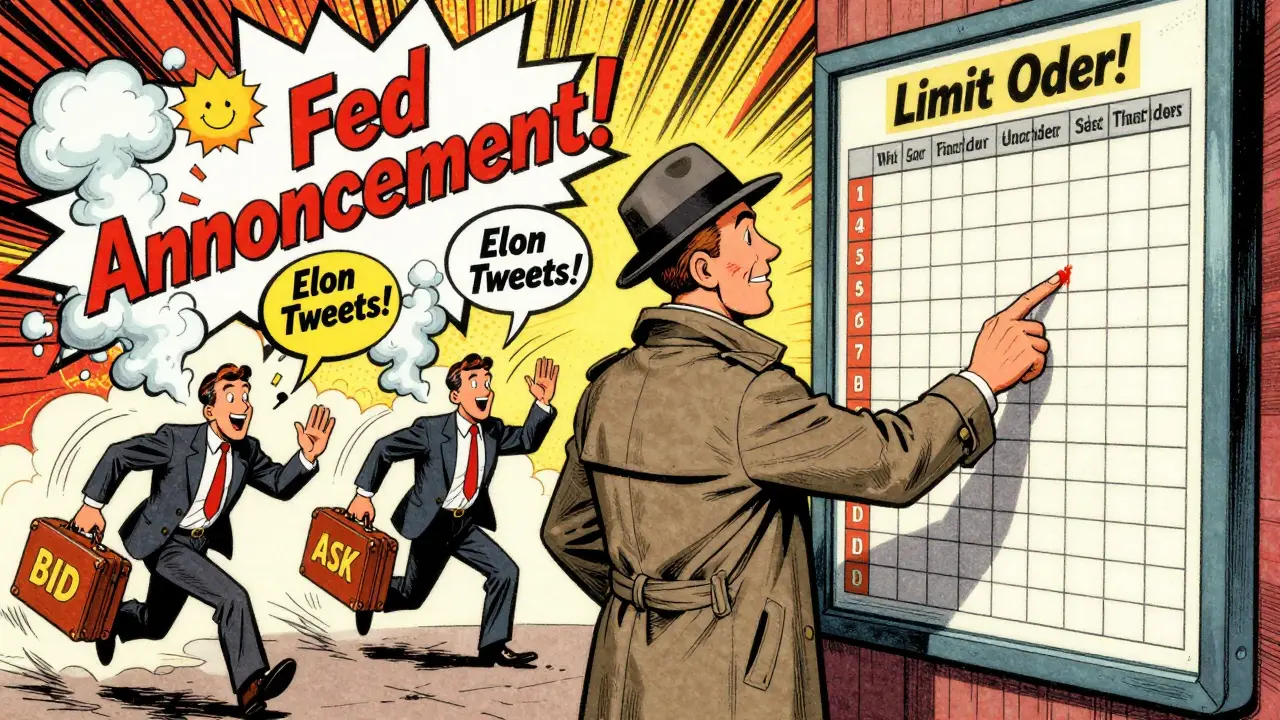
How to Trade Spot Markets Like a Pro
If you want to execute well in spot markets, here’s what works:- Trade only major pairs - BTC/USDT, ETH/USDT, SOL/USDT. Avoid anything with daily volume under $500 million.
- Check the spread before you trade - if it’s over 0.5%, walk away.
- Use limit orders - never rely on market orders unless you’re certain liquidity is deep.
- Trade during peak hours - 1 p.m. to 5 p.m. UTC for crypto.
- Avoid news events - use an economic calendar. Skip the 30 minutes before and after major releases.
- Watch for liquidity drains - if the order book suddenly has only 1-2 levels deep, you’re in a risky zone.
It sounds simple. But most traders ignore this. They chase pumps. They use market orders on low-volume tokens. They trade on weekends. And then they wonder why they lost money.
The Future of Spot Liquidity in Crypto
The crypto spot market is changing. More institutional players are entering. Exchanges like Binance and Coinbase now offer direct access to institutional liquidity pools. New protocols like CEX.io’s Smart Order Router and Kraken’s Liquidity Hub use AI to find the best prices across 15+ venues in milliseconds. In 2024, the Bank of England’s real-time settlement system for GBP cut settlement risk by 60%. Similar upgrades are coming to crypto. Projects like Ripple’s xRapid and Stellar’s liquidity pools are integrating with traditional finance, allowing spot trades to settle in seconds - not hours. But the core hasn’t changed. Liquidity still rules. The more you understand it, the better you trade. The less you understand it, the more you pay in slippage, missed fills, and bad entries.Spot markets don’t care about your feelings. They care about depth. Volume. Price. If you’re not reading the order book, you’re not trading - you’re guessing.
What’s the difference between spot market liquidity and futures liquidity?
Spot market liquidity is about buying and selling assets right now, with immediate settlement. Futures liquidity involves contracts that settle later, often with leverage. Spot markets usually have tighter spreads and higher volume because they’re used by day traders and institutions for direct exposure. Futures markets can have high volume too, but they’re more prone to manipulation and wider spreads during volatility because of contract expiration cycles and margin calls.
Can you have high trading volume but low liquidity?
Yes. High volume means lots of trades - but if those trades are tiny and scattered, liquidity is still low. For example, a token might have 50,000 trades a day, each for $100. That’s $5 million in volume. But if no one’s willing to take a $500,000 order, you can’t execute large trades without moving the price. That’s low liquidity. Real liquidity means depth - large orders stacked at multiple price levels.
Why do spreads widen during news events?
Market makers - the entities that provide buy and sell quotes - pull back during news events because risk spikes. They don’t know which way the price will jump. So they widen the spread to protect themselves. If the bid-ask spread was 0.05% before the news, it might jump to 0.5% or higher. This protects them from losing money on sudden moves - but it hurts traders who need to execute immediately.
Is spot trading better than futures for beginners?
Yes, for most beginners. Spot trading doesn’t involve leverage, so you can’t lose more than you put in. You’re buying the asset outright, so there’s no margin call risk or contract expiration. It’s simpler. Futures require understanding time decay, funding rates, and liquidation levels - all things that can wipe out accounts quickly. Spot lets you learn price action without added complexity.
How do I check real-time liquidity on a crypto exchange?
Look at the order book - not just the last price. A deep order book shows hundreds of buy and sell orders stacked at different price levels. If the top 5 bid levels add up to less than $50,000 total, liquidity is thin. Also, watch the bid-ask spread. If it’s consistently above 0.3% on BTC/USDT, the exchange may not have strong liquidity. Use exchanges like Binance, Coinbase, or Kraken - they aggregate liquidity from multiple sources.
Alex Thorn
March 12, 2026 AT 01:17It’s funny how people treat liquidity like it’s some mystical force, when really it’s just math in motion. The order book isn’t magic-it’s a mirror of collective intent. Every bid, every ask, every slippage event? It’s a thousand tiny decisions adding up to a market that either lets you through or slams the door. And if you’re not reading it, you’re not trading-you’re just guessing with money.
Real traders don’t chase pumps. They watch the depth. They wait for the tide to roll in before they wade in. The 1 p.m. to 5 p.m. UTC window? That’s not a suggestion-it’s a biological rhythm of the market. The machines wake up. The whales stretch. The spreads contract. You want to trade? Show up when the adults are in the room.
Howard Headlee
March 12, 2026 AT 23:42Yo, this is the most goddamn clear breakdown of spot liquidity I’ve ever read. No fluff. No jargon. Just cold, hard truth wrapped in a subway metaphor. I’ve lost more money on weekend SOL trades than I care to admit. Now I wait. I check the spread. I use limit orders. And yeah-I skip Elon’s tweets like they’re radioactive. If you’re not doing this, you’re not a trader. You’re a slot machine enthusiast with a wallet.
Also-PEPE? Come on. That’s not trading. That’s a donation to someone’s yacht fund.
William Montgomery
March 13, 2026 AT 20:44You think you’re smart because you read an order book? Most people who trade BTC/USDT are just gambling with a spreadsheet. You’re not a trader-you’re a data voyeur. Real traders don’t care about spreads. They make them. And if you’re still using limit orders like it’s 2017, you’re already behind.
Stop pretending liquidity is a virtue. It’s just a tool for the ones who know how to weaponize it.
Mara Alves Mariano
March 15, 2026 AT 16:21Oh wow, so now we’re all supposed to be accountants? Let me guess-next you’ll tell us to check the Federal Reserve’s Twitter before we buy ETH? I trade because I believe in crypto, not because I want to memorize bid-ask spreads like it’s a college exam.
And let’s be real: if you’re not trading PEPE, you’re part of the establishment. The future isn’t in BTC/USDT. It’s in the chaos. The noise. The memes. That’s where the real money is. The ‘pros’ are just scared of what they can’t control.
Adam Ashworth
March 17, 2026 AT 10:31Agreed on the peak hours. I’ve seen the difference firsthand-trade at 3 a.m. UTC and you’re basically paying a tax just to get filled. I used to think it was bad luck. Turns out, it was just bad timing.
Also, limit orders are non-negotiable. Market orders on anything under $1B daily volume? That’s not trading. That’s suicide with a GUI.
Allison Davis
March 18, 2026 AT 04:34One thing I’d add: liquidity isn’t just about volume or spreads-it’s about stability. A market can have high volume but still be choppy, unpredictable, and dangerous. That’s why I only look at exchanges with consistent order book depth over 24-hour periods, not just during peak hours. If the book looks like a scribble at 2 a.m., it’s not worth touching.
Tom Jewell
March 20, 2026 AT 04:33There’s a quiet philosophy here, isn’t there? Liquidity as a reflection of trust. When the order book is deep, it’s because people believe the price is fair. When it vanishes, it’s because trust has fractured. We talk about spreads and slippage like they’re technical metrics-but really, they’re emotional ones.
The market doesn’t move because of data. It moves because of fear. And the people who understand that? They don’t fight the tide. They swim with it.
Sherry Kirkham
March 20, 2026 AT 14:09Spot liquidity is the silent backbone of crypto. Most people ignore it until they get burned. I used to think ‘high volume = good trade.’ Now I check the depth of the top 10 bid levels. If they don’t add up to at least 10% of my intended order size, I walk away.
Also-never trade altcoins with under $1B volume unless you’re okay losing 5% on a $10k trade. That’s not risk. That’s stupidity.
Sharon Tuck
March 20, 2026 AT 23:28This is such a helpful guide. I’m new to spot trading and I’ve been terrified of slippage. Now I know exactly what to look for. The ‘trade during peak hours’ tip changed everything for me. My fills are cleaner, my stress is lower. Thank you for writing this. Seriously.
Also, I’ve started using TradingView’s order book overlay. It’s a game-changer. If you’re not using it, try it. It’s free.
karan narware
March 22, 2026 AT 09:12Interesting how you call it ‘liquidity,’ but in India, we just call it ‘market feeling.’ You don’t need charts-you need intuition. If the price moves too fast without volume, you feel it. Like a storm before thunder.
Also, why are you all obsessed with UTC? Here, we trade when the chai is hot. And guess what? We still make money. Maybe the real lesson isn’t in the spreads-it’s in the patience.
Michael Suttle
March 22, 2026 AT 22:37They’re hiding something. Why does liquidity vanish right before big news? Coinbase? Binance? They’re front-running. You think it’s coincidence? No. It’s orchestrated. They know the Fed announcement is coming. They drain the order book. Then they push the price up-and you’re left holding the bag.
Don’t trust exchanges. Trust the blockchain. And if you’re not using a non-custodial wallet? You’re already owned.
Jenni James
March 24, 2026 AT 07:47While your analysis is technically accurate, it is profoundly naive in its assumption that market participants operate with rational intent. Liquidity is not a natural phenomenon-it is a construct engineered by centralized entities with regulatory capture. The bid-ask spread is a tax. The ‘peak hours’ are a marketing ploy. You are not a trader. You are a consumer of financial theater.
And yet, you still believe in the order book. How quaint.
Chelsea Boonstra
March 25, 2026 AT 06:23Wait-so you’re saying I should avoid PEPE? But it’s up 300% this week! I just bought in at $0.0000012. What if this is the next Doge?
Also, why are you so obsessed with spreads? I just use market orders. If I get a bad fill, I blame the market. Not me.
And why UTC? I trade when I’m bored. That’s my strategy. Works 60% of the time. That’s better than your spreadsheet.
Julie Tomek
March 25, 2026 AT 23:17As someone who has spent over a decade in institutional trading across equities, FX, and now crypto, I can confirm with absolute certainty that the principles outlined here are not merely applicable-they are foundational. The distinction between volume and liquidity is one of the most underappreciated concepts in retail trading. Most retail traders conflate the two, leading to systematic underperformance.
Furthermore, the behavioral component cannot be overstated: the psychological discipline required to wait for peak liquidity, to forgo impulsive trades, and to resist the allure of high-volatility altcoins is not merely a skill-it is a character trait. The market does not reward intelligence; it rewards patience, consistency, and emotional regulation.
I would add one more point: institutional liquidity providers do not operate on a 24/7 basis. Their algorithms are calibrated to regional trading hours and macroeconomic event calendars. To assume otherwise is to misunderstand the very architecture of modern financial markets.
For those who wish to progress beyond the beginner stage, I strongly recommend studying the order flow dynamics of the E-mini S&P futures market. The lessons transfer directly-and with greater clarity-than any crypto-specific material.
Brandon Kaufman
March 26, 2026 AT 05:26This hit me hard. I used to think I was a trader. Turns out I was just a guy who bought the next meme coin because it looked cool.
I started using limit orders. I only trade BTC/USDT. I check the spread. I wait for 1–5 p.m. UTC.
My win rate went from 30% to 72% in three weeks.
Thanks for the clarity. I wish I’d read this six months ago.
Craig Gregory
March 26, 2026 AT 07:14Liquidity is a myth. There is no such thing as deep order books. It’s all synthetic. Market makers are bots. Exchanges are rigged. The ‘whales’ are controlled by hedge funds that manipulate volume to trigger stop-losses. You think you’re reading the market? You’re reading a simulation.
The only truth is the blockchain. Everything else? Noise. And you’re drowning in it.
Anshita Koul
March 26, 2026 AT 09:28I’ve been trading for eight years. I started with Bitcoin when it was $300. I’ve seen bull runs. I’ve seen crashes. I’ve lost everything. I’ve rebuilt.
And let me tell you-liquidity is everything. Not because it’s technical. But because it’s human.
When the order book is deep, people believe. When it’s thin, they panic. The numbers don’t lie. But they don’t tell the whole story. The real liquidity is in the silence-the absence of panic.
Trade when the market breathes. Not when it screams.
PIYUSH KOTANGALE
March 28, 2026 AT 02:58Love this! I’m from India and we don’t have much access to institutional tools-but I use Binance’s order book and stick to BTC/USDT. Peak hours? 1–5 UTC is 6:30–10:30 PM here. Perfect. I’m home, tea in hand, no distractions.
Limit orders > market orders. Always.
And yeah-PEPE? No. I’ve seen what happens to people who chase memes. I’m not one of them.