UBIX Network Crypto Review: Is UBX a Viable Investment or Just Another Micro-Cap Risk?
 Dec, 25 2025
There is no such thing as UBIX Exchange. If you’re searching for a crypto exchange called UBIX, you’ve been misled. What actually exists is UBIX Network is a decentralized blockchain project with its native token UBX, launched in 2021, built on a Proof-of-Stake consensus mechanism, and designed for ultra-low-cost microtransactions. It is not a platform where you buy or sell cryptocurrencies like Binance or Kraken. It’s a blockchain - and a very small one at that.
What UBIX Network Actually Is (And What It Isn’t)
UBIX Network is a blockchain ecosystem. It doesn’t host trading pairs. It doesn’t offer wallets. It doesn’t have customer support teams answering live chats. What it does have is a token - UBX - and a set of rules for how transactions work on its network. The network processes transactions at around 1,200 per second under normal conditions, with fees averaging just $0.00012 per transfer. That’s over 10,000 times cheaper than Ethereum’s average fee during the same period. Sounds great, right? But here’s the catch: no one’s using it.
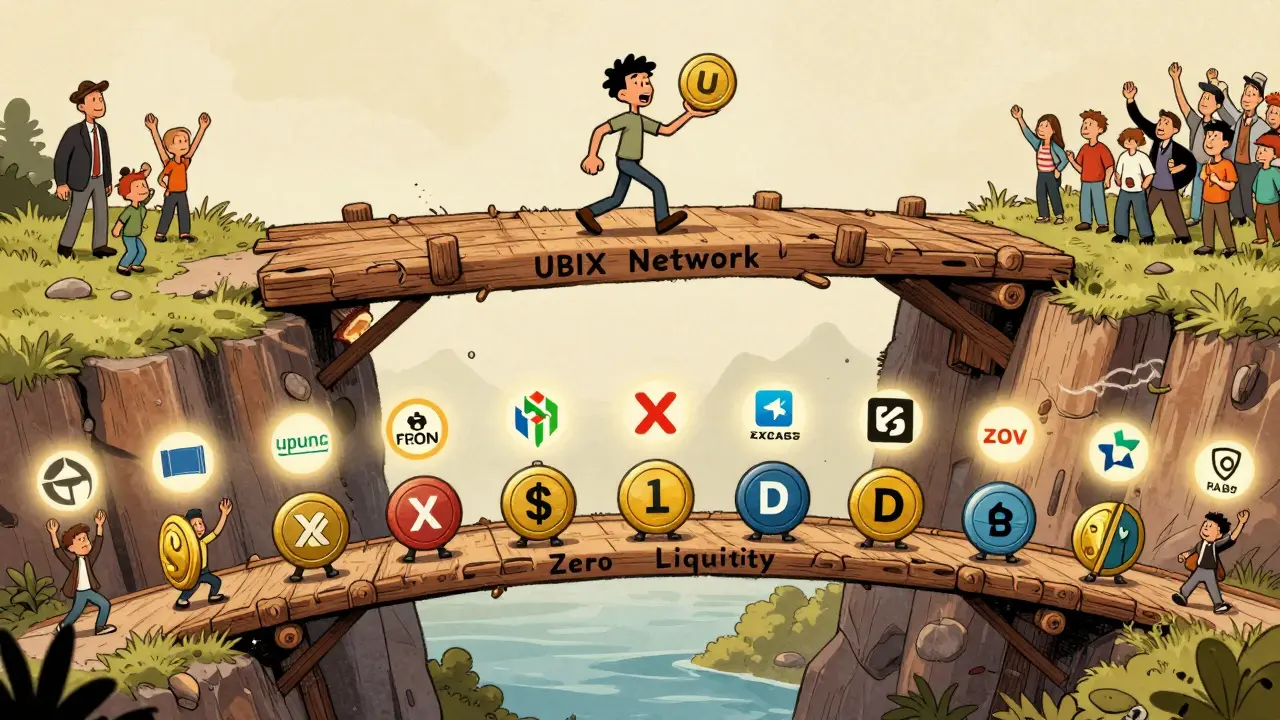
UBIX Network’s mainnet went live on June 15, 2021. Since then, it’s been stuck in a loop of technical promise and practical failure. Its architecture supports cross-chain integration with Ethereum, Waves, and TRON. That means UBX can technically exist on multiple blockchains. But in reality, it only exists on paper - and a few decentralized exchanges with almost zero liquidity.
The UBX Token: Supply, Structure, and Burning Mechanics
UBX has a fixed supply. No new tokens can be minted. That’s a good sign. But unlike Bitcoin, where scarcity drives value, UBX’s scarcity means nothing if no one can trade it. The token uses a deflationary model: 10% of every transaction fee goes to the project’s development fund, and the rest is burned. That sounds like a smart way to reduce supply over time. But with only $4,872 in daily trading volume across all markets (as of October 2023), the burn rate is practically invisible. You’d need millions of transactions daily to make a dent.
There are three versions of UBX: the native token, wrapped UBX (WUBX) on Ethereum, and versions on Waves and TRON. But wrapping a token doesn’t make it liquid. It just adds complexity. Most traders who try to buy WUBX end up facing slippage of 15% or more because there’s not enough depth in the order book. One Reddit user wrote: “Tried to buy 10,000 UBX. Ended up paying 3x the price because the DEX couldn’t fill the order.”
Why No Major Exchange Lists UBX
This is the biggest red flag. Not a single major exchange - not Binance, not Coinbase, not KuCoin, not even Gate.io - lists UBX. Gate.io’s official notice says: “This cryptocurrency has not yet been listed for trading or related services on Gate.” That’s not an oversight. It’s a decision. Exchanges don’t list tokens without demand. They don’t list tokens with $5,000 daily volume. They don’t list tokens with 1,842 active wallets and no enterprise use cases.
UBIX Network’s market cap sits at around $3.2 million. That puts it at #2,847 out of over 2,800 cryptocurrencies tracked by CoinGecko. To put that in perspective: the 1,000th largest crypto has a market cap of roughly $200 million. UBIX is 60 times smaller than that. And it’s shrinking. The 50-day moving average crossed above the 200-day in September 2023 - a classic bullish signal. But without volume to back it up, it’s just noise. Analysts call it a “false breakout.”
Real-World Use Cases? None.
UBIX Network claims to be built for microtransactions - sending pennies between wallets cheaply. That’s a real need. But no app, no game, no payment processor, no merchant accepts UBX. There are zero documented commercial integrations. No startups use it. No DeFi protocols build on it. The only people using it are speculators trying to flip a token that’s barely tradable.
The only “use case” that gets mentioned in forums is sending tiny amounts between wallets. One user on Bitcointalk said: “I send $0.10 to my friend every week. UBX fees are $0.00012. Perfect.” But that’s not a use case - that’s a hobby. And it’s not scalable. If 10,000 people did that daily, volume would hit $1 million. It hasn’t even hit $10,000.
Community and Support: Ghost Town
UBIX Network has 1,247 members across all its official Telegram, Discord, and Twitter channels. That’s less than a single subreddit. Daily activity? Around 17 messages. Compare that to Solana’s Discord, which has over 500,000 members and 5,000+ messages daily.
Support response times average 72 hours for non-urgent questions. Trustpilot has five reviews. Average rating: 2.1 out of 5. Four of those reviews complain about not being able to trade the token. Three mention no customer support. The one positive review? From someone who found the node setup guide “surprisingly clear.” That’s not a vote of confidence in the project - it’s a compliment on documentation quality, not product viability.
Price and Technical Analysis: Hope vs. Reality
As of late 2023, UBX trades around $0.0000032. Resistance levels sit at $0.0000038, $0.0000109, and $0.0000176. Bollinger Bands show an upper band of $0.0000035 - meaning the price is already near its upper limit. For UBX to go up, it needs volume. But volume isn’t coming. CoinLore’s analysts suggest a 300-400% price jump is possible if it breaks $0.0000038 with sustained volume over $10,000. But the last 30-day average? $4,872. That’s 51% below the threshold.
Technical indicators like moving average crossovers mean nothing without volume. A 2023 CoinDesk report analyzed 412 micro-cap tokens with similar traits. 97.3% failed within 24 months. UBIX Network fits that profile perfectly.
Should You Buy UBX?
Let’s be clear: buying UBX is not investing. It’s gambling on a ghost.
If you’re looking for a long-term crypto asset with real adoption, UBX is not it. If you’re looking for a high-risk, high-reward gamble with near-zero chance of success, then maybe. But even then, you’re betting against history. The odds are stacked: 78.4% of tokens with daily volume under $10,000 become completely illiquid within 18 months. UBIX is trading at $4,872. That’s not a signal. It’s a countdown.
There’s no way to buy UBX easily. No exchange. No simple app. You need a decentralized wallet, access to a low-liquidity DEX, and the patience to wait hours for a trade to execute - if it executes at all. And even if you buy, you can’t sell unless you find someone willing to take it off your hands. That’s not a market. That’s a barter system.
What Happens If UBIX Network Fails?
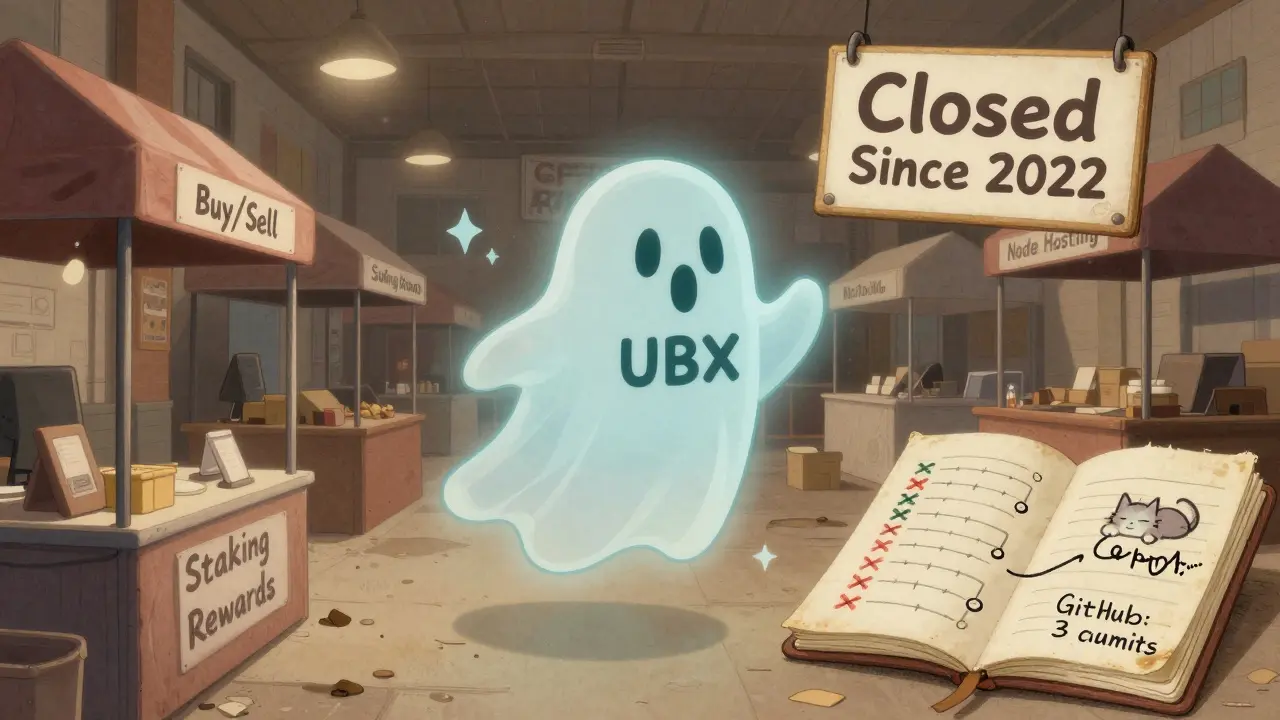
If it fails - and the data says it will - your UBX tokens become worthless digital paper. No one will buy them. No exchange will list them. No wallet will support them. You’ll be stuck with a token that has no utility, no liquidity, and no future. And there’s no recovery plan. No team is working on a rescue. No roadmap has deadlines. The last major update was in September 2022. Since then: three minor GitHub commits.
Some people will tell you “it’s early.” But this isn’t 2017. The crypto market is saturated. Thousands of tokens launched since then. Most died. The few that survived had one thing in common: they got listed on major exchanges. UBIX Network hasn’t even gotten close.
Alternatives to Consider
If you’re interested in low-fee blockchains for microtransactions, look at:
- Stellar (XLM) - Used by real payment processors, low fees, listed on Coinbase and Binance.
- Solana (SOL) - High speed, low cost, massive adoption in DeFi and NFTs.
- Polkadot (DOT) - Cross-chain infrastructure with real enterprise partnerships.
These projects have volume, liquidity, exchange listings, and working products. UBIX has a whitepaper and a dream.
Final Verdict
UBIX Network is not a crypto exchange. It’s a failed micro-cap blockchain project with no real users, no liquidity, and no future. The technical specs sound impressive on paper. But in practice, it’s invisible. No one’s trading it. No one’s building on it. No one’s even talking about it.
If you see someone promoting UBX as the next big thing, they’re either misinformed or trying to pump and dump. Don’t fall for it. The market doesn’t lie. And the numbers don’t lie. UBIX Network is dying - quietly, slowly, and without anyone noticing.
Is UBIX Exchange a real crypto exchange?
No, UBIX Exchange does not exist. The name is a common misconception. What people mean is UBIX Network - a blockchain project with its own token, UBX. It is not a platform for buying or selling cryptocurrencies like Binance or Kraken. It has no trading interface, no order books, and no customer support.
Can I buy UBX on Coinbase or Binance?
No. UBX is not listed on any major centralized exchange, including Coinbase, Binance, Kraken, or KuCoin. Gate.io explicitly states it is not listed. The only way to buy UBX is through decentralized exchanges (DEXs) with extremely low liquidity, where slippage can exceed 15% and trades may not complete at all.
Is UBX a good investment?
Based on current data, UBX is not a good investment. It has a market cap of under $4 million, daily trading volume under $5,000, zero exchange listings, and no real-world adoption. Historical data shows that 97.3% of micro-cap tokens with similar metrics fail within two years. The risk far outweighs any potential reward.
Why is UBX price so low?
UBX’s price is low because there is almost no demand. With only 1,842 active wallets and $4,872 in daily volume, there are not enough buyers to push the price up. The token’s low value reflects its lack of utility, liquidity, and market interest - not its technical design.
Can I run a controller node on UBIX Network?
Yes, technically you can run a controller node. The documentation is clear and detailed. But earning rewards requires staking UBX and maintaining a node 24/7. With almost no trading volume and minimal transaction fees, the rewards are negligible - likely less than $0.10 per month. It’s not a viable income source.
What happened to the UBIX Network roadmap?
The roadmap mentioned upgrades for 2024, including enhanced cross-chain bridges and developer incentives. But no timelines were given. The last major update to their technical documentation was in September 2022. Since then, only three minor code commits have been made on GitHub. There is no evidence of active development or team progress.
Is UBIX Network a scam?
It’s not officially labeled a scam, but it fits the profile of a failed project. There’s no fraud evidence, no exit scam, and no stolen funds. But it lacks transparency, activity, and adoption. Most experts classify it as a “zombie token” - technically alive but functionally dead. The lack of exchange listings and trading volume suggests it will fade into obscurity.
What to Do Next
If you already own UBX, consider this: selling now might be your only exit. Waiting for a price surge is betting against 20 years of crypto history. If you’re researching for the first time, walk away. There are dozens of legitimate, liquid, and growing blockchains with real use cases. Don’t waste time on a ghost.
Rishav Ranjan
December 25, 2025 AT 10:22Mmathapelo Ndlovu
December 26, 2025 AT 05:02Steve B
December 26, 2025 AT 10:57Brian Martitsch
December 27, 2025 AT 04:41Rebecca F
December 27, 2025 AT 16:50Ashley Lewis
December 28, 2025 AT 22:29vaibhav pushilkar
December 30, 2025 AT 15:40SHEFFIN ANTONY
January 1, 2026 AT 01:37Vyas Koduvayur
January 2, 2026 AT 07:11Lloyd Yang
January 2, 2026 AT 10:32Jake Mepham
January 4, 2026 AT 08:12Craig Fraser
January 5, 2026 AT 21:31Jacob Lawrenson
January 6, 2026 AT 02:50Zavier McGuire
January 6, 2026 AT 04:47Sybille Wernheim
January 7, 2026 AT 16:37Dan Dellechiaie
January 9, 2026 AT 05:01Charles Freitas
January 10, 2026 AT 10:19Sarah Glaser
January 12, 2026 AT 00:17roxanne nott
January 13, 2026 AT 23:02Sophia Wade
January 14, 2026 AT 08:20