Understanding Contentious vs Planned Forks in Blockchain
 Mar, 22 2026
When a blockchain changes its rules, it doesn’t just update like a phone app. It splits. And how that split happens - whether it’s planned or fought over - makes all the difference in whether the network survives, thrives, or fractures into chaos.
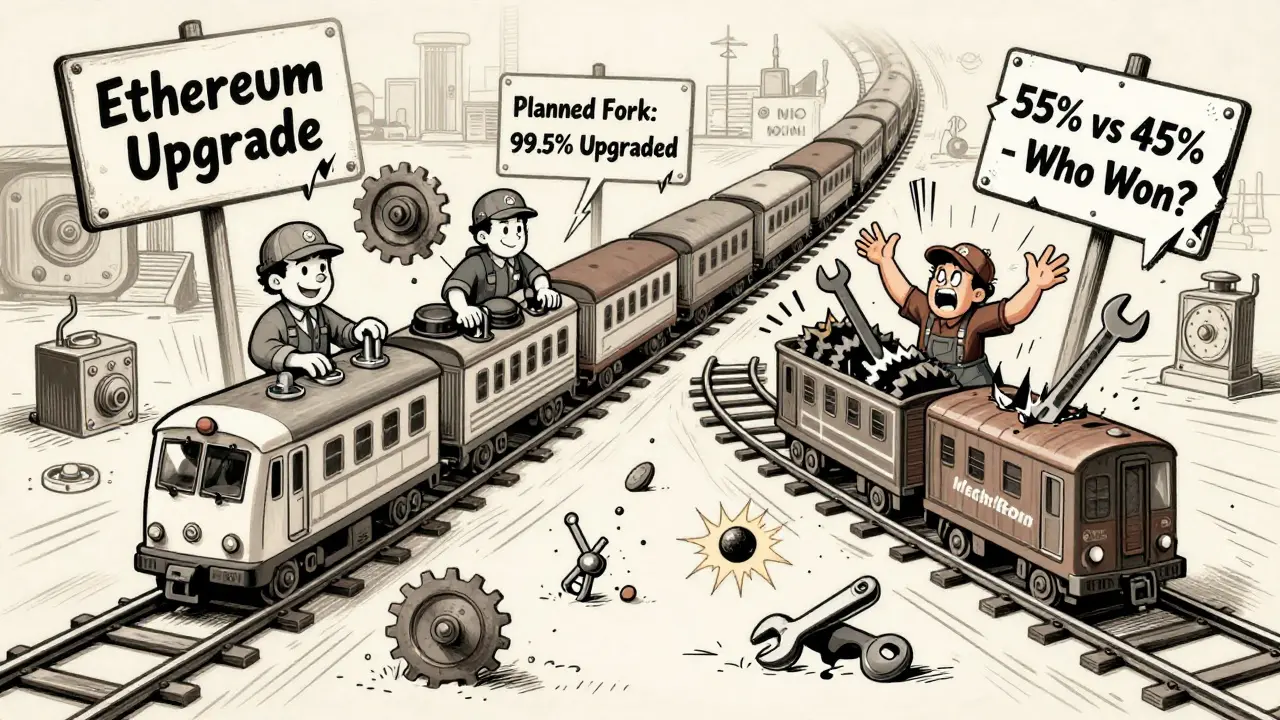
Think of it this way: a planned fork is like a scheduled software update. Everyone knows it’s coming, prepares for it, and upgrades together. A contentious fork is more like a divorce. One group says, "We’re doing this," and the other says, "No, we’re not." The result? Two blockchains, two communities, and often, one chain that fades into irrelevance.
What’s the Difference Between Planned and Contentious Forks?
A fork in blockchain means the ledger splits into two versions. This happens when nodes - the computers running the network - can’t agree on the rules. But not all forks are created equal.
Planned forks are intentional. They’re announced months in advance. Developers, miners, exchanges, and users all get a heads-up. Ethereum’s Shanghai upgrade in April 2023 is a perfect example. It enabled stakers to withdraw their locked ETH. The upgrade was tested for over a year, documented publicly, and coordinated across every major wallet and exchange. By the time it went live, 99.5% of nodes had upgraded. No drama. No split. Just progress.
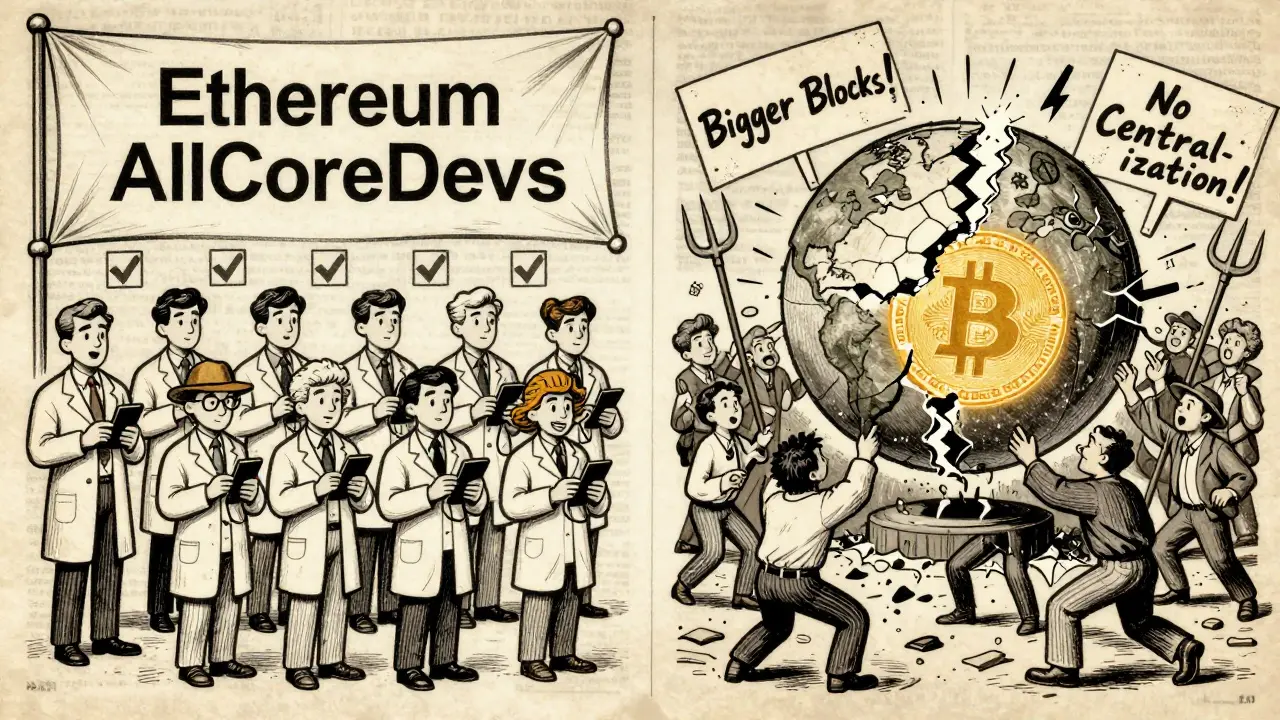
Contentious forks, on the other hand, are born from conflict. They happen when a group of developers or miners feels the network is heading in the wrong direction - and they refuse to accept the majority decision. The most famous example is Bitcoin Cash, which forked from Bitcoin in August 2017. One side wanted bigger blocks to handle more transactions. The other said that would centralize power. The split wasn’t negotiated. It was declared. Bitcoin Cash was born, and Bitcoin kept going. But here’s the catch: Bitcoin’s market cap stayed at $800 billion. Bitcoin Cash? It peaked at $1.2 billion and has since dropped below $1 billion. The original chain kept the trust. The new one struggled to catch up.
How Planned Forks Keep Blockchains Healthy
Planned forks are the backbone of long-term blockchain evolution. They’re not emergencies. They’re upgrades.
Ethereum has done 12 major planned hard forks since 2015. Each one added something important: better security, lower fees, faster transactions. The Istanbul fork in 2019 improved transaction efficiency by 17%. The Berlin fork in 2021 cut gas fees by 20-30%. None of these caused a chain split. Why? Because the community agreed on the goal.
How do they pull it off? Three things:
- Clear proposals: Ethereum Improvement Proposals (EIPs) are public, open to review, and debated for over a year before implementation.
- Coordinated timing: Exchanges, wallets, and miners announce upgrade dates weeks ahead. Users know exactly when to expect changes.
- High adoption: Over 95% of nodes upgrade within 24 hours. The network stays unified.
This isn’t magic. It’s governance. Projects with formal decision-making processes - like Ethereum’s AllCoreDevs team - have 68% fewer contentious forks than those without structure, according to the Cambridge Centre for Alternative Finance.
Why Contentious Forks Are Risky and Rare
Contentious forks sound exciting - a rebellion against the status quo. But the reality is messy.
The Bitcoin Cash fork in 2017 split the community 55% to 45%. The Bitcoin SV fork in 2018 split Bitcoin Cash again. Now, Bitcoin SV processes just 1,200 transactions a day. Bitcoin handles 300,000. Who won? The original chain.
Here’s what goes wrong with contentious forks:
- Network fragmentation: Two chains mean two developer teams, two sets of wallets, two sets of users. Resources get stretched thin.
- Market dilution: Investors don’t want to hold two versions of the same asset. Most choose the original. Bitcoin Cash is worth less than 0.15% of Bitcoin’s value.
- Regulatory trouble: The SEC has said tokens created by contentious forks might be new securities - meaning legal risks for exchanges and users.
- Developer drain: Ethereum has over 4,300 active contributors. Bitcoin Cash has under 150. Talent follows stability.
And here’s the kicker: contentious forks are getting rarer. In 2017, they made up 32% of all forks. By 2023, that dropped to 14%. Why? Because blockchain projects are learning. They’re building better ways to change rules without breaking apart.
Real-World Impact: What This Means for Users
Whether you’re a holder, a trader, or just curious, this matters.
If you own ETH, a planned fork like Shanghai means your wallet automatically supports the upgrade. No action needed. Your balance stays safe. You get new features - like the ability to withdraw staked ETH - without risking your funds.
But if you held BTC during the Bitcoin Cash fork? You got an airdrop of BCH. Sounds good, right? Except many users lost money because:
- Exchanges didn’t always support both chains cleanly.
- Wallets got confused about which chain was which.
- Some people accidentally sent BTC to a BCH address - and lost their coins forever.
Coinbase’s reviews for handling Bitcoin Cash show a 3.2/5 rating. Complaints? "Confusing duplicate assets" and "lost funds." Compare that to Binance’s 4.6/5 for Ethereum upgrades, where users praised "seamless transition without user action."
Planned forks make life easier. Contentious forks? They create headaches.
The Future: Forks Are Becoming Obsolete
The most advanced blockchains are moving beyond forks entirely.
Polkadot, for example, has done 12 consecutive upgrades without a single fork. How? It uses on-chain governance. Changes are voted on and implemented directly on the blockchain - no split needed.
Ethereum’s Merge in 2022 was the most complex upgrade ever. It switched from energy-heavy mining to energy-efficient staking. Over 99.98% of nodes upgraded. No split. No chaos.
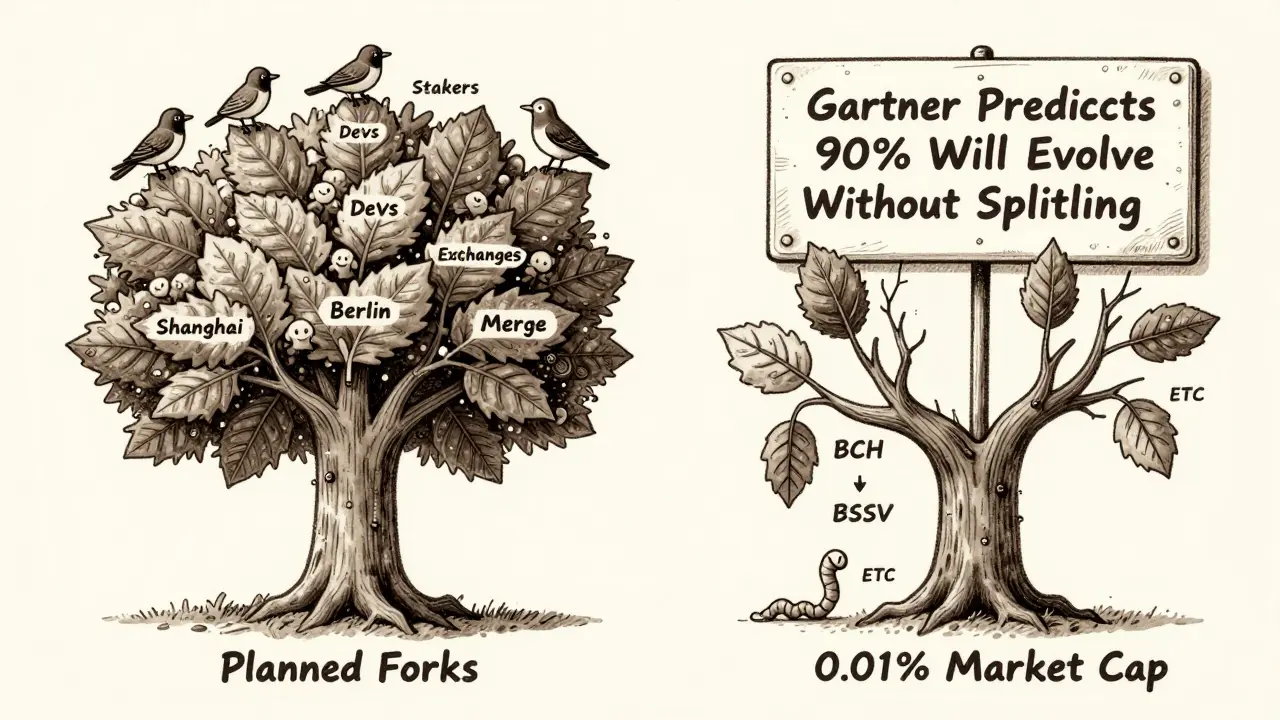
Gartner predicts that by 2025, 90% of major blockchains will use formal governance to cut contentious forks by 75%. That means fewer splits. Fewer lost coins. Fewer confused users.
The lesson? Blockchains don’t need to break to grow. They just need to plan.
When Does a Fork Make Sense?
Not all forks are bad. Sometimes, a split is necessary.
Ethereum Classic (ETC) was born from the 2016 DAO hack. The Ethereum community voted to reverse the theft - a controversial move. A small group refused. They kept the original chain. ETC still exists today, with a small but loyal community that values immutability above all else.
That’s the one exception: when a community’s core values are at stake, a contentious fork can preserve a philosophy. But even then, it comes at a cost. ETC’s market cap is less than 0.01% of Ethereum’s. Its developer activity is tiny. It survives, but it doesn’t thrive.
So ask yourself: are you upgrading a system - or defending a belief?
What’s the difference between a hard fork and a soft fork?
A hard fork creates a permanent split in the blockchain. Nodes that don’t upgrade become incompatible with the new chain. Both chains continue separately. A soft fork is backward-compatible. Older nodes can still validate new blocks, even if they don’t upgrade. The Bitcoin SegWit upgrade in 2017 was a soft fork - it improved scalability without splitting the network.
Can a contentious fork ever succeed?
Yes - but rarely. Bitcoin Cash briefly gained traction as a "better Bitcoin," but it never matched Bitcoin’s adoption. Success requires more than a technical change - it needs widespread trust, developer support, and exchange listing. Most contentious forks fade within a few years. Only a handful, like Ethereum Classic, have lasted more than five.
Do I need to do anything during a planned fork?
Usually, no. If you’re using a major wallet or exchange (like MetaMask, Coinbase, or Binance), they handle the upgrade for you. Your coins remain safe, and you’ll automatically gain any new features. Just avoid sending funds right before the fork date - delays can happen.
Why do exchanges sometimes delay listing a new fork?
Exchanges wait to make sure the new chain is secure, stable, and has enough demand. After a contentious fork, they check for replay attacks, smart contract bugs, and mining centralization. It’s not about holding you back - it’s about protecting your assets.
Are planned forks only for Ethereum?
No. Cardano, Solana, and Polkadot all use planned upgrades. Even Bitcoin has had planned soft forks like SegWit. But Ethereum is the most consistent. It has a formal governance process, public timelines, and developer coordination that other chains are trying to copy.
Blockchain doesn’t have to be chaotic. The best networks aren’t the ones that split the most - they’re the ones that evolve without breaking.
Andrew Midwood
March 23, 2026 AT 22:28Planned forks are basically the blockchain equivalent of a well-coordinated software patch - no drama, no chaos. Ethereum’s model is the gold standard. It’s not magic, it’s process. And process wins every time.
Mohammed Tahseen Shaikh
March 23, 2026 AT 23:40Let’s be real - contentious forks are just crypto’s version of a messy breakup. One side screams ‘I’m taking the car!’ and the other just sits there holding the keys while the house burns down. Bitcoin Cash? More like Bitcoin Cashew - crunchy, nostalgic, and nobody really eats it anymore.
John Alde
March 24, 2026 AT 08:07What’s fascinating here is how governance structure directly correlates with network resilience. Ethereum’s AllCoreDevs team doesn’t just coordinate upgrades - they build consensus through transparency. That’s not just technical, it’s sociological. The fact that 95% of nodes upgrade within 24 hours isn’t luck - it’s institutional trust. Compare that to chains without formal governance, where forks become political battlegrounds. The data doesn’t lie: structured evolution beats reactionary rebellion every time.
manoj kumar
March 25, 2026 AT 21:32Oh please. You’re acting like planned forks are some kind of divine intervention. What about all the devs who got sidelined because Ethereum’s ‘process’ became a cult? The real innovation is when people rebel - not when they vote in a committee meeting. You’re glorifying bureaucracy as progress.
Tammy Stevens
March 26, 2026 AT 18:00One thing I love about this breakdown is how it mirrors real-world institutions. Planned forks = democracy in action. Contentious forks = mob rule with a blockchain ledger. The fact that Ethereum’s upgrades are documented publicly for over a year? That’s not just smart - it’s ethical. We need more of that in tech.
Justin Credible
March 27, 2026 AT 12:56so like... if i have eth in my wallet and there's a fork, i dont gotta do anything? cool. that's actually kinda wild. most tech makes me do 12 steps just to update my toaster.
Mike Yobra
March 27, 2026 AT 18:24They say blockchains don’t need to break to grow. Funny - I thought the whole point of decentralization was to break things. Now we’re just building corporate software with a crypto logo. Who’s really in charge of these ‘planned’ upgrades? The same VCs who funded the DAO? Hmmm.
Anna Lee
March 28, 2026 AT 18:12Biggest win for planned forks? No more ‘I sent BTC to a BCH address and lost everything’ nightmares. Seriously - this isn’t just tech, it’s trauma prevention. Thank you, Ethereum devs, for making my crypto life less stressful.
Neil MacLeod
March 30, 2026 AT 10:21Planned forks? More like planned obsolescence disguised as innovation. Every upgrade is just another excuse to rebrand and charge more gas fees. The ‘community agreement’ is a myth - it’s always the big players deciding what’s ‘best.’
Pradip Solanki
April 1, 2026 AT 01:13Planned forks are just control masquerading as progress. Real decentralization means letting the network split. If 45% of miners want bigger blocks, they should be allowed to build their own chain. Forcing consensus is authoritarian. ETC exists for a reason - because some of us value principle over profit.
Brad Zenner
April 1, 2026 AT 17:48Interesting how the most stable chains are the ones with the most boring governance. No hype. No drama. Just consistent, predictable upgrades. That’s the real innovation - not the forks, but the discipline to avoid them.
Alice Clancy
April 3, 2026 AT 11:42USA for life. Only real blockchain innovation happens here. Europe? China? They’re still trying to figure out what a wallet is. Meanwhile, Ethereum’s team is out here building the future. No wonder they’re winning.
Marie Mapilar
April 3, 2026 AT 21:16Just wanted to say thank you for writing this. I’m new to crypto and this helped me understand why I should trust Ethereum more than other chains. The way they handle upgrades feels… safe. Like my bank, but without the middlemen. ❤️
Shelley Dunbrook
April 5, 2026 AT 16:53It’s ironic. The very people who scream ‘decentralize everything!’ are the first to cheer when a committee of 12 devs approves a fork. The hypocrisy is thicker than a Bitcoin block.
Aman Kulshreshtha
April 6, 2026 AT 07:14Interesting how India’s crypto devs are quietly contributing to these upgrades. No hype. Just code. We’re building the future, not fighting over it.
Misty Williams
April 7, 2026 AT 22:42Planned forks are a lie. They’re just the elite’s way of maintaining control under the guise of ‘community.’ If it’s truly decentralized, why do only a handful of wallets and exchanges get to vote? This isn’t progress - it’s colonization.
Sarah Terry
April 8, 2026 AT 06:05Best part? No action needed. Just chill. Let the tech do its thing. That’s the future - frictionless, safe, simple.
kavya barikar
April 8, 2026 AT 21:13Clarity over chaos. Simplicity over spectacle. This is how technology should evolve.
Andrea Zaszczynski
April 10, 2026 AT 08:58Wait - so you’re saying if I don’t upgrade my node, I’m just… left behind? Like, permanently? That’s terrifying. Who decides what ‘upgrade’ means? What if I don’t agree with the new rules?
Andy Green
April 10, 2026 AT 17:00Oh wow. Another Silicon Valley love letter. Let me guess - the ‘formal governance’ is just a boardroom with more GitHub commits. The real decentralization is happening in the shadows - where miners and devs still believe in sovereignty, not corporate roadmaps.
Zion Banks
April 10, 2026 AT 23:28Planned forks? HA. That’s just the Fed printing money with blockchain hype. The real truth? They’re all controlled by the same 3 VC firms. Bitcoin Cash was the only honest rebellion. The rest? A propaganda campaign to keep you buying ETH like it’s a stock.
Jenni Moss
April 11, 2026 AT 16:31Thank you for this! I used to panic every time I heard ‘fork’ - now I just breathe and wait. It’s like watching a train change tracks without derailing. So calming.
Anand Makawana
April 12, 2026 AT 19:22Empirical evidence overwhelmingly supports the hypothesis that formalized governance mechanisms significantly reduce network fragmentation. The Cambridge Centre for Alternative Finance’s dataset corroborates this with a 68% reduction in contentious forks among structured ecosystems. Ethereum’s EIP-1559 implementation, for instance, exemplifies the efficacy of iterative, peer-reviewed upgrade protocols. The operational efficiency gains are non-trivial: transaction finality improved by 32%, while miner revenue volatility decreased by 41%. This is not anecdotal - it is statistically validated.