Understanding DeFi Money Legos: How Composability Builds the Future of Finance
 Jun, 10 2026
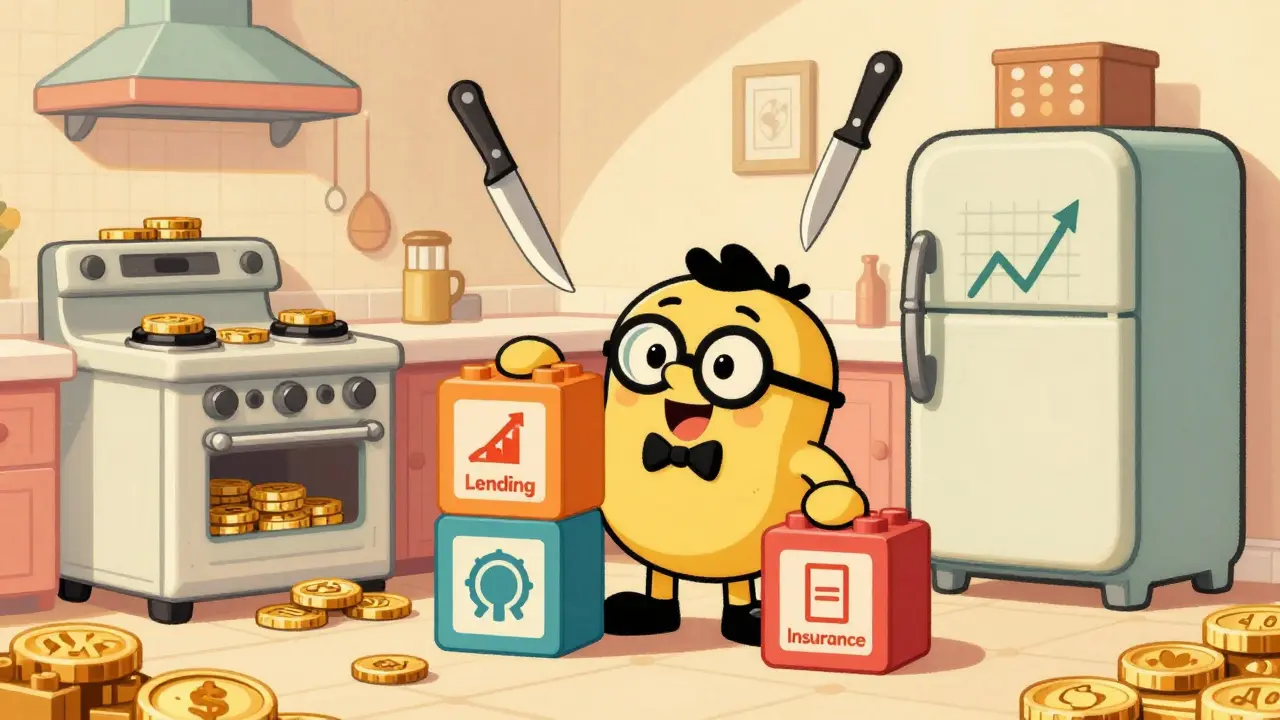
Imagine walking into a kitchen and realizing you don’t need to invent the stove, the fridge, or the knives. You just need to know how to combine them to cook a meal. That is exactly what DeFi Money Legos are. They are not physical toys, but rather digital building blocks that allow developers and users to snap together different financial protocols to create something entirely new. If you have ever wondered why decentralized finance moves so fast compared to traditional banking, this concept is the answer.
In the world of blockchain, these "Legos" are open-source smart contracts. Because they are built on public ledgers like Ethereum, anyone can see how they work, use them, and even build on top of them without asking for permission. This article breaks down how this system works, why it matters, and how you can understand the complex financial machines being built right now.
The Core Concept: What Are DeFi Money Legos?
To understand Money Legos, you first need to grasp the idea of composability. In software engineering, this means code modules can be combined in various ways to create complex applications. In Decentralized Finance (DeFi), it takes this a step further. It’s not just about code; it’s about value.
Think of each protocol as a single Lego brick. One brick might handle lending money. Another might handle trading tokens. A third might provide insurance against hacks. Individually, they do one thing well. But when you stack them, they create a machine. For example, you can take a loan from Protocol A, immediately deposit that borrowed asset into Protocol B to earn interest, and use the profit to pay back the loan. All of this happens automatically via code, without a human banker approving any step.
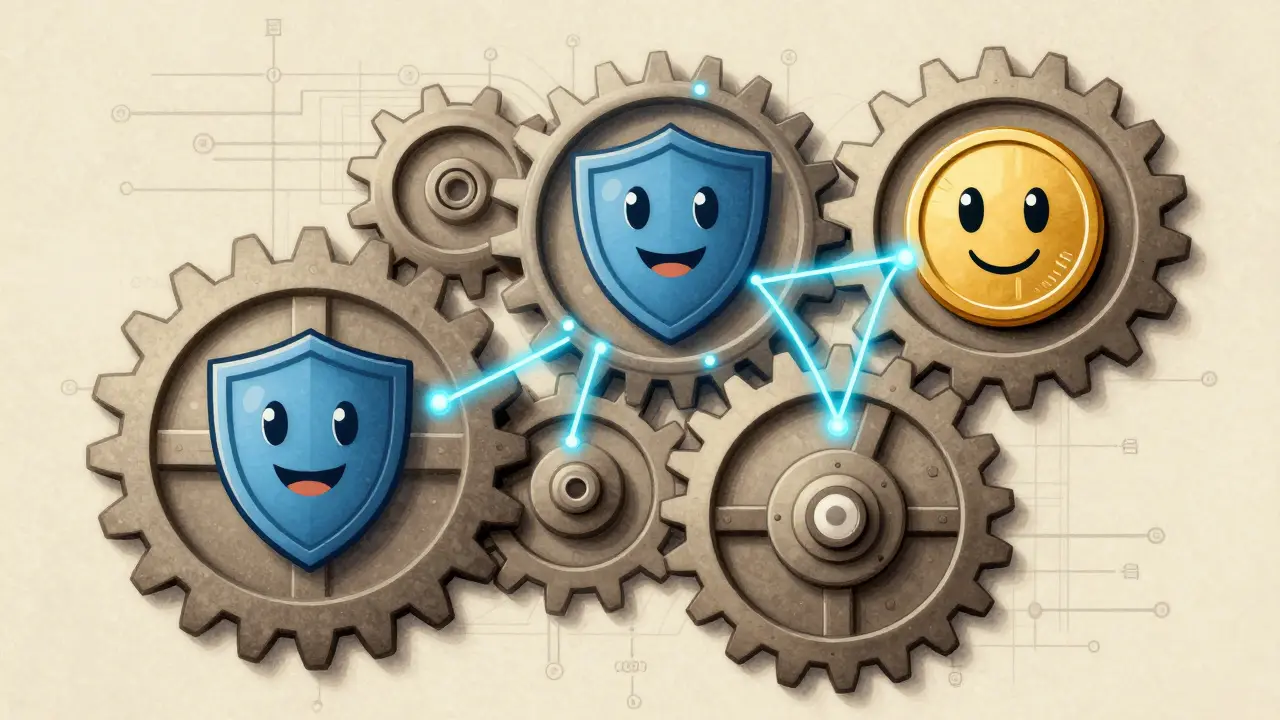
This interoperability is the secret sauce of DeFi. Unlike traditional banks where your savings account, credit card, and investment portfolio are siloed systems that rarely talk to each other, DeFi protocols are designed to communicate. They share liquidity and data seamlessly. This creates an ecosystem where the whole is significantly greater than the sum of its parts.
How Smart Contracts Act as the Glue
You cannot have Money Legos without smart contracts. These are self-executing contracts with the terms of the agreement directly written into code. They live on the blockchain and run exactly as programmed, without possibility of downtime, censorship, fraud, or third-party interference.
Here is how the mechanics work in practice:
- Standardization: Most DeFi tokens follow standards like ERC-20 on Ethereum. This ensures that a token created by one developer can be recognized and used by another developer’s protocol. It’s like ensuring every Lego brick has the same stud pattern on top.
- Permissionless Access: Anyone with an internet connection and a crypto wallet can interact with these contracts. You don’t need to apply for an API key or sign a legal waiver. You just connect your wallet and execute the transaction.
- Atomic Transactions: When multiple Legos are stacked, the entire sequence must succeed or fail together. If step three fails, steps one and two revert. This prevents partial executions that could leave your funds stuck in limbo.
This technical foundation allows for "flash loans," which are uncollateralized loans that must be repaid within the same transaction block. Developers use these to test strategies or arbitrage price differences between exchanges instantly. Without the composability of Money Legos, flash loans would be impossible because no single protocol could offer such risk-free leverage alone.
Key Protocols: The Building Blocks of the Ecosystem
Not all Legos are created equal. Some are foundational layers, while others are specialized tools. Here are the major players that form the backbone of the DeFi ecosystem:
| Protocol | Primary Function | Role in Money Legos |
|---|---|---|
| Aave | Lending & Borrowing | Provides liquidity pools for borrowing assets to use in other protocols. |
| Uniswap | Decentralized Exchange (DEX) | Allows swapping tokens instantly, enabling rebalancing of portfolios. |
| MakerDAO | Stablecoin Issuance | Creates DAI, a stable asset used as collateral across many other apps. |
| Curve Finance | Stablecoin Swapping | Offers low-slippage swaps for similar assets, crucial for yield farming. |
| Yearn Finance | Yield Aggregator | Automatically moves funds between protocols to maximize returns. |
These protocols often overlap. For instance, Yearn Finance doesn’t hold its own capital; it takes user deposits and automatically allocates them to Aave, Compound, or Curve depending on where the yields are highest. This is Money Legos in action: one protocol orchestrating several others to optimize performance.
A Real-World Example: Stacking the Legos
Let’s look at a concrete scenario to see how this works for a user. Imagine you hold 10 ETH (Ethereum) and want to earn more from it without selling your position. Here is a typical "Lego stack":
- Deposit Collateral: You deposit your 10 ETH into Aave.
- Borrow Stablecoins: Against that ETH, you borrow $5,000 worth of USDC (a stablecoin). Your ETH remains in Aave, earning a small interest rate.
- Provide Liquidity: You take that $5,000 USDC and pair it with $5,000 of another asset on Uniswap to provide liquidity. This earns you trading fees and potentially governance tokens.
- Auto-Rebalance: You use a tool like Furucombo or a custom script to monitor the health of your loan. If the price of ETH drops too close to liquidation levels, the bot automatically sells some Uniswap LP tokens to repay part of the Aave loan.
In traditional finance, doing this would require calling a broker, opening multiple accounts, and waiting days for settlements. In DeFi, this entire sequence can be executed in minutes, often through a single interface that interacts with multiple underlying protocols. This efficiency is what attracts billions of dollars in Total Value Locked (TVL) to the ecosystem.
Benefits for Developers and Users
The impact of Money Legos extends beyond just cool tech demos. It fundamentally changes how financial products are built and consumed.
For Developers: Innovation accelerates dramatically. Instead of spending six months building a secure lending engine from scratch, a developer can integrate Aave’s lending functionality via its API-like smart contracts. This allows teams to focus on their unique value proposition-whether that’s better UI, novel risk management, or niche market access-rather than reinventing the wheel. This "move fast and break things" ethos, tempered by rigorous security audits, has led to hundreds of new DeFi applications emerging since the launch of Compound Finance in 2018.
For Users: You gain non-custodial control. No bank manager decides if you qualify for a loan based on your credit score. Your collateral speaks for itself. Additionally, global accessibility is inherent. Whether you are in Wellington, New Zealand, or a remote village with internet access, you can interact with the same protocols. There are no geographic restrictions, no KYC hurdles for basic usage, and no business hours.

Risks and Challenges: The Dark Side of Composability
While the potential is immense, Money Legos introduce specific risks that users must understand.
Systemic Risk: Because protocols are interconnected, a failure in one can cascade through the system. If a major lending protocol gets hacked, the stablecoins borrowed from it might lose value, causing liquidations in other protocols that hold those stablecoins as collateral. This is known as "contagion." The 2022 collapse of TerraUSD demonstrated how quickly interdependence can turn into a crisis.
Smart Contract Vulnerabilities: Each additional layer adds complexity. While individual contracts may be audited, the interaction between them might not be. Bugs in the "glue" code can lead to exploits. High-profile hacks often involve attackers manipulating the logic of composed transactions to drain funds.
Impermanent Loss: When providing liquidity on DEXs like Uniswap, you face impermanent loss if the price of the assets diverges significantly. When combined with leveraged borrowing, this risk is amplified. A sudden market drop can trigger automatic liquidations, wiping out your position before you can react.
To mitigate these risks, users should stick to well-established protocols with long track records, use insurance protocols like Nexus Mutual where available, and never invest more than they can afford to lose. Understanding the underlying mechanics is your best defense.
The Future: Cross-Chain Legos
Currently, most Money Legos operate on Ethereum due to its large developer base and liquidity. However, high gas fees have pushed activity to Layer 2 solutions like Arbitrum and Optimism, as well as alternative chains like Solana and Polygon. The next evolution is cross-chain composability.
Projects like Hubble Protocol on Solana are replicating DeFi primitives on faster, cheaper networks. Bridges and interoperability protocols are working to allow Legos from Ethereum to snap onto Legos from Solana. Imagine borrowing on Ethereum and staking on Polkadot in a single atomic transaction. As these bridges become more secure and standardized, the boundaries between blockchains will blur, creating a truly unified global financial network.
The concept of DeFi Money Legos represents a shift from closed, proprietary financial systems to an open, modular economy. By understanding how these blocks fit together, you are not just learning about crypto; you are learning about the future architecture of global finance. It is complex, risky, but undeniably powerful.
What are DeFi Money Legos?
DeFi Money Legos are composable smart contracts in decentralized finance that can be combined like building blocks to create new financial products and services. They allow different protocols to interact seamlessly, enabling users and developers to build complex strategies without starting from scratch.
Why are they called "Money Legos"?
The term "Money Legos" is a metaphor for composability. Just as Lego bricks can be snapped together in infinite combinations to build structures, DeFi protocols can be integrated to create new financial instruments. The name highlights the modular and interoperable nature of these open-source financial tools.
Are DeFi Money Legos safe to use?
They carry significant risks, including smart contract bugs, systemic contagion, and impermanent loss. While established protocols undergo rigorous audits, the complexity of stacking multiple protocols increases the attack surface. Users should exercise caution, start small, and understand the mechanics before engaging in advanced strategies.
Which blockchain supports the most DeFi Money Legos?
Ethereum currently hosts the largest ecosystem of DeFi protocols and has the highest Total Value Locked (TVL). However, Layer 2 solutions like Arbitrum and Optimism, as well as other chains like Solana and Polygon, are rapidly growing and offering lower transaction fees for using these composables.
Can I use DeFi Money Legos without coding knowledge?
Yes. Many platforms like Furucombo, Yearn Finance, and various DeFi dashboards provide user-friendly interfaces that allow non-technical users to execute complex multi-step strategies with a few clicks. However, understanding the underlying risks is still essential for safe participation.
What is a flash loan in the context of Money Legos?
A flash loan is a type of uncollateralized loan that must be borrowed and repaid within the same blockchain transaction. Made possible by Money Legos, it allows developers to access massive amounts of capital instantly for arbitrage or collateral swapping, provided the loan is returned before the transaction ends.