Understanding Order Book Depth and Liquidity in Crypto Trading
 Feb, 7 2026
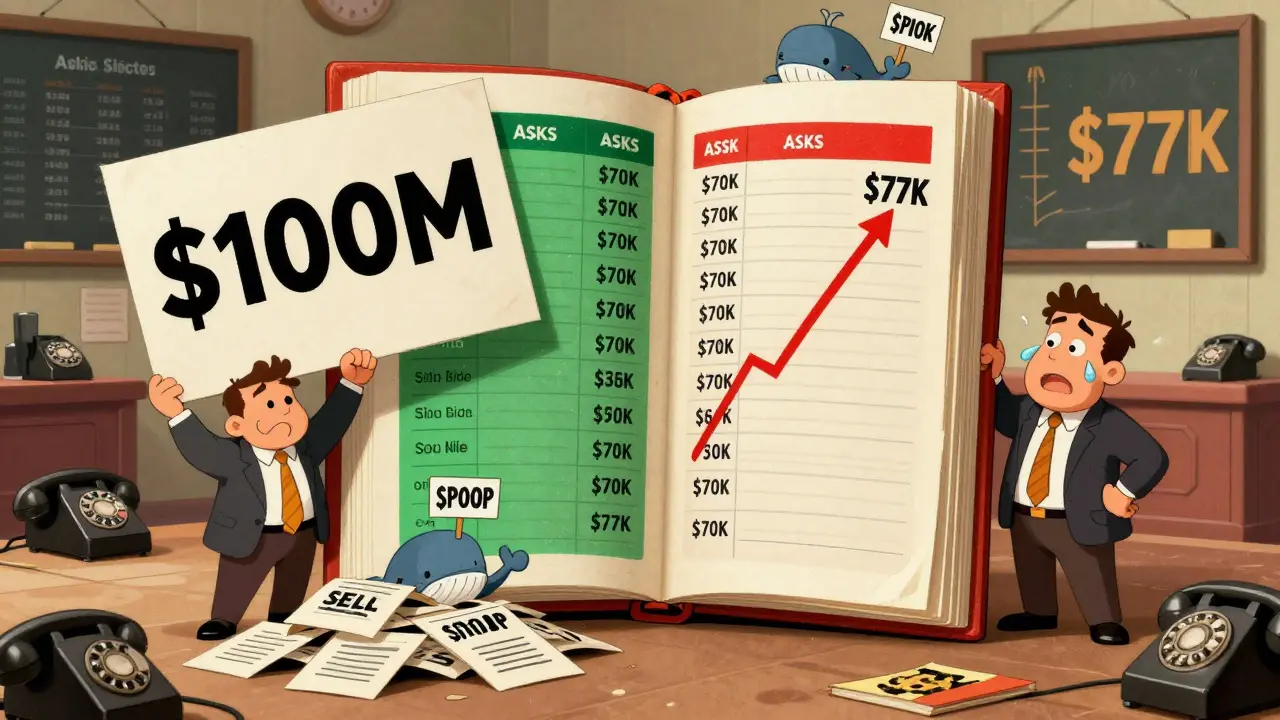
When you place a market order to buy Bitcoin, you might expect it to fill at the current price. But what if the price suddenly jumps 5% before your order executes? That’s not a glitch - it’s a lack of liquidity. The reason this happens lies in something most beginners ignore: order book depth. It’s not just another chart overlay. It’s the hidden architecture of every trade, showing you exactly how much buying and selling power exists right at the price you care about.
What Is Order Book Depth, Really?
Think of the order book as a live spreadsheet. On one side, you see all the buy orders (bids), stacked from highest price down. On the other, sell orders (asks), stacked from lowest price up. Order book depth is the total volume of those orders within a certain distance from the current market price - usually 0.5%, 1%, or sometimes even 0.1%.
For example, if Bitcoin is trading at $70,000, the bid depth at 1% means: how much USD is tied up in buy orders between $69,300 and $70,000. The ask depth at 1% means: how much USD is tied up in sell orders between $70,000 and $70,700.
A deep order book has thick layers of orders - thousands or even millions of dollars worth - close to the current price. A shallow one? Barely any. That’s why a $100,000 buy order on a deep market barely moves the price, but on a shallow one, it spikes 10%.
Why Depth Matters More Than Price Alone
Price tells you where the last trade happened. Depth tells you what happens next.
Imagine two altcoins:
- Coin A: $5 million in buy orders within 1% of price. A $1 million market buy? Price moves 0.8%.
- Coin B: Only $300,000 in buy orders within 1%. Same $1 million buy? Price jumps 15%.
That’s not luck. That’s liquidity. Coin B’s shallow depth means even small trades cause wild swings. That’s why you see altcoins pump 20% on low volume - there’s nothing to hold the price down.
Professional traders don’t just watch price. They watch depth. If the bid depth suddenly drops from $4 million to $800,000, that’s a red flag. It means big buyers are pulling out. Price might follow.
Understanding Bid-Ask Imbalance
Depth isn’t just about total volume. It’s about imbalance.
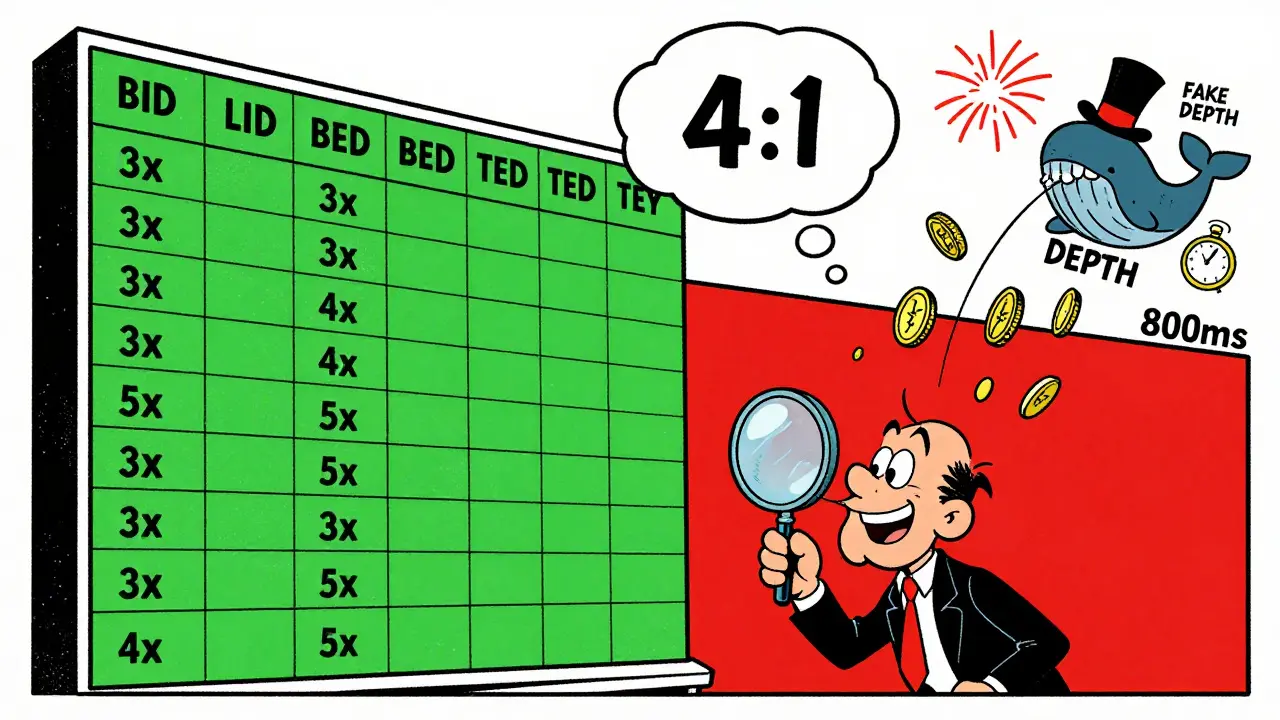
The bid-ask imbalance compares buy volume to sell volume in a narrow range - say, within 0.5% of the current price. If there’s 3x more buying than selling, that’s a strong signal. It suggests buyers are eager, and price is likely to rise. If sellers dominate? Watch for a drop.
Platforms like TradingView and CoinGlass show this as a color gradient: green for buy pressure, red for sell pressure. But don’t just look at the color. Look at the numbers. A 70:30 ratio within 0.5% is far more meaningful than a 55:45 ratio. The bigger the gap, the stronger the momentum.
One trader on Reddit reduced slippage by 28% just by setting alerts for when the imbalance hit 3:1 within 0.5%. That’s not magic - it’s using depth to time entries before big moves.
The Dark Side: Spoofing and Fake Depth
Here’s the ugly truth: not all depth is real.
Large players - often called whales - can place massive buy or sell orders just to scare others. Then they cancel them before they’re filled. This is called spoofing. You see a wall of 500 BTC in bids, feel safe, and buy… only to watch the orders vanish and price crash.
Bookmap’s 2024 analysis found that spoofed orders typically disappear within 800 milliseconds. Genuine liquidity? It stays. The trick is learning to spot the difference.
Real depth: orders stay stable for seconds, even during small price swings. Fake depth: orders appear suddenly, vanish when you move, and reappear in a different spot. Watch the order book like a live video - not a static image.
One trader on Bitcointalk got burned twice this way. First, he saw a deep bid wall and bought in. The orders vanished. Price dropped 12%. Second, he saw a massive ask wall and shorted. It vanished. Price spiked. He lost both trades.
How to Use Depth in Real Trading
You don’t need fancy tools to start. Here’s how to use depth right now:
- Open your exchange’s depth chart (Binance, Coinbase, Bybit all have it).
- Focus on BTC/USDT or ETH/USDT first. These have the deepest books.
- Look at the 1% depth. If buy depth is over $100 million, the market is stable. Under $20 million? Be cautious.
- Watch for sudden drops in depth. If the bid depth falls 50% in 30 seconds, don’t rush in. Wait.
- Combine depth with volume. If price rises on low volume but depth is growing, that’s a strong signal. If price rises on high volume but depth is shrinking? That’s a trap.
Beginners should start with alerts. Set a notification when the bid-ask imbalance crosses 4:1 within 0.5%. That’s a high-probability setup. Don’t trade on every signal - just the extreme ones.
What Depth Can’t Tell You
Depth is powerful, but it’s not a crystal ball.
It won’t tell you about:
- Dark pool liquidity: Big institutions trade off-exchange. You can’t see those orders.
- Whale movements: If a whale moves $50 million from one exchange to another, your depth chart won’t show it until the order hits.
- News events: A regulatory announcement can wipe out depth in seconds. Depth reacts - it doesn’t predict.
That’s why pros combine depth with on-chain data. If Bitcoin’s order book depth is rising while wallet balances on exchanges are falling, that’s a bullish sign - people are moving coins off exchanges, signaling long-term holding.
The Bigger Picture: Why Depth Is Becoming Standard
In 2020, the average Bitcoin order book depth within 1% was $18.7 million. By late 2024, it hit $214.3 million. That’s a 1,046% increase. Why? Because the market matured.
Institutional players - hedge funds, family offices, crypto-native firms - don’t trade on price alone. They need depth. They need to know they can move $50 million without crashing the market.
That’s why Binance, Coinbase, and others now show depth in real time. The SEC even required exchanges to standardize depth reporting in 2024 to prevent spoofing. Depth isn’t a luxury anymore - it’s a baseline.
Even retail traders are catching on. A 2024 Whaleportal survey found that 68% of those who used depth analysis regularly reported better trade execution. But 41% gave up early because they couldn’t tell real depth from fake.
Tools You Can Actually Use
You don’t need to pay $99/month to start.
- Free: CoinGlass, TradingView (basic), Binance depth chart - all give you the core numbers.
- Mid-tier: TradingView Premium ($14.95/month) adds alerts, heatmaps, and better visualization.
- Pro: Bookmap Pro ($99/month) shows live order flow with millisecond updates - great for scalpers.
Start free. Learn the patterns. Then upgrade only if you’re trading more than $10,000 per trade.
One pro trader summed it up: "I only act when depth, volume, and price all line up. If two of the three are off? I wait. It’s not about being right every time. It’s about avoiding the traps."
Final Takeaway
Order book depth isn’t about predicting the future. It’s about seeing the present clearly.
It tells you if the market can handle your trade. If big players are still in. If the price you see is supported - or just a mirage.
Most traders lose money because they trade price alone. They don’t look under the hood. Depth is the hood. Learn to read it. Start with BTC/USDT. Watch the 1% depth. Notice how it changes before big moves. Set one alert. Wait a week. You’ll start seeing patterns you never noticed before.
It’s not flashy. It’s not a secret formula. But it’s the difference between guessing and knowing.
What does order book depth tell me about market liquidity?
Order book depth shows how much buying and selling pressure exists near the current price. High depth means there are large volumes of orders close to the market price - this means the market can absorb big trades without big price swings. Low depth means even small orders can cause sharp price moves, which is a sign of low liquidity and higher risk.
Is deeper order book depth always better?
Generally, yes - for major assets like Bitcoin or Ethereum. Deep depth means stable prices and lower slippage. But on small altcoins, deep depth can be misleading. It might be fake - placed by whales to lure traders in before pulling out. Always check if the depth is stable over time, not just how big it looks.
How do I tell if depth is real or spoofed?
Real depth stays in place for several seconds, even as price moves slightly. Spoofed orders appear suddenly, vanish when you move your cursor or place a trade, and often reappear in a different location. Watch the order book like a video - not a still image. If orders disappear within 500-800 milliseconds, they’re likely fake.
Why does my depth chart look different on Binance vs. Coinbase?
Each exchange has its own order book. Liquidity isn’t shared between them. A coin might have deep depth on Binance but shallow depth on Coinbase because most traders are on one platform. Always check depth on the exchange you’re trading on. Aggregated depth across exchanges can be misleading - studies show up to 22% discrepancies during volatility.
Can I use order book depth for long-term investing?
Not really. Depth is a short-term, microstructure tool. It’s designed for traders who execute orders within minutes or hours. Long-term investors should focus on fundamentals like adoption, network growth, and on-chain activity. Depth won’t help you decide whether to hold Bitcoin for 5 years - but it will help you avoid buying at a fake top or selling at a fake bottom.
What’s the best depth interval to watch for beginners?
Start with 1% depth on major pairs like BTC/USDT. That’s wide enough to filter out noise but narrow enough to show real liquidity. Once you’re comfortable, try 0.5% for tighter signals. Avoid 0.1% unless you’re trading large amounts - it’s too sensitive and full of false signals.
Jim Laurie
February 8, 2026 AT 11:16Bro this post hit different. I used to think price was everything until I started staring at the depth chart like it was a damn horoscope. One time I saw $80M in bids on BTC/USDT and jumped in-only to watch it vanish in 3 seconds. Spoofed. Hard. Now I wait for stability. If the bids don’t flinch when price dips 0.3%, I’m in. No more FOMO. Just patience. And coffee. Lots of coffee.
Udit Pandey
February 8, 2026 AT 16:48It is truly unfortunate that so many retail traders in the Western world are blinded by short-term technical indicators and fail to recognize the foundational importance of order book depth. In India, we have been taught since childhood that true wealth is built on understanding structure, not chasing momentum. This article, though written in English, carries the wisdom of ancient economic principles. One must not be swayed by the noise of the market, but rather, one must observe the silent architecture beneath.
Sharon Lois
February 9, 2026 AT 22:09Depth? LOL. You think the exchanges aren’t manipulating this? SEC ‘standardized reporting’? Yeah right. They just made it look prettier while the whales still front-run every tick. I’ve seen bid walls appear right before a dump-right after a ‘verified’ influencer tweets ‘BUY.’ CoinGlass? More like CoinLies. They’re all in on it. You’re being played. Always.
mahikshith reddy
February 11, 2026 AT 14:40You think depth is about numbers? No. It’s about energy. The market breathes. The bids are inhales. The asks are exhales. When the imbalance hits 4:1? That’s not a signal-it’s a spiritual alignment. The universe whispers, ‘Go long.’ But most people are too busy checking their phone to hear it. You’re not trading crypto. You’re dancing with the Tao. And if you don’t feel it? You’re not ready.
Brendan Conway
February 12, 2026 AT 19:54Man I just started looking at depth last month. Used to think ‘buy low sell high’ was enough. Now I check the 1% bid on BTC before I even open my trade app. If it’s under $50M? I wait. If it’s over $150M? I feel cool. No need to be a genius. Just pay attention. And stop scrolling memes. That’s half the battle.
Katie Haywood
February 14, 2026 AT 17:28So you’re telling me I’ve been trading like a chump for two years? 😅 Honestly? I thought depth was just for ‘pros.’ Now I get it. I set an alert for 3:1 imbalance on ETH/USDT. Got in on a 7% pump without chasing. Didn’t even need to stare at the screen. Just got a notification. Life changed. Thanks for the nudge.
Matt Smith
February 15, 2026 AT 14:51Depth? Pfft. 😎 I only trade based on Elon’s tweets and how many times a subreddit says ‘moon.’ My depth chart? It’s just a pretty rainbow. I don’t need numbers. I need vibes. And my last trade? 14x. So yeah. I’m winning. 🚀
Josh Flohre
February 16, 2026 AT 11:40Incorrect. The notion that depth indicates liquidity is fundamentally flawed. Liquidity is defined by trade execution speed and slippage, not order volume. A $200 million bid wall with 90% of orders at 0.01% spread is illusory. Real liquidity requires depth with velocity, not static volume. Your analysis is amateurish. Fix your definitions.
Jesse Pasichnyk
February 18, 2026 AT 00:44Yo I’m from the Midwest and I used to think crypto was just digital gold. Then I saw a $300k bid wall on SOL vanish in 2 seconds. Felt like I got punk’d. Now I check depth before every trade. If it’s thin? I walk away. No shame. Better to miss a move than lose half your stack. Simple. Real. Works.
Jordan Axtell
February 18, 2026 AT 16:37You think depth matters? What about the 1000 people on Bybit with 500 BTC each? They don’t even show up on the order book. I’ve watched whales drain liquidity with hidden orders. You’re staring at a mirror. The real game is in the dark pools. You think you’re reading depth? You’re just reading what they want you to see. Wake up.
Shruti Sharma
February 20, 2026 AT 02:41depth? more like depth of my bank account after i bought that fake bid wall. i thought it was solid. turns out it was just a trap. now i only trust volume. and even then… i still lose. why is this so hard?
David Bain
February 20, 2026 AT 08:06While the article presents a compelling framework for evaluating order book depth, it neglects the critical role of temporal persistence in distinguishing genuine liquidity from spoofed orders. Empirical studies from the London School of Economics (2023) indicate that genuine liquidity exhibits a minimum persistence threshold of 1.8 seconds. Any order lasting less than this duration should be classified as transient noise. The author’s heuristic of ‘several seconds’ is statistically imprecise and potentially misleading.
Deeksha Sharma
February 22, 2026 AT 05:40I love how this post reminds me that crypto isn’t just about money-it’s about learning. I used to panic when price moved. Now I pause. I check the depth. I breathe. It’s not about winning every trade. It’s about not losing because you didn’t look. Thank you for this. It’s helping me grow.
Freddie Palmer
February 22, 2026 AT 19:57Wait, wait, wait-so if bid depth drops 50% in 30 seconds, you wait? What if the price is rising? What if volume is spiking? Isn’t that a bullish sign? Or is depth the only signal? What if depth is stable but volume is low? What if the imbalance is 2:1 but price is stuck? I need more nuance here. This feels like a rule, not a system.
Taybah Jacobs
February 23, 2026 AT 07:41Thank you for this clear, thoughtful breakdown. As someone who mentors new traders, I’ve struggled to explain why depth matters beyond ‘it prevents slippage.’ This articulates it perfectly: depth reveals intent. It shows whether the market is being led by conviction or chaos. I’ll be sharing this with my students. Well done.
Alisha Arora
February 25, 2026 AT 02:18Ugh I’ve been doing this for 3 years and I still get burned. I saw a $200M bid wall on ADA. Thought I was smart. Then it vanished. Price dropped 18%. Now I check if the depth changes when I move my mouse. If it does? I close the tab. No more drama. I’m done.
Mrs. Miller
February 26, 2026 AT 08:34You know, in Japan, we have a word: ‘ma.’ It means the space between things. The silence between notes. The gap between bids and asks? That’s ma. You don’t just see depth-you feel it. The pause. The tension. The breath before the move. That’s where the truth lives. Not in the numbers. In the quiet.
Michael Sullivan
February 27, 2026 AT 08:06Depth? Bro. I’ve seen bots create fake walls that look like the Great Wall of China. 🤡 Then they dump. You think you’re smart? You’re the bait. The market is a slaughterhouse. And you? You’re the cow with a PhD in crypto. 🐄📉
Reda Adaou
February 27, 2026 AT 12:46This is the kind of post that helps people who are just starting out. I remember when I first saw a depth chart and thought it was a glitch. Now I use it every day. No judgment. No ego. Just checking. It’s not about being right-it’s about not getting wrecked. Thank you for keeping it real.
Paul Jardetzky
February 28, 2026 AT 09:05LOOK. DEPTH IS YOUR SECRET WEAPON. 🚀 Set ONE alert. 4:1 imbalance on BTC/USDT at 0.5%. That’s it. Do that for a week. You’ll see patterns. You’ll feel the market. You’ll stop guessing. You’ll stop losing. Start today. Not tomorrow. TODAY. You got this.
Paul Gariepy
February 28, 2026 AT 11:47I’ve been trading for 7 years. I used to think depth was for nerds. Then I lost $40k on a fake bid wall. Now I check depth before every trade. Even if I’m just buying $50 of ETH. Why? Because I don’t want to be the guy who gets wiped out because he didn’t look under the hood. I’m not a genius. I’m just careful. And that’s enough.
Danica Cheney
March 2, 2026 AT 11:42Matthew Ryan
March 3, 2026 AT 08:12I’ve been reading this thread and I appreciate the different perspectives. I used to ignore depth entirely. Now I check it passively-like background music. I don’t trade off it alone, but it’s part of the rhythm. Helps me stay calm. Doesn’t make me rich, but keeps me in the game.
Nathaniel Okubule
March 4, 2026 AT 19:09Thank you for sharing this insightful overview. The distinction between genuine and spoofed liquidity is a critical component of market integrity. As a novice trader, I have found that focusing on the 1% depth on BTC/USDT has significantly improved my execution quality. I recommend this approach to all individuals seeking to engage in the cryptocurrency market with prudence and discipline.
Jim Laurie
March 5, 2026 AT 04:03Wait-so you’re saying if the bid drops 50% in 30 sec, you wait? What if price is rising? I saw that exact scenario last week. Bid dropped from $120M to $50M. Price went up 8%. I thought I was doomed. But the volume spiked. Turns out, the whales were moving in from off-chain. Depth lied. Volume told the truth. Lesson? Never trust one signal. Always cross-check.