What Are Governance Tokens in Crypto? A Practical Guide to Voting Power
 May, 28 2026
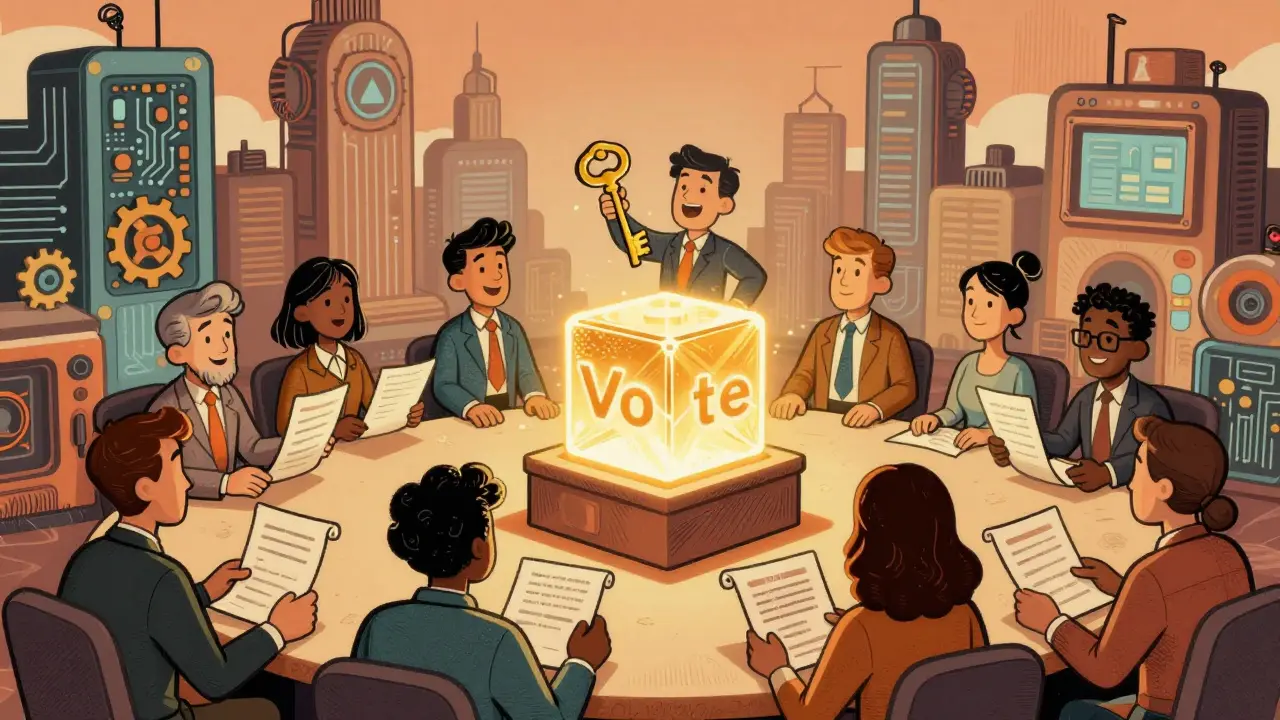
Imagine buying a share in a company, but instead of just waiting for dividends, you get an actual vote on how the business is run. You decide where the money goes, which features get built next, and who gets hired. That is the core promise of Governance Tokens, which are digital assets that grant holders voting rights within decentralized protocols and organizations. In the world of cryptocurrency, these tokens are shifting power from centralized CEOs to distributed communities.
If you have been watching the rise of Decentralized Finance (DeFi), you have likely seen acronyms like UNI, COMP, or MKR. These are not just currencies you can trade; they are keys to a digital democracy. But how do they actually work? Do they really give you power, or is it all just hype? Let’s break down what governance tokens are, how they function, and whether holding them makes you a true stakeholder or just another number in a whale’s portfolio.
The Basics: What Exactly Is a Governance Token?
At its simplest, a governance token is a type of cryptocurrency that allows you to participate in the decision-making process of a blockchain protocol or a Decentralized Autonomous Organization (DAO). Unlike Bitcoin, which is designed to be digital gold, or Ethereum, which powers smart contracts, governance tokens are tools for coordination.
When a project launches a governance token, it is essentially saying, "We don’t want a board of directors anymore. We want the community to steer the ship." The first major example of this was MakerDAO’s MKR token, launched in late 2017. Since then, hundreds of projects have adopted this model. Today, there are over 200 active governance token implementations across the Web3 ecosystem, with a combined market capitalization that has frequently exceeded $15 billion.
The primary purpose here is distribution of control. In traditional finance, decisions are made by executives behind closed doors. In a DAO governed by tokens, proposals are submitted publicly, debated openly, and voted on by token holders. This aligns incentives between developers, users, and investors. If everyone has a say, everyone has a stake in the outcome.
How Governance Tokens Work: From Proposal to Vote
So, how does your vote actually count? It usually comes down to a simple rule: one token equals one vote. This is known as proportional voting. If you hold 1,000 tokens, you have ten times the voting power of someone holding 100 tokens. While this sounds straightforward, the mechanics can vary depending on the protocol.
Most governance happens in two stages:
- Discussion Phase: Ideas are proposed on forums like Discourse or Discord. Community members debate the merits, risks, and technical details. This is often called "off-chain" governance because no code is executed yet.
- Voting Phase: Once a proposal is refined, it moves to an on-chain vote. This can happen directly on the blockchain using smart contracts, or via off-chain platforms like Snapshot.org, which simulate votes without gas fees. If the proposal passes, developers implement the changes in the code.
About 68% of major protocols use a hybrid model, combining off-chain discussion with on-chain execution. For example, Uniswap’s UNI token holders vote on fee structures and treasury allocations. Compound’s COMP token governs interest rates and collateral types for its lending platform. The technical standard for most of these tokens is ERC-20 on Ethereum, though other chains like Solana are developing their own standards.
The Whale Problem: Is It Really Democratic?
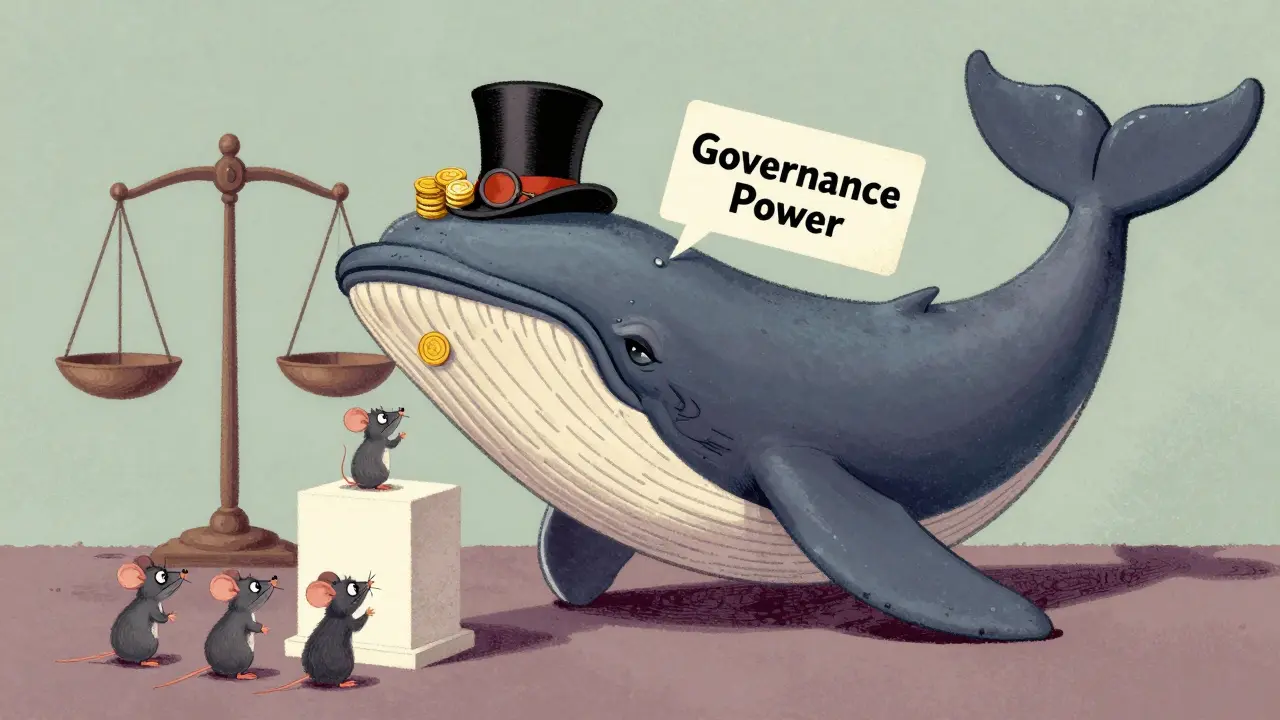
Here is where things get complicated. Critics argue that governance tokens create a plutocracy rather than a democracy. Because voting power is tied to token holdings, those with the most money have the most voice. This is often referred to as "whale dominance."
Data supports this concern. An analysis by iTrustCapital showed that the top 100 holders of MKR tokens controlled over 62% of the voting power. In many smaller protocols, participation rates hover below 0.5%, meaning a handful of large holders can effectively dictate outcomes. This undermines the ideal of decentralization. If only a few wealthy individuals decide the future of a protocol, is it truly community-led?
To combat this, some projects are experimenting with alternative voting mechanisms. Quadratic voting, for instance, weights votes based on the square root of tokens held. This reduces the influence of large holders and gives more weight to smaller participants. Balancer has tested this approach to mitigate whale dominance. Another solution is delegation, where token holders can delegate their voting power to trusted experts or representatives, similar to a representative democracy.
Governance Tokens vs. Utility Tokens: Know the Difference
It is easy to confuse governance tokens with utility tokens, but they serve different purposes. Understanding this distinction is crucial for investors and users alike.
| Feature | Governance Token | Utility Token | Currency Token |
|---|---|---|---|
| Primary Function | Voting and decision-making | Access to services or discounts | Value transfer and store of value |
| Example | UNI (Uniswap) | BNB (Binance Coin) | BTC (Bitcoin) |
| Value Driver | Protocol success and adoption | Usage volume and demand | Scarcity and network effect |
| Risk Profile | Regulatory scrutiny, low liquidity | Platform dependency | Market volatility |
A utility token like BNB gives you discounts on trading fees. A currency token like Bitcoin is used to send value. A governance token like UNI gives you a say in the protocol’s future. However, the lines are blurring. Many governance tokens also offer staking rewards or fee sharing, making them hybrid assets. This complexity adds to the regulatory uncertainty surrounding them.
Real-World Impact: Successes and Failures
Do governance tokens actually work? The answer is mixed. There are notable successes and stark failures.
One of the biggest success stories is MakerDAO during the "Black Thursday" crash in March 2020. When markets plummeted, MKR holders quickly voted to implement emergency shutdown procedures and adjust collateral ratios. This rapid response helped stabilize the DAI stablecoin and prevented a total collapse of the protocol. It proved that decentralized governance could act swiftly in a crisis.
On the flip side, consider the Yearn.finance governance proposal #49 in 2021. A controversial partnership was approved with less than 1% voter participation. Critics called it a textbook case of governance failure, highlighting how low engagement can lead to poor outcomes. Similarly, the Cream Finance exploit in 2022 saw governance delays exacerbate losses, showing that slow decision-making can be dangerous in security emergencies.
These examples show that while governance tokens enable community-led innovation, they also require high levels of engagement and vigilance. Without active participation, the system can be hijacked by bad actors or ineffective leadership.
How to Get Started with Governance Tokens
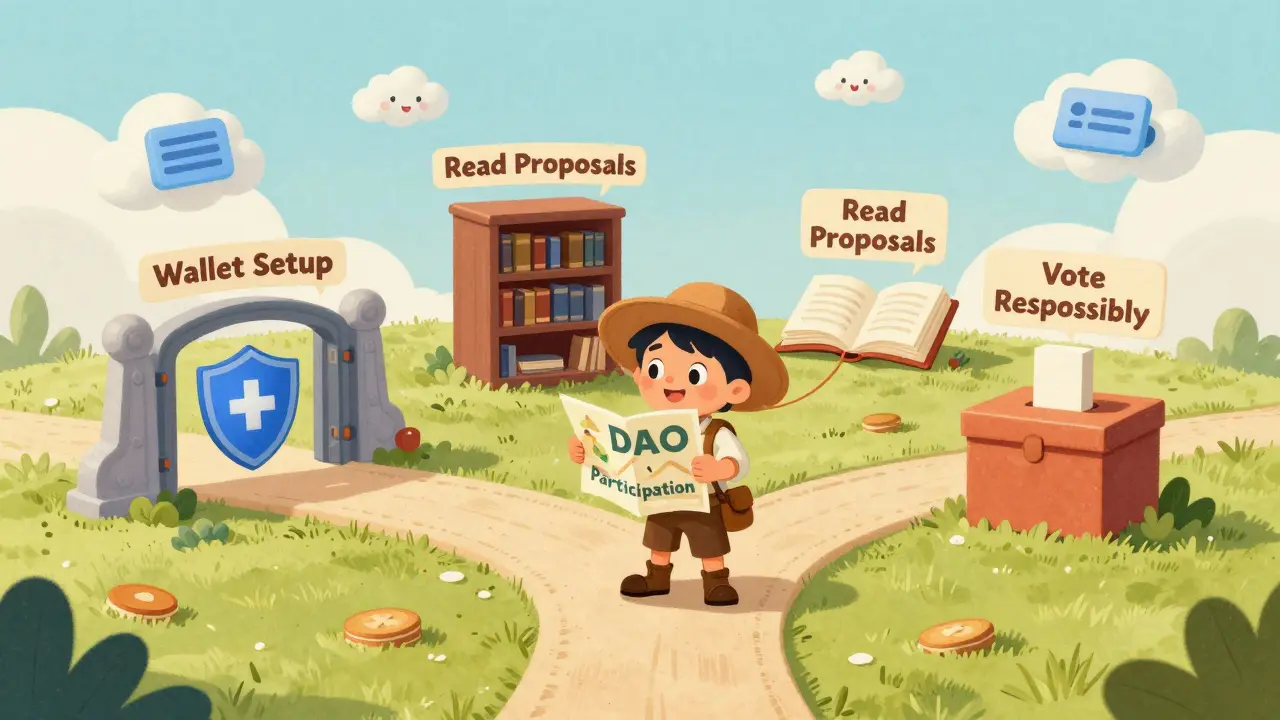
If you want to participate, here is a practical roadmap. Keep in mind that effective participation requires time and learning. Surveys suggest new users spend 40-60 hours understanding the basics before feeling confident.
- Acquire Tokens: Buy governance tokens on reputable exchanges like Coinbase or Uniswap. Ensure the exchange supports the specific token you are interested in.
- Set Up a Wallet: Use a non-custodial wallet like MetaMask or Ledger. You need full control of your private keys to vote securely.
- Connect to Governance Platforms: Visit the protocol’s governance portal. Many use Snapshot.org for off-chain voting. Connect your wallet to cast your vote.
- Engage in Discussions: Join the project’s Discord or Telegram channels. Read forum posts on Discourse. Understanding the context of proposals is key to making informed decisions.
- Vote Responsibly: Don’t just vote yes or no blindly. Research the proposal, check for conflicts of interest, and consider the long-term impact on the protocol.
Documentation quality varies widely. Aave scores highly for clarity, while others like SushiSwap have been criticized for complex interfaces. Look for projects with active community support and clear guidelines.
Regulatory Risks and Future Outlook
The legal landscape for governance tokens is evolving rapidly. The U.S. Securities and Exchange Commission (SEC) has increased scrutiny, arguing that some governance tokens may qualify as securities. The 2023 enforcement action against Uniswap Labs signaled that regulators are watching closely. This creates uncertainty for holders and developers alike.
Despite these challenges, the trend toward decentralized governance is strong. By 2026, industry analysts predict that most major protocols will incorporate multi-dimensional reputation systems, where voting power is not just based on token holdings but also on contribution history and expertise. This could address the whale dominance problem and make governance more equitable.
Governance tokens represent a bold experiment in digital democracy. They are not perfect, and they face significant hurdles. But they offer a unique opportunity to reshape how we organize and collaborate online. Whether they succeed depends on our willingness to engage, learn, and participate responsibly.
Are governance tokens considered securities?
This is a complex legal question. In the United States, the SEC has argued that some governance tokens may be securities if investors expect profits primarily from the efforts of others. However, tokens that provide genuine voting rights and utility within a decentralized network may not fit this definition. Legal opinions vary, and regulations differ by country. Always consult a financial advisor and stay updated on local laws.
Can I earn passive income from governance tokens?
Some governance tokens offer staking rewards or fee-sharing mechanisms. For example, holding and staking UNI tokens may entitle you to a portion of the protocol’s trading fees. However, these rewards are not guaranteed and depend on the protocol’s performance and governance decisions. Treat them as potential upside, not a fixed income stream.
What is the difference between on-chain and off-chain voting?
On-chain voting occurs directly on the blockchain using smart contracts. It is transparent and immutable but can be expensive due to gas fees. Off-chain voting uses platforms like Snapshot to simulate votes without executing transactions. It is cheaper and faster but relies on trust that the results will be implemented on-chain. Most protocols use a hybrid approach.
How do I prevent my vote from being influenced by whales?
You cannot directly control whale behavior, but you can look for protocols that implement quadratic voting or delegation systems. These mechanisms reduce the disproportionate influence of large holders. Additionally, engaging in community discussions helps ensure that diverse perspectives are heard, even if voting power is unequal.
Is it safe to participate in governance?
Participating in governance involves risks, including smart contract vulnerabilities, phishing attacks, and social engineering. Always use a secure hardware wallet, verify URLs carefully, and never share your private keys. Be cautious of proposals that seem too good to be true or rush you into quick decisions. Due diligence is essential.
mark valmart
May 29, 2026 AT 01:26honestly just buy the dip and forget about voting lol
Crystal Davis
May 30, 2026 AT 10:09You are fundamentally misunderstanding the mechanics of decentralized governance if you think this is anything other than a thinly veiled mechanism for venture capitalists to maintain control while washing their hands of liability. The data cited regarding MKR holders is cherry-picked to ignore the broader context of liquidity provision incentives that actually drive value. It is amusing how retail investors cling to the illusion of democracy when every major protocol’s treasury is effectively managed by a handful of multi-sig wallets controlled by founders who never intended to relinquish power. The concept of quadratic voting is a theoretical band-aid on a systemic wound; it has failed in practice because human nature favors coordination among large holders regardless of the mathematical weighting. Stop pretending that holding a token makes you a shareholder in any meaningful legal or economic sense.
Bill Gunn
May 30, 2026 AT 17:32I totally see where you're coming from, Crystal! 😊 It's super important to look at the bigger picture here though. While whales do have a lot of sway, the fact that we even have these platforms to debate is huge progress compared to traditional finance. 🚀
Think about it: before governance tokens, you had zero say in how your money was used. Now? You can at least read the proposals and voice your opinion on Discord. It's not perfect, but it's a start! 🌱 I've been delegating my votes to trusted community members who actually do the research, and it feels good to know my stake is being represented responsibly. Plus, seeing projects like Uniswap evolve based on community feedback is pretty cool. 💯 What do you guys think about delegation as a middle ground?
kamal ifrani
June 1, 2026 AT 14:59This whole article is a joke. You people are sheep. The system is rigged against you from day one. The developers print more tokens for themselves while you beg for scraps. It is not democracy, it is feudalism with a tech coat of paint. Wake up! 🤡
saradee dee
June 3, 2026 AT 06:29Oh wow, Kamal, that is so harsh! 😢 I really think everyone here is trying their best to understand this new world. It's okay to be frustrated, but let's try to keep the conversation friendly, shall we? We all want better outcomes for the community. Maybe if we work together, we can find solutions that help everyone feel heard. Let's focus on the positive steps forward rather than tearing each other down. Peace and love! ✨
Joshua Alcover
June 3, 2026 AT 17:42The aforementioned discourse exhibits a profound lack of intellectual rigor typical of unregulated digital markets. One must consider the geopolitical implications of decentralized autonomous organizations operating outside sovereign jurisdiction. The notion that 'community' governance supersedes established regulatory frameworks is not merely naive; it is dangerous. These entities facilitate capital flight and undermine national monetary sovereignty. The SEC's scrutiny is not an attack on innovation but a necessary assertion of state authority over financial instruments that claim anonymity while impacting real-world economies. To suggest otherwise is to ignore the fundamental social contract between citizen and state.
Diana Morris
June 5, 2026 AT 03:20stop being such a buzzkill joshua nobody cares about your government lectures just get out of here
Barclay Chantel
June 6, 2026 AT 21:09I simply cannot be bothered to engage with this level of naivety. Governance tokens are the epitome of modern folly-pretending that a random assortment of internet users can manage complex financial protocols better than trained professionals. It is laughable. The entire premise relies on the assumption that participants are rational actors with aligned incentives, which is empirically false. Most holders are too lazy or uninformed to vote, leaving the door open for bad actors. It is a circus, and we are all clowns waiting for the next rug pull.
Hadleigh Edwards
June 8, 2026 AT 12:27I think we need to look at the long-term vision here because while there are definitely growing pains and some folks might feel left out initially, the trajectory is undeniably pointing towards a more inclusive future where technology empowers individuals to have a direct say in the systems they rely upon, and although the current implementation leaves much to be desired in terms of accessibility and true decentralization, the very existence of these mechanisms proves that the desire for democratic control is strong and persistent among users who are tired of having decisions made for them by distant executives who don't understand the nuances of the ecosystem, so we should celebrate the small victories and continue to push for improvements rather than dismissing the entire concept as a failure just because it hasn't reached utopia yet.
Dianne Wright
June 10, 2026 AT 06:35i mean its kinda sad how everyone pretends to care about governance when they just want free money. i voted on three proposals last year and learned nothing except that most people are idiots. why bother
Eric Grosso
June 11, 2026 AT 09:54does anyone else think the gas fees for on-chain voting are still way too high for small holders? i tried to vote once and it cost me more than the token itself was worth lol
Dana Rapoport
June 12, 2026 AT 23:50The philosophical underpinning of governance tokens suggests a shift from shareholder capitalism to stakeholder capitalism, albeit in a digital realm. However, the practical application often falls short of this ideal due to the inherent biases of wealth concentration. We must ask ourselves: does ownership equate to wisdom? In many DAOs, the answer appears to be no. The silence of the majority is deafening, and the voices that do speak are often those with the most to lose financially, not necessarily those with the most insight into the protocol's health. This creates a disconnect between the stated values of decentralization and the reality of plutocratic decision-making.
Joe Clements
June 14, 2026 AT 22:49Hey everyone, just wanted to chime in and say that I've found delegation to be a really helpful tool. Instead of trying to read every single proposal myself, I delegate to a few reputable voters who align with my values. It takes the pressure off and still lets my voice count in a way. Hope that helps someone feeling overwhelmed!
lorna erni
June 15, 2026 AT 09:09Let's stop making excuses for bad design! If the system is broken, fix it! Don't just complain about whales, build tools that counter them. Quadratic voting is a start, but we need more aggressive measures to protect small holders. We need to fight for our rights in this space! No more passive participation!
Rosie Morris
June 15, 2026 AT 20:17i totally agree with lorna its so frustrating when big holders just dump on us little guys. we need more protection for regular users. its not fair at all.
Christina Pearce
June 17, 2026 AT 06:35I appreciate the detailed breakdown in the post, especially the section on regulatory risks. It's crucial to stay informed about the SEC's stance. For those looking to participate safely, I highly recommend starting with smaller, well-documented protocols where the community is active and transparent. Always verify links and use hardware wallets. Safety first!
stalin brian
June 19, 2026 AT 02:06in my country we dont trust banks so this stuff is kinda cool but yeah the language is hard to understand for normal people. maybe simpler guides would help more folks join in.
Miss Masquer
June 20, 2026 AT 15:36As someone who has participated in several DAOs across different cultural contexts, I find that the barrier to entry is not just technical but also linguistic and educational. Many valuable perspectives are lost because discussions happen primarily in English and assume a baseline knowledge of blockchain mechanics that many potential contributors do not possess. We need to invest more in multilingual resources and beginner-friendly tutorials to truly achieve global decentralization. Without inclusivity, we are merely replicating existing power structures in a new format.
trisya hazriyana
June 23, 2026 AT 07:50lol yeah right. governance is just a marketing term for 'we sold you a useless coin'. smart contracts cant save you from stupid humans making bad decisions. typical web3 hype cycle. boring.
Sam Dashti
June 24, 2026 AT 08:10I wonder if the rise of AI agents voting on behalf of token holders will change the dynamic? Imagine bots analyzing proposals in real-time and executing votes based on predefined strategies. Could that reduce whale dominance if everyone uses similar algorithms? Or would it just create a new class of 'algo-whales'? Just thinking out loud here...
Edith Mair
June 24, 2026 AT 08:58Stop speculating and look at the facts. AI voting introduces security vulnerabilities and centralization points. Who controls the AI? Who audits the code? It's another layer of complexity that benefits no one but the tech providers. Stick to human oversight for now.
Debbie Lewis
June 25, 2026 AT 12:21I just quietly observe these threads. Everyone is so passionate. I just hold my UNI and wait for the price to go up. Voting seems like too much work for the rewards.
Craig Swanson
June 26, 2026 AT 10:19Listen up! If you aren't participating in governance, you are part of the problem. Don't hide behind 'it's too hard.' Take responsibility for your investments. Educate yourself. Delegate if you must, but do not be silent. Your silence gives power to those who want to exploit the system. Get involved now!