What Happens When You Withdraw Crypto to Fiat in China: Bank Reactions and Risks
 May, 11 2026
You might think that holding Bitcoin or Ethereum is safe because the law doesn't explicitly criminalize possession. But trying to convert those digital assets into Chinese Yuan (CNY) through a bank account is a different story entirely. In China, the moment you attempt to withdraw cryptocurrency to fiat currency via formal banking channels, you trigger a complex web of regulatory alarms designed to stop you cold.
Since September 2021, the People's Bank of China (PBoC) has classified all cryptocurrency-related financial activities as illegal. This isn't just a suggestion; it's a strict mandate enforced by nine government agencies working together. If you are wondering how banks react when they see money coming from crypto sources, the short answer is: aggressively. They don't just decline the transaction-they investigate, freeze your accounts, and report you to authorities.
The Regulatory Wall: Why Banks Must Say No
To understand why Chinese banks act so swiftly, you need to look at Circular No. 237. Issued in late 2021, this document explicitly prohibits financial institutions from providing any services related to virtual currencies. This includes everything from opening accounts for exchanges to settling payments for individual traders.
For a bank employee, facilitating even a single crypto-to-fiat transfer carries massive personal and institutional risk. Dr. Li Wei, a senior researcher at the Chinese Academy of Financial Inclusion, notes that banks found helping with these conversions face immediate revocation of their business licenses. Senior managers can face criminal liability, and fines can reach up to five times the transaction amount. Given these stakes, banks have zero incentive to be lenient.
The legal gray area exists only for individuals holding coins on private wallets. The moment that value touches the formal banking system-whether through a wire transfer, Alipay, or WeChat Pay-it becomes an "illegal financial activity." The bank’s job is to keep the two worlds separate.
How Banks Detect Crypto Transactions
You might assume that if you sell your crypto on an overseas exchange and withdraw to a bank account under your name, it looks like normal income. However, Chinese banks use sophisticated monitoring systems that go far beyond simple manual checks.
Banks employ automated algorithms trained to spot specific patterns associated with crypto cash-outs. These include:
- Rapid sequential transfers: Moving money quickly between multiple accounts to obscure the source.
- Small aggregations: Many small deposits that add up to a large sum, often used to avoid reporting thresholds.
- Known wallet connections: Transactions linked to IP addresses or wallet addresses on the PBoC's blacklist of over 14,000 crypto-related entities.
In 2025, data showed that 68% of flagged transactions were detected because they originated from IP addresses associated with known crypto exchanges. Another 23% were caught due to rapid movement of funds between accounts. The remaining cases involved direct links to blacklisted addresses.
The Ministry of Public Security supports these banks with a comprehensive monitoring network. This means that if your transaction triggers an alert, it’s not just a bank clerk looking at your screen. It’s part of a coordinated effort involving risk management, compliance, and technology teams mandated to monitor all customer funds for virtual currency links.
The Consequences: Freezes, Fines, and Blacklists
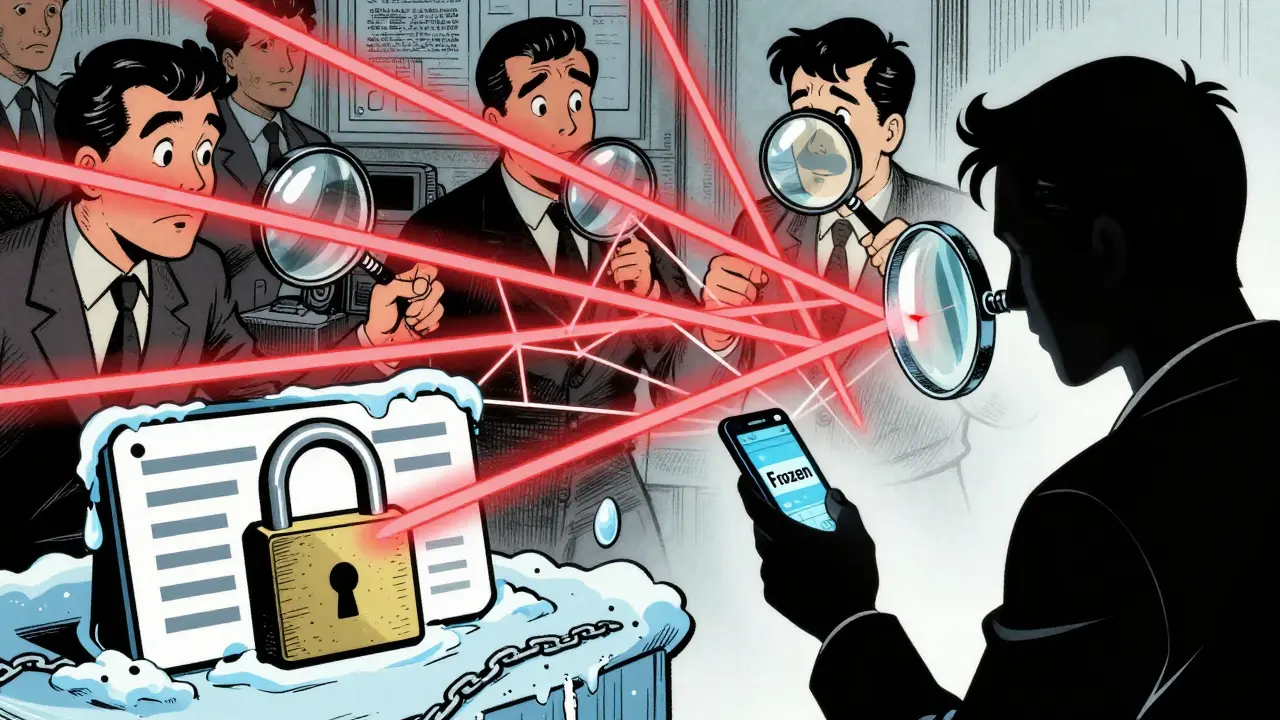
If a bank suspects your funds come from crypto, the reaction is immediate. The standard procedure involves freezing your account within 24 hours. According to Circular No. 319, issued by the PBoC in June 2022, banks must report suspicious activities to the China Anti-Money Laundering Monitoring and Analysis Center (CAMLMAC) and local PBoC branches right away.
Here is what typically happens after a freeze:
- Initial Freeze: Your account is locked for 72 hours while the bank investigates.
- Extended Restriction: In 89% of cases, the freeze lasts longer than 30 days as authorities dig deeper.
- Enhanced Due Diligence: You may be required to provide proof of income source. If you cannot prove the funds are legitimate non-crypto earnings, the money may be confiscated.
- Blacklisting: You could be added to a credit blacklist, preventing you from using other financial services in China.
Real-world enforcement is harsh. In April 2025 alone, the Agricultural Bank of China froze 217 accounts in Guangdong Province after detecting patterns consistent with crypto withdrawals. Investigations revealed connections to offshore exchanges serving Chinese residents. The total value frozen in such operations across China reached ¥2.1 billion ($290 million) in the first half of 2025.
Capital Controls and Cross-Border Complications
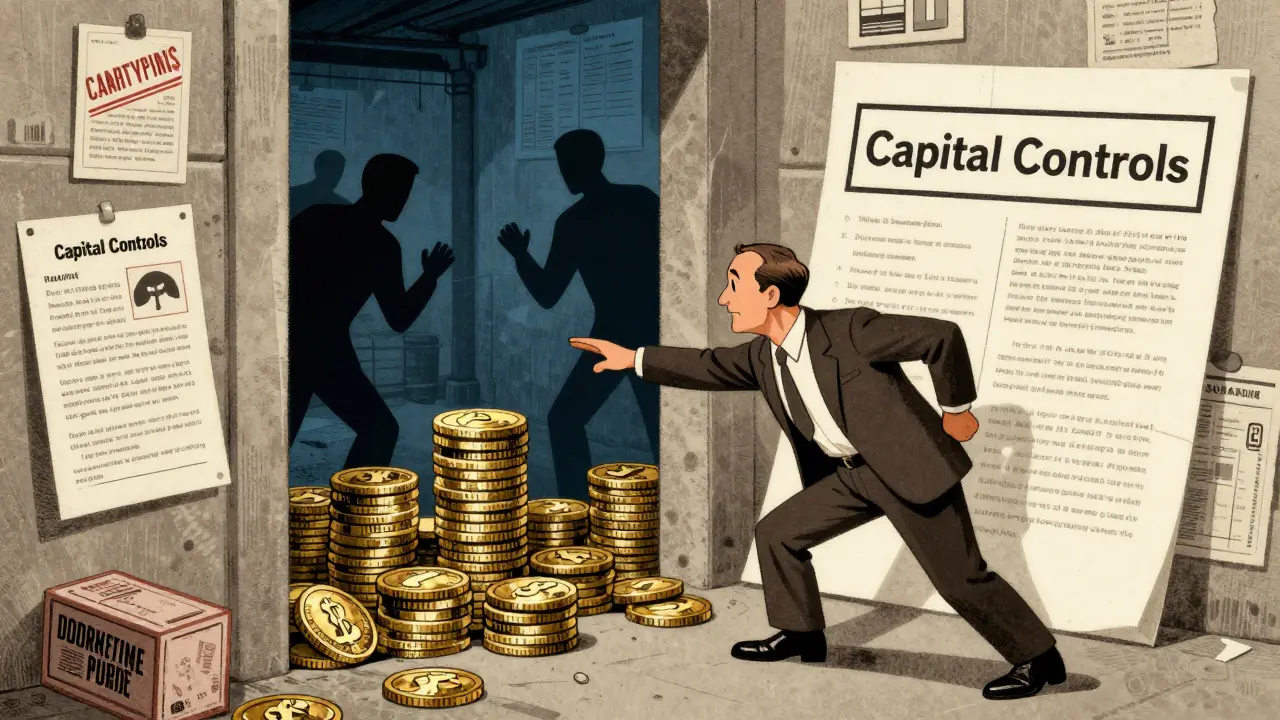
Even if you manage to convert crypto to fiat outside of China, moving that money back into the country hits another wall: capital controls. The State Administration of Foreign Exchange (SAFE) limits individual foreign currency conversions to $50,000 annually.
This limit creates a bottleneck for anyone trying to repatriate funds earned from global crypto markets. Banks now scrutinize any incoming foreign transfers exceeding HK$50,000 ($6,400) to Hong Kong accounts with extra care, especially since Hong Kong introduced its own Stablecoins Ordinance in August 2025. While Hong Kong allows regulated stablecoin trading, mainland banks are strictly prohibited from participating in that market.
This divergence creates a tricky situation. If you try to route funds through Hong Kong to bypass mainland restrictions, mainland banks will likely flag the transaction as an attempt to circumvent capital controls. The result is often the same: frozen assets and legal scrutiny.
| Activity Type | Detection Method | Immediate Consequence | Long-Term Risk |
|---|---|---|---|
| Direct Exchange Withdrawal | IP/Wallet Address Matching | Account Freeze (72+ hours) | Credit Blacklist |
| P2P Trade Settlement | Transaction Pattern Analysis | Enhanced Due Diligence | Fines & Asset Confiscation |
| Cross-Border Transfer | SAFE Capital Control Checks | Rejection of Transfer | Legal Investigation |
The Rise of Informal Networks
Faced with these strict banking reactions, many Chinese citizens turn to informal money laundering networks (CMLNs). These underground channels allow users to move value without touching formal banks. However, this path is dangerous. FinCEN estimates that Chinese citizens transacted approximately $8.2 billion through informal channels in 2024, up from $5.7 billion in 2023.
Banks are now specifically trained to identify CMLN activity. Unusual cash deposits exceeding ¥200,000 ($27,500) per transaction trigger enhanced due diligence. Since banks know that crypto holders often use these networks to cash out, any involvement with such networks can lead to severe penalties, including accusations of money laundering.
Future Outlook: AI and Stricter Enforcement
The situation is not expected to ease soon. S&P Global projects that China's strict crypto regulations will persist through 2027. Banks are investing heavily in better detection tools. By Q2 2026, Chinese banks are expected to implement AI-powered blockchain analysis tools capable of tracing cryptocurrency flows across multiple blockchains with 92% accuracy.
This means that even if you try to mix your coins or use privacy-focused cryptocurrencies, the bank's new AI systems will likely connect the dots between your on-chain activity and your bank account. The gap between anonymity and traceability is closing rapidly.
With approximately 12.7 million Chinese citizens still holding crypto assets, primarily through overseas exchanges, the demand for fiat conversion remains high. But the supply of safe, legal ways to do it is effectively zero. Until the digital yuan achieves significant penetration in retail payments-a milestone not expected before 2028-the current restrictive environment will remain.
Is it illegal to hold cryptocurrency in China?
No, it is not explicitly illegal for individuals to hold cryptocurrency in China. However, buying, selling, or converting it to fiat currency through financial institutions is strictly prohibited and classified as an illegal financial activity.
What happens if my bank detects a crypto withdrawal?
Your bank will likely freeze your account immediately. They are required to report the activity to the China Anti-Money Laundering Monitoring and Analysis Center within 24 hours. You may face extended account restrictions, fines, and potential blacklisting from the financial system.
Can I use Hong Kong banks to withdraw crypto to fiat?
Hong Kong has introduced a regulated stablecoin framework, but mainland Chinese banks are prohibited from participating in this market. Transferring funds from Hong Kong to mainland China triggers strict capital control checks by SAFE, making it difficult to move crypto-derived funds without detection.
How do banks detect crypto transactions?
Banks use AI algorithms to monitor for patterns like rapid fund movements, transactions from blacklisted IP addresses, and links to known crypto wallet addresses. Over 68% of detected cases involve IP address matching with crypto exchanges.
Will China lift the crypto ban soon?
Unlikely in the near term. S&P Global predicts strict regulations will continue through 2027. Relaxation may only occur after the digital yuan reaches 30% penetration in retail payments, which is not expected before 2028.
Tobias Gjerlufsen
May 12, 2026 AT 21:15you people really think the state cares about your 'freedom' to trade magic internet money lol its a surveillance state they built the traps specifically for you idiots who ignore circular 237
the ai detection isnt even that advanced anymore its just pattern matching on ip addresses and wallet clusters if you touch fiat through a chinese bank account you are literally signing your own death warrant financially
stop pretending there is a loophole there is none the pboc has total control over every yuan that moves
Ruben Michel
May 12, 2026 AT 22:37One must acknowledge the sheer bureaucratic efficiency of the People's Bank of China in this matter. The implementation of Circular No. 237 was not merely a regulatory suggestion but a definitive structural realignment of the financial architecture. To suggest otherwise is to misunderstand the fundamental nature of sovereign monetary policy in a command economy. The banks are not acting out of malice; they are adhering to strict compliance protocols designed to preserve systemic stability.
Samara McCallum
May 13, 2026 AT 03:31i mean sure they freeze accounts but like is it really that bad if you just hold it in a cold wallet instead?
people make it seem so dramatic when really its just about finding the right peer to peer network maybe im missing something obvious here but why does everyone panic so much over a few frozen transactions
Tobias Gjerlufsen
May 14, 2026 AT 09:22@samara mcallum you are completely delusional if you think p2p networks are safe now
they track the cash deposits too any deposit over 200k rmb triggers enhanced due diligence immediately you think they dont know who the crypto users are they have the entire supply chain mapped out
stop giving bad advice based on 2019 tactics
Sheldon Friesen
May 16, 2026 AT 07:31Oh, look at you! Trying to be the smartest person in the room with your little "delusional" comments! How... quaint!
But seriously, let me break this down for you simpletons: The AI tools rolling out in Q2 2026 are going to be absolutely devastating for anyone thinking they can hide behind privacy coins! It’s not just about IP addresses anymore! It’s about cross-chain analysis! And do you know what that means?! It means your anonymity is dead! Long live the blockchain!
Larry Port
May 16, 2026 AT 09:22I've been following the SAFE capital controls closely. The $50,000 annual limit is a hard ceiling for most retail investors trying to repatriate funds. Even if you use Hong Kong as an intermediary, the mainland banks are watching those inbound transfers like hawks. The divergence between HK's Stablecoins Ordinance and mainland restrictions creates a false sense of security. Most people don't realize that routing through HK often flags the transaction as circumvention rather than legitimate trade.
Ashley Rodriguez
May 16, 2026 AT 21:07it seems like such a complicated situation for everyone involved i guess the government just wants to protect their currency from volatility which makes sense in a way but it feels really harsh on regular people who just wanted to try investing
i wonder if the digital yuan will actually solve this problem or if it will just make everything more controlled because honestly i cant see them letting go of that power anytime soon especially with all the new ai monitoring tools they are buying
Gavin Wonnacott
May 18, 2026 AT 15:16You naive fools. You think you can outsmart the state? Let me tell you something about my experience dealing with these systems. I knew a guy in Shenzhen who thought he could use a shell company to move his gains. Now he’s working in a factory in Guangdong.
The Ministry of Public Security doesn’t play games. They have your data before you even type your password. Stop dreaming about freedom. Accept your place.
robert Whitehead
May 20, 2026 AT 02:40This is exactly why crypto should remain decentralized and outside the reach of corrupt banking institutions. But no, people always want to cash out into fiat and get caught by the very system they claim to hate. It’s a moral failure of the community to keep engaging with these illegal channels. If you’re doing it in China, you’re complicit in breaking the law and enabling further crackdowns on honest holders.
Jocelyn Garcia
May 20, 2026 AT 19:15From a tech perspective, the 92% accuracy rate for multi-chain tracing by Q2 2026 is impressive. The integration of heuristic clustering with behavioral biometrics is what really scares me. It’s not just about the transaction graph anymore; it’s about the user interaction patterns. If you’re mixing coins, the timing and fee structures still leave fingerprints. The CMLN volume increase to $8.2B shows demand, but the risk/reward ratio is getting worse fast.
Zara Zaman
May 20, 2026 AT 19:48Good luck trying to bypass our laws. This is how we maintain economic stability. Foreigners shouldn't interfere with our internal financial policies anyway. The PBOC knows best. If you don't like it, leave the country. We don't need your crypto chaos disrupting our markets. Stay in your lane.
Tobias Gjerlufsen
May 21, 2026 AT 06:33@zara zaman shut up nobody asked for your nationalist rant
we are talking about technical enforcement mechanisms not your political opinions
focus on the fact that the ip blacklists are updated daily and your 'stability' is just censorship
Bridget Coogle
May 23, 2026 AT 00:32its really sad to see how stressful this must be for people living there
i hope everyone stays safe and follows the local laws to avoid trouble
maybe the digital yuan will eventually offer a safer way to transact without all this fear
Amit Varpe
May 24, 2026 AT 00:03lol watch them cry 😂
china is winning the crypto war by simply banning it
your precious bitcoin is worthless if you cant buy rice with it
Bronwen Butler
May 25, 2026 AT 19:02actually the article misses the point about hong kong
hk is not china proper so the regulations are different
but yes mainland banks will flag anything coming from hk that looks suspicious