What is CATX (CATX) crypto coin? The confusing truth behind the volatile token
 Jan, 14 2026
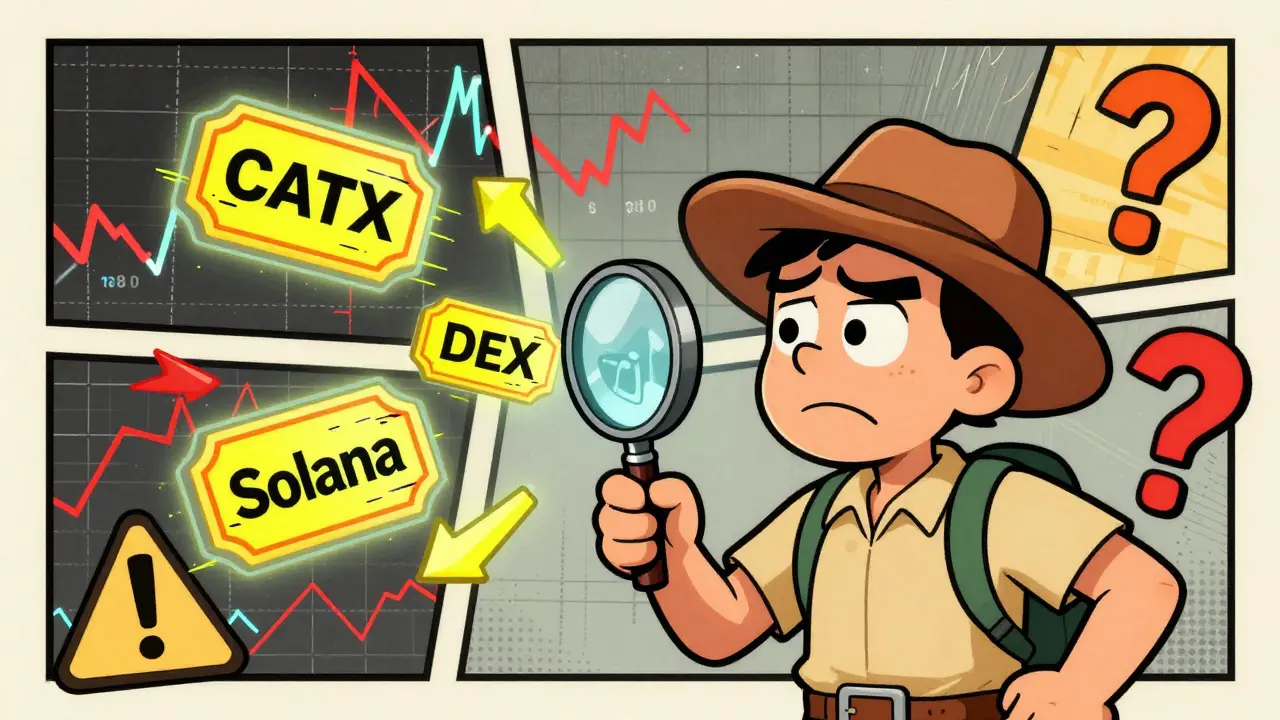
If you’ve seen CATX pop up on your crypto tracker and wondered what it actually is, you’re not alone. The token has been flying under the radar with wild price swings, conflicting descriptions, and a story that doesn’t add up. One site says it’s a gaming token. Another calls it a decentralized exchange. A third claims it runs on Solana. Meanwhile, its price varies by 10,000x across platforms. This isn’t a bug - it’s a red flag.
What is CATX supposed to be?
There’s no clear answer. CATX is a symbol with no consistent identity. CoinPaprika says it’s a token built for gaming microtransactions, meant to power in-game purchases like skins or power-ups. Cryptorank says it’s the native token of Catex - a decentralized exchange (DEX) built on Unichain, using Uniswap V4 tech. CoinSwitch claims it’s a Solana-based Web3 coin. These aren’t minor differences. They’re contradictory definitions of entirely different projects.And here’s the kicker: there’s no official website, no verified whitepaper, and no active GitHub repository to back up any of these claims. The “Catex” site linked in some listings just redirects to a generic Uniswap liquidity pool. No team names. No roadmap. No technical documentation. Just a ticker symbol and a bunch of price charts.
Why does the price change so wildly?
CATX doesn’t move because of news, updates, or adoption. It moves because of speculation and manipulation. In January 2025, CoinGecko recorded a 2,472% surge in 24 hours. A few weeks later, it dropped 12.5% in seven days. CoinPaprika reported a 4,533% jump over seven days. These aren’t normal crypto fluctuations - they’re pump-and-dump patterns.Compare that to real projects. Enjin (ENJ), a gaming token with actual partnerships and 200+ games using its tech, doesn’t see 1,000% daily spikes. Uniswap (UNI), a legitimate DEX with billions in volume, trades steadily. CATX’s volatility has nothing to do with utility. It’s purely driven by traders chasing quick gains on low-liquidity markets.
Where does CATX actually run?
The blockchain confusion is even worse than the project description mess. Some sources say it’s on Solana - a high-speed, low-fee chain. Others say it’s on Unichain, an Ethereum Layer 2. CoinMarketCap lists it as an ERC-20 token, which means Ethereum. But there’s no official contract address that everyone agrees on.That means you could be buying one token on one exchange and a completely different one on another. Both use the symbol CATX. Both have different contract addresses. Both have different prices. One might be a real token with minimal liquidity. The other could be a scam coin created just to trap unsuspecting buyers.
Wallets like Trust Wallet list CATX as “partially supported” - meaning you have to manually enter the contract address. But which one? There are at least three different CATX addresses floating around. If you pick the wrong one, you could send your money to a dead end with no way to recover it.
Who’s holding CATX - and why?
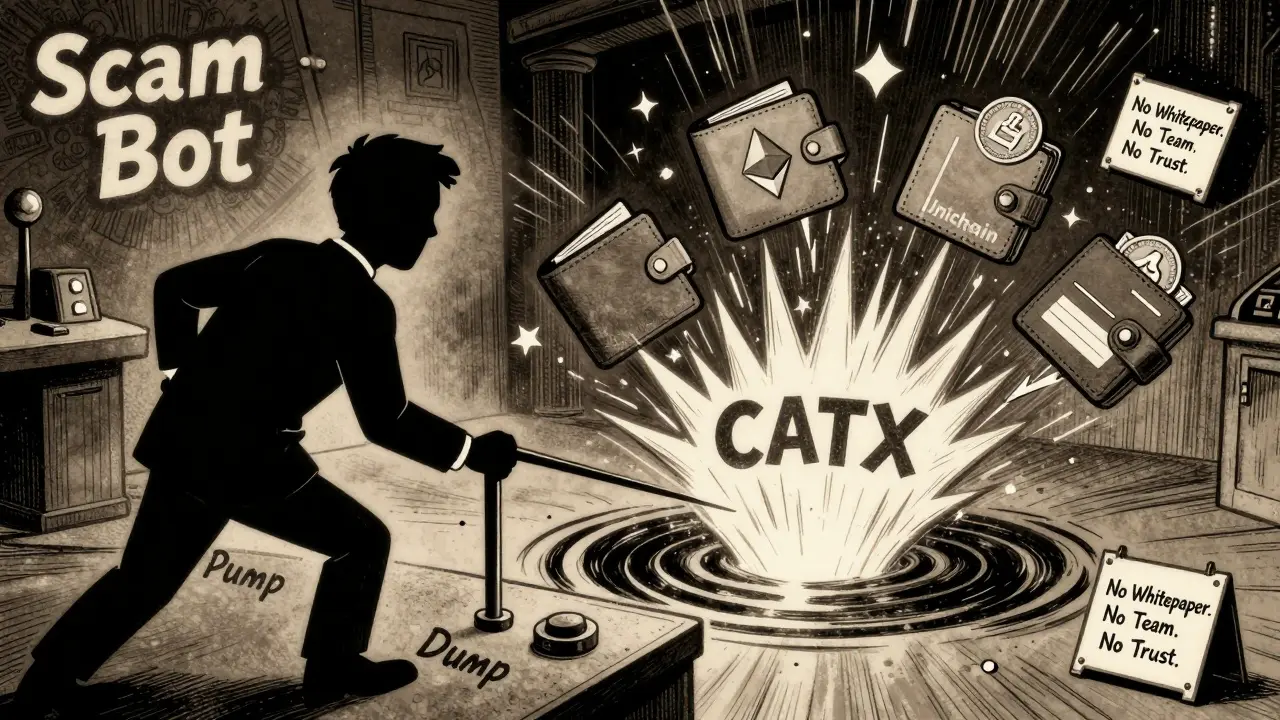
CoinMarketCap says only 3,120 wallets hold CATX. That’s less than 0.001% of the number of wallets holding even small, established tokens. For context, Shiba Inu (SHIB) has over 1.2 million holders. CATX’s entire community could fit in a small Discord server.Reddit threads are full of users asking: “Is this a gaming token or a DEX token?” One top comment says: “I bought thinking it was for gaming. The website just linked to a Uniswap pool. Total mess.” Trustpilot reviews for “Catex DEX” average 1.8 out of 5. Common complaints: “Can’t tell what this even is,” and “Prices differ by 10,000x between platforms.”
LunarCrush shows 67% bearish sentiment - far above the crypto market average of 52%. That’s not just skepticism. That’s active distrust.
Why experts are warning against CATX
Dr. Elena Rodriguez from Delphi Digital called CATX “a textbook example of misleading project marketing.” Messari labeled it a “High-Risk Speculative Asset,” pointing to price discrepancies so extreme they suggest wash trading - where bots buy and sell to each other to fake volume.The SEC’s January 2026 Token Verification Framework specifically flagged tokens with “multiple conflicting project descriptions across data aggregators” as potential enforcement targets. That’s not a warning you ignore. If regulators start cracking down, CATX will vanish overnight.
Blockworks grouped CATX with meme-adjacent tokens like TITANO and SAFEMARS - low-cap coins with no real use case, just hype. But unlike those, CATX doesn’t even have a community. No meme culture. No influencers. No long-term holders. Just short-term traders riding the rollercoaster.
Can you trade CATX safely?
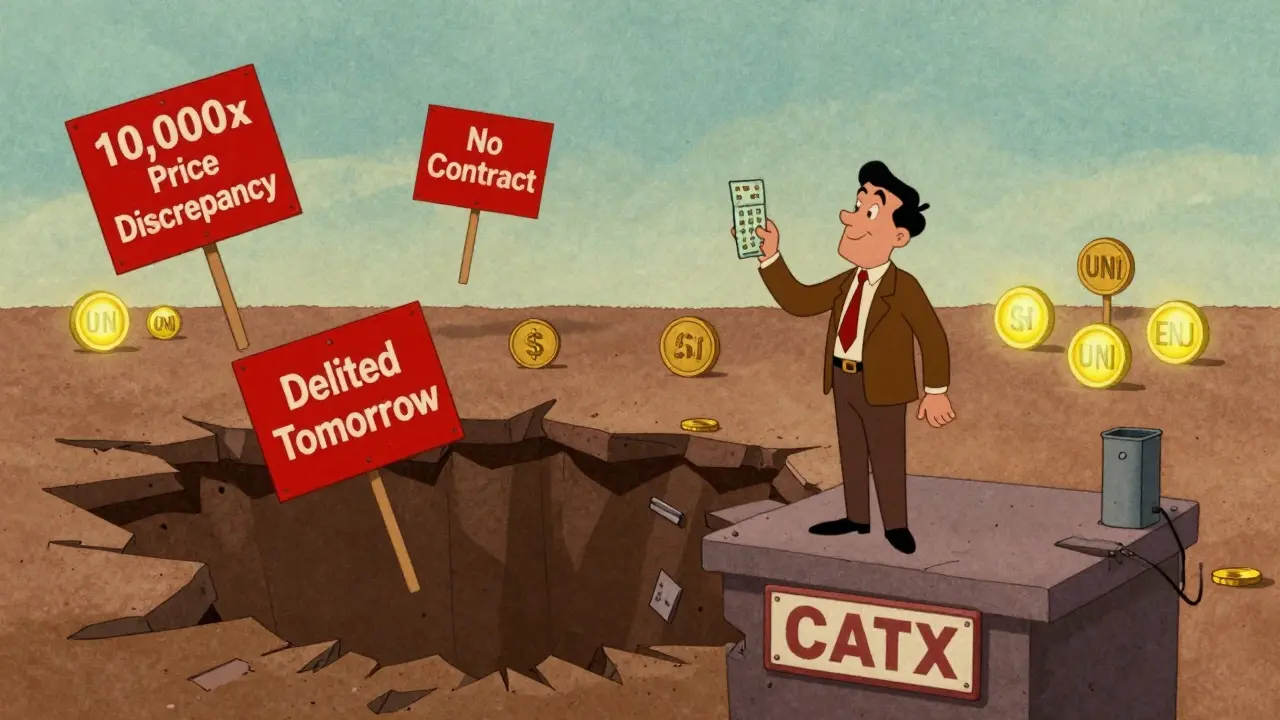
Technically, yes - but only if you treat it like gambling, not investing. If you’re thinking of buying CATX, here’s what you need to do:- Ignore every price you see on CoinGecko, CoinMarketCap, or CoinPaprika. They’re all different.
- Find the exact contract address on Etherscan or Solscan - not from a trading site, but from a verified blockchain explorer.
- Check if that address has any transaction history beyond a few hundred trades. If it’s mostly one wallet moving tokens around, walk away.
- Never invest more than you’re willing to lose. This isn’t a portfolio asset. It’s a lottery ticket.
- Don’t trust any “official” social media accounts. The last verified post from any CATX-linked X account was January 3, 2026.
Most people who trade CATX either make a quick profit and cash out - or get stuck holding a token that suddenly becomes untradeable. There’s no middle ground.
What’s the future of CATX?
The future is bleak. There’s no development activity. No team updates. No new partnerships. No product launches. The only “roadmap” mentioned is vague - “expanding use cases in DeFi” - but no one knows what that means because no one knows what the project is.Messari’s January 2026 report says CATX has a 92% historical failure rate within 12 months. That’s not a prediction. That’s a pattern. Tokens like this don’t fade out slowly. They collapse suddenly - often after a big pump lures in new buyers.
And when it happens, you won’t be able to sell. Liquidity will vanish. Wallets will stop supporting it. Exchanges will delist it. And you’ll be left with a digital asset that’s worth nothing - and no way to prove you ever owned it.
Bottom line: Is CATX worth your time?
No. Not as an investment. Not as a tool. Not even as a curiosity worth studying. CATX isn’t a cryptocurrency. It’s a symbol with no substance - a ghost ticker riding on confusion, hype, and bad data.If you want to get into gaming tokens, look at ENJ or GALA. If you want to trade DEX tokens, try UNI or CAKE. They have teams, whitepapers, active development, and real users. CATX has none of that.
There’s a reason the top crypto analysts avoid it. There’s a reason regulators are watching it. And there’s a reason the community is overwhelmingly negative. CATX isn’t a coin you buy. It’s a warning sign you should recognize.
Is CATX a real cryptocurrency?
CATX is a token symbol, but it doesn’t represent a single, verifiable project. Multiple conflicting descriptions exist across platforms - some say it’s for gaming, others say it’s a DEX token. There’s no official team, no whitepaper, and no consistent blockchain. This lack of transparency makes it unreliable as a legitimate cryptocurrency.
Why do different sites show different prices for CATX?
Different platforms are tracking different tokens that all use the CATX ticker. Some are on Ethereum, others on Solana or Unichain. Each has its own contract address, supply, and liquidity. Price discrepancies of 10,000x or more are common because they’re not the same asset - just the same name.
Can I buy CATX on Coinbase or Binance?
No, CATX is not listed on any major centralized exchange like Coinbase or Binance. It’s only available on decentralized exchanges (DEXs) like Uniswap, and even then, only through manual contract entry. This limits access and increases risk.
Is CATX built on Ethereum or Solana?
There is no consensus. Some sources claim it’s on Ethereum (ERC-20), others say Solana (SPL), and some say Unichain (an Ethereum Layer 2). This contradiction is a major red flag. Always verify the contract address on a blockchain explorer before sending funds.
Should I invest in CATX?
No. CATX has no verifiable utility, no development activity, and extreme volatility driven by speculation. Experts and regulators have flagged it as high-risk. If you trade it, treat it like gambling - never as an investment. Never risk more than you can afford to lose.
What happened to the Catex DEX?
There’s no functional Catex DEX. The website linked to CATX redirects to a generic Uniswap liquidity pool. No official app, no UI, no governance system. The name “Catex” appears to be used only in marketing materials to create the illusion of a legitimate project - but there’s no product behind it.
Is CATX a scam?
It’s not officially labeled a scam, but it exhibits all the hallmarks: fake project identity, conflicting data, zero transparency, and pump-driven price action. Many analysts consider it a “zombie token” - one kept alive by speculation with no real foundation. Treat it as high-risk and avoid unless you’re prepared to lose everything.
Vinod Dalavai
January 14, 2026 AT 09:28Hannah Campbell
January 15, 2026 AT 23:39kristina tina
January 16, 2026 AT 23:49Liza Tait-Bailey
January 17, 2026 AT 02:39Christina Shrader
January 17, 2026 AT 20:34Jill McCollum
January 19, 2026 AT 18:50Andre Suico
January 21, 2026 AT 03:58Bill Sloan
January 22, 2026 AT 11:19Sarah Baker
January 22, 2026 AT 23:20ASHISH SINGH
January 24, 2026 AT 03:41Pat G
January 25, 2026 AT 08:30Alexis Dummar
January 25, 2026 AT 15:26Alexandra Heller
January 26, 2026 AT 12:53Hailey Bug
January 26, 2026 AT 17:56Bryan Muñoz
January 27, 2026 AT 07:55Chris O'Carroll
January 29, 2026 AT 00:08Chidimma Okafor
January 30, 2026 AT 23:43Josh V
January 31, 2026 AT 20:52Pramod Sharma
February 2, 2026 AT 06:32Tony Loneman
February 4, 2026 AT 00:42Haley Hebert
February 4, 2026 AT 19:32Kelly Post
February 5, 2026 AT 20:49