What is Ethereum (ETH)? A Complete Guide to the Crypto Platform and Coin
 Jun, 25 2026
You have likely heard of Bitcoin, but you might be scratching your head when people talk about Ethereum or the second-largest cryptocurrency in the world by market cap. It is easy to confuse the two. If Bitcoin is digital gold, Ethereum is more like digital oil-or perhaps a global computer that runs on money. Understanding what it actually *is* requires looking past the price charts and into the technology underneath.
At its core, Ethereum is not just a coin you buy and hold. It is a decentralized, open-source blockchain platform. This means it is a network of computers working together without a central boss. On this network, developers can build applications that run automatically using code called smart contracts. The native currency used to pay for these operations is called Ether, often referred to as ETH.
Key Takeaways
- Ethereum is a platform: Unlike Bitcoin, which focuses on storing value, Ethereum allows programmers to build apps (dApps) directly on its blockchain.
- ETH is fuel: You need Ether (ETH) to pay for transaction fees, known as "gas," to use any application on the network.
- Smart Contracts are key: These are self-executing agreements with terms written into code, enabling DeFi, NFTs, and DAOs.
- Proof-of-Stake security: Since 2022, Ethereum uses energy-efficient validators rather than power-hungry miners to secure the network.
- Market Leader: As of mid-2026, ETH remains the #2 cryptocurrency by market capitalization, serving as the backbone for most Web3 activity.
The Difference Between Bitcoin and Ethereum
To understand Ethereum, you first need to know what it isn't. Bitcoin was created in 2009 primarily as a peer-to-peer electronic cash system and a store of value. Its scripting language is limited intentionally to keep the network simple and secure. You can send Bitcoin from person A to person B, and that is mostly it.
Ethereum, proposed by programmer Vitalik Buterin in 2013 and launched in July 2015, had a different goal. Buterin wanted a blockchain that could do more than just move money. He envisioned a "world computer" where anyone could deploy software that no single entity could shut down. This capability comes from being Turing-complete, meaning the Ethereum Virtual Machine (EVM) can execute complex logic loops and conditions, much like the software on your laptop.
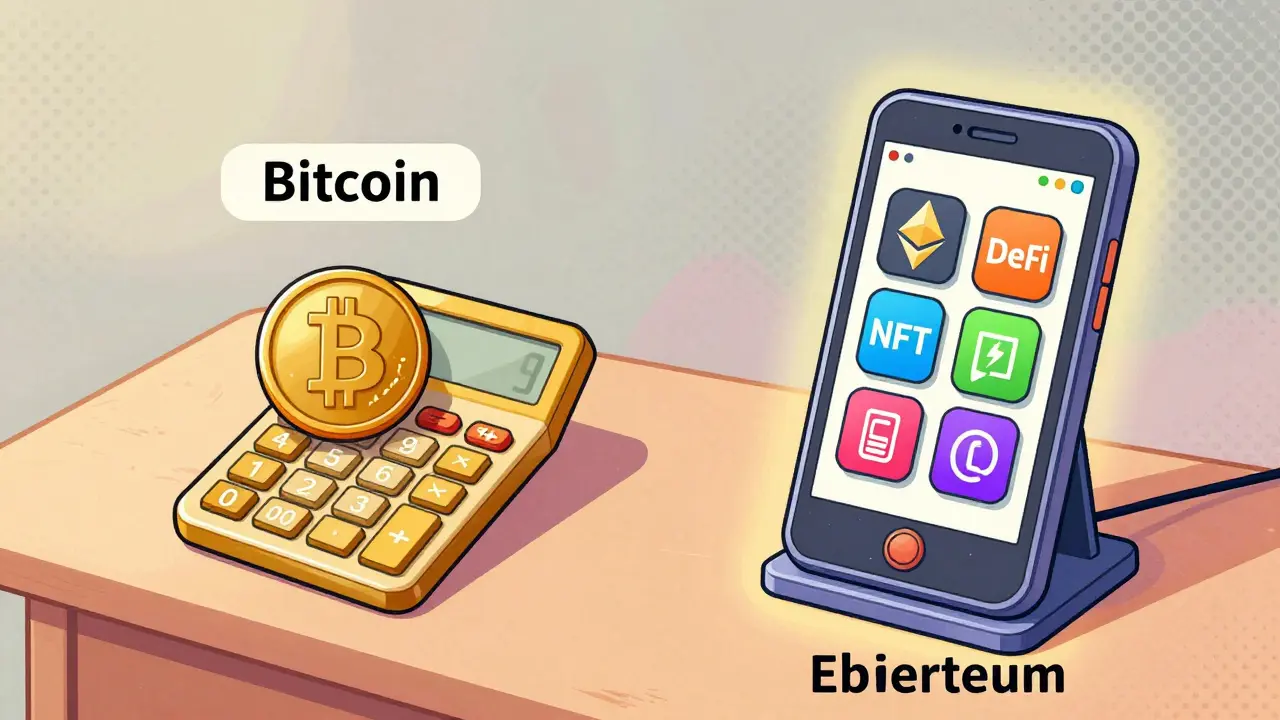
Think of it this way: Bitcoin is like a calculator-it does one thing very well. Ethereum is like a smartphone operating system (iOS or Android)-it provides the foundation upon which thousands of different apps can be built.
How Smart Contracts Power the Ecosystem
The magic ingredient in Ethereum is the smart contract. A smart contract is a self-executing agreement with the terms of the agreement between buyer and seller being directly written into lines of code.
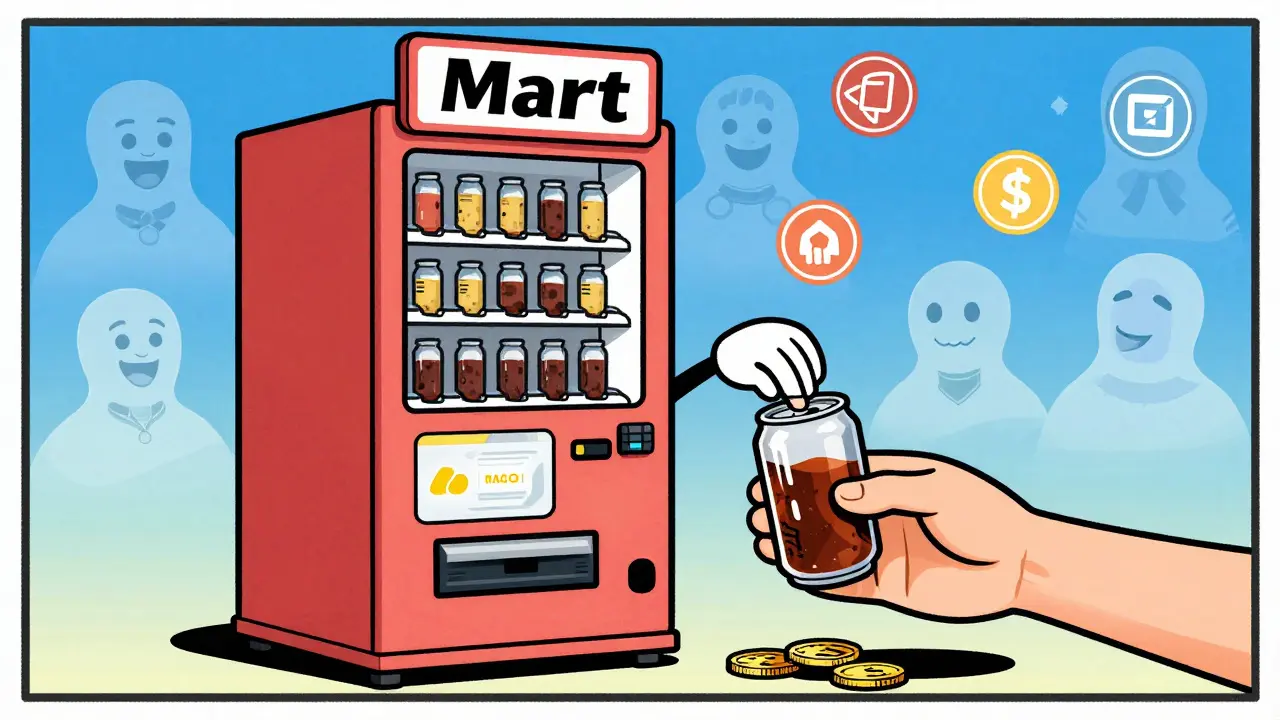
Imagine a vending machine. You put money in, select a snack, and the machine gives it to you. There is no cashier, no trust required, and no chance of the machine "forgetting" to give you your soda if you paid. That is a simple smart contract.
On Ethereum, these contracts handle billions of dollars in value daily. They power:
- Decentralized Finance (DeFi): Lending platforms where you can earn interest or take out loans without a bank.
- Non-Fungible Tokens (NFTs): Unique digital ownership records for art, music, or game items.
- Decentralized Autonomous Organizations (DAOs): Internet communities with shared treasuries governed by token holders rather than CEOs.
Because these contracts live on the blockchain, they cannot be altered once deployed. This creates a level of transparency and immutability that traditional databases simply cannot match.
What Exactly is Ether (ETH)?
If Ethereum is the platform, Ether (ETH) is the native cryptocurrency used to pay for services on the network. Every time you interact with an Ethereum app-whether swapping tokens, minting an NFT, or playing a blockchain game-you must pay a fee. This fee is called "gas."
Why does gas exist? Because computing power costs money. When you run a smart contract, it uses processing power from the nodes (computers) securing the network. Gas ensures that users pay for the resources they consume and prevents bad actors from spamming the network with infinite loops of code for free.
As of June 2026, the circulating supply of ETH is approximately 120.7 million coins. The total market capitalization hovers around $195 billion USD, keeping it firmly in the number two spot behind Bitcoin. The price fluctuates based on demand for network usage and broader market sentiment, but its utility as "fuel" gives it a fundamental value proposition distinct from meme coins or pure speculation assets.
From Mining to Staking: The Merge Explained
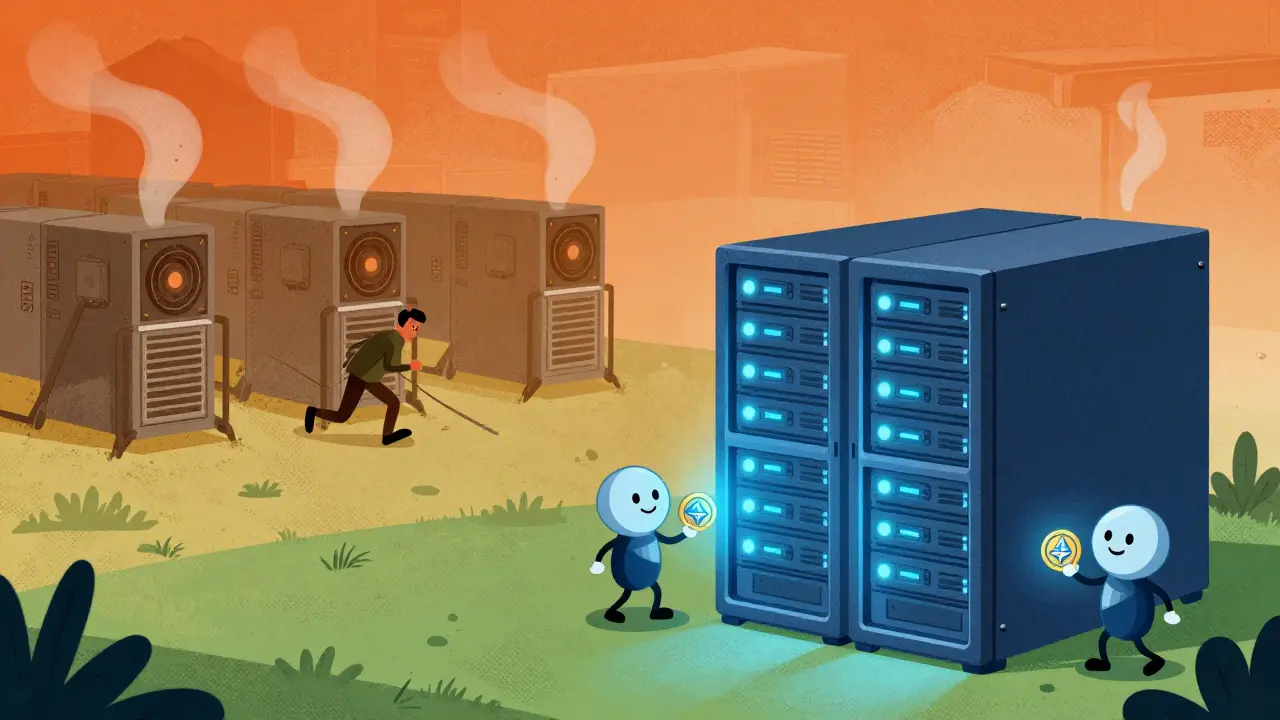
For years, Ethereum secured its network through Proof-of-Work (PoW), the same method Bitcoin uses. Miners competed to solve complex math puzzles using powerful hardware, consuming vast amounts of electricity. The winner got to add the next block of transactions and received new ETH as a reward.
This changed dramatically on September 15, 2022, with an event known as "The Merge." Ethereum switched to Proof-of-Stake (PoS). Here is how it works now:
- Validators replace miners: Instead of buying GPUs, participants lock up (stake) 32 ETH to become validators.
- Energy efficiency: This shift reduced Ethereum's energy consumption by over 99%.
- Security model: Validators are chosen pseudo-randomly to propose blocks. If they try to cheat, their staked ETH is "slashed" (destroyed).
This change made Ethereum environmentally friendly while maintaining high security levels. It also opened the door for smaller investors to participate in securing the network through staking pools, though running a solo validator still requires significant capital and technical know-how.
Understanding Gas Fees and Scalability
If you have ever tried to use Ethereum during a busy period, you have probably encountered high gas fees. When many people want to use the network at once, users bid up the price of gas to get their transactions processed faster. In peak times, simple transfers can cost tens or even hundreds of dollars.
This is Ethereum's biggest pain point. To fix this, the roadmap has shifted toward a "rollup-centric" future. Layer 2 (L2) solutions like Arbitrum, Optimism, and Base sit on top of Ethereum. They bundle thousands of transactions together and post a compressed summary back to the main Ethereum chain.
For the user, this means paying pennies instead of dollars for transactions, while still inheriting Ethereum's robust security. By mid-2026, most everyday interactions happen on these Layer 2 networks, with the main Ethereum layer acting as the ultimate settlement court.
| Feature | Bitcoin (BTC) | Ethereum (ETH) |
|---|---|---|
| Primary Use Case | Store of Value / Digital Gold | Programmable Money / App Platform |
| Consensus Mechanism | Proof-of-Work (Mining) | Proof-of-Stake (Staking) |
| Smart Contracts | Limited Scripting | Full Turing-Complete Support |
| Block Time | ~10 Minutes | ~12 Seconds |
| Supply Cap | 21 Million (Hard Cap) | No Hard Cap (Deflationary Pressure via Burns) |
| Main Innovation | Decentralized Currency | d>Decentralized Applications (dApps)
Getting Started with Ethereum
Using Ethereum is different from using a bank account. You are responsible for your own security. Here is the basic workflow for a new user:
- Get a Wallet: Download a non-custodial wallet like MetaMask or Rainbow. This generates a private key and a seed phrase. Never share your seed phrase with anyone.
- Buy ETH: Purchase ETH on a centralized exchange (like Coinbase or Kraken) and withdraw it to your wallet address.
- Connect to dApps: Use your wallet to connect to decentralized applications. For example, you might connect to Uniswap to swap tokens or OpenSea to view NFTs.
- Manage Gas: Always keep some extra ETH in your wallet to pay for gas fees. If you run out, you cannot move your other tokens out.
The learning curve is steep. Mistakes are irreversible. If you send ETH to the wrong address, there is no customer support to call. This is why starting with small amounts and reading documentation carefully is crucial.
Risks and Challenges
Ethereum is not without flaws. Critics often point to three main issues:
- User Experience (UX): Managing keys, understanding gas limits, and approving contract interactions is confusing for non-technical users.
- Centralization Concerns: While the protocol is decentralized, a large portion of staking is done through a few major providers (like Lido or exchanges), which raises questions about validator concentration.
- Regulatory Uncertainty: Governments worldwide are still figuring out how to regulate DeFi and tokens built on Ethereum. This creates legal risks for builders and users alike.
Despite these challenges, Ethereum retains the largest developer community in crypto. Network effects matter: because so many tools, libraries, and projects are built for Ethereum, it remains the default choice for serious infrastructure development.
Is Ethereum better than Bitcoin?
It depends on your goal. Bitcoin is superior as a store of value due to its simplicity, fixed supply, and longer track record. Ethereum is superior if you want to use decentralized applications, lend/borrow crypto, or trade NFTs. They serve different purposes in the digital asset ecosystem.
Will ETH price go to zero?
While no investment is risk-free, ETH has a strong utility case. As long as people use Ethereum for DeFi, NFTs, and stablecoins, there will be demand for ETH to pay gas fees. However, volatility is high, and prices can drop significantly in bear markets.
What is the difference between ETH and ERC-20 tokens?
ETH is the native currency of the Ethereum network. ERC-20 tokens (like USDC, UNI, or SHIB) are secondary tokens built *on top* of Ethereum. Think of ETH as the electricity that powers the grid, and ERC-20 tokens as the appliances plugged into it.
How do I stake Ethereum safely?
You can stake directly by running a validator node (requires 32 ETH and technical skills) or use a staking pool/service (like Lido, Rocket Pool, or exchange staking). Pools allow you to stake smaller amounts but introduce counterparty risk. Always research the provider before locking your funds.
Are Ethereum transactions private?
No. All Ethereum transactions are public and visible on the blockchain explorer. Anyone can see the sender, receiver, and amount. For privacy, users often use mixing services or Layer 2 solutions with privacy features, though regulatory scrutiny on these tools is increasing.