What is UMM (UMM) crypto coin? A clear breakdown of price, purpose, and risks
 Jan, 24 2026
UMM, or Universal Metaverse Expansion Protocol, isn’t another meme coin chasing viral trends. It’s a token built with one goal: to make it easier for developers to build metaverse apps without getting stuck in blockchain technical chaos. But here’s the problem - while the idea sounds solid, the execution is messy. If you’re wondering whether UMM is worth your time, you need to know what’s real and what’s just noise.
What UMM actually does
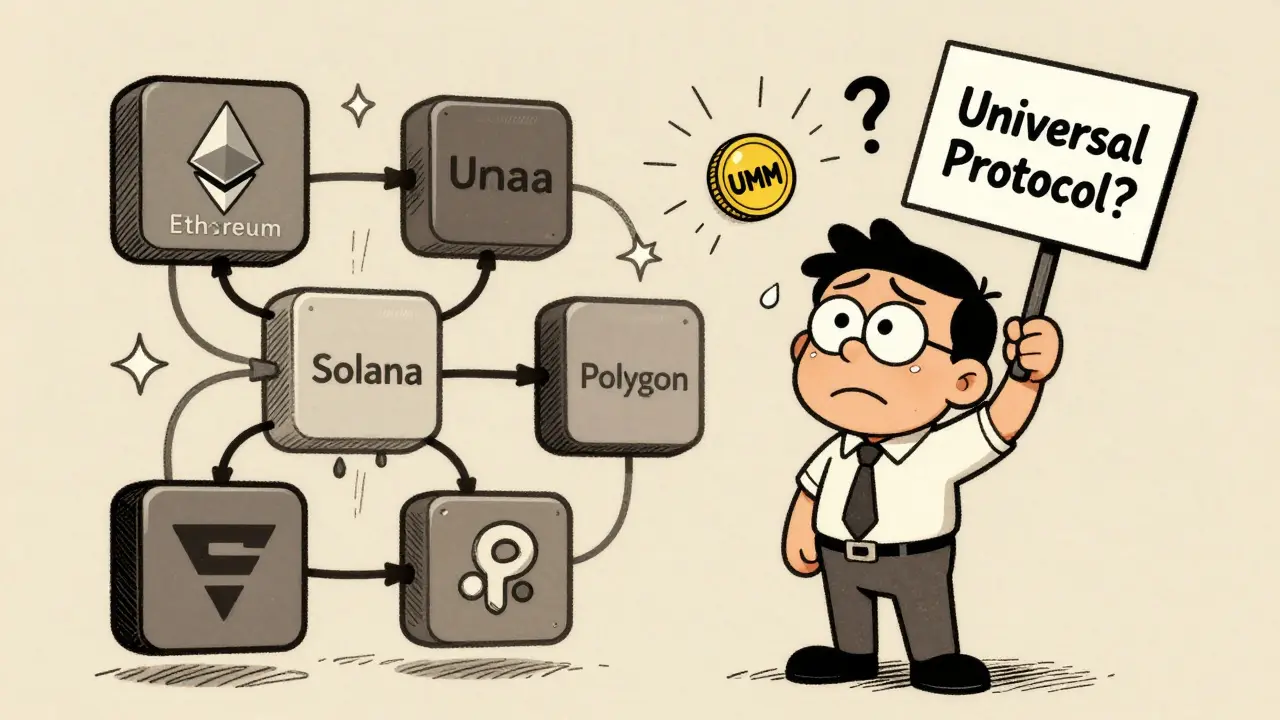
UMM is designed as infrastructure, not a consumer app. Think of it like a set of pre-built tools for developers trying to connect their metaverse projects to multiple blockchains. Instead of coding separate integrations for Ethereum, Solana, or Polygon, UMM offers standardized plug-ins for storage, communication, and cross-chain transactions. The project claims it removes the need to "overthink the technical differences" between chains. That’s useful - if it actually worked the way it says.
The token itself, UMM, runs as an ERC-20 token on Ethereum. That means it uses Ethereum’s security and smart contract system. But here’s where things get confusing. Some sites say UMM is built on Solana. Others say Ethereum. CoinMarketCap and Binance list it as ERC-20. LBank and CoinLore don’t clarify. This isn’t just a minor inconsistency - it’s a red flag. If the core tech isn’t clearly defined, how can developers trust it?
Price history and market performance
UMM launched in September 2024 at $0.975. By July 26, 2025, it hit its peak at $3.48 - a 255% gain in under 10 months. That’s impressive. But since then, it’s dropped nearly 17%. As of January 2026, it’s trading around $2.89, according to CoinMarketCap.
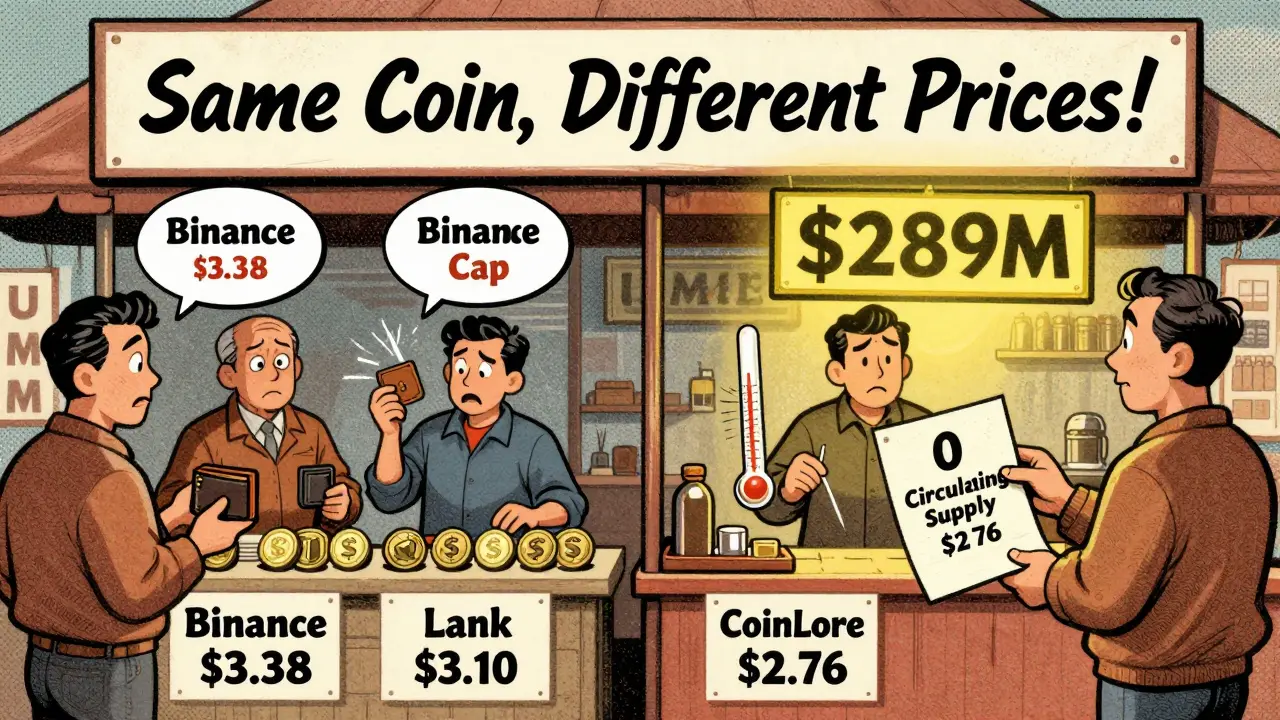
But here’s the twist: the price isn’t the same everywhere. On Coinbase, it’s at $3.38. On LBank, it’s $3.10. On CoinLore, it’s $2.76. That’s a $0.62 difference between the highest and lowest prices for the same token. That kind of inconsistency doesn’t happen with major coins like Bitcoin or Ethereum. It suggests thin trading, low liquidity, and possibly manipulated data.
Trading volume is equally all over the place. Binance reports $1.58 million in 24-hour volume. LBank says $920,000. CoinMarketCap says $1.35 million. CoinLore claims only 387,247 tokens traded. If you’re trying to buy or sell UMM, you might not find buyers at the price you expect. Slippage could eat into your profits.
Supply and market cap: The numbers don’t add up
UMM has a fixed supply of 100 million tokens. That part is consistent. But here’s where it gets weird. Coinbase says all 100 million are in circulation. Binance says 0 are in circulation. CoinMarketCap says 100 million are circulating. That’s impossible. One of them is wrong - or worse, they’re all pulling data from unreliable sources.
Market cap is calculated by multiplying price by circulating supply. So if Binance says supply is zero, its market cap should be $0. But it shows $289 million. That’s not a glitch - it’s a contradiction. It means the data feeding these platforms is either outdated, misreported, or intentionally misleading. You can’t make smart investment decisions when the basic numbers are broken.
Where UMM stands compared to competitors
The metaverse space isn’t empty. Decentraland (MANA) and The Sandbox (SAND) have combined market caps over $3 billion. Polygon has already solved cross-chain scaling for thousands of apps. Chainlink handles decentralized data feeds. The Graph indexes blockchain data for developers.
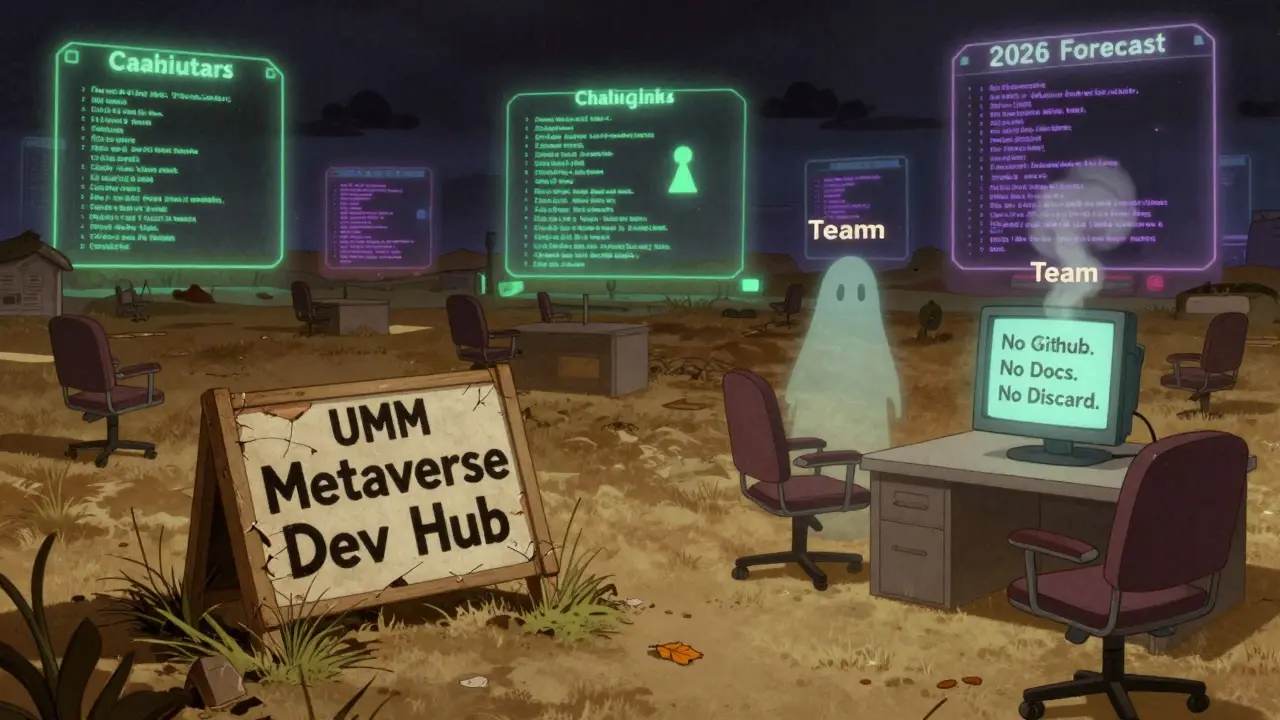
So what makes UMM different? It claims to be a "universal protocol" - but it doesn’t show it. There’s no GitHub repo. No public roadmap. No developer documentation. No active Discord or Telegram. The only thing you’ll find are price charts and exchange listings. That’s not a project. That’s a listing.
Analysts at Delphi Digital say tokens without clear utility, active development, and a real community have an 85% chance of losing 80% of their value within 18 months. UMM checks none of those boxes. It’s sitting at #3751 on CoinMarketCap. That’s not just low - it’s near the bottom of the entire crypto market.
Community and trust: Where’s the proof?
There are no verified reviews on Trustpilot. No official social channels. CoinMarketCap lists zero user reviews despite a $289 million market cap. Reddit has a few scattered posts. One user says they used the storage protocol and found the API decent. Another called it "another metaverse token chasing hype without real utility." The upvotes tell the story - the skeptical comment got 24 upvotes. The positive one got 12.
LunarCrush shows 62% bearish sentiment among the tiny amount of social chatter. That’s not a community. That’s a graveyard.
If you’re a developer, you’d want to see code. You’d want to know how to integrate UMM into your project. You’d want tutorials, examples, support. You’d want to know if anyone else is using it. None of that exists. And that’s the biggest risk.
Is UMM a scam?
No, not by legal definition. It has a contract address. It’s listed on exchanges. It’s not a Ponzi scheme. But that doesn’t mean it’s safe or valuable.
It’s a high-risk, low-transparency project. The team hasn’t released public information. The tech claims aren’t verifiable. The data is inconsistent. The community is invisible. The competition is overwhelming. And the price, while up from its low, is already down 17% from its peak.
Some people bought early and made money. That’s how these tokens work. But if you’re buying now, you’re not investing in a project - you’re gambling on speculation.
What’s the future for UMM?
Forecasting UMM is like predicting the weather with a broken thermometer. CoinCodex says it’ll drop 25% to $2.56 by February 2026. But Binance shows a 6.6% gain over the last 30 days. Which one’s right? Neither, probably. The market is too thin to trust any single signal.
The broader metaverse market is growing - projected to expand at 34% annually through 2030. But UMM isn’t positioned to capture any of that growth. It’s not integrated into major platforms. It’s not used by known developers. It’s not even clearly built on one blockchain.
If the team suddenly releases real documentation, opens a GitHub repo, starts responding to questions, and builds real partnerships - then maybe UMM has a shot. But as of now? There’s no evidence they’re doing any of that.
Should you buy UMM?
If you’re looking for a long-term investment in metaverse infrastructure - look at Polygon, Chainlink, or even established metaverse platforms like Decentraland. They have teams, code, users, and track records.
If you’re looking to gamble on a low-cap token with high volatility and zero transparency - then UMM might be your pick. But know this: you’re not betting on technology. You’re betting that someone else will pay more for it next week.
And if you’re a developer? Don’t waste your time. There’s nothing here to build on.
Is UMM a real cryptocurrency?
Yes, UMM is a real token with a contract address on Ethereum. But "real" doesn’t mean legitimate or valuable. It exists on exchanges, but lacks transparency, documentation, and community support - which are essential for any crypto project to be trusted.
Where can I buy UMM?
UMM is listed on exchanges like Binance, Coinbase, LBank, and CoinLore. But prices vary significantly between them, and trading volume is low. This makes buying and selling risky - you may not get the price you see, and you could face difficulty exiting your position.
Is UMM built on Ethereum or Solana?
Most reliable sources, including CoinMarketCap and Binance, list UMM as an ERC-20 token on Ethereum. However, CoinSwitch and some other platforms claim it’s on Solana. This contradiction suggests poor data management or misleading promotion. Always verify the contract address (0x4b77...181D1d) before interacting with the token.
Why is UMM’s market cap inconsistent across platforms?
Because the circulating supply data is conflicting. Coinbase says 100 million tokens are circulating. Binance says zero. CoinMarketCap says 100 million. Since market cap = price × circulating supply, this leads to impossible numbers. It’s a sign that data feeds are unreliable - a major red flag for any crypto asset.
Does UMM have a whitepaper or developer docs?
No verified whitepaper or developer documentation exists. There are no GitHub repositories, no API guides, no tutorials. Without these, developers can’t build on UMM, and investors can’t verify its claims. This is one of the biggest weaknesses of the project.
Is UMM a good investment in 2026?
Based on current data, no. UMM lacks the foundation - team transparency, active development, community, and clear utility - that successful crypto projects need. Its price rise from $0.97 to $3.48 was likely speculative. The recent drop and lack of growth signals suggest it’s losing momentum. Unless the team releases real progress, it’s more likely to decline than rise.
Can I use UMM in metaverse apps today?
Not practically. While the project claims to offer plug-ins for metaverse development, there’s no evidence that any real application is using UMM. Without documentation, code samples, or developer tools, it’s impossible to integrate. It remains a theoretical concept, not a working tool.
What’s the biggest risk with UMM?
The biggest risk is that UMM has no verifiable foundation. No code, no team, no community, no clear blockchain base, and inconsistent data. You’re investing in a promise, not a product. If the team disappears or stops updating, the token could become worthless overnight - and you’d have no recourse.
Heather Crane
January 25, 2026 AT 18:19Okay but can we just appreciate how rare it is to see a crypto project that actually admits its own flaws? Most of these tokens are just flashy landing pages with no substance - UMM at least gives you the full picture. I’m not buying, but I respect the honesty.
Nathan Drake
January 26, 2026 AT 14:44It’s funny how we treat crypto like it’s supposed to be transparent when the entire system is built on opacity. If you’re waiting for a team to publish a whitepaper before you invest, you’re already behind. The market doesn’t care about documentation - it cares about momentum. And right now, UMM has a pulse.
Deepu Verma
January 27, 2026 AT 01:03Look, I’ve seen a hundred metaverse tokens come and go. Most die because they’re just rebranded ICOs. But UMM? It’s got potential - if the team wakes up. The idea of cross-chain plug-ins is solid. I’ve tried similar tools on Polygon and they’re a nightmare to integrate. If UMM actually delivers on that, even half as well as it claims, it could be the quiet backbone of the next wave of dev tools. Just needs a GitHub repo and a Discord that doesn’t look like a ghost town.
Julene Soria Marqués
January 28, 2026 AT 13:14LOL the price differences between exchanges are hilarious. Coinbase at $3.38? That’s the ‘I’m a retail investor who doesn’t know how to read a chart’ price. LBank at $2.76? That’s the real market. And Binance saying 0 tokens are circulating? Classic. Someone’s feeding fake data to pump it. You’re not investing in tech - you’re betting on someone else’s delusion.
Bonnie Sands
January 30, 2026 AT 13:11Wait - if Binance says circulating supply is zero but the market cap is $289M, that means they’re using total supply instead of circulating? That’s not a glitch. That’s fraud. And CoinMarketCap just goes along with it? They’re all in on it. This isn’t a project - it’s a honeypot. Someone’s draining liquidity and the exchanges are letting it happen because they take fees. You’re not buying crypto - you’re buying a rigged slot machine.
MOHAN KUMAR
February 1, 2026 AT 13:10Why even talk about this? No code. No team. No updates. Just price charts and confused exchange listings. If you want to gamble, go to Vegas. At least they give you free drinks. This? This is just taking money from people who don’t know how to Google.
Darrell Cole
February 3, 2026 AT 09:25Dave Ellender
February 4, 2026 AT 21:48There’s something refreshing about a post that doesn’t scream ‘BUY NOW’ or ‘SCAM ALERT’. It just lays out the facts - the inconsistencies, the silence, the lack of dev activity. And honestly? That’s more useful than any influencer’s 30-second TikTok breakdown. UMM might not be a scam, but it’s definitely not an investment. It’s a curiosity.
Adam Fularz
February 6, 2026 AT 07:28UMM? More like UMMmm... as in ‘I’m not sure if this is real or just a bot farm on Binance’. No docs, no team, no GitHub - and yet somehow it’s trading at $2.89? I don’t get it. Either the whole thing’s a front for laundering or someone’s got a really long-term grift going. Either way, I’m staying out.
Linda Prehn
February 7, 2026 AT 17:45I mean… if you’re into this kind of thing, fine. But I just don’t understand why anyone would waste their time on something that doesn’t even have a Discord server. Like… is this a crypto project or a spreadsheet someone made in 2023 and forgot about?
Adam Lewkovitz
February 8, 2026 AT 07:39America built the internet. China builds AI. Europe builds regulations. Who’s building this UMM nonsense? Some guy in a basement in Moldova? If this was real, it’d be backed by a top-tier VC or at least a known dev team. But no. Just a token with a weird name and a bunch of fake numbers. This is why crypto is a joke.
Clark Dilworth
February 8, 2026 AT 19:40From an infrastructure standpoint, the concept of a universal metaverse protocol is not inherently flawed. The real issue is execution velocity and data integrity. Without a verifiable node map, API documentation, or cross-chain middleware deployment logs, the token remains a speculative abstraction - a digital phantom limb. The market is pricing in potential, but the absence of on-chain utility renders it functionally inert. It’s not a scam - it’s a vacuum.
Brenda Platt
February 9, 2026 AT 04:03Hey, I get that this looks sketchy - but maybe the team is just quiet because they’re actually building? I’ve seen devs disappear for months to ship something real. Maybe they’re coding in the shadows. I’m not saying buy it - but don’t write it off just because it’s not on Twitter every hour. Give it 6 months. If nothing happens, then walk away. But don’t be the person who screams ‘scam’ before the code even exists.
😊Arnaud Landry
February 9, 2026 AT 13:46Let’s be honest - the entire crypto market is a pyramid scheme wrapped in blockchain jargon. UMM is just the latest layer. The fact that exchanges are listing it with conflicting data proves they’re complicit. They don’t care if it’s real. They care if it brings trading volume. And you? You’re the one paying the fee to play their game. Wake up. This isn’t finance. It’s theater.
Mark Estareja
February 10, 2026 AT 22:41People keep saying ‘no GitHub’ like that’s the end-all. But most of the real infrastructure projects - like Chainlink or The Graph - started with zero public code too. They built in private, then released when it was ready. Maybe UMM’s doing the same. The market cap inconsistency? That’s a data feed issue, not a project failure. The price is up 255% - that’s real demand. Don’t confuse bad APIs with bad ideas.
David Zinger
February 11, 2026 AT 03:50Oh wow a token with inconsistent supply data and no team? Shocking. Next you’ll tell me some guy on Reddit posted a link to a contract address and called it a whitepaper. This is why crypto is a joke. I bet the founder is a 19-year-old in India who just learned how to deploy an ERC-20. And now he’s got a $300M market cap. The system is broken.
😂steven sun
February 11, 2026 AT 06:05bro u guys are overthinking this. its just a coin. if it goes up you cash out. if it goes down you say ‘oh well’. no need for github or whitepapers. just buy low sell high. thats how u make money. u dont need to understand it just trust the chart.
Catherine Hays
February 12, 2026 AT 09:06They listed it on Coinbase. That’s all you need to know. If it wasn’t legit, Coinbase wouldn’t touch it. End of story. You’re all just jealous because you didn’t buy at $0.97. Now you’re crying about ‘data inconsistencies’ because you missed your chance. Grow up.
Chidimma Catherine
February 14, 2026 AT 07:17Actually i think this is a good oppurtunity for africa. we need more crypto projects that are not just for usa and europe. if umm is really built for devs then maybe we can use it to build metaverse apps in nigeria and ghana. no one else is doing this for us. even if its messy its better than nothing
Mike Stay
February 14, 2026 AT 12:44Let’s take a step back. The metaverse isn’t dead - it’s just waiting for infrastructure to catch up. UMM isn’t the answer, but it’s a symptom of a real problem: fragmentation. Every blockchain has its own rules, its own tools, its own silos. What if someone *could* build a universal bridge? Even if UMM fails, the *idea* is valid. The fact that no one’s building it properly is the real tragedy. This token might be a ghost, but the need it claims to fill? That’s alive and screaming.
Taylor Mills
February 16, 2026 AT 04:24Look at the trading volume. 1.5 million on Binance? That’s nothing. It’s a dead coin with a few pumps. The fact that it’s at #3751 on CoinMarketCap says it all. You think you’re getting in early? You’re getting in last. The whales already dumped. The only people buying now are the ones who still think crypto is a lottery ticket. Don’t be one of them.