What is Yearn Finance (YFI)? Explaining the DeFi Yield Aggregator and Governance Token
 Feb, 4 2026
Contrary to what many assume, Yearn Finance isn't a cryptocurrency coin-it's a DeFi protocol that automates yield farming. The YFI token? It's just a governance tool. Let's clear up the confusion.
What Yearn Finance Actually Is
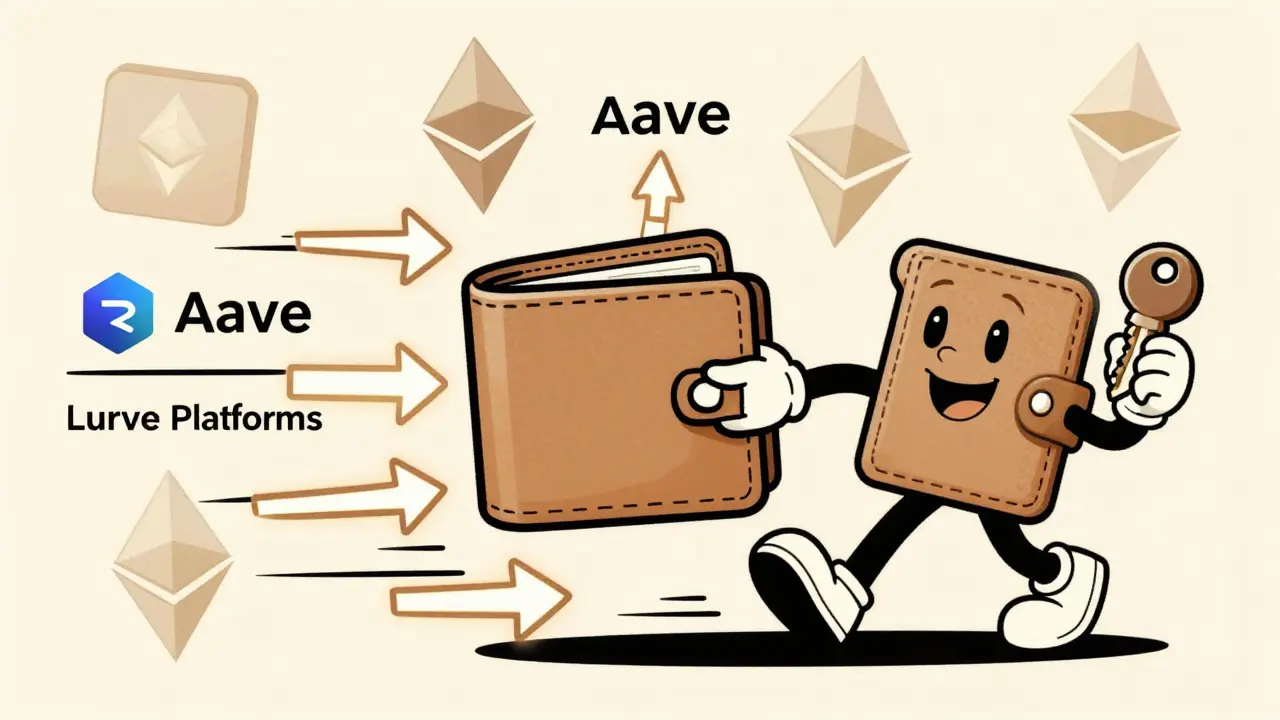
Yearn Finance is a decentralized finance protocol built on Ethereum that automates yield farming across lending platforms. Created by developer Andre Cronje and launched in February 2020, it quickly became one of DeFi's fastest-growing projects. Unlike centralized platforms like banks or exchanges, Yearn uses smart contracts to move your crypto between protocols like Aave and Compound without intermediaries. Your funds stay in your wallet-you never hand over control. This self-custody model is key to why it's popular in DeFi.
How Yearn Finance Works
Imagine depositing DAI into Yearn. Instead of earning a fixed rate, the protocol constantly checks interest rates across platforms. If Aave offers 5.2% APY and Compound offers 4.8%, Yearn automatically shifts your DAI to Aave. You receive yDAI tokens representing your share. This rebalancing happens in the background, triggered by deposits or withdrawals. No manual monitoring needed. As of Q3 2024, Ethereum gas fees averaged $1.50-$3.00 per transaction, but Yearn's Zap tool bundles steps to save on costs. For example, depositing into a vault and adding liquidity to Curve can be done in one click.
Key Products: Earn, Vaults, and Zap
Yearn's ecosystem has three main tools:
- Earn: Shows real-time interest rates across lending platforms. You can manually move assets to the best rate.
- Vaults: Automated strategies that rebalance funds between protocols. For example, the yDAI vault shifts deposits between Aave, Compound, and Curve to maximize returns. Stablecoin vaults like yUSDC have averaged 3.2-4.8% APY in 2024.
- Zap: Bundles multiple transactions into one click. This saves gas fees by combining steps like depositing into a vault and adding liquidity to a pool.
What Is the YFI Token?
YFI token is the governance token for Yearn Finance, with no monetary value beyond voting power. Holders vote on protocol changes like fee adjustments or new vaults. Each YFI equals one vote. There are only 30,330 YFI tokens in circulation-all distributed during Yearn's 2020 launch. No tokens were reserved for developers or investors, making it community-owned. Unlike coins like Bitcoin, YFI can't be used for payments; its only purpose is governance.

Pros and Cons of Using Yearn Finance
Pros:
- Automated optimization: No need to manually track rates; Yearn does the work. For example, a user who deposited 50 ETH in January 2023 earned 3.8 ETH in yield over 18 months-significantly more than direct staking on Lido.
- Self-custody: You keep control of your funds, unlike centralized platforms like Celsius (which collapsed in 2022).
- High yields: Consistently outperforms single-protocol options. Reddit user DeFiInvestor2020 reported consistently outperforming Compound by 0.7-1.2% with yUSDC vaults.
Cons:
- High gas fees: Ethereum transactions cost $1.50-$3.00 per operation, which can eat into small deposits. A Trustpilot review from August 2024 mentioned losing $200 in gas fees due to interface confusion.
- Complex interface: New users often struggle with vault types and withdrawal mechanics. A BLOX guide notes new users typically need 5-7 hours to become proficient.
- Security risks: A $11 million governance attack in February 2023 exploited a voting flaw. While Yearn has improved security, past incidents highlight risks.
Current Stats and Market Position
As of September 2024, Yearn Finance managed $213 million in total value locked (TVL), down from its peak of $800 million in 2020. According to Bankless, it's now the seventh-largest yield aggregator, behind Beefy Finance ($310M TVL) and Idle Finance ($185M). Despite this, Yearn's vault strategies remain among the most sophisticated in DeFi. The protocol charges a 5% performance fee on Vaults and 0.5% management fee on Earn. In 2023, this generated $1.8 million in fees-far below the $21 million projected in 2020. This decline reflects market consolidation after the 2022 crypto winter.
Recent Developments and Future Plans
In July 2024, Yearn partnered with ShapeShift to integrate its yield strategies across 750+ cryptocurrencies on 11 blockchains. This lets users earn yield without extra fees. The 2025 roadmap includes expanding to Solana and Bitcoin Layer 2 networks, lowering fees to 3% performance fee plus 0.1% deposit fee, and launching 'Yearn Insurance' to protect against smart contract failures. These changes aim to address past issues like the $11 million attack. Industry analysts like Delphi Digital project Yearn's TVL could reach $350 million by Q4 2025-a 64% increase-but this still represents only 6.2% of the projected $5.6 billion yield aggregator market.
Real User Experiences
Reddit threads show mixed feedback. A September 2024 thread titled "Yearn Vaults performance after the v3 update" had 247 upvotes. Users reported stablecoin vaults averaging 3.2-4.8% APY, but gas fees hurt small deposits. Conversely, a Trustpilot review from August 15, 2024, rated Yearn 2.5/5 stars, complaining: "The interface confused me and I accidentally deposited into the wrong vault, losing $200 in gas fees." According to DeFi Llama, Yearn has a 4.3/5 average rating across 127 reviews, with "automatic optimization" praised in 68% of positive reviews and "high gas fees" cited in 42% of negatives.
Who Should Use Yearn Finance?
Yearn is best for intermediate-to-advanced DeFi users. Data from DappRadar shows 72% of its user base has at least 12 months of DeFi experience. Beginners often struggle with the complexity-like choosing between single-asset vs. LP vaults or understanding withdrawal mechanics. If you're new to DeFi, simpler platforms like Compound or Aave might be better starting points. But if you're comfortable with smart contracts and want automated yields, Yearn's vault strategies can outperform manual efforts. For example, the yETH vault consistently outperforms direct staking on Lido by 1.5-2% annually based on 2024 data.
Frequently Asked Questions
Is YFI a cryptocurrency coin?
No. YFI is a governance token for Yearn Finance, not a currency. It's used for voting on protocol changes, not for buying goods or services. Unlike coins like Bitcoin or Ethereum, YFI has no monetary function beyond governance. There are only 30,330 YFI tokens in existence, all distributed during Yearn's 2020 launch.
How do I start using Yearn Finance?
First, connect an Ethereum wallet like MetaMask. Then visit Yearn's website and select a vault matching your risk tolerance. Stablecoin vaults (like yUSDC) are the safest for beginners. Deposit your assets, and Yearn will automatically optimize yields. For small deposits, use Zap to bundle transactions and save on gas fees. First-time users typically need 8-12 minutes for setup.
Is Yearn Finance safe?
Yearn has faced security issues, like a $11 million governance attack in February 2023. However, it has since improved safeguards, including multi-sig wallets and code audits. No major exploits have occurred since the 2023 incident. That said, DeFi always carries smart contract risks. Only invest what you can afford to lose, and avoid using Yearn for large sums until you're comfortable with its mechanics.
Why is Yearn's TVL lower than in 2020?
After the 2020 DeFi boom, the market consolidated during the 2022 crypto winter. Competitors like Beefy Finance and Idle Finance grew faster, while Yearn's Ethereum-only focus made it less accessible during high gas fee periods. Yearn expanded to other blockchains in 2023 (Fantom, Arbitrum, Optimism), but it still lags behind simpler yield aggregators. Its TVL dropped from $800 million in 2020 to $213 million in 2024, though it remains a top player in complex vault strategies.
What's the difference between Earn and Vaults?
Earn shows real-time interest rates across lending platforms like Aave and Compound. You manually move assets to the best rate. Vaults automate this process-they rebalance funds between protocols without user input. For example, the yDAI vault shifts deposits between Aave, Compound, and Curve to maximize returns. Earn is for hands-on users; Vaults are for "set it and forget it" strategies.
Alisha Arora
February 4, 2026 AT 10:33YFI is purely a governance token, not a cryptocurrency coin.
Ryan Chandler
February 5, 2026 AT 00:09OH MY GOD! Yearn's latest partnership with ShapeShift is a GAME-CHANGER for DeFi! Now 750+ cryptos across 11 chains! This is HUGE! 💯
Brittany Coleman
February 5, 2026 AT 03:39Yearn's approach to automated yield farming makes sense. Simple. Effective.
Molly Andrejko
February 6, 2026 AT 08:59Yearn Finance is a great tool for those who want to automate their yield farming, without managing it themselves; however, gas fees can be a hurdle for smaller deposits; it's important to weigh the pros and cons before diving in.
perry jody
February 6, 2026 AT 09:04Yearn's Vaults are 🔥! Automated yields saving me time and boosting returns. Just need to watch those gas fees though! 🚀
Kyle Pearce-O'Brien
February 6, 2026 AT 15:57YFI's governance model is the epitome of decentralized autonomy; however, the current TVL decline reflects market consolidation. As a seasoned DeFi participant, I see potential in the Solana expansion-truly a paradigm shift in yield aggregation. 🚀💎
Matthew Ryan
February 7, 2026 AT 00:14Yearn's vaults do offer good yields but the interface can be tricky for newcomers. It's a solid option once you get the hang of it.
Nathaniel Okubule
February 7, 2026 AT 23:54Yearn Finance is an excellent platform for experienced DeFi users. The automated strategies are efficient, but beginners should start with simpler protocols to build their knowledge first.
Robin Ødis
February 8, 2026 AT 08:06i think people really dont understand that yearn is not a coin but a protocol. the yfi token is purely for governance. yet so many people confuse it with a currency. and the gas fees are insane for small deposits. also the interface is confusing. like seriously. why is it so complicated? i lost 200 bucks in gas fees because i clicked the wrong thing. its ridiculous. and the security risks are still there. remember the $11m attack? yeah. so yeah. just saying.
Danica Cheney
February 9, 2026 AT 20:28yearn is cool but gas fees suck. easy to mess up deposits. just saying.
Michael Sullivan
February 11, 2026 AT 20:20YFI = governance token. Period. No coin. Stop calling it a currency. And gas fees? Yes. But Zap tool helps. 🤷♂️
Joshua Herder
February 12, 2026 AT 20:48i disagree with everything you just said. yearn is not as good as people think. sure, it automates yield farming but the reality is that most users end up losing money due to gas fees and complexity. the 'high yields' are only for large deposits. for the average person, it's a disaster. and the 'self-custody' claim is laughable-smart contract risks are real. this whole thing is overhyped.
Reda Adaou
February 13, 2026 AT 13:38Yearn's vaults can be great for those who know what they're doing. For beginners, it's better to start with a simple platform like Aave. The key is to understand the risks before jumping in. Stay safe out there!
Paul Gariepy
February 13, 2026 AT 18:13Yearn Finance is a powerful tool for yield optimization; however, users must be cautious about gas fees-especially for small deposits. The Zap feature is a lifesaver for bundling transactions. I've personally saved hundreds by using it correctly. Also, the YFI token is strictly for governance; it's not a currency. Always double-check your deposits!