Why Are Ethereum Gas Fees High? The Truth Behind the Costs in 2026
 Aug, 6 2026
You click "Swap" on your favorite decentralized exchange. You wait. Then you see it: a fee that feels like robbery for moving $50 worth of tokens. It’s frustrating, right? For years, this was the standard experience on Ethereum is the world's leading programmable blockchain platform.. But here is the twist: if you are reading this in 2026, those days of paying $86 for a simple transfer are largely behind us. So why do we still hear about high gas fees? And more importantly, how can you stop overpaying?
The short answer is supply and demand. The long answer involves some clever engineering, a bit of economics, and a few tools you might not be using yet. Let’s break down exactly what drives these costs up, why they have dropped so drastically recently, and how you can keep your wallet happy.
The Mechanics of Gas: What Are You Actually Paying For?
To understand why fees spike, you first need to know what "gas" actually is. Think of Ethereum as a massive, global computer. Every time someone runs an app or sends money, they are asking that computer to do work. Gas is the unit of measurement for the computational effort required to execute operations on the Ethereum network.
Validators-the computers securing the network-need to be paid for their electricity and hardware. They don’t get paid per second; they get paid per operation. A simple ETH transfer is easy. It takes about 21,000 units of gas. Complex actions, like swapping tokens on Uniswap is a popular decentralized exchange protocol built on Ethereum., require the network to check balances, update ledgers, and execute smart contracts. That can cost 150,000 to 300,000 gas units or more.
The price of that gas isn't fixed. It fluctuates based on how many people want to use the network at the same time. When everyone wants to move money during a market rally, the block space (the room available in each new block) fills up instantly. Users start bidding against each other to get their transactions processed first. That competition drives the price up.
The Game Changer: How the Dencun Upgrade Slashed Costs
If you remember 2024, gas prices were painful. The average transaction cost around $15. By early 2025, something shifted dramatically. Enter the Dencun Upgrade is a major Ethereum network upgrade implemented in March 2024 that introduced proto-danksharding to reduce Layer 2 costs.
This wasn't just a minor tweak. It fundamentally changed how data is handled on the network. Before Dencun, Layer 2 networks had to pay full price to post their transaction data back to Ethereum mainnet. After the upgrade, that data posting became significantly cheaper through a mechanism called EIP-4844.
The results speak for themselves. In 2025, average gas prices plummeted by roughly 95%. Where a swap used to cost $86, it now averages around $0.39. NFT mints, which once ran users $145, dropped to less than a dollar. This is the most significant improvement in Ethereum’s history regarding affordability.
| Transaction Type | Average Cost (2024) | Average Cost (2025/2026) | Reduction |
|---|---|---|---|
| Simple ETH Transfer | $5 - $10 | $0.10 - $0.30 | ~90% |
| Token Swap (DeFi) | $15 - $86 | $0.39 - $1.50 | ~95% |
| NFT Mint | $50 - $145 | $0.65 - $2.00 | ~96% |
Why Do Fees Still Spike? The Congestion Factor
So if fees are down 95%, why do headlines still scream about expensive gas? Because Ethereum is still a finite resource. Even with cheaper base layers, the mainnet has limits. When a viral event happens-a highly anticipated token launch, a popular NFT drop, or a sudden market crash-the network gets congested.
Take the WLFI token launch in early 2025. Demand surged so hard that gas prices jumped from under 1 gwei to over 100 gwei in minutes. Transfers that usually cost pennies suddenly exceeded $145. This isn't a bug; it's a feature of a secure, decentralized network. If there were no limit on how much could fit in a block, the network would slow to a crawl or become vulnerable to attacks.
Experts like Sid Sridhar, CEO of a Web3 infrastructure firm, point out that these spikes remind us that while Ethereum is sophisticated, its Layer 1 capacity can still be overwhelmed by single-point demand. The solution isn't necessarily to make Layer 1 bigger-it's to move activity elsewhere.
The Real Solution: Layer 2 Networks
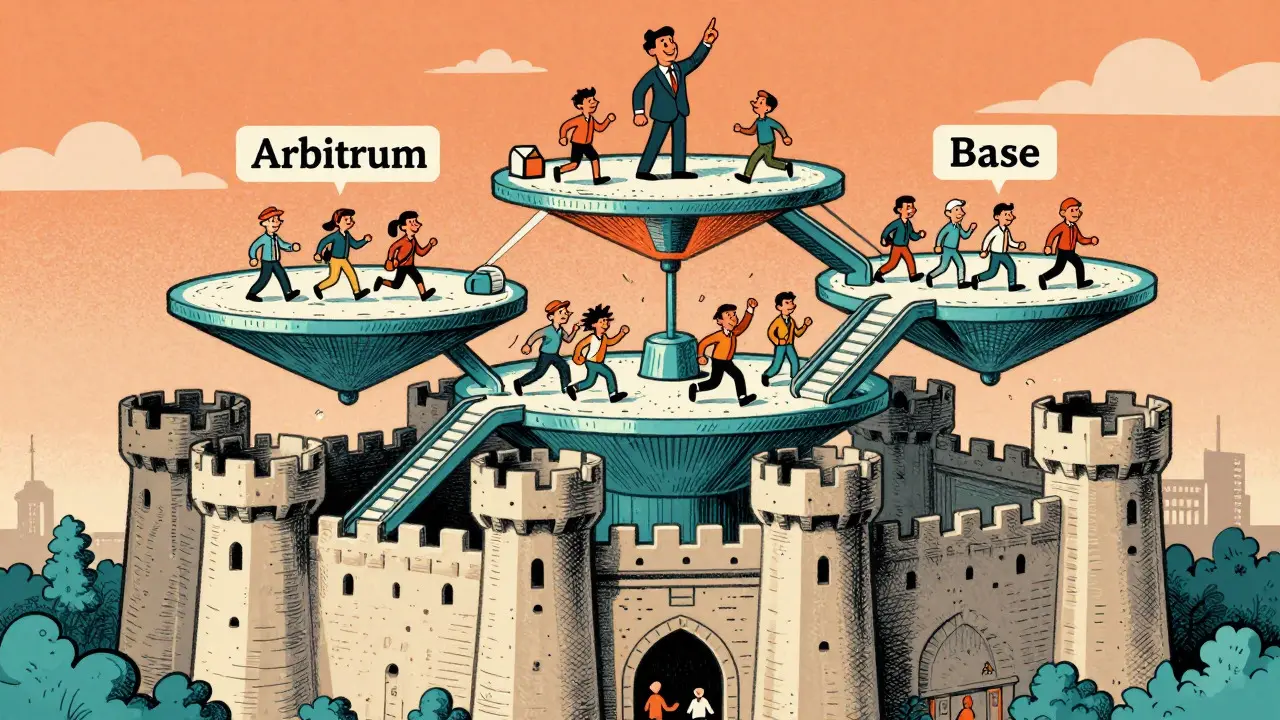
If you want to avoid high fees entirely, you likely aren't even supposed to be on the Ethereum mainnet for daily tasks. This is where Layer 2 Scaling Solutions are blockchain networks built on top of Ethereum to increase throughput and reduce costs. come into play.
Networks like Arbitrum is an optimistic rollup Layer 2 solution for Ethereum., Optimism is another leading optimistic rollup platform on Ethereum., and Base is Coinbase's Layer 2 blockchain built on the OP Stack. process thousands of transactions off-chain and then bundle them together to settle on Ethereum. This means you get Ethereum’s security but pay a fraction of the cost.
For most users, the difference is night and day. On Arbitrum or Optimism, a complex DeFi interaction might cost $0.05. On Base, it could be even less. These networks have absorbed the vast majority of retail traffic, leaving the mainnet mostly for large institutional moves and critical settlement layers.
How to Save Money on Your Next Transaction
You don’t need to be a developer to optimize your costs. Here are practical steps to keep your fees low:
- Use Layer 2s whenever possible: Check if your favorite dApp supports Arbitrum, Optimism, Base, or Polygon. If it does, switch your wallet network before interacting.
- Time your transactions: Gas fees follow patterns. They are typically 25-40% lower on weekends and during early morning hours (UTC). Avoid trading during peak US business hours if you’re not in a rush.
- Check real-time trackers: Tools like ETH Gas Station is a website providing real-time estimates of Ethereum gas prices. show you the current speed vs. cost trade-off. If "Fast" is too expensive, try "Standard" unless your transaction is time-sensitive.
- Batch your operations: If you’re moving multiple assets, look for wallets or interfaces that allow batching. One transaction fee is always better than five.
Is Ethereum Still Worth It?
Critics often point to Solana is a high-performance blockchain known for low fees and high speed. or Binance Smart Chain is a blockchain parallel to Binance Chain, offering smart contract functionality. as cheaper alternatives. And yes, their base fees are often lower. But Ethereum holds a unique position. It has the deepest liquidity, the most developers, and the highest security guarantees. With over $50 billion locked in DeFi protocols, it remains the financial backbone of crypto.
The narrative has shifted. Ethereum is no longer trying to be the fastest chain for every micropayment. It is becoming the settlement layer for a multi-chain ecosystem. For the average user, this means using L2s for daily spending and saving the mainnet for high-value storage or specific applications that require direct mainnet access.
The era of unaffordable gas is ending. By understanding the mechanics and leveraging the right tools, you can navigate the network efficiently without breaking the bank.
What is the average gas fee on Ethereum in 2026?
As of 2026, following the Dencun upgrade, the average gas fee for a simple transaction on Ethereum mainnet is approximately $0.10 to $0.30. However, for most users interacting via Layer 2 networks like Arbitrum or Base, fees are often below $0.05.
Why did Ethereum gas fees drop so much recently?
The primary driver was the Dencun upgrade (EIP-4844), which reduced the cost for Layer 2 networks to post data to Ethereum mainnet. Additionally, the migration of most retail traffic to Layer 2 solutions has reduced congestion on the mainnet.
When are Ethereum gas fees the lowest?
Gas fees are typically lowest on weekends and during early morning hours UTC (roughly 2 AM to 6 AM UTC). Network activity drops during these times, reducing competition for block space.
Should I use Layer 2 or stay on Ethereum Mainnet?
For daily transactions, swaps, and NFT interactions, Layer 2 networks like Arbitrum, Optimism, and Base are significantly cheaper and faster. Use Ethereum Mainnet only for high-value transfers, specific DeFi protocols that require it, or when you need maximum security assurance for large holdings.
What causes sudden spikes in gas fees?
Sudden spikes occur during periods of high network congestion, such as popular token launches, viral NFT mints, or significant market volatility. During these events, users bid up the priority fees to ensure their transactions are processed quickly, driving overall costs higher temporarily.