Why Byzantine Fault Tolerance Matters for Cryptocurrency
 Feb, 12 2026
Imagine a group of generals surrounding a city. Each one has to decide whether to attack or retreat. But some of them are traitors. They might send conflicting messages - telling one group to attack while telling another to retreat. If the loyal generals can’t agree on a plan, the whole army fails. This is the Byzantine Generals Problem, and it’s the exact same problem that every cryptocurrency has to solve - except instead of generals, you have computers, and instead of attacking a city, they’re confirming transactions.
That’s where Byzantine Fault Tolerance (BFT) comes in. It’s not a buzzword. It’s the mathematical guarantee that lets a network of computers agree on what’s true, even when some of them are lying, broken, or hacked. Without BFT, cryptocurrency wouldn’t work. Not because it’s hard to code - but because without it, your money could vanish in seconds.
How BFT Keeps Your Crypto Safe
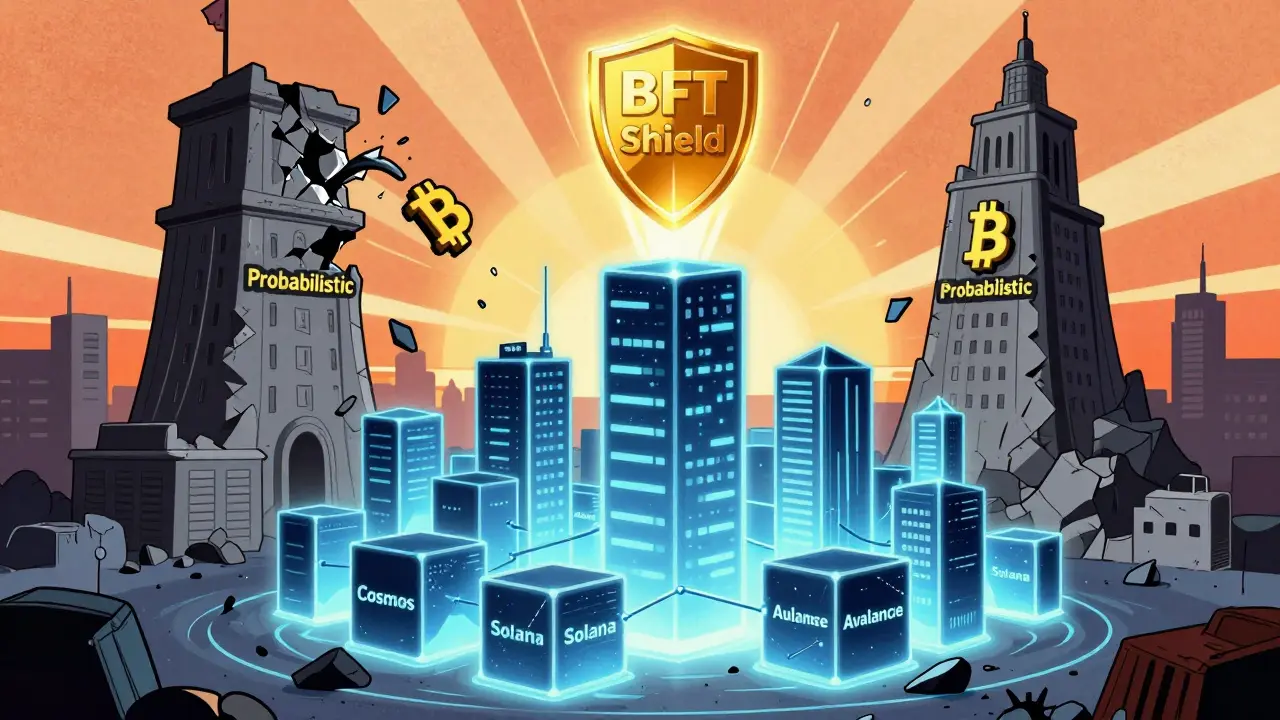
Bitcoin didn’t invent BFT, but it made it real. Satoshi Nakamoto’s solution wasn’t about voting or shouting louder. It was about making cheating expensive. In Bitcoin, you need to control over half the network’s computing power to rewrite history. That’s called Proof-of-Work, and it’s a clever workaround - not true BFT, but it gets the job done. But it’s slow. And messy. A transaction might look confirmed, then disappear hours later if a longer chain pops up. That’s probabilistic finality. It’s not final. It’s just likely.
Modern blockchains like Cosmos, Solana, and Avalanche don’t rely on luck. They use Practical Byzantine Fault Tolerance (pBFT) or similar systems. Here’s how it works: every validator votes. For a block to be locked in, at least two-thirds of them must agree. That means even if one-third of the nodes are malicious, the network still works. No reorgs. No surprises. Once it’s final, it’s gone forever.
This matters because real money is on the line. If you’re lending $50,000 on a DeFi platform and the network flips the transaction 10 minutes later, you lose everything. BFT-based chains like Cosmos avoid that. They give you deterministic finality - meaning the moment your transaction is confirmed, it’s done. No waiting six blocks. No hoping the chain doesn’t shift.
The Math Behind the Magic
It’s not guesswork. It’s math. The 1/3 threshold isn’t arbitrary. It comes from the original Byzantine Generals paper from 1982. If more than one-third of your nodes are faulty, they can outvote the honest ones. Simple as that. So if you have 100 validators, you can tolerate up to 33 bad actors. 34, and the system breaks.
This is why network size matters. PBFT works great with 100-200 nodes. But if you try to scale to 10,000, the voting becomes a bottleneck. Every node has to talk to every other node. The message traffic explodes. That’s why Bitcoin’s Proof-of-Work scales better for massive networks - even if it’s slower. Newer systems are trying to fix this. Ethereum’s Casper FFG, for example, uses a two-layer system: economic incentives to choose the right chain, then BFT-style finality on top. It’s not pure BFT, but it’s close.
Some research is even pushing beyond 1/3. A Stanford paper from early 2023 showed a new protocol that could work with as few as 20% honest nodes under specific conditions. But these are still experiments. For now, 1/3 is the gold standard.

Why This Matters More Than You Think
Most people think security means “no hacks.” But that’s not the real threat. The real threat is consensus failure. A hacker doesn’t need to steal your keys. They just need to trick the network into accepting a fake transaction. BFT stops that.
Look at what happened on Bitcoin in 2010. A bug caused a single transaction to create 184 billion BTC. It was caught. But if Bitcoin didn’t have enough miners to reject it? It would’ve crashed. That’s the difference between probabilistic and deterministic systems. Bitcoin survived because its network was big enough to override the error. But smaller chains? They don’t have that luxury.
DeFi users know this. Reddit threads from January 2023 show users losing thousands when transactions on non-BFT chains reversed. One user lost $2,350 because a “confirmed” trade got undone. That’s not theoretical. That’s real money. And BFT-based chains? They didn’t have that problem.
That’s why institutions are switching. Banks, hedge funds, and payment processors don’t want “maybe” transactions. They want certainty. That’s why 73% of banking blockchain projects now use PBFT variants, according to IBM’s 2023 survey. The EU’s MiCA regulation, which took effect in January 2024, even requires crypto networks handling financial services to prove they can handle 1/3 faulty nodes. No BFT? No license.
Trade-Offs: Speed, Cost, and Complexity
BFT isn’t perfect. It’s not magic. It has costs.
- Latency: Every vote takes time. In PBFT, a block can take 3-5 seconds to finalize. Bitcoin can confirm in 10 minutes - but it’s not final. For high-frequency trading, that delay matters.
- Scalability: PBFT needs fewer than 200 nodes to stay efficient. That’s why chains like Solana use a hybrid: BFT for finality, but with leader-based block production to keep speed high.
- Complexity: Setting up validators, managing key rotation, syncing clocks - it’s hard. Developers need 120 hours of training just to audit a BFT system, compared to 80 for simpler ones. Poor documentation? That’s why some newer chains get 3.2/5 on developer surveys.
And then there’s the hardware. To run a validator node on a serious BFT chain, you need at least a 4-core CPU, 8GB RAM, and 100Mbps internet. Not your old laptop. This pushes decentralization toward professional operators - which some purists hate. But it also makes attacks harder. You can’t just spin up 33 fake nodes on a cloud server. They have to be properly configured, funded, and maintained.
What’s Next for BFT?
BFT isn’t standing still. Ethereum’s Casper FFG upgrade in 2023 cut finality time from 6.4 minutes to under 5. Cosmos’s IBC protocol now connects 63 BFT chains, handling over a million cross-chain transactions daily. Polkadot’s NPoS combines economic staking with BFT finality. Even Bitcoin might adopt a BFT-style layer in the future - not to replace Proof-of-Work, but to add finality on top.
And the research keeps going. Linear BFT. Asynchronous BFT. Threshold signatures. Each tries to solve the same problem: how to agree fast, securely, and at scale. The goal isn’t to replace BFT - it’s to make it faster, cheaper, and more flexible.
One thing’s certain: if a new cryptocurrency doesn’t implement BFT - or something that matches its guarantees - it’s not decentralized. It’s just a database with a fancy name.
Real-World Impact: Who Uses BFT and Why
Let’s look at who’s winning:
- Cosmos (ATOM): Uses Tendermint BFT. Finalizes in 1-2 seconds. Powers over 60 independent blockchains. Used by major DeFi protocols.
- Solana (SOL): Uses a modified BFT called Sealevel. Handles 65,000 transactions per second. Popular for NFTs and high-speed trading.
- Avalanche (AVAX): Combines Snowball BFT with subnet flexibility. Used by institutional DeFi apps.
- Ethereum (post-Bellatrix): Uses Casper FFG. 99.98% finality rate. Still the most used, but now with BFT finality on top.
Compare that to Ethereum Classic or Bitcoin Cash - chains without BFT finality. They’re still around. But they handle less than 5% of DeFi value. Why? Because users and institutions won’t risk serious money on chains where transactions can still flip.
That’s the bottom line. BFT isn’t about technology for tech’s sake. It’s about trust. It’s about knowing that when you send crypto, it won’t disappear. That’s why 78% of DeFi users ranked irreversible transactions as their top priority in a CoinDesk survey. BFT delivers that. Nothing else does.
What is Byzantine Fault Tolerance (BFT) in simple terms?
BFT is a system that lets a network of computers agree on what’s true, even if some of them are lying or broken. Think of it like a group of friends deciding where to eat - but one of them is secretly trying to mess things up. BFT ensures the group still picks a restaurant, even if one or two are being sneaky.
Why can’t cryptocurrencies just use a central server?
Because the whole point of cryptocurrency is to remove trust in any single entity. A central server can be hacked, shut down, or corrupted. BFT lets thousands of independent computers agree without needing to trust each other - that’s what makes crypto decentralized.
Is Bitcoin Byzantine Fault Tolerant?
Bitcoin uses Proof-of-Work, not classic BFT. It achieves similar results by making attacks too expensive - you’d need over half the network’s computing power to cheat. But it doesn’t guarantee finality. Transactions can still be reversed, especially if they’re recent. So Bitcoin is fault-tolerant in practice, but not by the strict mathematical definition of BFT.
How many malicious nodes can BFT handle?
A properly designed BFT system can handle up to one-third of the nodes being malicious. For example, in a network of 99 validators, up to 33 can behave badly - and the rest will still reach agreement. Beyond that, the system breaks.
Do all blockchains use BFT?
No. Older chains like Bitcoin and Ethereum (pre-upgrade) use probabilistic finality. Newer chains like Cosmos, Solana, and Avalanche use BFT for faster, guaranteed finality. Around 93% of new Layer 1 blockchains launched since 2022 include BFT as a core feature.
Why is BFT important for DeFi?
DeFi apps like lending platforms and automated trading bots rely on instant, irreversible transactions. If a transaction reverses after a loan is issued, it can trigger cascading failures. BFT ensures that once a trade or payment is confirmed, it’s permanent - which is essential for financial safety.
Can BFT be hacked?
Not if it’s implemented correctly. The math behind BFT is proven. But bugs in code, misconfigured nodes, or poor validator selection can create weaknesses. The system itself isn’t hackable - but the implementation might be. That’s why audits and real-world testing matter.
What’s the difference between deterministic and probabilistic finality?
Deterministic finality means a transaction is final the moment it’s confirmed - no chance of reversal. Probabilistic finality means it’s likely final, but could still be undone if a longer chain appears. BFT gives you deterministic finality. Bitcoin gives you probabilistic.
Santosh kumar
February 13, 2026 AT 19:20Claire Sannen
February 14, 2026 AT 03:31Christopher Wardle
February 15, 2026 AT 04:15Holly Perkins
February 16, 2026 AT 14:27Will Lum
February 17, 2026 AT 12:50Sanchita Nahar
February 19, 2026 AT 01:10Ben Pintilie
February 19, 2026 AT 09:10Sakshi Arora
February 20, 2026 AT 05:24bala murali
February 21, 2026 AT 22:26Kaz Selbie
February 22, 2026 AT 19:30SAKTHIVEL A
February 23, 2026 AT 15:49Tammy Chew
February 23, 2026 AT 23:02Lindsey Elliott
February 25, 2026 AT 22:13Beth Trittschuh
February 26, 2026 AT 00:26Benjamin Andrew
February 27, 2026 AT 21:38